Bitcoin: The Original Crypto and How It Changed Everything
When you hear Bitcoin, the first decentralized digital currency built on a public ledger called blockchain. Also known as BTC, it was created not to make money, but to remove banks from the middle of every transaction. That’s the core idea. No central authority. No one can shut it down. And it all started with a single block—the genesis block, the first block ever mined in Bitcoin’s chain, embedded with a headline about bank bailouts—a quiet protest written in code.
Bitcoin runs on Proof of Work, a consensus system where miners compete to solve hard math problems to add new blocks. It’s slow. It’s energy-heavy. But it’s also the most battle-tested security model in crypto history. Every other coin that claims to be "better" still has to prove it can match Bitcoin’s uptime, its network size, and its resilience. Even Ethereum, now using Proof of Stake, started as a Bitcoin clone. And when you see people talking about blockchain, a distributed, tamper-proof digital record that stores transactions across thousands of computers, they’re usually talking about Bitcoin’s architecture—even if they don’t say it out loud.
Bitcoin didn’t just invent crypto. It created the playbook. Every airdrop, every exchange, every DeFi protocol, every regulatory crackdown—it all traces back to Bitcoin’s existence. The fake tokens, the dead exchanges, the scams pretending to be the next big thing? They’re trying to be Bitcoin without understanding why Bitcoin works. The posts below don’t just mention Bitcoin. They show how its DNA shows up everywhere: in the way consensus algorithms evolved, in the legal battles over ownership, in the hidden timestamps that carry political meaning, and in the fact that even when everything else crashes, Bitcoin is still standing.
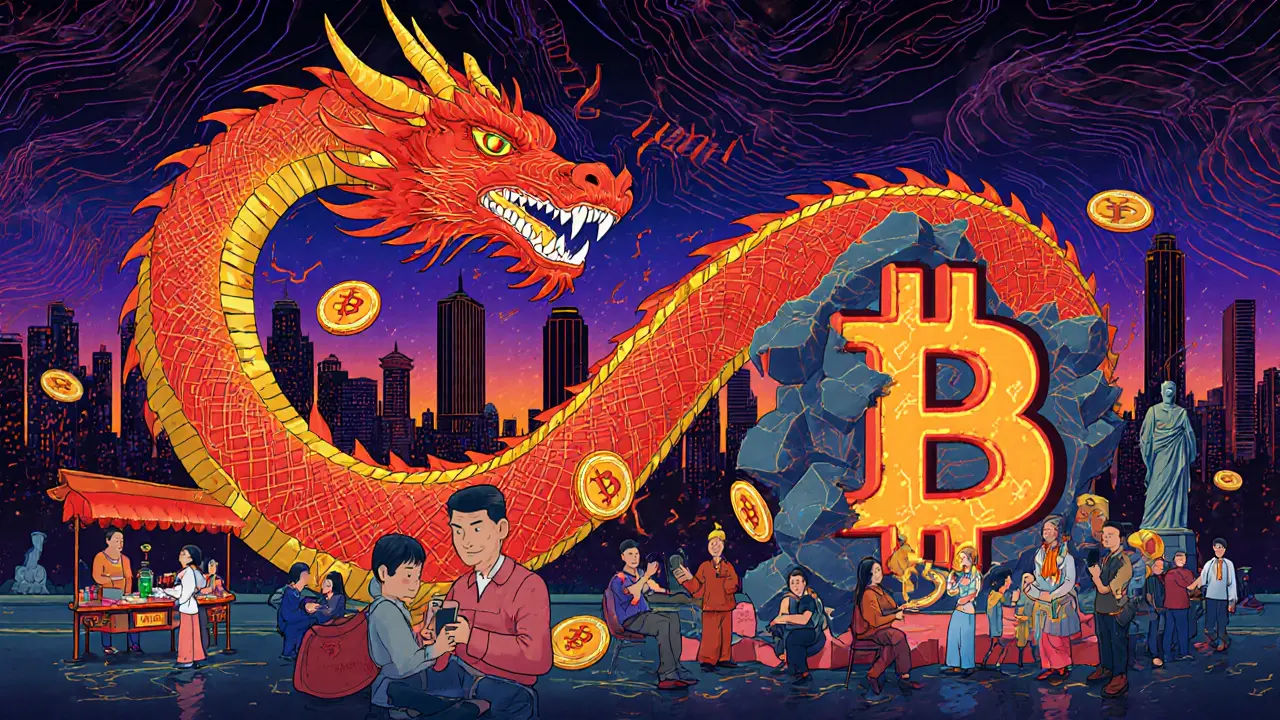
E-CNY vs Bitcoin: How China Is Replacing Crypto with State-Controlled Digital Money
China has banned Bitcoin and replaced it with its own digital currency, the e-CNY. Unlike Bitcoin’s decentralized system, the e-CNY is fully controlled by the state, enabling surveillance, eliminating cash, and expanding financial influence globally.