Are Crypto Payments Allowed in Iran? What You Need to Know in 2025
Iran Crypto Payment Feasibility Checker
Check Your Transaction
See if your proposed crypto activity complies with Iran's current regulations. Based on article content from 2025 regulations.
Result
Enter transaction details to check compliance
Can you use Bitcoin or Ethereum to pay for goods in Iran? The short answer is: not really - not the way you’d use cash or a credit card. But it’s not that simple. Iran doesn’t outright ban cryptocurrency. Instead, it’s built a system where the government watches everything, controls the flow, and lets you trade only if you play by their rules.
What’s Actually Allowed?
Cryptocurrency mining is legal in Iran - and it’s big. The country accounts for about 4.5% of global Bitcoin mining, thanks to cheap electricity. But here’s the catch: miners must get a license from the Ministry of Industry, Mine and Trade. They’re forced to sell their coins directly to the Central Bank of Iran at fixed prices. Many miners can’t afford the high electricity rates set by the government, so they go underground. In late 2024, rolling blackouts hit cities like Tehran and Isfahan, and officials blamed illegal mining for draining the power grid.So mining? Allowed - but tightly controlled. Payments? Not so much.
Why Can’t You Just Pay With Crypto?
On December 27, 2024, Iran’s Central Bank shut down all online gateways that let people convert rials to crypto - and vice versa. That meant apps like Nobitex couldn’t accept bank transfers anymore. No more buying Bitcoin with your salary. No more paying a freelancer in Ethereum.By January 2025, the government reopened some payment channels - but only through their own system. Every transaction now has to go through a government API. That means the Central Bank sees every trade, every wallet address, every amount. It’s not about stopping crypto. It’s about owning it.
Peer-to-peer crypto payments - like sending Bitcoin to a shop owner for groceries - are effectively banned. No licensed exchange will allow it. No bank will process it. And if you try to do it privately, you’re risking fines, account freezes, or worse.
Advertising Is Completely Banned
In February 2025, Iran went further. It outlawed all cryptocurrency advertising - online and offline. No more YouTube videos promoting Bitcoin. No more billboards for crypto exchanges. No more Instagram posts telling people to “buy now.” This isn’t just about reducing speculation. It’s about keeping crypto out of public view. The government wants people to know crypto exists, but not to think it’s normal, safe, or worth trusting.What About Foreign Exchanges?
Many Iranians still use foreign platforms like Binance or Kraken. But to do that, they need a VPN. That’s not illegal - but it’s risky. The government doesn’t have direct control over these platforms, but they can still track users through bank records, IP logs, or even social media activity. In July 2025, Tether froze 42 Iranian-linked addresses - many tied to Nobitex - in a move that sent shockwaves through Iran’s crypto community. It showed how easily international players can cut off access when pressured by U.S. sanctions.Iranian exchanges are also banned from using foreign-mined coins for domestic transactions. That means even if you buy Bitcoin on a foreign exchange, you can’t legally use it to pay someone inside Iran. The only legal path is through government-approved platforms - and even then, only for conversion to rials, not spending.
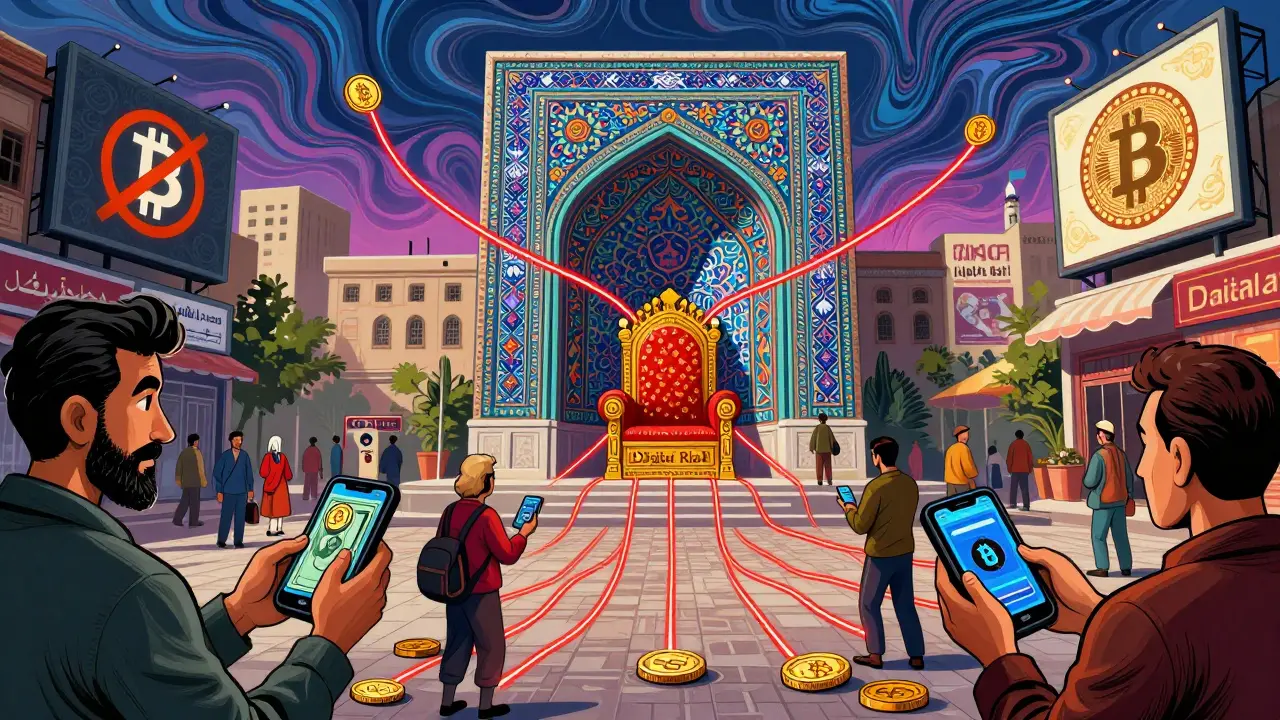
The Digital Rial Is the Real Goal
Iran isn’t trying to become a crypto haven. It’s trying to replace crypto with something it controls: the digital rial. This isn’t Bitcoin. It’s not decentralized. It’s not mined. It’s a central bank digital currency (CBDC) - essentially, electronic cash issued by the Central Bank of Iran. You can’t buy it. You can’t trade it. You can only receive it through approved banks or government apps.The digital rial is being tested on Kish Island, a free-trade zone. The goal? Reduce reliance on the U.S. dollar and give the government total control over every transaction. If you pay with digital rial, the state knows exactly when, where, and how you spent it. That’s the opposite of crypto’s original promise - but perfect for a government that fears losing monetary control.
Why Do Iranians Still Use Crypto?
Despite all the restrictions, Iranians still trade crypto - because the rial keeps falling. In 2024, inflation hit over 50%. Savings vanished. Salaries couldn’t keep up. Crypto became a lifeline. Even with government surveillance, people use it to protect their money. Some buy Bitcoin to hold it as a store of value. Others use it to send money abroad to family or pay for services that can’t be accessed through traditional banks.In 2025, Iran saw $3.7 billion in total crypto flows - down 11% from 2024. That drop isn’t because people lost interest. It’s because the government made it harder. The daily trading volume used to be $16-20 million. Now, it’s squeezed through narrow, monitored channels.
Who’s Really in Control?
The Islamic Revolutionary Guard Corps (IRGC) has been linked to crypto mining and trading. International watchdogs have flagged IRGC-linked wallets for sanctions violations. The U.S. and EU have targeted these wallets with asset freezes. Iran’s government denies any official involvement - but the lines are blurry. Miners pay taxes to the state. Exchanges report to the Central Bank. And the Central Bank answers to the highest levels of power.So when you ask if crypto payments are allowed in Iran, the real question is: who’s paying whom?

What Happens If You Break the Rules?
There’s no public list of punishments - but reports suggest serious consequences. People caught running unlicensed exchanges have faced jail time. Bank accounts have been frozen. Wallets have been seized. The government doesn’t need to pass new laws to punish crypto users. They already have broad authority under anti-money laundering and counter-terrorism financing laws. If you’re using crypto outside their system, you’re already under suspicion.Bottom Line: It’s Not About Ban - It’s About Control
Crypto payments aren’t banned in Iran. They’re absorbed. The government doesn’t want to kill crypto. It wants to own it. Mining is legal because it brings in revenue. Trading is allowed only through monitored channels. Advertising is banned to keep the public from getting too curious. And the digital rial is coming to replace everything.If you’re in Iran and want to use crypto, your only safe path is through a government-approved exchange - and even then, you’re not paying for goods. You’re converting your rials into crypto, holding it, and hoping the value holds. Any attempt to use it like money? That’s a gamble - with your freedom on the line.
What’s Next?
The digital rial rollout will likely expand beyond Kish Island in 2026. Once it’s nationwide, the government will have full visibility into every digital transaction. At that point, even the underground crypto market may shrink. For now, Iran walks a tightrope: using crypto to dodge sanctions, while crushing its freedom to protect the rial.So no, you can’t pay for coffee with Bitcoin in Tehran. But you can still buy it - if you’re willing to let the state watch every step.
Cristal Consulting
December 6, 2025 AT 05:32This is actually one of the most clear-eyed takes on Iran’s crypto strategy I’ve seen. The digital rial isn’t just a replacement-it’s a surveillance tool wrapped in tech jargon. People think crypto is about freedom, but here it’s just another leash.
Still, the fact that Iranians keep finding ways to use it despite the risks? That’s human resilience in action.
michael cuevas
December 7, 2025 AT 06:13So let me get this straight-the government lets you mine Bitcoin but won’t let you spend it? Sounds like a国企 version of capitalism. They want the hashpower, not the freedom. Classic.
Meanwhile, I’m over here trying to buy a coffee with Dogecoin and getting side-eyed by baristas.
Jerry Perisho
December 8, 2025 AT 16:10Key detail everyone misses: Iran’s crypto flows dropped 11% not because people stopped using it, but because the government choked off the pipelines. The real story is how people adapted-using P2P, VPNs, and offshore wallets just to keep their savings from evaporating.
The rial’s collapse made crypto necessary, not optional. The state can monitor, but it can’t unsee what’s already in people’s hands.
Brooke Schmalbach
December 10, 2025 AT 07:16Let’s be brutally honest-this isn’t crypto regulation. It’s economic warfare disguised as policy. The Central Bank isn’t trying to control crypto. It’s trying to control *people*. Every wallet address logged, every transaction traced, every miner taxed into submission. This is authoritarianism with a blockchain logo.
And the fact that they’re still mining? That’s not compliance. That’s desperation. They’re extracting value from their own citizens’ desperation to survive inflation.
Josh Rivera
December 10, 2025 AT 13:26Oh wow, Iran’s finally doing something right. Ban advertising, control exchanges, track every coin. What a brilliant move. Next they’ll outlaw breathing without a permit.
Meanwhile, the rest of the world is still pretending crypto is about ‘decentralization’ while governments everywhere are building their own digital prisons. Funny how that works.
Jonathan Sundqvist
December 11, 2025 AT 17:25Iranians using crypto to dodge sanctions? Big deal. We should be sanctioning them harder. If they want to use crypto, let them suffer the consequences. No more energy subsidies, no more mining licenses. Let their grid collapse completely.
Then maybe they’ll stop pretending they’re victims when they’re just playing games with global finance.
Neal Schechter
December 12, 2025 AT 13:35As someone who’s lived in Tehran for five years, I’ve seen this play out. The digital rial rollout on Kish Island? It’s working. People are using it for small business payments now-restaurants, pharmacies, even taxis.
But here’s the twist: they’re still buying Bitcoin on the side. Not to spend. Just to hold. It’s like having two wallets-one for the state, one for survival.
Nelson Issangya
December 13, 2025 AT 20:22Don’t forget-the people using crypto aren’t criminals. They’re moms, teachers, engineers trying to feed their families while the rial crumbles. This isn’t about rebellion. It’s about dignity.
And yeah, the state’s watching. But you can’t watch every single transaction. People are smarter than they think.
Scott Sơn
December 14, 2025 AT 21:14Imagine being so terrified of your own citizens’ financial autonomy that you have to ban crypto ads. Like, what, are people gonna start thinking for themselves if they see a YouTube video? The government’s afraid of education. That’s the real crime here.
Meanwhile, I’m sitting here with my 2018 Bitcoin bag wondering if I should’ve moved to Tehran instead of Florida.
Tara Marshall
December 15, 2025 AT 12:38Iran’s system is a paradox. They need crypto to bypass sanctions but can’t let it exist as real money. So they turn it into a state-controlled asset with no utility. The digital rial isn’t the future-it’s the endpoint of control.
And the worst part? It might actually work.
Kenneth Ljungström
December 16, 2025 AT 20:51Just wanted to say-this post nailed it. The real villain here isn’t Iran. It’s the global financial system that left people with no choice. Sanctions broke the rial. The state responded by trying to own the escape route.
But people? They’re still finding cracks. That’s hope right there.
Holly Cute
December 18, 2025 AT 02:55Okay but let’s be real-this whole thing is just a giant performance art piece. The government lets miners mine because they need the revenue. They ban payments because they’re terrified of losing control. They create a digital rial that’s literally just a glorified bank app.
Meanwhile, Iranians are out here using Telegram bots to trade Bitcoin like it’s 2017. The whole thing is absurd. And beautiful. And terrifying. And honestly? Kinda poetic.
It’s like watching a dragon try to swallow a swarm of fireflies. The dragon thinks it’s winning. The fireflies know they’re still glowing.
Thomas Downey
December 18, 2025 AT 06:52One cannot help but observe the tragic irony of a nation that once prided itself on revolutionary ideals now becoming the very instrument of financial authoritarianism it once denounced. The digital rial, far from being a technological innovation, is the apotheosis of centralized control-a dystopian monument to the erosion of economic liberty.
It is not merely a currency; it is a confession of fear. And in this, Iran joins the ranks of those who mistake surveillance for stability, and obedience for order.
nicholas forbes
December 20, 2025 AT 00:08Some people are gonna say ‘but crypto is illegal!’ No. It’s not illegal. It’s just… inconvenient. Like trying to buy a car without a license plate.
Iran didn’t ban crypto. They made it so hard to use that only the desperate or the stupid try anymore.
And honestly? That’s worse than a ban.
Joe West
December 21, 2025 AT 15:58Just one sentence: Iran didn’t kill crypto. They just made it a ghost.