Are Cryptocurrencies Securities? The Real Regulatory Rules in 2026
When you buy Bitcoin or Ethereum, are you buying a currency-or are you buying a security? This isn’t just a technical question. It’s the difference between legal compliance and federal enforcement. Between keeping your investment and losing it in a court-ordered asset freeze. And right now, in early 2026, the answer depends on how the token was sold, not what it is.
It’s Not About the Token-It’s About the Sale
The U.S. Securities and Exchange Commission (SEC) doesn’t look at Bitcoin and say, "This is a security." They look at how it was sold. The legal test they use is called the Howey Test, named after a 1946 Supreme Court case about orange groves. Yes, oranges. The court ruled that if people invest money into a common enterprise expecting profits mainly from someone else’s work, that’s a security-even if it’s not a stock or bond. Apply that to crypto. If a team raises money by selling tokens with promises like "your investment will grow as we build the network" or "you’ll earn rewards from our platform’s success," that’s likely a security. The SEC has used this logic to go after dozens of projects since 2017. Kik, Telegram, Ripple, Coinbase, Kraken-all faced enforcement because their token sales looked like unregistered stock offerings. But here’s the twist: Bitcoin itself isn’t considered a security. Why? Because when it launched in 2009, there was no central team promising profits. No marketing campaign. No roadmap. Just code. Same with Ethereum after its 2015 launch-once the network became decentralized and users were transacting directly, the SEC stopped treating it as a security. That’s why Bitcoin and Ethereum ETFs were approved in 2023 and 2025. The SEC didn’t change its rules. It just recognized that the underlying assets no longer fit the Howey Test.The Two Regulators, One Market
There’s a quiet war happening between two federal agencies. The SEC says most tokens are securities. The Commodity Futures Trading Commission (CFTC) says Bitcoin and Ethereum are commodities, like gold or wheat. Both agencies have enforcement power. Both have won big cases. The CFTC fined Binance $1.8 billion in 2023 for offering unregistered crypto derivatives. They also hit Uniswap Labs with a $3.5 million penalty in January 2026 for running an unregistered trading platform. Meanwhile, the SEC went after Coinbase for $600 million in June 2024, Kraken for $30 million in February 2023 over staking, and Genesis for $50 million in January 2023 for selling unregistered securities. The result? Confusion. A project might be fine under CFTC rules but get shut down by the SEC. A DeFi protocol with no CEO might be safe under CFTC oversight but still be targeted by the SEC because someone once promoted it as an investment. This split creates a regulatory gray zone where even well-meaning teams don’t know if they’re breaking the law.Stablecoins: The Wild Card
Stablecoins are supposed to be simple: $1 = $1. But the SEC doesn’t see them that way. USDC and USDT are backed by cash and short-term bonds. They’re treated more like digital bank accounts under state money transmission laws. But algorithmic stablecoins? Those are a different story. TerraUSD (UST) collapsed in May 2022, wiping out $40 billion in market value. It wasn’t backed by anything-just code that tried to maintain its peg. The SEC didn’t just investigate. They used it as proof that unregulated digital assets can trigger systemic risk. That collapse helped push through the Clarity for Payment Stablecoins Act in 2023, which now requires stablecoin issuers to be federally chartered banks or credit unions. Paxos got hit with a $150 million penalty in January 2026 for issuing BUSD without proper registration. Why? Because the SEC argued that BUSD’s promise of stability was a marketing tactic to attract investors-not just a payment tool. The line between a payment system and an investment product is thin, and regulators are drawing it tightly.
Utility Tokens Aren’t Safe Either
Many projects tried to dodge securities rules by calling their tokens "utility tokens"-meaning they’re only for accessing a service, not for profit. But the SEC doesn’t buy that label. In 2017, Munchee sold tokens for a restaurant review app. They claimed they were just for buying food discounts. The SEC shut them down anyway. Why? Because their marketing said investors could profit from the app’s future success. The token’s function didn’t matter. The promise of profit did. Fast forward to 2025: a startup called ChainLend raised $20 million by selling tokens that gave users access to a peer-to-peer lending platform. They insisted it was a utility token. The SEC sued. Why? Because the tokens were sold to investors before the platform existed. The platform was still in development. The team promised future rewards. That’s the Howey Test in action.What Happens When You Get Caught?
The penalties aren’t small. Telegram had to return $1.2 billion to investors. Ripple paid $125 million. Coinbase paid $600 million. Kraken paid $30 million. But money isn’t the worst part. When the SEC comes after a project, they freeze assets. They shut down trading. They force token holders to liquidate. One Reddit user, "CryptoComplianceGuy," described how his $85,000 investment in a DeFi protocol vanished overnight after the SEC targeted similar platforms in 2024. He couldn’t sell. He couldn’t withdraw. He had to cash out at a 60% loss. The human cost is real. A 2026 survey of 250 crypto startups found that 68% delayed or canceled token launches because of SEC uncertainty. Another 42% said they were scared to even build a website. Thirty-one U.S.-based crypto firms moved overseas between 2023 and 2025, taking $4.7 billion in potential investment with them.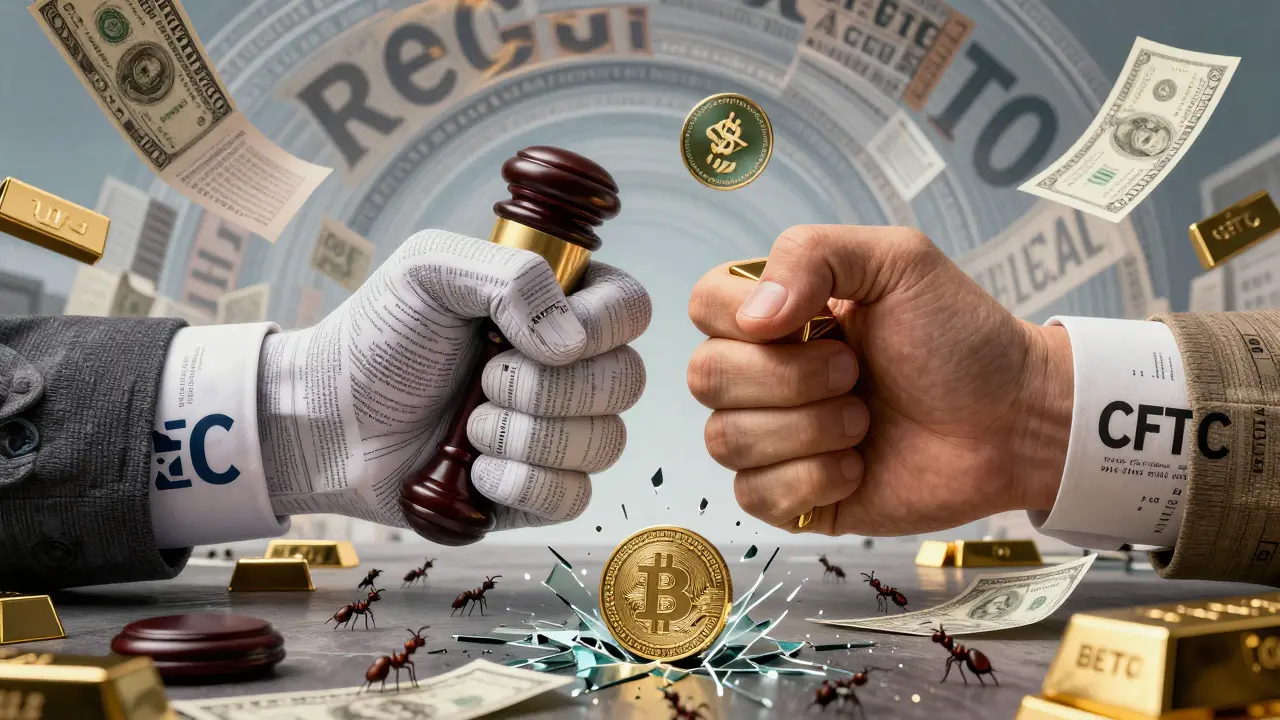
Is There a Clear Path Forward?
There’s no perfect answer yet. But some signs point to change. The SEC approved spot Ethereum ETFs in March 2025. That was a quiet signal: Ethereum, despite being a token, isn’t treated like a security anymore. The same happened with Bitcoin ETFs in 2023. That doesn’t mean all tokens are safe. But it does mean the SEC is starting to make distinctions based on network maturity-not just token type. The Responsible Financial Innovation Act (S.3425), introduced in January 2026, could be a turning point. It proposes clear rules: if a network is decentralized, and the token is used for transactions or access-not profit-then it’s not a security. That would give projects real guidance instead of guesswork. Meanwhile, the International Organization of Securities Commissions (IOSCO) released new global guidance in December 2025, urging regulators to focus on "economic substance, not form." In plain terms: stop looking at whether something is called a token or a coin. Look at what it actually does.What Should You Do Right Now?
If you’re an investor:- Ask: "Was this token sold with promises of profit?" If yes, it’s risky.
- Check if the project is registered with the SEC. If not, and it’s raising money from U.S. investors, proceed with caution.
- Bitcoin and Ethereum are the safest bets. They’ve been tested and cleared.
- Don’t use marketing language like "earn passive income," "get rich," or "future value." Stick to "access to service" or "network participation."
- Wait until your network is fully decentralized before selling tokens to the public.
- Get legal advice from someone who understands both blockchain and securities law-not just a general attorney.
FAQ
Is Bitcoin a security?
No. Bitcoin is not classified as a security by the SEC. It was launched without a central team promising profits, and its network is fully decentralized. The SEC has treated Bitcoin as a commodity since 2018, and its approval of Bitcoin ETFs in 2023 confirmed this status.
Is Ethereum a security?
No, Ethereum is not currently classified as a security. While its initial sale in 2015 raised funds and resembled a securities offering, the SEC has since acknowledged that its network has become sufficiently decentralized. The approval of spot Ethereum ETFs in March 2025 was a clear signal that regulators now treat Ethereum as a commodity, not a security.
What makes a cryptocurrency a security?
A cryptocurrency becomes a security when it meets the Howey Test: (1) an investment of money, (2) in a common enterprise, (3) with a reasonable expectation of profits, (4) derived from the efforts of others. If a project raises money by promising future returns, rewards, or growth tied to a team’s work, the SEC will likely classify it as a security-even if the token has "utility."
Can a token start as a security and become a commodity?
Yes. This is known as the "decentralize-and-morph" model. The SEC has stated that tokens issued during a fundraising phase may start as securities, but if the network later becomes fully decentralized-with no central team controlling development or profits-they may no longer qualify as securities. Bitcoin and Ethereum are the clearest examples of this transition.
Why do some crypto projects get fined while others don’t?
It depends on how they sold the tokens, not what they are. Projects that marketed tokens as investments, promised returns, or raised money before the network was live are targeted. Those that launched without marketing, allowed open participation, and avoided profit promises are rarely touched. The SEC doesn’t punish tokens-it punishes sales tactics.
What’s the risk of holding non-security tokens?
Even if a token isn’t classified as a security, it can still be risky. Market volatility, smart contract bugs, exchange hacks, and regulatory crackdowns on related services (like staking or lending) can still cause losses. The absence of security classification doesn’t mean safety-it just means you’re not subject to SEC rules.
Andrew Edmark
February 15, 2026 AT 16:58Man, I just watched my buddy lose $40k because he invested in a "utility token" that got shut down by the SEC. He thought it was safe because it "gave access to a platform." But the marketing said "earn passive income" - classic Howey trap. 😔
Don’t get me wrong, I’m all for innovation, but if you’re promising returns, you’re playing with fire. The SEC isn’t the enemy - ignorance is.
Dominica Anderson
February 16, 2026 AT 07:10America’s regulatory chaos is why crypto will never scale here. We’re a nation of lawyers, not builders.
jennifer jean
February 16, 2026 AT 09:48It’s wild how much the same pattern repeats - people get excited about a new tech, then the SEC shows up like a dad at a teenage party. 🤷♀️
But honestly? If you’re selling tokens with promises of profit, you’re not building a network - you’re running a pyramid. No judgment, just facts. 💡
Charrie VanVleet
February 16, 2026 AT 15:16Big thanks to the OP for breaking this down so clearly. Seriously, this should be required reading for anyone even thinking about launching a token.
I’ve seen too many devs get crushed because they didn’t know the difference between "access" and "investment." It’s not about the code - it’s about the pitch. And that’s on the team, not the regulator.
If you’re reading this and you’re building something? Talk to a crypto-savvy lawyer before you even write a whitepaper. Save yourself the nightmare.
Anandaraj Br
February 17, 2026 AT 11:07USA always overcomplicate everything why not just ban crypto and be done with it lol
everybody knows its just gambling with more steps
why pretend its tech
AJITH AERO
February 18, 2026 AT 12:30So the SEC says Bitcoin isn’t a security… but they still taxed it like one. Classic. 😏
Geet Kulkarni
February 18, 2026 AT 20:29It is fascinating how regulatory arbitrage manifests in the blockchain space. One jurisdiction’s commodity is another’s unregistered security.
Moreover, the semantic distinction between utility and investment is not merely legal - it is epistemological. The ontology of value has been reconfigured by decentralized consensus mechanisms.
One might argue that the Howey Test, rooted in 1940s agrarian capitalism, is ill-equipped to evaluate digital asset ecosystems predicated on algorithmic governance.
kieron reid
February 19, 2026 AT 11:02Everyone’s scared of the SEC. But no one’s scared of the CFTC. Funny how that works.
Ian Plunkett
February 20, 2026 AT 07:33Imagine being so afraid of innovation that you turn every new idea into a courtroom drama. 🎭
Bitcoin was born from a crisis. Now we’re drowning in compliance paperwork. What a time to be alive.
Avantika Mann
February 20, 2026 AT 14:57I love how this post explains the nuance - it’s not about the token, it’s about the promise. 🙌
So many people think they’re safe because they call it "utility" - but if the marketing sounds like a stock pitch, you’re already in trouble.
Stay humble, stay clear, and always ask: "Who’s doing the work?"
Nikki Howard
February 20, 2026 AT 23:43It is imperative to recognize that the convergence of financial regulation and technological innovation necessitates a paradigm shift in jurisprudential frameworks. The Howey Test, while historically significant, is fundamentally anachronistic in the context of decentralized autonomous networks.
Furthermore, the jurisdictional fragmentation between the SEC and CFTC constitutes a systemic risk to market integrity.
Tarun Krishnakumar
February 21, 2026 AT 13:00Let me tell you what they’re not telling you. The SEC isn’t regulating crypto - they’re protecting Wall Street’s monopoly. The whole "Howey Test" thing? It’s a smokescreen. The real reason Bitcoin and Ethereum were "cleared"? Because they’re too big to kill. The rest? Just collateral damage.
Did you know the SEC’s top lawyers used to work for Goldman Sachs? Coincidence? Nah. It’s a rigged game. They want you to think this is about legality. It’s about control.
They let Bitcoin slide because they can’t touch it. But if you’re building something new? You’re the sacrifice. They’ll crush you slowly, with fines, lawsuits, and asset freezes - all while pretending they’re protecting you.
And don’t get me started on the CFTC. They’re just the nice cop. The SEC’s the one with the bat. You think they’re fighting each other? Nah. They’re playing tag. You’re the ball.
They’re scared. Because if crypto becomes real money, the whole system cracks. And they know it.
So yeah - "decentralized"? Cool. But don’t be fooled. They’ll find a way to make you pay.
Sasha Wynnters
February 21, 2026 AT 17:40It’s not about tokens - it’s about narrative. The SEC doesn’t hate crypto. They hate the myth of meritocracy wrapped in blockchain code.
People don’t invest in code. They invest in stories. "We’re building the future." "Join the revolution." "Earn while you sleep." That’s not tech. That’s cult.
Bitcoin’s "freedom" was just a story too. But it was told without a pitch deck. That’s the difference.
The real revolution? When we stop selling dreams and start building tools.
george chehwane
February 22, 2026 AT 00:51Let’s be real - the Howey Test is a relic. The SEC’s entire framework is built on the assumption that there’s a central entity to hold accountable. But DeFi? DAOs? No CEO. No whitepaper. No legal entity. Just code and community.
They’re trying to fit a blockchain into a 1946 orange grove lawsuit. It’s not just outdated - it’s absurd.
And yet they’re still suing people for "promising future utility." Bro, if I say "this app will let you order pizza," and someone buys the token to use it - is that a security? Or are you just mad you can’t tax pizza?
Scott McCrossan
February 22, 2026 AT 23:12Oh great, another post pretending the SEC is fair. Newsflash: they’ve never lost a crypto case. Ever. Why? Because they pick the fights they can win.
They don’t care about the law. They care about control. They’ll destroy small teams to scare off competition. Meanwhile, Coinbase? They paid the fine and kept operating.
It’s not regulation. It’s extortion.
Rajib Hossaim
February 23, 2026 AT 01:22The regulatory ambiguity surrounding digital assets presents a significant challenge to innovation. However, it is imperative to approach this matter with a spirit of constructive dialogue rather than adversarial posturing.
Collaborative engagement between regulators and developers may yield a sustainable framework that balances investor protection with technological advancement.
Jenn Estes
February 23, 2026 AT 04:40So you’re telling me the SEC cares about "promises" but not about the fact that 80% of these projects are just scams? 🤔
Why not just ban all tokens and call it a day? Less paperwork, less pain.
Jeremy Fisher
February 23, 2026 AT 22:00You know, I grew up in India, where people still use cash for everything. Then I moved to the States and saw how fast crypto moved here - and how fast the rules changed.
It’s not just about law. It’s about culture. In the U.S., we turn everything into a lawsuit. In Japan? They’re building crypto ATMs. In Switzerland? They’re giving out visas for blockchain founders.
Here? We’re busy arguing over whether a token is a security or a utility - while the rest of the world builds the future without us.
And honestly? I don’t blame them for leaving. Who’d want to build something here, only to get sued because you said "earn passive income" in your Discord?