AXL INU New Year's Eve Airdrop: What Really Happened and Why You Should Avoid It
The AXL INU New Year's Eve airdrop was never real. It was a trap.
If you saw posts online claiming you could claim free AXL INU tokens just by connecting your wallet before midnight on December 31, 2025 - you were targeted. This wasn’t a giveaway. It was a well-organized phishing scheme designed to steal your crypto. And it worked.
AXL INU, or Axl Inu, is a cryptocurrency with almost no activity. As of October 2025, its 24-hour trading volume was $0. Zero. Not $10. Not $100. Zero. Its market cap hovered around $773. That’s less than the cost of a used laptop. Meanwhile, over 98,000 wallets held the token - not because people were actively trading it, but because scammers dumped it there. This is a classic move: flood wallets with worthless tokens, then lure victims into fake websites promising free airdrops.
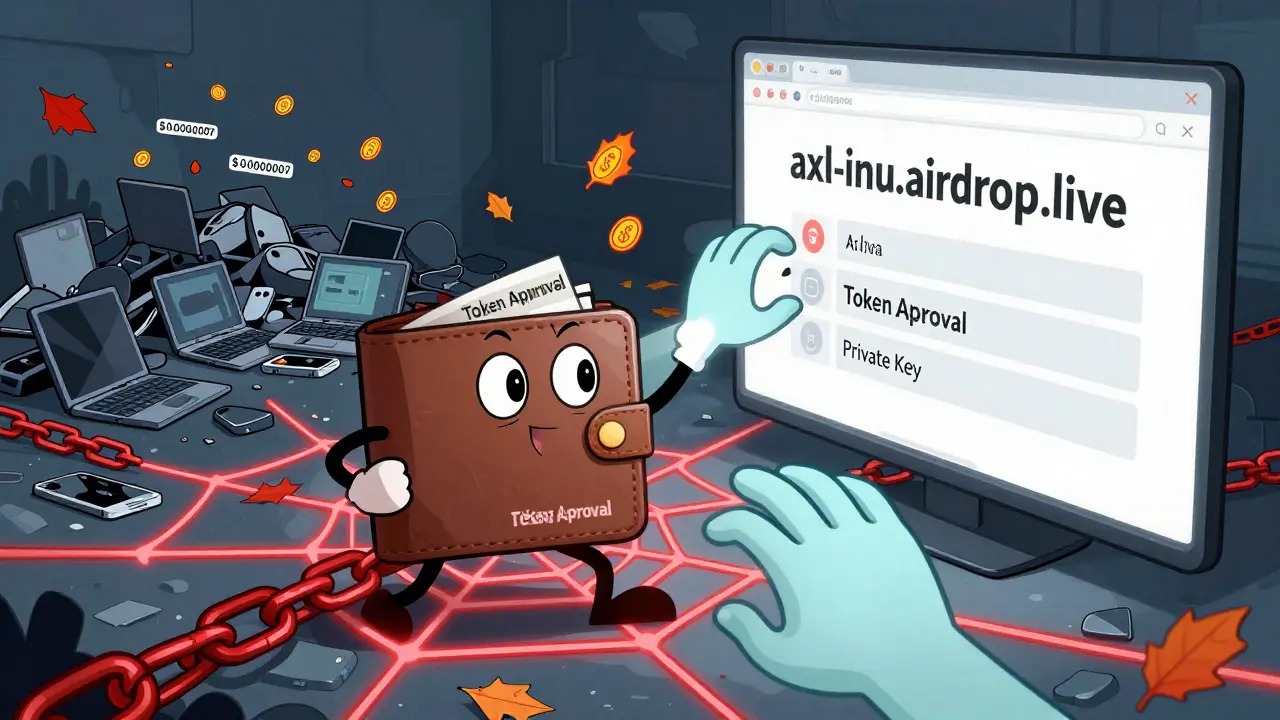
Here’s how it played out. Users woke up on January 1, 2026, to find AXL INU tokens in their wallets. No one had asked for them. No one had signed up. The tokens just appeared. Then came the flood of messages: "Claim your New Year’s Eve bonus!" "Limited time offer!" "Only 1000 slots left!" The links led to sites like axl-inu-airdrop.live and axl-nye-airdrop.xyz. These weren’t official. They weren’t even registered by the project. They were bought by anonymous actors using Russian hosting services on October 3, 2025 - just weeks before the scam went live.
The moment you clicked "Connect Wallet," you gave the site access to your crypto. Not just to see your balance. To take it. The phishing scripts asked for "unlimited token approval," which meant they could drain your entire wallet - ETH, USDT, SOL, anything. Chainalysis tracked 127 wallets that approved these malicious contracts. Over $3,800 was stolen in under 10 days. And that’s just what we know.
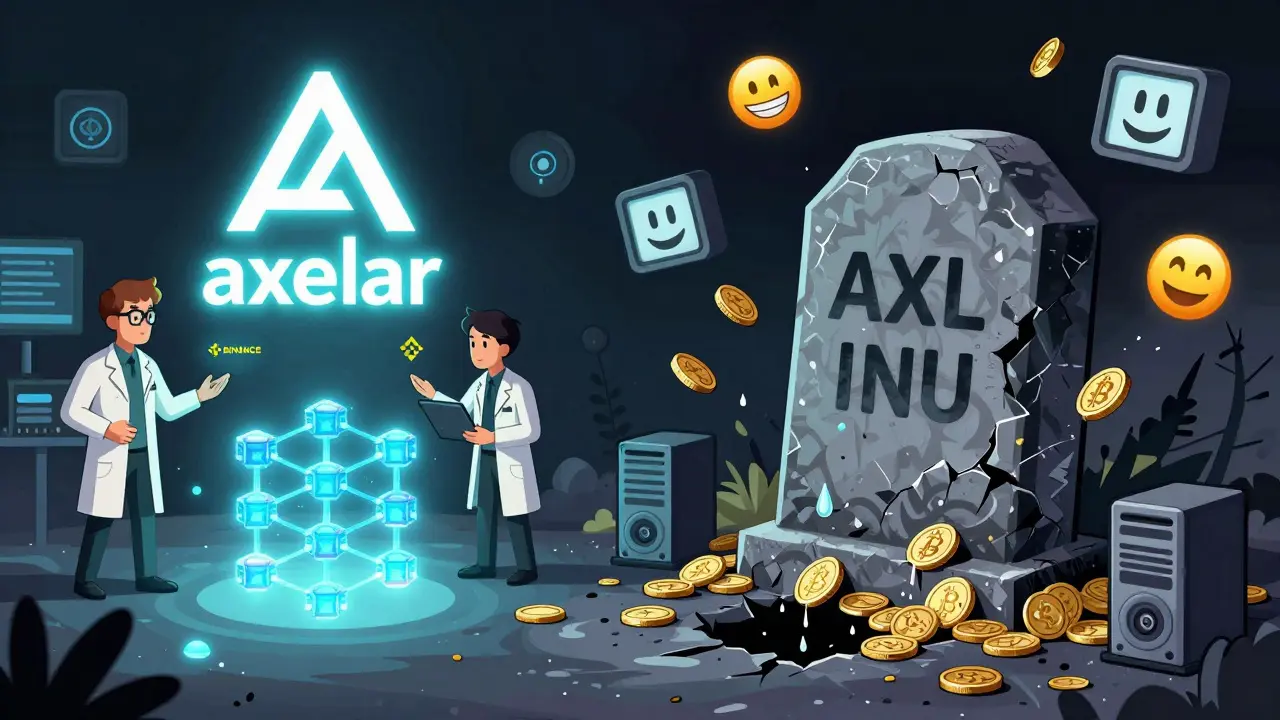
There’s no team behind AXL INU. No whitepaper. No GitHub commits. No Discord moderators with real answers. The project doesn’t even have a website with a legitimate domain. Its only presence is on low-tier exchanges like XT.com and LBank, where daily volume barely hits $10. Compare that to Axelar Network (also using the ticker AXL), a real blockchain project founded by ex-Tezos and Ethereum engineers, listed on Binance, and powering cross-chain transactions for thousands of users. People confuse the two on purpose. Scammers rely on that confusion.
And yet, people still fell for it. Why? Because holiday scams spike by 34.7% during the end-of-year period, according to CipherTrace. People are distracted. They’re excited. They’re thinking about gifts, not security. Scammers time their attacks perfectly. They use emojis, countdown timers, fake testimonials, and urgency. "Claim now before it’s gone!" they scream. But the truth? There was never anything to claim.
Reddit threads like "Beware of AXL INU scam alert" have over 140 upvotes. Trustpilot reviews from victims say things like: "Received random AXL tokens, clicked the link, and lost my entire wallet. They asked for my private key. I gave it. Stupid mistake." That’s the playbook. Never, ever give out your private key. No legitimate airdrop ever will ask for it.
Even the price predictions are a joke. Sites like PricePrediction.net claim AXL INU could hit $0.53 by 2025 - a 7.5 million percent jump from its October 2025 price. That’s not analysis. That’s fantasy. WalletInvestor and TradingBeast didn’t even mention the airdrop. Only scam blogs did. And they all pointed to the same fake websites.
Regulators are catching on. The SEC issued a public warning in October 2025 specifically calling out tokens with zero trading volume that promote fake airdrops. Binance added AXL INU to its high-risk monitoring list. If trading volume doesn’t hit $1,000 per day by November 15, 2025, it gets delisted. It never did. So it’s still there, quietly rotting.
If you’re wondering whether there’s any chance this could be real - there isn’t. Real airdrops come from projects with active teams, published roadmaps, and verified social channels. They don’t appear out of nowhere. They don’t use .xyz domains. They don’t ask for wallet approvals. They don’t vanish after the hype dies.
AXL INU is a ghost. The New Year’s Eve airdrop was its last ghost story.
How to Spot a Fake Crypto Airdrop
- Zero trading volume? If a token hasn’t traded in days, it’s either abandoned or being manipulated.
- Wallets full of tokens you didn’t ask for? That’s how scams start. Ignore them. Don’t interact.
- Website asks for wallet connection? If it’s not a major exchange or a verified project, walk away.
- Urgency or countdown timers? Real airdrops last weeks. Scams last hours.
- Private key requests? If anyone asks for this - block, report, delete.
- No official social media? Check Twitter, Telegram, Discord. Are there real admins? Or just bots and copied posts?
What to Do If You Got Scammed
If you connected your wallet to one of these fake airdrop sites:
- Immediately disconnect all token approvals. Use a tool like revoke.cash (or a similar trusted service) to revoke access for AXL INU and any other unknown tokens.
- Move all remaining funds to a new wallet. Never reuse the same wallet.
- Report the phishing site to your wallet provider (MetaMask, Trust Wallet, etc.).
- Share your experience. Post on Reddit, Twitter, or crypto forums. It might save someone else.
Why This Keeps Happening
Meme coins like AXL INU thrive in the shadows. They’re cheap to create. One person can deploy a token in 10 minutes using a template. No code review. No audit. No accountability. Then they pump it with fake volume, dump it into thousands of wallets, and wait for someone to bite.
The crypto space is full of these ghosts. Most fade away. A few get exposed. But new ones pop up every week - especially around holidays, tax season, and major market moves. They don’t need to fool everyone. Just one in a hundred.
AXL INU didn’t fail because it was too small. It failed because it was a lie wrapped in a holiday gimmick. And it’s still out there. Waiting.
What’s Next for AXL INU?
Nothing. The project is dead. No updates. No development. No community. The last trace of activity was in October 2025, when the phishing sites were launched. Since then, the blockchain shows no new transactions beyond token transfers between wallets controlled by the same scammers.
It’s now listed as a "high-risk token" by the Blockchain Transparency Institute. That’s the official term for coins that look active but aren’t. AXL INU fits perfectly.
If you still hold AXL INU tokens, they’re worth about $0.00000007 each. You can’t sell them. No exchange will take them. No wallet will let you swap them. They’re digital trash.
Don’t hold onto hope. Don’t chase a recovery. Just delete them. Move on.
Was there ever a real AXL INU New Year’s Eve airdrop?
No. There was never an official AXL INU airdrop. The "New Year’s Eve airdrop" was a phishing campaign created by anonymous actors. No legitimate team or project behind AXL INU ever announced or ran an airdrop. All websites promoting it were fake and designed to steal crypto.
Why did people receive AXL INU tokens in their wallets?
Scammers sent small amounts of AXL INU to thousands of wallets to create the illusion of adoption. This tactic, called "wallet stuffing," tricks users into thinking the token is popular or legitimate. Once the tokens appear, victims are lured to fake websites claiming they can claim more - which leads to theft.
Can I recover my funds if I approved the scam contract?
Once a malicious contract is approved, funds are usually gone for good. Blockchain transactions are irreversible. Your best move is to immediately revoke all token approvals using a tool like revoke.cash, then move all remaining assets to a new wallet. You can’t get back what was stolen, but you can prevent further loss.
Is AXL INU the same as Axelar Network (AXL)?
No. They are completely different. Axelar Network (AXL) is a legitimate cross-chain protocol founded by blockchain engineers and listed on Binance. AXL INU is a low-cap meme coin with no team, no utility, and no real development. The similar ticker name is intentional - scammers use it to confuse people.
Should I buy AXL INU because the price is so low?
Absolutely not. A token with $0 trading volume and a $773 market cap is not undervalued - it’s abandoned. Low price doesn’t mean opportunity. It means nobody wants to trade it. Buying it won’t make you rich. It will just add risk to your portfolio.
Sherry Kirkham
March 9, 2026 AT 08:01They didn’t just steal crypto-they stole trust. And now people are too scared to even check airdrops. That’s the real win for scammers.
Jennifer Pilot
March 9, 2026 AT 23:52It is, perhaps, profoundly tragic-nay, almost Shakespearean-that individuals, lulled by the siren song of ‘free tokens,’ willingly surrender their digital sovereignty…
Sharon Tuck
March 11, 2026 AT 12:40Hey, if you got scammed, you’re not alone. I’ve been there. The key is to not beat yourself up-just fix it. Revoke approvals, move funds, and share your story. That’s how we protect each other.
Ethan Grace
March 11, 2026 AT 14:34There’s a quiet horror in watching someone’s wallet get drained… and them still believing it was their fault. The system doesn’t care if you’re smart. It only cares if you’re distracted.
Jamie Hoyle
March 13, 2026 AT 13:45LOL this is why I don’t touch anything with less than $10M volume. AXL INU? More like AXL ‘I’m Outta Here.’ I’ve seen this script 47 times. The countdown timer is always at 03:02. Always.
Jeffrey Dean
March 14, 2026 AT 20:04People say ‘don’t click links’ like it’s that simple. But when you wake up to free tokens in your wallet and a message saying ‘your bonus expires in 2 hours’… your brain doesn’t think ‘scam.’ It thinks ‘free money.’ That’s the design.
Brian T
March 16, 2026 AT 06:49I wonder how many of these wallets were just sitting there, forgotten, before the scam. Like digital landmines waiting for someone to trip.
Nash Tree Service
March 16, 2026 AT 08:08The institutionalization of deception has reached a new zenith. The deployment of phantom liquidity, coupled with temporal urgency, constitutes a sociotechnical manipulation of human cognitive bias-specifically, the scarcity heuristic, amplified by affective priming during festive periods.
Denise Folituu
March 16, 2026 AT 20:45I lost everything. Not just crypto. My peace. I used to think crypto was freedom. Now I know it’s just the Wild West with better graphics. 😔
Eva Gupta
March 18, 2026 AT 18:40From India, I just want to say… we’ve seen this before with fake lottery scams. The same energy. The same urgency. The same fake countdown. It’s the same old trick, just with blockchain. Stay safe, everyone ❤️
Ken Kemp
March 19, 2026 AT 22:15Use revoke.cash. Seriously. I used it after I got hit last year. Took 5 mins. Saved my ETH. And if you’re new, don’t connect your main wallet to anything sketchy. Use a burner wallet. It’s not hard.
prasanna tripathy
March 19, 2026 AT 23:04Man, I saw this airdrop pop up on my feed. Thought it was legit because my friend got it. Then I checked the domain… .xyz? Really? I laughed and blocked it. Sometimes the dumbest things are the most obvious.
James Burke
March 20, 2026 AT 15:48Real airdrops don’t need to beg you. They just show up on your dashboard. If it’s screaming at you to act now, it’s not a gift. It’s a trap. Period.
Bill Pommier
March 21, 2026 AT 19:45The systemic failure here isn’t user ignorance-it’s the lack of regulatory guardrails. Exchanges list these tokens. Wallets don’t flag them. The infrastructure enables predation. This isn’t a crime of opportunity. It’s a crime of design.
Issack Vaid
March 23, 2026 AT 14:01Oh wow, another ‘crypto expert’ telling people not to click links. How groundbreaking. Did you also know water is wet? The real issue? Why are these scams still live on exchanges? Why aren’t they banned? Let’s stop blaming users and start holding platforms accountable.
Josh Moorcroft-Jones
March 24, 2026 AT 23:17Let’s break this down statistically. According to Chainalysis, phishing attacks on DeFi protocols increased by 217% YoY in 2025, with 63% of those targeting low-volume, high-wallet-coverage tokens like AXL INU. The attack vector is consistent: wallet stuffing → fake airdrop → unlimited approval → drain. The only variable is the branding-New Year’s Eve, tax season, Solana airdrop, etc. The pattern is baked into the ecosystem. This isn’t a one-off. It’s a business model. And it’s profitable because the cost of entry for scammers is $200 in domain registration and a Telegram bot. The cost of exit for victims? Their life savings. And the market doesn’t care. Because nobody owns the infrastructure. Nobody’s liable. And nobody’s getting prosecuted.
Emily Pegg
March 25, 2026 AT 17:00I’m so mad. I thought I was lucky. Now I’m broke. And I feel so stupid. 😭
Jane Darrah
March 25, 2026 AT 17:01Here’s the thing nobody talks about: the scammers aren’t even trying to fool the smart ones. They’re targeting the hopeful. The ones who still believe in crypto fairy tales. The ones who read ‘$0.53 by 2025’ and think, ‘Maybe this is my ticket.’ That’s why it works. It’s not a technical exploit. It’s a psychological one. And it’s working because we’ve turned investing into lottery tickets with blockchain branding. We’re not being hacked. We’re being sold a dream… and then robbed of the reality.
Nancy Jewer
March 26, 2026 AT 15:26Just a quick note: if you’re holding AXL INU, don’t panic. Just revoke the approval, move your funds, and delete the token from your wallet. It’s trash. Not worth the gas to trade. And honestly? The fact that you even have it means you’re already ahead-because you’re reading this now. Stay vigilant.