BitcoinAsset X CoinMarketCap Airdrop Details: What Actually Happened and Why It’s Gone
Back in early 2023, a project called BitcoinAsset X (BTA) started making waves in crypto circles with promises of a CoinMarketCap airdrop. People were excited. Forums lit up. Telegram groups exploded. The idea was simple: register on CoinMarketCap, hold a small amount of Bitcoin, and get free BTA tokens. No purchase. No fees. Just a free token drop. But here’s the truth - that airdrop never really happened the way people thought.
What Was BitcoinAsset X?
BitcoinAsset X, or BTA, claimed to be a decentralized asset-backed token tied to Bitcoin. The pitch? Every BTA token represented a fraction of real Bitcoin held in reserve. Sounds legit, right? But there was no public blockchain explorer for BTA. No whitepaper with clear technical specs. No GitHub repo. No team members with verifiable profiles. Just a website, a Twitter account, and a CoinMarketCap listing.
CoinMarketCap listed BTA as a new token in January 2023. The listing itself triggered a wave of interest. People assumed that if CoinMarketCap was hosting it, it had to be real. But CoinMarketCap doesn’t verify projects. It just collects data from exchanges and wallets. That’s it. Many low-quality or outright scam tokens get listed there because the platform is open by design.
The Airdrop Promise
The BTA team announced an airdrop for CoinMarketCap users. They said if you had a CoinMarketCap account and had traded at least $20 worth of crypto before March 1, 2023, you’d qualify for free BTA tokens. No KYC. No wallet connection. Just sign up and wait.
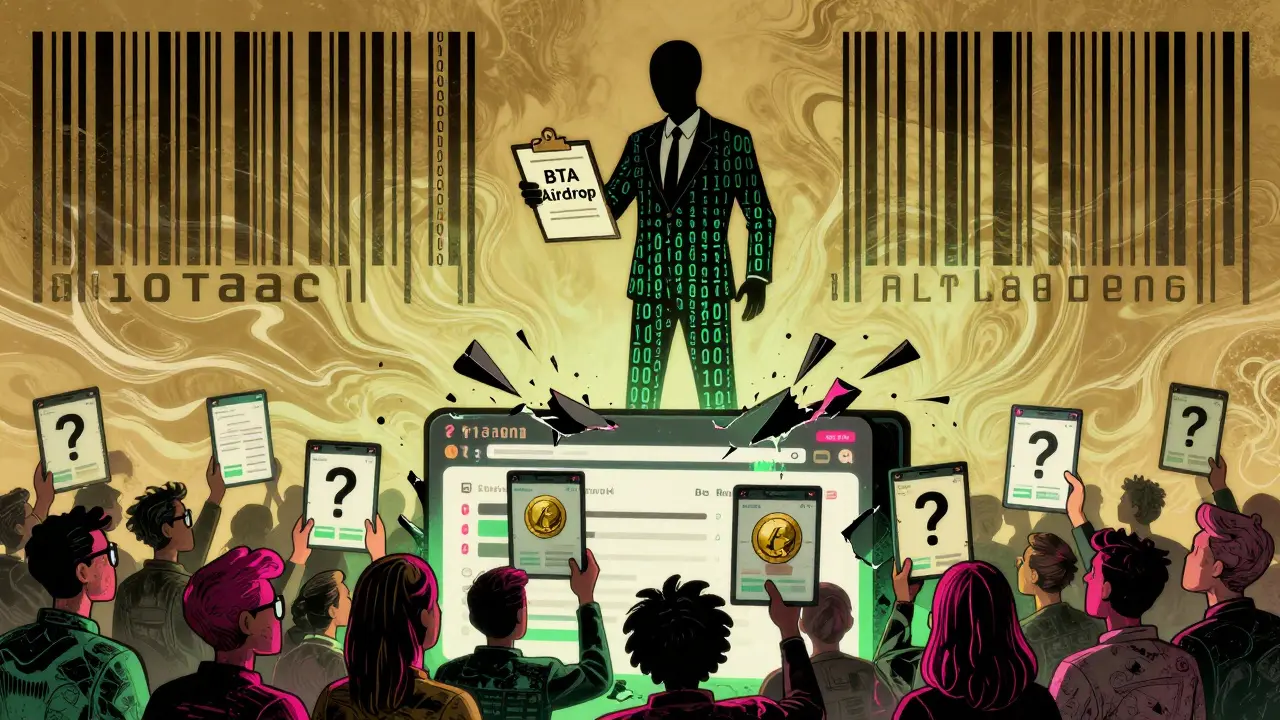
Thousands signed up. Some even shared screenshots of their CoinMarketCap trade history to prove eligibility. The community was hopeful. A few early adopters claimed they received tokens. But those tokens couldn’t be transferred. They didn’t show up in MetaMask. They didn’t appear on any blockchain. They were just numbers on a website dashboard.
By April 2023, the airdrop portal disappeared. The BTA website went dark. The CoinMarketCap listing vanished. No announcement. No explanation. Just silence.
Why Did It Fail?
This wasn’t a technical glitch. It was a classic pump-and-dump setup dressed up as a community giveaway.
- There was no actual token contract deployed on Ethereum, BSC, or any chain.
- No liquidity pool was ever created.
- No exchange ever listed BTA for trading.
- There was zero on-chain activity linked to the BTA symbol.
Compare this to real airdrops. In December 2020, 1inch distributed 90 million tokens to over 55,000 wallets. Those tokens were real. They showed up in wallets. They were tradable. The project had a team, code, audits, and a roadmap. BTA had none of that.
What happened with BTA was a data harvesting operation. The team collected email addresses, CoinMarketCap user IDs, and possibly wallet addresses. That data was sold to marketers or used for phishing campaigns. The airdrop was never about giving away value - it was about gathering targets.
What About Bitcoin Asset [OLD]?
Some people confuse BTA with another project called Bitcoin Asset [OLD]. That’s a different token, listed on obscure exchanges with no trading volume. It’s not connected to the CoinMarketCap airdrop. It’s just another ghost token with a similar name, likely created to ride off the confusion.
Bitcoin Asset [OLD] has a supply of over 167 billion tokens, but zero in circulation. That’s a red flag. When a token has billions of units but no one owns them, it’s usually a sign the project never launched properly - or was designed to be worthless from day one.
How to Spot a Fake Airdrop
Here’s how to avoid getting burned next time:
- Check the blockchain. If you can’t find the token on Etherscan, BscScan, or Solana Explorer, it’s fake.
- Look for a team. Real projects have LinkedIn profiles, GitHub commits, and public interviews.
- Verify the contract address. If the airdrop asks you to connect your wallet to a website you’ve never heard of, walk away.
- Search for audits. If there’s no CertiK, Hacken, or PeckShield report, treat it with extreme caution.
- Check CoinMarketCap’s listing date. New tokens with no history and sudden spikes in interest are often traps.
Real airdrops don’t ask for your private keys. They don’t require you to send crypto to claim free tokens. They don’t vanish after a month.
What You Can Do Now
If you signed up for the BTA airdrop, you didn’t lose money - you lost time. But you might have exposed your email or CoinMarketCap account to spam. Change your CoinMarketCap password. Enable two-factor authentication. Monitor your inbox for phishing emails pretending to be from "BitcoinAsset Support."
There’s no way to recover BTA tokens. They never existed outside a database that’s now gone. Don’t waste money chasing them. Don’t fall for rebranded versions. Don’t believe anyone who says "they’re coming back." They’re not.
Why CoinMarketCap Can’t Stop This
People blame CoinMarketCap for listing fake tokens. But the platform isn’t a gatekeeper. It’s a data aggregator. It doesn’t approve projects. It doesn’t vet teams. It just pulls data from exchanges and wallets. If someone creates a token called "BTA" and lists it on a shady exchange, CoinMarketCap will show it - unless someone reports it.
That’s why you can’t rely on CoinMarketCap to tell you if a token is real. You have to do your own research. Always.
Final Thought
The BTA airdrop was never about giving away Bitcoin-backed value. It was about exploiting hype, trust, and the illusion of legitimacy. CoinMarketCap’s name was used as a badge of credibility - and it worked. Too well.
Today, BTA is dead. The website is gone. The tokens are dust. But the lesson lives on: if an airdrop sounds too easy, it’s probably a trap. Real crypto rewards come from real projects. Not from websites that disappear after a month.
Was the BitcoinAsset X (BTA) airdrop real?
No, the BitcoinAsset X (BTA) airdrop was not real. There was no actual token deployed on any blockchain. The tokens you saw on the website were fake numbers. No one ever received tradable BTA tokens. The project vanished after collecting user data and generating hype.
Did CoinMarketCap run the BTA airdrop?
No, CoinMarketCap did not run the airdrop. They only listed the token as part of their data aggregation system. The airdrop was run by the BTA team. CoinMarketCap doesn’t verify, approve, or sponsor projects - they just display data from exchanges and wallets.
Can I still claim BTA tokens?
No, you cannot claim BTA tokens. The website and airdrop portal shut down in April 2023. The token never existed on any blockchain, so there’s nothing to claim. Any site offering to restore your BTA tokens is a scam.
What’s the difference between BitcoinAsset X and Bitcoin Asset [OLD]?
BitcoinAsset X (BTA) was the name of the fake CoinMarketCap airdrop project. Bitcoin Asset [OLD] is a separate, unrelated token with no trading volume and zero circulation. Both are worthless, but they are not the same project. The similar names were likely used to confuse people.
How do I know if a crypto airdrop is safe?
Check if the token has a real contract address on a blockchain explorer. Look for a public team, audited code, and liquidity on a major exchange. Never connect your wallet to unknown sites. Never pay fees to claim free tokens. Real airdrops don’t ask for your private keys or require you to send crypto first.
Should I trust CoinMarketCap listings?
No, you shouldn’t trust CoinMarketCap listings as a sign of legitimacy. The platform lists thousands of tokens, including many scams. It doesn’t verify projects. Always research the team, code, and community before trusting any token - even if it’s on CoinMarketCap.
If you’re looking for real airdrops, focus on established projects like Uniswap, Arbitrum, or Polygon. They’ve distributed millions in tokens with transparent rules and on-chain proof. Skip the ones with no code, no team, and no history. They’re not gifts - they’re traps.
Jack and Christine Smith
December 28, 2025 AT 18:53so i signed up for this thing and got nothing?? like i thought i was getting free bitcoin or something?? turns out i just gave my email to a bunch of scammers?? wow. thanks for that. i feel so smart now.
Prateek Chitransh
December 29, 2025 AT 00:57oh wow. another coinmarketcap ‘listing’ = real project myth. this is like the 47th time this year. i’m starting to think CM’s logo is just a magnet for dumpster fires. also, no one ever reads the fine print, do they? the ‘we don’t verify’ disclaimer is right there in tiny font. but sure, blame the platform. not the 500k people who clicked ‘sign up’ without googling ‘bitcoinasset x scam’.
Amy Garrett
December 29, 2025 AT 08:14OMG i was so hyped for this airdrop!!! i even told my mom about it and she was like ‘is this real??’ and i was like ‘mom its coinmarketcap!!’ and now i feel like such a dork 😭 i just changed my password and deleted my cm account. no more freebies for me.
Haritha Kusal
December 29, 2025 AT 11:23its sad but true. so many people just want free stuff without checking if its real. i wish more folks took 5 mins to look at the blockchain first. i saw someone on twitter say they got 1000 bta tokens and i was like… bro that’s just a number on a website. no blockchain = no value. just like fake pokemon cards.
nayan keshari
December 31, 2025 AT 05:24you people are ridiculous. coinmarketcap isn’t a scam, you are. you think every token needs a whitepaper and a github? that’s not how crypto works. the market is chaotic. if you didn’t do your homework, that’s on you. stop crying about free tokens that never existed. you’re not owed anything.
Monty Burn
January 2, 2026 AT 05:15the real tragedy here isn’t the scam it’s the collective delusion that legitimacy can be outsourced to a website. we’ve turned data aggregation into divine revelation. we don’t ask ‘what is this?’ we ask ‘why isn’t this on cm?’ as if the algorithm is a priest with a holy ledger. the gods of crypto are silent. we built our altars anyway.
Kenneth Mclaren
January 4, 2026 AT 00:09this was a deep state operation. you think it’s just some guy in a basement? no. the cia, the fbi, and coinmarketcap are all in bed together. they use these fake airdrops to collect biometric data from crypto users. your email? your ip? your wallet history? it’s all in a black vault somewhere. next time you see ‘free token’ it’s not a giveaway - it’s a recruitment ad for the crypto surveillance state.
Ian Koerich Maciel
January 4, 2026 AT 21:48Thank you for this meticulously researched and deeply informative post. The clarity with which you delineated the absence of on-chain activity, the lack of verifiable team members, and the predatory nature of data harvesting in this context is both commendable and urgently necessary. I would like to extend my gratitude for your diligence in elucidating the structural vulnerabilities inherent in crypto’s current information ecosystem. This should be required reading for all new entrants to the space.
Andy Reynolds
January 6, 2026 AT 15:16man this whole thing feels like a carnival barker yelling ‘step right up’ with a fake diamond ring. everyone rushes in, nobody checks if the ring’s real, then they’re mad when the tent collapses. but here’s the twist - the barker didn’t even have a tent. just a cardboard sign and a phone number that rings into a voicemail. we’re not just gullible - we’re *performing* gullibility. like it’s a sport.
Alex Strachan
January 8, 2026 AT 10:34sooo… i got scammed by a website that looked like coinmarketcap? 🤡 i literally thought i was getting rich. now i’m just getting spam emails from ‘bitcoinassetx-support@bta-secure[.]xyz’. thanks for the free identity theft, internet. 🤦♂️ at least i learned to never trust a logo again. also… free tokens? more like free regret.
Antonio Snoddy
January 9, 2026 AT 21:42you know what’s really tragic? not that the airdrop was fake - but that we still believe in the myth of the free lunch. we’ve been conditioned by capitalism to think that if something is ‘free,’ it must be a gift from the universe. but in crypto, ‘free’ is just the bait. the hook is your attention. the line is your data. the fisherman? the same people who sold you NFT monkeys and now want you to invest in ‘metaverse real estate.’ we don’t get scammed because we’re stupid - we get scammed because we’re lonely. we want to belong to something bigger. so we click. we sign. we hope. and then we cry when the dream evaporates. but the dream was never real. it was just a mirror reflecting our hunger.
Rajappa Manohar
January 10, 2026 AT 21:13no blockchain = no token. done.
Johnny Delirious
January 11, 2026 AT 07:09It is imperative that all participants in the digital asset ecosystem exercise due diligence and exercise prudence in the face of unverified token offerings. The absence of verifiable on-chain activity constitutes a material risk factor, and reliance upon third-party aggregators without independent verification is an egregious lapse in fundamental due diligence. This incident underscores the critical necessity for individual accountability in decentralized environments.
Bianca Martins
January 11, 2026 AT 20:44my friend just got a DM from someone saying ‘hey your BTA tokens are ready to claim!’ and they almost connected their wallet 😱 i told them to screenshot it and report it. if you ever see someone offering to ‘restore’ your bta tokens - run. that’s the second stage of the scam. they want your seed phrase. don’t be the next victim.
alvin mislang
January 11, 2026 AT 22:17you people are pathetic. you signed up for a free token and now you’re acting like you got robbed? you didn’t lose money - you lost the ability to think critically. if you can’t tell a scam from a real project after two minutes of googling, you shouldn’t be touching crypto. this isn’t a conspiracy - it’s a lesson. and you failed.
Jackson Storm
January 12, 2026 AT 23:50hey if you’re new to crypto and you’re reading this - here’s the cheat sheet: if it’s not on etherscan or bscscan, it’s not real. if there’s no team on linkedin, it’s sketchy. if they ask you to connect your wallet to claim free stuff - close the tab. i’ve seen this movie 100 times. the ending’s always the same: you lose time, not money… but trust me, time is the currency you can’t get back.