Coinbase Geographic Crypto Restrictions by Country: What’s Allowed and What’s Blocked in 2026
If you’re trying to use Coinbase to buy Bitcoin, Ethereum, or any other crypto with your bank account or debit card, and it suddenly says "This service isn't available in your country", you’re not alone. Millions of people around the world hit this wall every day-not because they’re doing anything wrong, but because Coinbase blocks access based on where they live. This isn’t a glitch. It’s policy. And understanding why-and where-you’re blocked can save you hours of frustration, wasted time, and even lost money.
Why Coinbase Blocks Countries at All
Coinbase doesn’t pick countries to block randomly. It’s forced to. The company is registered as a financial services provider in the U.S., meaning it has to follow strict rules from the U.S. Treasury’s Office of Foreign Assets Control (OFAC). These rules ban transactions with people, companies, or even entire countries under sanctions-like Russia, Iran, Syria, North Korea, Cuba, and Crimea. If Coinbase let someone in Russia buy Bitcoin with a Russian bank account, it could face fines of millions of dollars-or worse, criminal charges. But it’s not just U.S. law. In Europe, Coinbase has to follow MiCA (Markets in Crypto-Assets Regulation), which came into full effect in 2025. That means even if a country isn’t sanctioned by the U.S., it might still be blocked if Coinbase hasn’t gotten the local license to operate there. In Germany, for example, Coinbase has full approval from BaFin. In the Philippines, it doesn’t-even though crypto use is huge there. The result? Coinbase operates like a gated community. You get in only if you’re from a country they’ve officially cleared. And that list changes often.Where You Can Use the Full Coinbase App (Fiat On-Ramps)
The Coinbase App is what most people think of when they think of Coinbase. It lets you buy crypto with dollars, euros, pounds, and other local currencies. You can link your bank account, use Apple Pay, Google Pay, or a debit card. But this version only works in 48 countries as of early 2026. Here are the major ones:- United States
- United Kingdom
- Germany, France, Italy, Spain, Netherlands
- Canada, Australia, Singapore, Japan
- Switzerland, Sweden, Denmark, Norway
- New Zealand, Ireland, Belgium, Austria
Where You Can Only Use Coinbase Wallet (No Fiat)
If you’re outside those 48 countries, you might still be able to use Coinbase Wallet. But here’s the catch: it doesn’t let you buy crypto with real money. It’s just a self-custody wallet. Think of it like a digital safe for your crypto-you can send and receive tokens, connect to decentralized apps (dApps), and store over 5,500 different coins and tokens. But you can’t deposit U.S. dollars, euros, or pesos. This wallet works in almost every country except the OFAC-sanctioned ones. So if you’re in India, Pakistan, Colombia, Brazil, or the UAE, you can download Coinbase Wallet and use it just fine. But if you try to add a bank account or card? It won’t let you. You’ll need to use a P2P exchange like Binance or LocalBitcoins to get crypto first, then send it to your Coinbase Wallet. Many users don’t realize this difference. They download the Coinbase App, get frustrated when it won’t accept their card, and assume the whole platform is blocked. But it’s not. Only the fiat part is.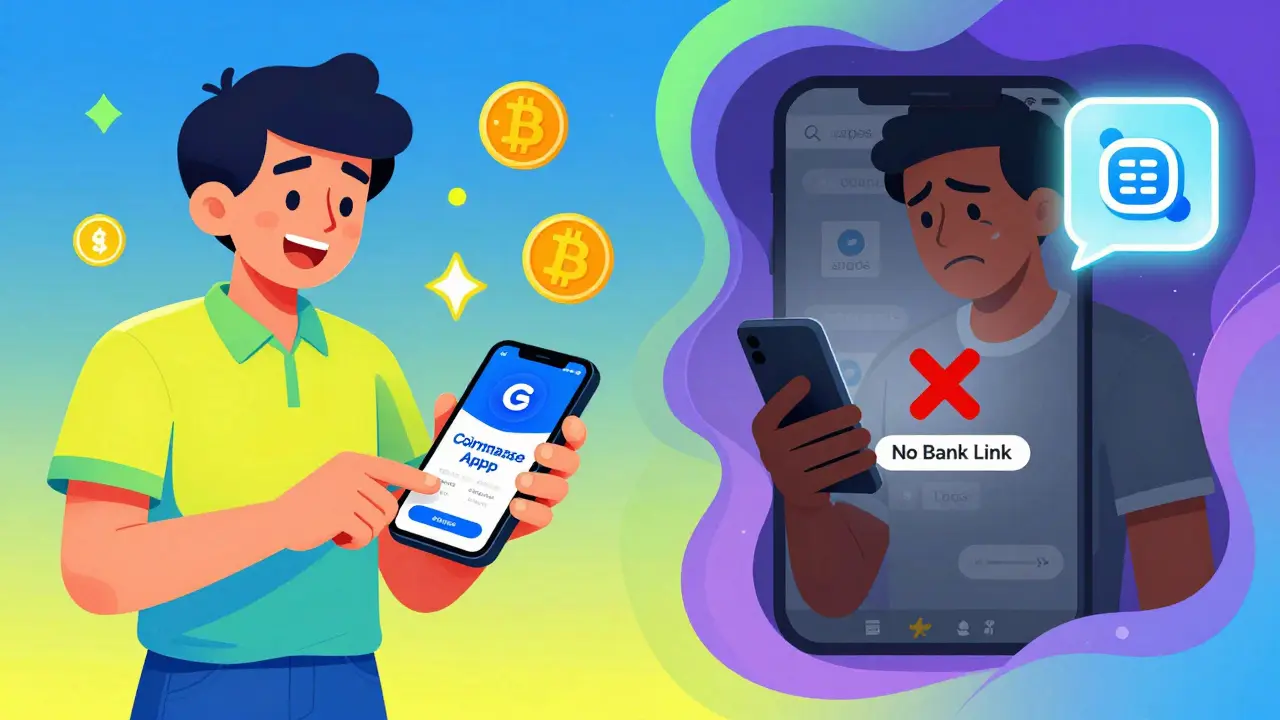
Key Countries Where Access Is Confusing or Partial
Some countries sit in a gray zone. Here’s what’s really happening:United Arab Emirates (UAE)
Coinbase says you can use Apple Pay and Google Pay to buy crypto in the UAE. But you can’t link your local bank account. That’s it. No AED deposits. No bank transfers. Just digital wallet payments. So if you’re a freelancer in Dubai with a local bank account, you’re stuck. You’ll need to use a third-party service to convert your AED to USD first, then use Apple Pay. It’s messy.India
India banned crypto exchanges from using banking services in 2018, but the ban was overturned in 2020. Since then, Coinbase tried to register with the RBI. It failed. So as of 2026, the Coinbase App is blocked in India. But Coinbase Wallet? Fully functional. Thousands of Indian users use Wallet to hold Bitcoin and Ethereum-but they buy it through P2P platforms like WazirX or CoinSwitch. They pay higher premiums (up to 8%) but get access to assets not available on local exchanges.Pakistan
Pakistan has over 10 million crypto users, according to Statista. But Coinbase doesn’t offer fiat services there. The Wallet works, but no bank deposits. Users report being blocked even when using a U.S. IP address. Some try VPNs. That’s risky. Coinbase’s system flags IP mismatches. One user in Lahore lost $2,300 after using a VPN-his account was frozen and never reopened.Russia
Since February 2022, Coinbase has completely cut off all fiat services in Russia. Even if you have a Russian passport and live in Moscow, you can’t buy crypto with rubles. But Coinbase Wallet still works. You can receive Bitcoin or Ethereum from someone abroad. You just can’t convert rubles into crypto on the platform.Colombia, Philippines, Nigeria
These are three of the fastest-growing crypto markets in the world. In the Philippines, 83% of crypto users want to buy with pesos. In Colombia, over 1.2 million people use crypto regularly. But Coinbase blocks them all. Local exchanges like PDAX (Philippines) and Paxful (Nigeria) fill the gap-but charge 3-5% fees. Coinbase’s fee is 0.5%. That’s a huge difference. But you can’t access it.How Coinbase Knows Where You Are
Coinbase doesn’t guess. It checks. When you sign up, it asks for:- Your government-issued ID (passport, driver’s license)
- Proof of address (utility bill, bank statement)
- Your device’s IP address
- Your phone number’s country code
Why Other Exchanges Are More Flexible
Binance, Kraken, and local platforms like Paxful and Luno don’t follow the same rules. Binance, for example, operates in over 190 countries. It doesn’t have U.S. regulatory oversight, so it can offer ruble, naira, and peso trading pairs. Kraken offers fiat services in 55 countries-more than Coinbase. But here’s the trade-off: they’re less regulated. That means less protection if something goes wrong. Coinbase is the only major exchange registered with the U.S. SEC. That’s why it’s trusted by banks and institutional investors. But that same trust forces it to be the most restrictive. You get safety-but at the cost of access.
What You Can Do If You’re Blocked
If you’re in a restricted country, here’s your realistic path:- Download Coinbase Wallet (not the App). It’s free and works globally except in OFAC countries.
- Use a peer-to-peer (P2P) exchange like Binance P2P, Paxful, or LocalBitcoins to buy crypto with your local currency.
- Send that crypto to your Coinbase Wallet address.
- Hold, trade, or stake your assets inside Wallet.
Caitlin Colwell
January 13, 2026 AT 00:41Denise Paiva
January 13, 2026 AT 03:51Charlotte Parker
January 14, 2026 AT 04:42Sarbjit Nahl
January 15, 2026 AT 14:07Paul Johnson
January 17, 2026 AT 09:17Meenakshi Singh
January 18, 2026 AT 21:02Kelley Ramsey
January 20, 2026 AT 17:12Danyelle Ostrye
January 21, 2026 AT 21:15Tracey Grammer-Porter
January 23, 2026 AT 01:11sathish kumar
January 23, 2026 AT 20:19Katrina Recto
January 24, 2026 AT 16:44Veronica Mead
January 25, 2026 AT 07:41