CoinDCX and WazirX: How Indian Crypto Exchange Regulations Are Reshaping the Market
India’s crypto market isn’t slowing down-it’s getting stricter. Since March 2023, every crypto exchange operating in India has had to follow banking-level rules. That means CoinDCX and WazirX, the two biggest local platforms, now face the same scrutiny as banks. No more loose KYC. No more ignoring suspicious transactions. And no more pretending cybersecurity is an optional add-on.
What Changed in 2023? The PMLA Rules Hit Hard
The big shift came when the Financial Intelligence Unit of India (FIU-IND) brought crypto exchanges under the Prevention of Money Laundering Act. Suddenly, every user had to go through full KYC-government ID, address proof, biometrics. Not just for big trades. For every single account. And every transaction? Tracked. Reported. Logged. If a user sends $500 to another wallet, the exchange must record both sender and receiver details. No exceptions. That’s the FATF Travel Rule, and India doesn’t even have a minimum threshold. It’s one of the strictest rules in the world.
Before this, exchanges like WazirX and CoinDCX operated like startups-fast, flexible, sometimes sloppy. After? They became compliance machines. Teams expanded. Legal departments grew. Software got rebuilt. And costs? Doubled. For smaller players, it was impossible. Many shut down. Those that stayed had to prove they could handle it.
The Breaches That Forced the Government’s Hand
Regulations don’t exist in a vacuum. They’re often born from disaster.
In 2024, WazirX got hacked. $230 million vanished. Not just user funds-wallets, cold storage, even some internal systems. The breach wasn’t just big. It was embarrassing. Users lost trust. Media slammed the exchange. Regulators took notice. And then, in July 2025, CoinDCX had its own major breach. Another $100 million+ stolen. Not because of a weak password. Because of a misconfigured API. A technical glitch. A mistake that shouldn’t have happened.
These weren’t random hacks. They were systemic failures. And they proved something: if you’re handling billions in digital assets, your security can’t be an afterthought. It has to be the core of your business.
September 2025: Cybersecurity Became a Legal Requirement
After the breaches, FIU-IND didn’t just tighten rules-they rewrote the game. Starting September 2025, every crypto exchange in India had to get a cybersecurity audit from a CERT-In-approved firm. Not just any audit. A deep, forensic review of every system: servers, APIs, wallets, employee access logs, incident response plans.
And here’s the kicker: you can’t just hire any firm. Only government-vetted auditors are allowed. Companies like Pi42 and Mudrex started offering compliance packages. Exchanges had to pay $50,000 to $200,000 just to get audited. For a startup? That’s more than their entire annual budget.
CoinDCX, with its unicorn valuation, could afford it. WazirX? They had to restructure, cut staff, and partner with security firms just to stay licensed. Smaller exchanges? Most didn’t survive. The market shrunk. The survivors? They’re now more secure than ever.
Offshore Exchanges Are Being Pushed Out
Indian users didn’t just use CoinDCX and WazirX. Many still traded on Binance, KuCoin, BingX, and Huione. But now, those platforms are getting notices. The Indian government gave them 45 days to register with FIU-IND or face a ban.
Binance? They paid a $2.2 million penalty. KuCoin? $41,000. Both registered. BingX? Still unregistered. And users are already seeing withdrawals frozen. Some platforms disappeared overnight. Others are fighting back legally.
The problem? Offshore exchanges don’t follow Indian KYC rules. They don’t report suspicious transactions. They don’t do audits. For regulators, that’s a red flag. For users? It’s a gamble. You might get lower fees and more coins, but if the platform gets blocked, your money could vanish with no recourse.
What Does This Mean for Traders?
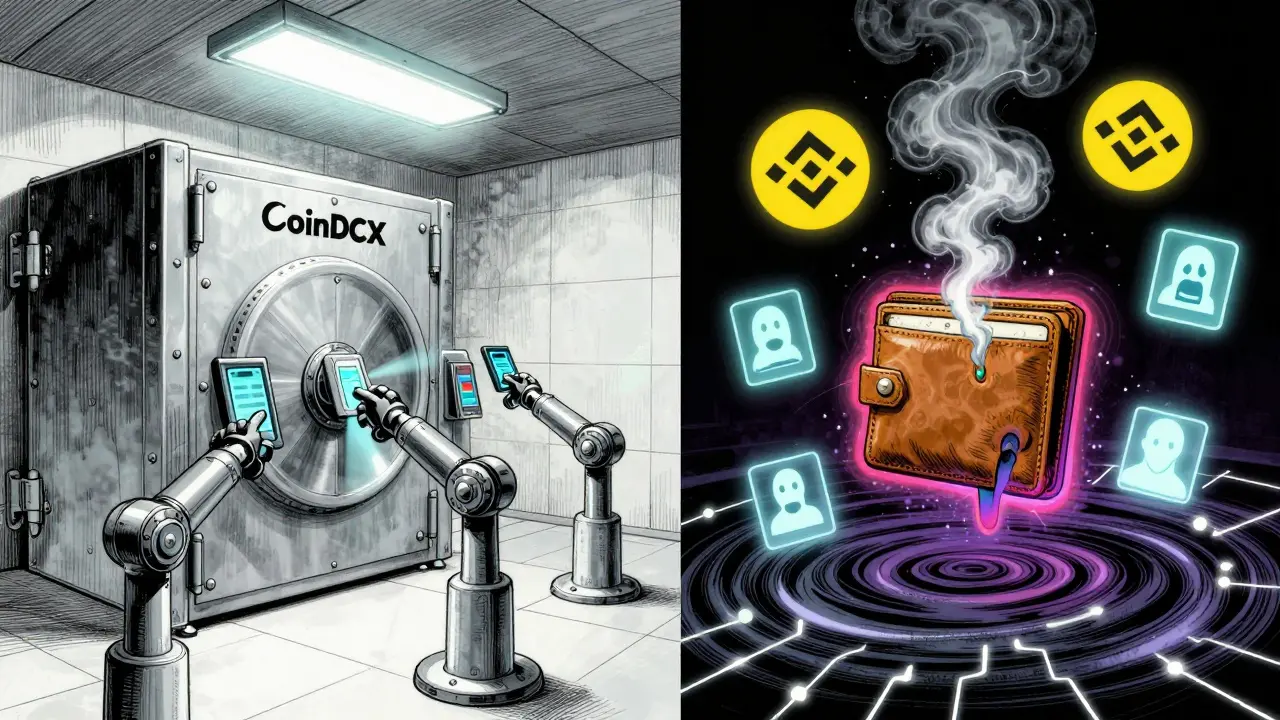
It’s a split screen. On one side: CoinDCX and WazirX. Slower, more expensive, but legal. Your funds are safer. Your data is protected. You can withdraw without fear of sudden freezes. On the other side: offshore platforms. Faster, cheaper, more coins-but one regulatory notice away from total loss.
Many traders are splitting their holdings. Keep 70% on CoinDCX or WazirX for safety. Use offshore for quick trades or niche tokens. But even that’s risky. If you’re caught using an unregistered platform, you could be flagged by FIU-IND for potential money laundering. That’s not a joke. It’s a real investigation.
And the fees? They’re up. CoinDCX now charges 0.15% per trade. WazirX? 0.18%. Before 2023, it was 0.1%. Why? Because compliance costs money. And that cost is passed to you.

Who’s Winning? Who’s Losing?
Winners: CoinDCX, WazirX, and other registered exchanges with deep pockets. They’re now the only legal options. They’ve got the resources to hire compliance officers, run audits, and build secure systems. They’re also partnering with global players like Singapore’s Liminal Custody to offer institutional-grade custody services.
Losers: Small exchanges, unregistered offshore platforms, and users who thought crypto was a free-for-all. The market is consolidating. The era of “just send your crypto to any app” is over. India is building a closed system-regulated, monitored, and controlled.
And here’s the irony: India is one of the top countries in the world for crypto adoption. Millions trade daily. But now, the government is treating crypto like a financial threat-not a tech innovation. That’s the trade-off.
What’s Next? The Road Ahead
There’s no sign of easing. If anything, the rules will get tighter. Next up? Real-time transaction monitoring. Mandatory insurance for user funds. And possibly, a government-backed digital rupee integration for crypto settlements.
Some experts say this will kill innovation. Others say it’s the only way to protect ordinary people. The truth? Both are right. India’s approach isn’t perfect. But it’s clear: if you want to operate here, you play by their rules. No shortcuts. No loopholes. No excuses.
For users, the message is simple: choose security over convenience. If you want to trade crypto in India, stick with registered platforms. The offshore options might look tempting. But one day, they could vanish-and with them, your money.