Double-Spending and 51% Attacks: How Blockchain Networks Get Manipulated
Imagine buying a coffee with Bitcoin, getting your drink, and then moments later realizing the transaction vanished - like it never happened. That’s not a glitch. It’s a double-spending attack, and it’s possible when someone controls more than half of a blockchain’s mining power. This is called a 51% attack. It’s not science fiction. It’s happened. And it’s still a real threat - just not to Bitcoin.
What Exactly Is a Double-Spend?
Digital money doesn’t have physical form, so there’s nothing stopping someone from copying a Bitcoin and trying to spend it twice. In a normal system, a bank or payment processor checks if you have enough balance before approving a transaction. Blockchains do it differently. Every transaction gets broadcast to the whole network. Miners group them into blocks, solve a hard math puzzle, and add the block to the chain. Once confirmed, that transaction is locked in. But what if someone secretly mines a different version of the chain - one that leaves out your payment? If they can make their hidden chain longer than the public one, the network will accept it as truth. Your coffee payment disappears. The same coins get spent again, this time to the attacker’s wallet. That’s double-spending. And it only works if the attacker controls the majority of the network’s computing power.How a 51% Attack Works
The blockchain follows one rule: the longest chain wins. Nodes trust the version with the most proof-of-work. So if you control more than 50% of the hash rate - meaning you’re doing more mining work than everyone else combined - you can outpace the rest of the network. Here’s how an attack plays out in real time:- The attacker makes a legitimate purchase - say, 100 coins for goods.
- The transaction gets confirmed on the main chain. The merchant ships the product.
- Meanwhile, the attacker secretly starts mining a new chain that excludes that transaction.
- They also add a new transaction on their secret chain, sending the same 100 coins to another address they control.
- Once their secret chain becomes longer than the public one, the network switches to it automatically.
- The original payment vanishes. The attacker keeps the goods and the coins.
Why Bitcoin Is Safe - For Now
Bitcoin’s network has over 700 exahashes per second. That’s 700 million billion calculations every second. To launch a 51% attack, you’d need to control more than 350 EH/s. The hardware alone would cost tens of millions of dollars. Plus, electricity bills would run into hundreds of thousands per day. And even if you pulled it off, the moment the attack was detected, Bitcoin’s price would crash. You’d be holding a pile of worthless coins. That’s why no one has successfully attacked Bitcoin. The cost is higher than the reward. Satoshi Nakamoto counted on this. He designed Bitcoin so that honest mining is always more profitable than cheating. But not every blockchain is built like this.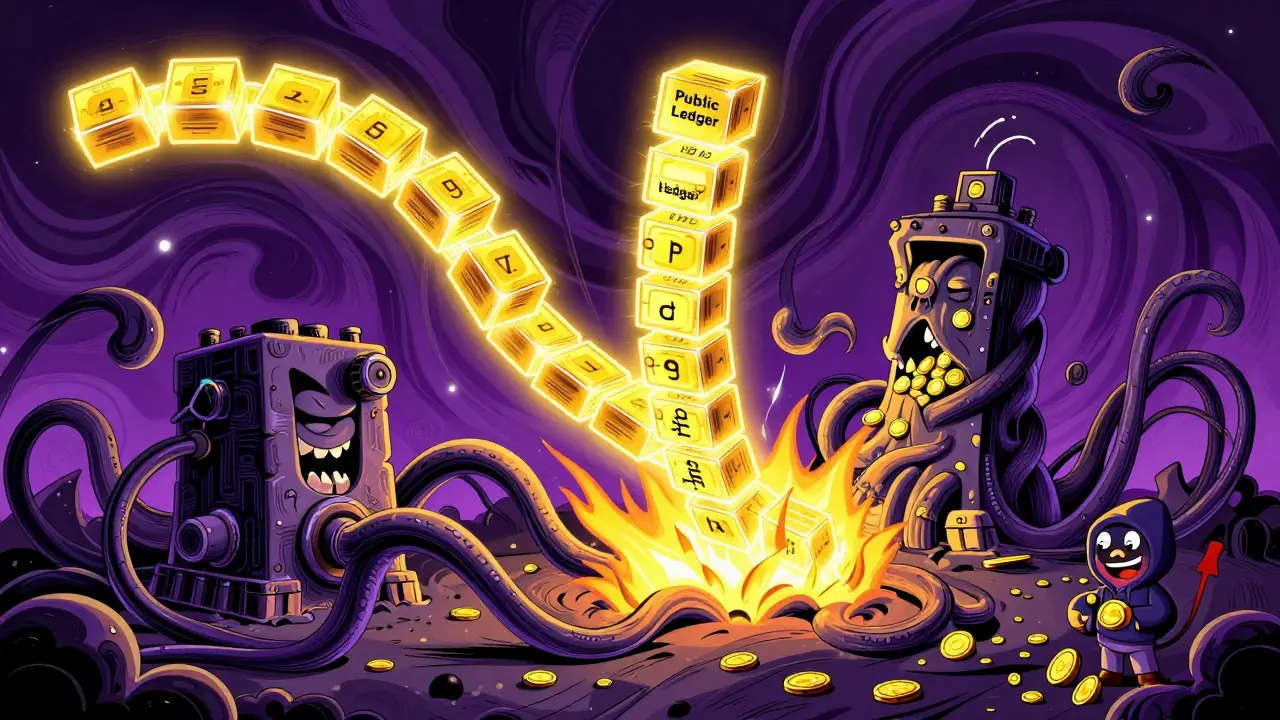
Where 51% Attacks Actually Happen
Smaller blockchains are easy targets. Ethereum Classic, Bitcoin Gold, and Vertcoin have all been hit. Why? Because their hash rates are tiny. A single mining pool from a bigger network can switch over and suddenly control 60% of the smaller network’s power. In 2020, Ethereum Classic took a hit where attackers double-spent over $5 million. The network had to hard-fork to undo the damage. Bitcoin Gold suffered two attacks in 2018, losing over $18 million in total. These weren’t theoretical. They were real, measurable losses. The pattern is clear: the smaller the network, the cheaper the attack. If a blockchain has a market cap under $100 million, it’s vulnerable. If it’s under $10 million, it’s practically asking for trouble.What Can’t a 51% Attack Do?
There’s a lot of fear around this. People think hackers can steal all the coins or break the whole system. That’s not true. Here’s what an attacker can’t do:- Steal coins from wallets they don’t own
- Create new coins out of thin air
- Change transaction rules or smart contracts
- Force other users to send them money
How to Spot a Vulnerable Network
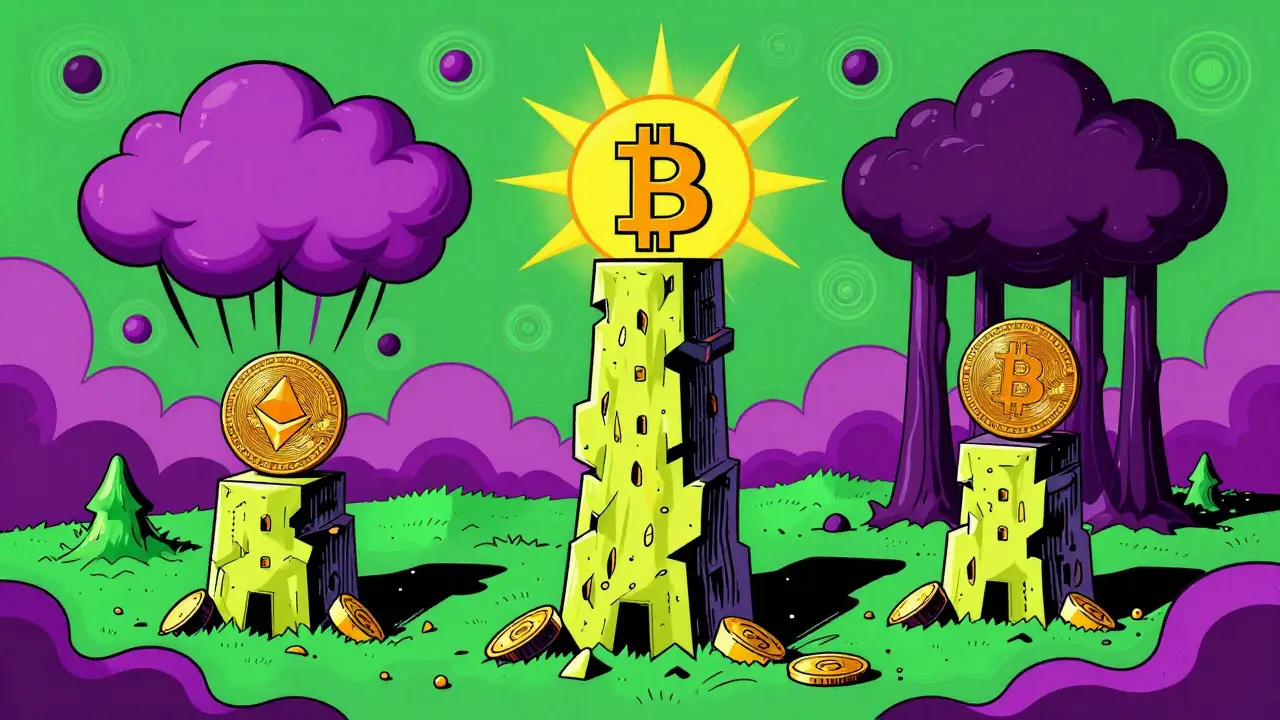
You don’t need to be a coder to tell if a cryptocurrency is at risk. Just look at three things:- Hash rate distribution - Is more than 30% of the mining power controlled by one pool? That’s a red flag.
- Market cap - If the coin’s total value is under $50 million, it’s not worth the cost to defend.
- Miner activity - Are miners switching from Bitcoin or Ethereum to mine this coin? That means they’re using spare capacity - and can leave just as fast.
What’s Being Done to Stop It?
Some blockchains are moving away from proof-of-work entirely. Solana, Cardano, and Polkadot use proof-of-stake, where security comes from who owns the coins - not who has the fastest computers. That makes 51% attacks nearly impossible because you’d need to buy over half the entire supply of coins. That’s way more expensive than buying mining rigs. Others are adding checkpoint systems. These are trusted blocks - often created by the core development team - that can’t be rewritten. Even if someone mines a longer chain, the network ignores it past the checkpoint. Monitoring tools are also getting smarter. If a network’s hash rate spikes suddenly - say, from 100 TH/s to 300 TH/s in a day - alerts go off. That’s a sign someone’s rented mining power to launch an attack.The Bigger Picture: Incentives Matter
The real lesson isn’t about technology. It’s about economics. Blockchains are secure because it’s cheaper to play fair than to cheat. But that only works if the network is big enough. A small blockchain with low trading volume and weak mining support is like a bank with one guard and no cameras. It doesn’t matter how fancy the vault is. If you can overpower the guard, you walk out with the cash. That’s why we’re seeing a natural selection in crypto. Networks that can’t attract enough miners die off. The ones that survive are the ones with enough scale to make attacks pointless.What Should You Do?
If you’re a user:- Avoid small, obscure coins unless you understand their mining setup.
- Wait for at least six confirmations before accepting large payments.
- Use wallets that show real-time hash rate data.
- Check if the network uses proof-of-work or proof-of-stake.
- Look at mining pool distribution - no single pool should have over 25%.
- Ask if there are checkpoints or community monitoring tools in place.
Can a 51% attack steal my Bitcoin?
No. A 51% attack can only reverse transactions that the attacker made themselves. It cannot access or steal coins from wallets they don’t control. The attack targets transaction history, not wallet balances.
Why hasn’t Bitcoin ever been hit by a 51% attack?
Bitcoin’s network is too large and expensive to attack. The cost of renting or buying enough mining hardware to control over half of its hash rate would run into hundreds of millions of dollars - far more than any potential profit. Plus, the market would crash if an attack happened, making the coins worthless.
Are smaller cryptocurrencies more at risk?
Yes. Networks with low hash rates - like Ethereum Classic or Bitcoin Gold - have been successfully attacked because it’s cheap to rent enough mining power to dominate them. Even a small group of miners from Bitcoin can temporarily switch over and take control.
Does proof-of-stake prevent 51% attacks?
Yes, effectively. In proof-of-stake systems, security comes from owning coins, not mining power. To launch a 51% attack, you’d need to buy over half of all coins in circulation - which is usually prohibitively expensive and would drive the price up, making the attack self-defeating.
How many confirmations are safe against a 51% attack?
For high-value transactions on vulnerable networks, six or more confirmations are recommended. On Bitcoin, one confirmation is usually enough because the network’s hash rate makes reversing transactions impractical. But on smaller chains, even ten confirmations may not be enough if an attacker already controls the majority of mining power.
John Doyle
February 12, 2026 AT 15:21Bitcoin's not safe because it's perfect. It's safe because it's too damn expensive to break.
kelvin joseph-kanyin
February 13, 2026 AT 19:01Grace Mugambi
February 14, 2026 AT 06:53Maybe the real innovation isn't blockchain. It's the incentive structure.
Benjamin Andrew
February 14, 2026 AT 06:56Christopher Wardle
February 14, 2026 AT 07:54Andrea Atzori
February 15, 2026 AT 21:36Proof-of-stake feels like the only real answer. You can't rent ownership. You can rent compute power. That's the difference.
Joe Osowski
February 16, 2026 AT 19:12Gaurav Mathur
February 16, 2026 AT 19:38Jeremy Lim
February 17, 2026 AT 20:17Beth Trittschuh
February 18, 2026 AT 00:59Peggi shabaaz
February 19, 2026 AT 13:10Holly Perkins
February 19, 2026 AT 15:11Sanchita Nahar
February 21, 2026 AT 07:57Ben Pintilie
February 22, 2026 AT 03:21