Future of Cryptocurrency Mining: Profitability, Hardware, and Energy Trends
You probably remember when mining Bitcoin meant plugging a laptop into the wall and waiting for magic to happen. That era is dead. Today, in late 2026, cryptocurrency mining is a high-stakes industrial game dominated by institutional players, massive energy contracts, and razor-thin profit margins. If you're thinking about buying a rig or investing in a mining company, you need to understand that the rules have fundamentally changed since the early days.
The biggest shift? Accessibility. Unless you have access to electricity below $0.05 per kWh, you are likely fighting an uphill battle against giants like Marathon Digital or Riot Platforms. But don't write off your home setup just yet. While Bitcoin mining has become a capital-intensive utility business, alternative coins still offer niches for smaller operators who know where to look. This guide breaks down exactly what works now, what doesn't, and where the industry is heading next.
Key Takeaways for Miners in 2026
- Bitcoin profitability is tight: Post-2024 halving rewards (3.125 BTC) require extreme efficiency and cheap power (<$0.06/kWh).
- GPU mining survives in altcoins: Coins like Monero, Ravencoin, and Kaspa remain viable for consumer hardware due to ASIC resistance.
- Energy is the primary cost driver: Renewable energy partnerships and geographic arbitrage determine success more than hardware specs alone.
- Institutionalization is complete: Mining is now viewed as digital infrastructure, attracting ESG-focused investors and regulatory scrutiny.
- Cloud mining is risky: Most cloud contracts fail to beat direct mining costs once fees and market volatility are factored in.
The Bitcoin Reality: Halving Effects and Hashrate Wars
Let's address the elephant in the room: Bitcoin mining. The April 2024 halving cut block rewards from 6.25 BTC to 3.125 BTC. This wasn't just a minor adjustment; it doubled the time needed to earn the same amount of revenue, assuming price stability. With Bitcoin's network hashrate hitting all-time highs, competition is fiercer than ever. You aren't just competing with other miners; you're competing with automated systems that shut down instantly if profitability dips below zero.
For individual miners, this means the "plug-and-play" model is obsolete. To stay profitable, you need specialized ASIC hardware from manufacturers like Bitmain or MicroBT. These machines are loud, hot, and expensive. A single modern ASIC miner can cost upwards of $5,000 to $10,000, and that's before you factor in the electrical upgrades needed to run it safely.
Geography matters more than hardware specs right now. The United States hosts roughly 35-40% of global Bitcoin mining capacity, but not all states are equal. Texas remains a hub because of its deregulated energy grid and frequent negative pricing events, where miners get paid to consume electricity. Wyoming offers favorable legal frameworks. Meanwhile, regions with high residential electricity rates ($0.15+ per kWh) simply cannot compete. If your local rate is above $0.08 per kWh, solo Bitcoin mining is likely a money-losing proposition unless you join a large pool and accept long-term volatility.
Alternative Coins: Where GPU Miners Still Have a Shot
If you already own gaming PCs or want to avoid the ASIC arms race, look at Proof-of-Work alternatives. These coins use algorithms designed to resist ASIC dominance, keeping mining accessible to those with GPUs. In 2026, three names stand out for different reasons.
Monero (XMR) continues to be the gold standard for privacy-focused CPU/GPU mining. Its RandomX algorithm favors general-purpose processors, meaning your older Ryzen CPUs might still find work. Block rewards sit around 0.6046 XMR, which sounds small until you consider Monero's consistent demand. It’s less volatile than meme coins and serves a specific utility purpose.
Ravencoin (RVN) and Kaspa (KAS) have emerged as favorites for GPU miners seeking higher returns. Ravencoin uses the KAWPOW algorithm, which is memory-hard and resistant to ASICs. Kaspa, while increasingly seeing ASIC development, still offers lucrative opportunities for high-end NVIDIA cards. However, beware: as soon as an ASIC-friendly variant gains traction, GPU profits on these coins can evaporate overnight.
Then there's the merged mining strategy. Litecoin (LTC) is often mined alongside Dogecoin (DOGE). Since they share the Scrypt algorithm, mining Litecoin automatically earns you Dogecoin without extra energy costs. This dual-income stream helps offset the declining value of pure LTC rewards, making it a surprisingly resilient option for mid-tier hardware.

Hardware Economics: ASIC vs. GPU vs. Cloud
Choosing your weapon depends entirely on your capital and risk tolerance. Here is how the options stack up in the current market.
| Feature | ASIC Miners | GPU Rigs | Cloud Mining |
|---|---|---|---|
| Primary Use | Bitcoin, Litecoin, Dash | Altcoins (ETH Classic, RVN, ERG) | Passive Exposure |
| Initial Cost | $5k - $100k+ | $5k - $25k | $100 - $5k (Contract) |
| Flexibility | Low (Single Algorithm) | High (Switch Algorithms) | None (Fixed Contract) |
| Resale Value | Drops rapidly after halving | Holds value better (Gaming use) | Zero (Service fee based) |
| Maintenance | High (Heat/Fan noise) | Medium (Software updates) | None |
ASICs are one-trick ponies. If you buy a machine for Bitcoin, it only mines Bitcoin. When difficulty spikes or price drops, you're stuck holding a depreciating asset. GPUs, conversely, are versatile. If Ravencoin becomes unprofitable, you can switch to Ergo or Ethereum Classic. Plus, when the crypto bear market hits, you can sell your graphics cards to gamers, recovering a significant portion of your investment.
What about cloud mining? Services like Genesis Mining or newer platforms promise passive income without the hassle of heat and noise. Be skeptical. Most cloud contracts include hidden maintenance fees that eat into profits. Furthermore, many providers operate on a Ponzi-like structure where new investor funds pay earlier contracts. Unless you find a contract with a proven track record and transparent audits, direct ownership usually yields better long-term results.
The Energy Factor: Sustainability and Location
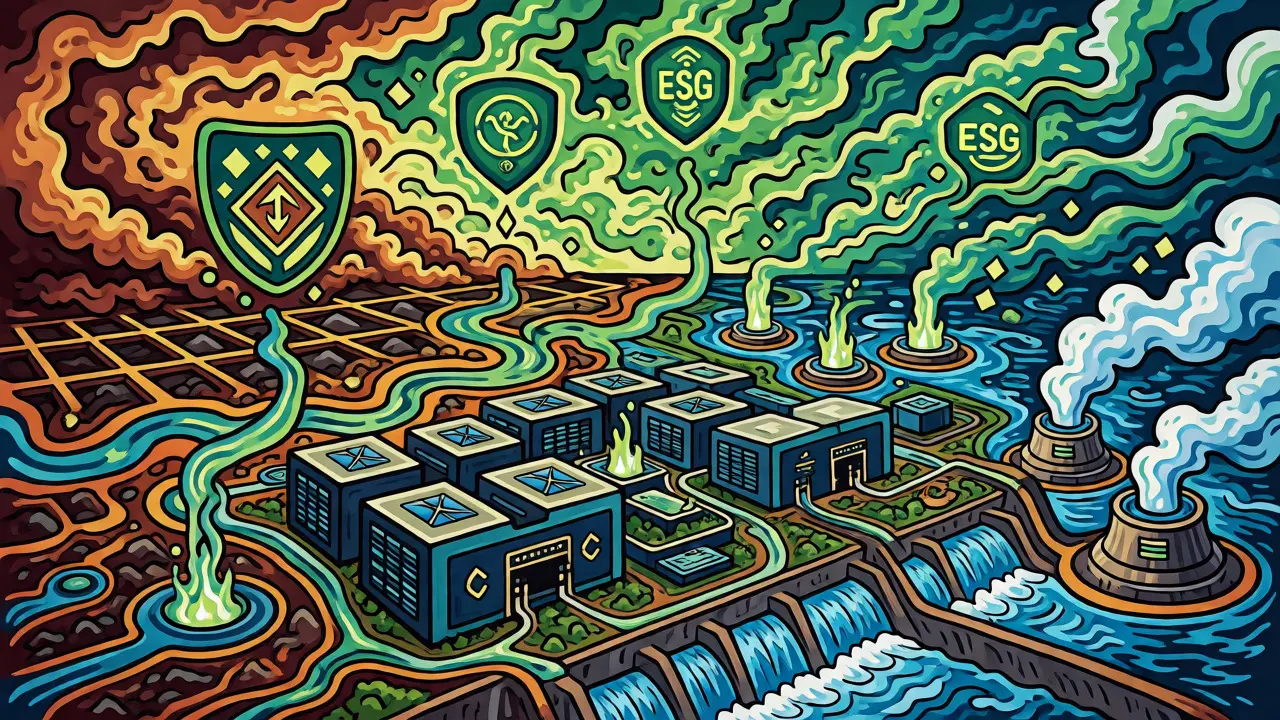
Electricity isn't just a line item; it's the existential threat to mining operations. In 2026, environmental, social, and governance (ESG) criteria drive institutional investment. Large miners are no longer just chasing the cheapest kilowatt-hour; they are chasing the cleanest one.
Operations in regions like Paraguay and El Salvador leverage hydroelectric power, offering both low costs and a green footprint. This attracts venture capital looking for sustainable exposure to crypto. Conversely, miners relying on coal-heavy grids face potential carbon taxes or regulatory penalties. For the home miner, this translates to a simple rule: if your grid is dirty, your mining is questionable in the eyes of future regulators.
There is also the trend of "energy arbitrage." Some facilities co-locate with flared gas sites or stranded renewable sources. They capture energy that would otherwise be wasted, turning a liability into a revenue stream. This innovation suggests that the future of mining isn't just about digging digital gold; it's about stabilizing energy grids by providing flexible load demand.
Regulatory Landscape and Future Risks
Governments are catching up. The European Union's Markets in Crypto-Assets (MiCA) regulation sets a precedent for how mining fits into broader financial law. In the US, states are experimenting with different approaches. Texas treats miners as industrial users, while New York has imposed moratoriums on proof-of-work mining due to environmental concerns.
Compliance is becoming mandatory. Institutional miners must report energy usage, prove source sustainability, and adhere to anti-money laundering (AML) standards. For individuals, tax implications remain complex. Every mined coin is a taxable event upon receipt, and selling it triggers another tax calculation. Keep meticulous records. Using software that integrates directly with mining pools can save you hours during tax season.
Looking ahead, we anticipate further consolidation. Small, inefficient miners will exit the space, sold off to larger entities. The remaining players will be tech-forward companies that treat mining as a data center service rather than a speculative gamble. Decentralization purists worry this centralizes hash power, but proponents argue it secures the network through professional reliability.
Practical Steps to Start Mining in 2026
If you still want to enter the arena, here is a realistic roadmap:
- Analyze your electricity rate: Check your bill. If it's over $0.10/kWh, focus on altcoins or skip mining entirely.
- Choose your niche: Do you want steady, low-risk returns (Litecoin/Doge)? Or high-volatility, high-reward potential (Kaspa/Ravencoin)?
- Calculate ROI carefully: Use online calculators like WhatToMine or NiceHash. Input your exact hardware specs and current network difficulty. Remember to subtract electricity costs daily.
- Plan for cooling: Mining generates immense heat. In summer, your rig acts as a heater. Ensure proper ventilation or invest in immersion cooling if scaling up.
- Join a pool: Solo mining is a lottery ticket. Joining a reputable pool smooths out income variance, ensuring regular payouts.
Mining today requires patience and precision. It is no longer a get-rich-quick scheme. It is a business operation where margins are measured in pennies per kilowatt-hour. Those who succeed are the ones who treat it with the seriousness of any other industrial venture.
Is Bitcoin mining still profitable for individuals in 2026?
Generally, no, unless you have exceptionally cheap electricity (under $0.05/kWh) and access to the latest ASIC hardware. For most individuals with standard residential rates, the cost of power exceeds the reward, leading to losses. Altcoin mining or joining a large pool offers better odds for hobbyists.
Which cryptocurrency is best for GPU mining right now?
Monero (XMR) remains strong for CPU/GPU hybrids due to its ASIC-resistant RandomX algorithm. For pure GPU setups, Ravencoin (RVN), Ergo (ERG), and Kaspa (KAS) are popular choices. However, profitability fluctuates daily, so always check current mining calculators before committing hardware.
How does the 2024 Bitcoin halving affect mining rewards?
The halving reduced the block reward from 6.25 BTC to 3.125 BTC. This effectively doubled the difficulty for miners to earn the same amount of Bitcoin, forcing less efficient operations offline and driving the network hashrate to new highs as remaining miners optimized their setups.
What is merged mining and should I do it?
Merged mining allows you to mine two cryptocurrencies simultaneously using the same computational power. The most common example is mining Litecoin and Dogecoin together. It increases overall revenue without increasing energy costs, making it highly recommended for Scrypt-based miners.
Are cloud mining services trustworthy?
Many are not. While some established providers exist, the sector is rife with scams and unsustainable models. Cloud mining often involves high maintenance fees that erode profits. Direct ownership of hardware provides more control and transparency, though it comes with higher upfront costs and management responsibilities.