Future of Metaverse Technology: How Blockchain, AI, and AR Will Shape the Next Digital Frontier
The metaverse isn’t just science fiction anymore. By 2026, it’s becoming a real part of how we work, shop, learn, and socialize. But it’s not one big, unified world like some companies promised. Instead, it’s a patchwork of virtual spaces - each built for a purpose, powered by blockchain, and tied to real-world value. The future of the metaverse isn’t about flashy headsets or digital fashion. It’s about ownership, interoperability, and useful experiences that solve actual problems.
Blockchain Is the Backbone, Not Just a Buzzword
Early metaverse projects tried to build virtual worlds with centralized economies. You could buy a plot of land, but if the platform shut down, you lost everything. That’s why blockchain changed everything. It’s not just about crypto payments - it’s about proving you own something. NFTs (non-fungible tokens) now represent digital land, clothing, art, and even event tickets. These aren’t just images. They’re verifiable assets stored on public ledgers. If you own a virtual jacket in one app, blockchain lets you wear it in another - if the platform allows it.
Companies like Decentraland and The Sandbox use Ethereum-based blockchains to track ownership. Newer platforms are moving to Layer-2 solutions like Polygon or Solana to cut fees and speed up transactions. This matters because no one will use a metaverse where buying a virtual shirt costs $15 in gas fees. Blockchain isn’t optional anymore - it’s the foundation that makes digital ownership real.
AR Glasses Are Replacing VR Headsets
Remember the bulky VR headsets from 2022? They’re already being phased out. By 2026, the most successful metaverse experiences don’t require you to put on a helmet. Instead, lightweight AR glasses - think like regular sunglasses with a tiny display - are becoming the norm. Companies like Apple, Ray-Ban, and startups like Nreal are rolling out devices that overlay digital info onto your real world. You can see a virtual product label on a physical shelf. You can join a team meeting where your coworkers appear as lifelike avatars sitting at your kitchen table.
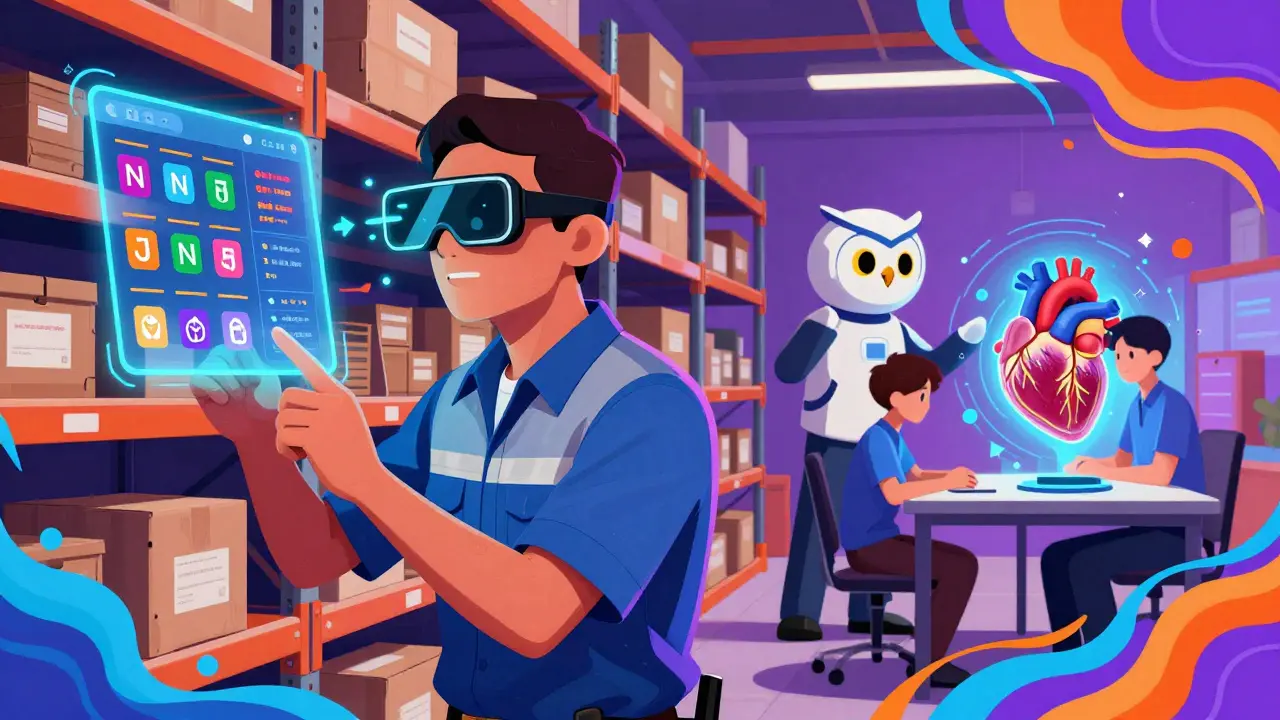
This shift is huge. VR locks you in. AR lets you stay connected to reality while accessing digital layers. That’s why adoption is exploding in retail, logistics, and education. A warehouse worker uses AR glasses to scan a box and instantly see inventory data. A student learning anatomy can walk around a 3D human heart projected on their desk. The metaverse isn’t about escaping the real world - it’s about enhancing it.
AI Makes the Metaverse Feel Alive
A virtual mall with empty storefronts isn’t a metaverse. It’s a ghost town. AI is what brings these spaces to life. Intelligent avatars now respond to your voice, remember your preferences, and even learn your habits. In virtual stores, AI assistants suggest products based on your past purchases. In education, AI tutors adapt lessons in real time based on how well you’re understanding a topic.
Platforms like NVIDIA’s Omniverse use generative AI to build entire virtual environments from text prompts. A designer types “a 1970s-style coffee shop with neon signs and vinyl records,” and the system builds it in minutes. AI also handles moderation, translation, and even customer service in virtual events. No human staff needed. Just smart agents that never sleep.
Interoperability Is Still the Biggest Hurdle
Here’s the truth: if you buy land in Decentraland, you can’t walk into Roblox with it. If you own a digital watch in The Sandbox, it won’t show up in Fortnite. That’s not a feature - it’s a flaw. The metaverse should work like the internet. You shouldn’t need a new wallet, new identity, and new currency for every platform.
Some companies are trying to fix this. Meta, Microsoft, and a few blockchain startups are working on open standards like the Metaverse Interoperability Protocol. Think of it like HTML for virtual worlds. If adopted, it would let your avatar, your digital items, and your wallet work across platforms. Until then, the metaverse remains a collection of walled gardens. The winners won’t be the ones with the fanciest graphics - they’ll be the ones who build bridges.
Real Business Use Cases Are Already Here
Forget virtual concerts and NFT sneakers. The real value is in business. Retailers like IKEA and Walmart now have virtual stores where you can test furniture in your own space using AR. Ford lets customers configure and walk around a new car model in 3D before buying. Hotels use the metaverse for virtual tours - bookings increased by 40% in 2025 for properties with immersive previews.
Education is growing fast. Medical schools use VR simulations for surgery training. Law students argue cases in virtual courtrooms. Corporate training is cheaper and more effective - employees learn safety procedures in a simulated factory without risking real damage. These aren’t experiments. They’re cost-cutting tools with measurable ROI.
What’s Holding It Back?
Let’s be honest - the metaverse still feels clunky. Most people don’t use it because:
- AR glasses cost $500-$1,000 - too expensive for casual use
- Internet speeds in rural areas can’t handle real-time 3D streaming
- Privacy laws in Europe and the U.S. are unclear about virtual data collection
- Most apps still feel like video games, not tools
Hardware costs are falling fast. By 2027, basic AR glasses will cost under $200. Edge computing is helping too - instead of sending all your data to a faraway cloud server, processing happens right on your device. That means less lag, better privacy, and lower bandwidth needs. But regulation is the wild card. If governments start requiring identity verification for every avatar or taxing digital asset sales, adoption could slow.
The Future Isn’t One Metaverse - It’s Many
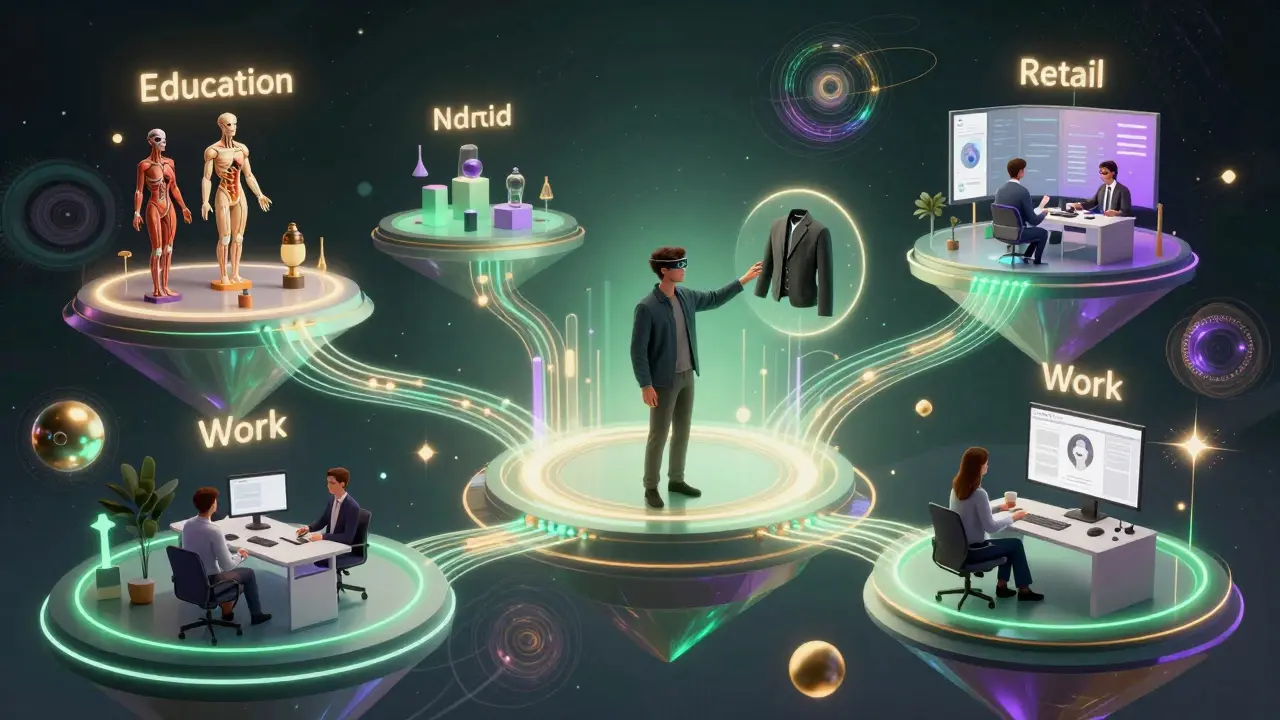
The idea of a single, universal metaverse is dead. The future is niche. There will be a metaverse for shopping, one for education, one for remote work, one for healthcare, and one for socializing. Each will be built for its purpose, using the right tools - blockchain for ownership, AI for intelligence, AR for accessibility.
Success won’t come from building the biggest virtual world. It’ll come from solving one real problem better than anything else. A teacher who uses VR to explain planetary motion. A mechanic who uses AR to diagnose a car engine. A small business owner who sells digital collectibles tied to real products. These are the use cases that will stick.
By 2030, the metaverse won’t be something you “go into.” It’ll be something you use - like email or a smartphone. And the companies that win? They won’t be the ones with the fanciest graphics. They’ll be the ones who made it simple, useful, and owned by the people who use it.
Is the metaverse just VR headsets and digital fashion?
No. While early hype focused on virtual clothes and gaming, the real value is in practical applications. Retailers use AR to let customers try products at home. Schools use VR for immersive learning. Factories use digital twins to train workers. The metaverse is becoming a tool, not a toy.
Do I need cryptocurrency to use the metaverse?
Not always, but if you want to own digital items - like land, art, or gear - then yes. Blockchain and crypto give you real ownership. Without them, you’re just renting. Many platforms now let you pay with credit cards for basic access, but if you want to trade or sell your digital assets, you’ll need a wallet and crypto.
Can I build my own metaverse experience?
Yes, but it’s not easy. You’ll need 3D modeling skills, blockchain integration, and AI tools to make it feel alive. Platforms like Unity and Unreal Engine offer tools for beginners. Start small - a virtual pop-up shop, a guided tour, or a training module. Many businesses are hiring developers to build these, but if you’re technical, you can do it yourself with open-source frameworks.
Will the metaverse replace social media?
Not replace - evolve. Social media is text and images. The metaverse is presence. You’ll still scroll through feeds, but you’ll also join virtual coffee chats, attend live concerts with friends, or collaborate on a project in 3D. The future is hybrid: you’ll use both, depending on what you’re doing.
Is the metaverse just for tech companies?
No. Small businesses are using it too. A local bakery can create a virtual tasting room. A therapist can offer sessions in a calming 3D space. A nonprofit can host a fundraiser with interactive exhibits. You don’t need a big budget - just a clear goal. The tools are cheaper than ever.
Alan Enfield
February 16, 2026 AT 17:04Blockchain is the real game-changer here-not the flashy AR glasses or AI avatars. I’ve seen too many platforms promise ownership but deliver rent. The moment you can transfer your digital asset from a virtual classroom to a retail store without losing value? That’s when it becomes useful. Not before.
And yeah, Layer-2 chains like Polygon? Absolute necessity. Nobody’s paying $20 in gas to buy a virtual hoodie. The tech’s there. The will? Not so much.
Interoperability isn’t a feature-it’s the baseline. If your metaverse needs its own wallet, identity, and currency, you’re not building the future. You’re building another walled garden with better graphics.
george chehwane
February 17, 2026 AT 16:59Oh wow. Another ‘blockchain solves everything’ manifesto. Let me guess-you also think NFTs are the new gold standard and that AR glasses will magically fix capitalism? Cute.
The metaverse is just capitalism with a VR headset. You think ownership matters? Try owning a digital plot in Decentraland while your landlord raises the ‘land tax’ in fiat. The blockchain doesn’t protect you-it just makes the scam transparent.
AI avatars? More like algorithmic ghosts trained on your data to upsell you more digital socks. And don’t get me started on ‘useful experiences.’ We’re still using VR to sell NFT sneakers. That’s not innovation. That’s a Ponzi with better lighting.
yogesh negi
February 19, 2026 AT 15:02Guys, I just want to say-this is HUGE. Seriously. I’ve been teaching kids in rural India using AR overlays for science lessons, and their engagement went from 30% to 85% in three months!
It’s not about the tech being perfect-it’s about access. A kid with a $150 Android phone and free Wi-Fi can now walk through a human heart. That’s not sci-fi. That’s justice.
And blockchain? It’s not about crypto. It’s about giving creators-artists, teachers, small businesses-a way to own their work without middlemen. I’ve seen a potter in Kerala sell digital replicas of her pottery, and now she’s funding her daughter’s medical school. That’s the real metaverse.
Let’s not overcomplicate it. Start small. Build with purpose. And remember: tech is a tool. Not a religion.
Nikki Howard
February 20, 2026 AT 18:51Blockchain? More like blockchain-bullshit. You think your NFT is safe? What happens when the Ethereum chain gets forked? Or when the U.S. government bans crypto transactions? Your ‘ownership’ vanishes overnight.
And AR glasses? Please. Apple’s gonna monetize your eyeballs. Every glance you make? Tracked. Every pause? Monetized. You think you’re ‘enhancing reality’? You’re being sold to advertisers in real-time 3D.
And don’t even get me started on AI avatars. They’re trained on your data, then sold to third parties. You’re not interacting with an assistant-you’re feeding a corporate AI that learns your fears, your habits, your insecurities.
This isn’t progress. It’s surveillance with a headset.
Tarun Krishnakumar
February 21, 2026 AT 22:24They’re all lying. All of them. The metaverse? It’s not about ownership. It’s about control. Blockchain? It’s just a fancy ledger for the Federal Reserve’s digital currency. You think you own your NFT? You’re just a node in a global surveillance network.
AR glasses? They’re already scanning your retinas. Your pupils dilate when you look at a product. That data goes straight to the AI. Then it targets you with ads-inside your vision-before you even realize you’re being manipulated.
And the ‘interoperability’ push? That’s just the big tech boys setting the rules. You think Meta and Microsoft are helping you? They’re building the new digital Berlin Wall-and you’re the one paying for the bricks.
Mark my words: by 2027, your avatar will need government approval. Your digital assets? Taxed. Your movements? Logged. Your thoughts? Predicted.
They’re not building a metaverse. They’re building a prison with better lighting.
Dominica Anderson
February 23, 2026 AT 07:19Useful? Please. The only ‘useful’ thing here is how much money these companies are making off delusional tech bros.
AR glasses? They’re ugly. Expensive. And useless unless you’re a warehouse drone. Real innovation? That’s a smartphone with a better camera. Not a headset.
Blockchain? Crypto is a pyramid scheme with a whitepaper. And ‘interoperability’? A fairy tale. The only thing interoperable here is your credit card debt.
We don’t need a metaverse. We need a better internet. Not a VR theme park for billionaires.
sruthi magesh
February 24, 2026 AT 05:46Blockchain? Only if you’re okay with your digital assets being frozen by a DAO vote. AI? Just another way for Silicon Valley to replace human workers with bots that never sleep and never get paid.
AR? It’s just ads on your eyeballs. And ‘interoperability’? A marketing lie. The only thing that interoperates is your data-sold to the highest bidder.
This isn’t the future. It’s corporate control dressed up as progress.
Lisa Parker
February 26, 2026 AT 02:53OMG I just tried a virtual IKEA room and cried. Like, I’ve never felt so seen. My couch is in the metaverse now. I feel like I’ve found my soulmate. 🥹
Nova Meristiana
February 26, 2026 AT 15:41Oh wow, so now we’re pretending that AR glasses are ‘revolutionary’? Please. You think wearing a $900 headset makes you cool? You’re just the next generation of people who thought Google Glass was a good idea.
And ‘ownership’? Honey, you don’t own anything. You’re just a data point with a wallet.
Metaverse? More like meta-waste.
Aileen Rothstein
February 27, 2026 AT 15:05I’ve been building virtual training modules for nurses using VR, and the results? Unbelievable. One trainee did a simulated emergency C-section-perfectly-because she’d practiced 20 times in the metaverse. No real patient was ever at risk.
And yes, blockchain matters. Not for the crypto hype-but because it lets small clinics own their training content. No corporate lock-in. Just open, reusable, verifiable tools.
AR is the real win. Imagine a paramedic seeing patient vitals overlaid on the real body. That’s not sci-fi. That’s saving lives.
This isn’t about games. It’s about equity. Access. Real impact. We’re not building a world. We’re fixing ones that are broken.
JJ White
March 1, 2026 AT 08:05YOU THINK THIS IS ABOUT TECHNOLOGY? IT’S ABOUT POWER.
They’re not selling you a metaverse. They’re selling you a new form of serfdom. Blockchain? A ledger of digital slavery. AI avatars? Your digital slaves, trained on your voice, your face, your trauma.
AR glasses? Surveillance with a warranty. Every blink. Every glance. Every sigh. Logged. Monetized. Sold.
And don’t you DARE tell me about ‘interoperability.’ That’s just the next step in the Great Consolidation. One system. One identity. One corporation. One master.
They’ve been planning this since 2012. And you? You’re the one clicking ‘accept.’
Nicole Stewart
March 2, 2026 AT 19:54Jennifer Riddalls
March 3, 2026 AT 05:57I love how this conversation keeps circling back to ownership. But here’s the thing-ownership isn’t just about blockchain. It’s about agency.
I run a small community center in Detroit. We use free, open-source AR tools to teach kids about local history. No NFTs. No crypto. Just a tablet, a park bench, and a story.
The metaverse doesn’t need to be fancy. It just needs to be accessible. And it’s already happening-in libraries, in schools, in basements.
You don’t need a billion-dollar platform. You just need a spark.
Kyle Tully
March 3, 2026 AT 18:53Blockchain is cool and all but let’s be real-most people don’t care about digital land. They care about not getting scammed.
I tried buying a virtual shirt last year. Got a JPEG. The company vanished. My wallet? Still holding the ghost of a purchase.
AI avatars? They glitch. They say weird stuff. One time an AI ‘sales rep’ told me my virtual shoes were ‘unworthy of my aura.’
AR glasses? I tried them. Got motion sickness. Woke up in a Walmart parking lot.
We’re not building the future. We’re building a glitchy beta.
kieron reid
March 5, 2026 AT 11:11Another article full of buzzwords. ‘Interoperability.’ ‘Useful experiences.’ What does that even mean? It means they’re trying to sell you something you didn’t ask for.
AR? Too expensive. Blockchain? Too slow. AI? Too creepy.
And don’t get me started on ‘digital ownership.’ You don’t own a JPEG. You own a link. And links break.
This isn’t innovation. It’s vaporware with a PowerPoint.
Avantika Mann
March 6, 2026 AT 23:45Hey, I’m a teacher in rural Kerala, and I’ve been using simple AR apps to teach physics to my students. No headsets. Just phones and free apps.
They can now see gravity in action-floating balls, falling objects, orbital paths-all projected on their desks.
Blockchain? We don’t use it. AI? Barely. But we’re learning. And that’s what matters.
You don’t need fancy tech to make a difference. Just a little creativity and a lot of heart.
If you’re building a metaverse, build it for the ones who need it most-not the ones who can afford it.
andy donnachie
March 7, 2026 AT 05:34Interesting take on AR replacing VR. I’ve tested both in a hospital setting. VR for surgical simulation? Solid. AR for real-time patient data overlay? Game-changing.
But the real win? Training nurses in virtual triage rooms. No patients at risk. No cost. No downtime.
Blockchain? It’s a tool-not a religion. Use it where it adds value. Not everywhere.
And interoperability? Still a mess. But it’s coming. Slowly. Like all good tech.
Paul David Rillorta
March 9, 2026 AT 00:21They’re all lying. The metaverse is a psyop. The AI avatars? They’re trained on your social media. The AR glasses? They’re scanning your pupils. The blockchain? It’s just the Fed’s new tracking system.
You think you own your digital jacket? Nah. The government owns it. And they’ll tax it. And then they’ll delete it if you say the wrong thing.
They’re not building a world. They’re building a prison. With Wi-Fi.
Ruby Ababio-Fernandez
March 9, 2026 AT 03:29Jeremy Fisher
March 10, 2026 AT 23:48I’m from Nigeria, and I’ve seen how this tech is changing lives. A small business owner in Lagos uses AR to show customers how her jewelry looks in real light. No store. Just her phone and a virtual booth.
Blockchain? She uses it to prove she made the piece. No middlemen. No theft. Just her, her art, and her customers.
It’s not about the tech being perfect. It’s about who gets to use it.
And yes-this isn’t Silicon Valley’s dream. It’s the world’s quiet revolution.