Honeyswap Review: Is This Low-Fee DEX Worth Your Time in 2026?
Imagine trying to buy a single coffee using Bitcoin on the Ethereum mainnet. You pay $50 in gas fees for a $4 transaction. It makes no sense. That is exactly the problem Honeyswap was built to solve. Launched in September 2020 as a fork of Uniswap V2, Honeyswap operates primarily on the Gnosis Chain (formerly xDai Chain). Its goal? To provide lightning-fast, near-zero cost trading for everyday users who are tired of paying exorbitant network fees just to swap tokens.
In 2026, the decentralized exchange (DEX) landscape is crowded. Giants like Uniswap and PancakeSwap dominate volume. So, where does Honeyswap fit in? It’s not trying to be the biggest. It’s trying to be the cheapest and most community-driven option for specific ecosystems. But does it actually work for you? Let’s break down the reality of trading on Honeyswap today.
What Exactly Is Honeyswap?
Honeyswap is a non-custodial automated market maker (AMM). Unlike centralized exchanges where a company holds your funds, Honeyswap uses smart contracts to facilitate trades directly between users. It runs on the 1Hive DAO governance model, meaning decisions about the protocol are voted on by holders of the HNY token.
The platform launched as a response to high Ethereum gas fees. By moving operations to the Gnosis Chain-a stablecoin-backed sidechain that later became an independent EVM-compatible chain-Honeyswap achieved transaction costs that are often less than a penny. While it has expanded to Polygon and plans further expansion to chains like Arbitrum, its heart remains on Gnosis.
Here is the core value proposition: If you are trading small amounts or micro-assets, Honeyswap saves you money. If you are moving millions of dollars, you will likely find the liquidity lacking compared to larger competitors.
How Fees and Incentives Work
One of the most unique aspects of Honeyswap is its fee structure and reward system. Most DEXs charge a flat fee, but Honeyswap splits its revenue in a way that rewards both global and local communities.
| Fee Component | Percentage | Recipient |
|---|---|---|
| Liquidity Provider Reward | 0.25% | Users providing liquidity to pools |
| Protocol Fund | 0.05% | Governance treasury / Development |
| Honey Token Allocation | 1/12 of total fees | Global 1Hive ecosystem incentives |
| Comb Token Allocation | 1/12 of total fees | Local chain-specific farming rewards |
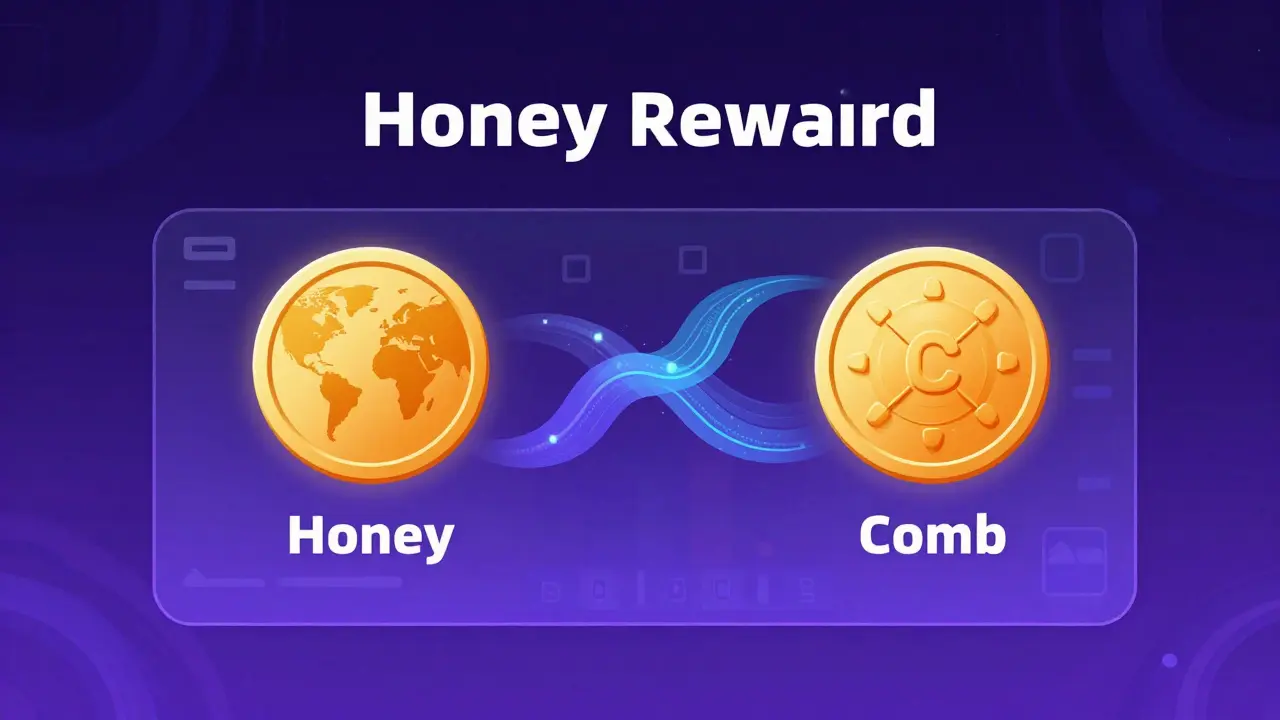
This dual-token model is crucial to understand. The Honey token represents global value within the 1Hive ecosystem, while the Comb token is specific to each chain (like Gnosis or Polygon). Comb tokens act as derivatives based on transaction volume on that specific chain. For traders, this means you can earn rewards just by swapping, though the amounts are generally modest unless you are a heavy user.
The standard swap fee is 0.30%. Compared to Uniswap’s 0.30% or Sushiswap’s similar rates, this is average. However, because the base transaction cost (gas) on Gnosis is negligible, the *effective* cost of trading on Honeyswap is significantly lower than on Ethereum-based DEXs.
Liquidity and Trading Volume: The Reality Check
Let’s get straight to the numbers, because this is where Honeyswap shows its limitations. As of 2025-2026 data, Honeyswap’s Total Value Locked (TVL) sits at approximately $1.04 million. To put that in perspective, Uniswap’s TVL is in the billions. Honeyswap handles roughly $31,000 to $32,000 in daily trading volume.
Why does this matter? Liquidity depth determines slippage. Slippage is the difference between the expected price of a trade and the price at which the trade is executed. On Honeyswap:
- Small trades (<$100): You will experience near-zero slippage. The experience is smooth and cheap.
- Medium trades ($100 - $1,000): You may see slight slippage, usually under 0.5%, depending on the pair.
- Large trades (>$5,000): Slippage can exceed 2%. This is painful for active traders.
The platform supports 26 coins and 40 trading pairs. You won’t find every new meme coin here. The selection focuses on established assets within the Gnosis and Polygon ecosystems. If you need to trade obscure tokens, you might have to look elsewhere. But for major pairs like GNO/DAI or USDC/ETH on Polygon, the spreads are tight.
Security and Trust Factors
When you use a DEX, you trust code, not a company. Honeyswap takes this seriously. The platform’s smart contracts have been audited by CertiK, a leading blockchain security firm. These audits check for vulnerabilities like reentrancy attacks or flash loan exploits.
However, being audited doesn’t mean invincible. Security also depends on how you interact with the protocol. Since Honeyswap is non-custodial, you are responsible for your own private keys. There is no customer support team to reset your password if you lose access to your wallet.
The project maintains a lean operational model. Annual protocol revenues are estimated at around $20,000. While this sounds low, it reflects the niche nature of the platform. It doesn’t require massive marketing budgets or large staff teams. The development is community-driven, which fosters transparency but can sometimes lead to slower feature updates compared to well-funded competitors.
User Experience: Getting Started
If you’ve used Uniswap before, Honeyswap will feel familiar. The interface is clean, minimal, and functional. Here is how you actually start trading:
- Set Up Your Wallet: You need a Web3 wallet like MetaMask, WalletConnect, or Fortmatic. MetaMask is the most common choice.
- Add the Network: Go to your wallet settings and add the Gnosis Chain (xDai) network. You’ll need the RPC URL and Chain ID. This step is critical; if you stay on Ethereum Mainnet, you won’t see any liquidity.
- Fund Your Wallet: Use a bridge like the xDai Bridge or OmniBridge to move assets from Ethereum to Gnosis. Alternatively, buy native Gnosis assets directly.
- Connect and Swap: Visit the Honeyswap website, connect your wallet, select your tokens, and approve the transaction. Confirm the swap in your wallet.
The learning curve is shallow for experienced DeFi users. For beginners, the multi-chain aspect can be confusing. Common pitfalls include forgetting to switch networks or misunderstanding the difference between Honey and Comb tokens. The documentation is technically comprehensive but lacks beginner-friendly guides compared to industry leaders.
Honeyswap vs. The Competition
Is Honeyswap better than Uniswap or SushiSwap? It depends entirely on what you value.
| Feature | Honeyswap | Uniswap (Ethereum) | SushiSwap |
|---|---|---|---|
| Primary Chain | Gnosis Chain / Polygon | Ethereum / L2s | Multi-chain |
| Avg Gas Cost | <$0.01 | $5 - $50+ | Varies by chain |
| Liquidity Depth | Low ($1M TVL) | Very High (Billions) | High |
| Best For | Micro-transactions, low-cost swaps | Large trades, max liquidity | Balanced approach |
| Governance | DAO (HNY Token) | DAO (UNI Token) | DAO (SUSHI Token) |
Honeyswap wins on cost. If you are trading $10 worth of tokens, paying $1 in gas on Ethereum is absurd. On Gnosis via Honeyswap, it’s free. Honeyswap loses on scale. If you want to move $100,000, you will get much better prices on Uniswap due to deeper liquidity pools.
Future Outlook: Where Is It Heading?
In 2026, Honeyswap is focusing on expansion. Plans include integrating more deeply with Arbitrum and other EVM-compatible rollups. The goal is to bring its low-fee model to broader markets. The DAO structure allows for flexible adaptation, but analysts note that without significant increases in volume, sustaining professional development teams remains a challenge.
The platform’s survival hinges on the continued adoption of the Gnosis Chain and Polygon. If these ecosystems grow, Honeyswap grows with them. It’s a symbiotic relationship. For now, it remains a reliable, niche tool for savvy DeFi users who prioritize efficiency over sheer scale.
Is Honeyswap safe to use?
Yes, Honeyswap is considered safe. Its smart contracts have been audited by CertiK, and it operates as a non-custodial platform, meaning you retain control of your funds. However, always verify contract addresses yourself and be cautious of phishing sites.
Can I use Honeyswap on mobile?
Yes, the Honeyswap interface is responsive and works well on mobile browsers. You can connect wallets like MetaMask or WalletConnect directly from your phone to trade on the go.
What is the minimum amount to trade on Honeyswap?
There is no official minimum trade amount set by the protocol. However, due to low liquidity, trading very small amounts (e.g., less than $1) might result in poor execution or dust tokens. It is best suited for trades above $5.
How do I get Gnosis Chain tokens?
You can bridge ERC-20 tokens from Ethereum Mainnet to Gnosis Chain using the official xDai Bridge or third-party bridges like OmniBridge. You can also buy GNO or DAI directly on centralized exchanges and withdraw them to a Gnosis-compatible wallet address.
Does Honeyswap require KYC?
No, Honeyswap is a decentralized exchange and does not require Know Your Customer (KYC) verification. You only need a compatible Web3 wallet to access the platform, preserving user privacy.