How Iranian Energy Subsidies Fuel Crypto Mining and Cause Power Blackouts
Iran Electricity vs Crypto Mining Calculator
How Much Does Mining Cost?
Results
Blackout Impact
Iran's power grid is already at 60-70% capacity. Mining consumes 5% of total output but causes 15-20% of imbalance.
For every 1,000 mining rigs: Causes 3-4 hours of daily blackouts for households.
Iran gives its citizens some of the cheapest electricity in the world-so cheap that mining Bitcoin costs less than $1,300 per coin. Meanwhile, global prices hover around $35,000. That’s not a business opportunity. It’s a national crisis disguised as economic policy.
The Hidden Cost of Cheap Power
Iran’s government subsidizes electricity at $0.01 to $0.05 per kilowatt-hour for industrial users, including licensed crypto miners. For comparison, the average U.S. household pays around $0.15 per kWh. In Italy, mining one Bitcoin costs over $300,000. In Iran, it’s cheaper than buying a used car. But here’s the catch: every Bitcoin mined uses more than 300 megawatt-hours of electricity. That’s the same amount of power 35,000 Iranian households use in a single day. And Iran has thousands of these machines running nonstop. According to Iran’s power grid operator Tavanir, crypto mining now consumes nearly 2,000 megawatts of electricity-about 5% of the country’s total power output. But because the grid is old, poorly maintained, and already running at 60-70% capacity, that 5% causes 15-20% of the country’s power imbalance. In plain terms: the system is collapsing under the weight of mining.Blackouts for the People, Power for the Miners
In the summer of 2025, Tehran residents faced 12-hour daily blackouts. Air conditioners shut off. Refrigerators went warm. Hospitals ran on generators. Meanwhile, mining farms in Ahvaz, Qom, and Mashhad kept running-some hidden inside stadium tunnels, others disguised as industrial warehouses. A Twitter user with 52,000 followers posted: “21 hours of blackouts this week while the IRGC’s mining farms in Ahvaz Stadium tunnels run 24/7-this is economic terrorism against ordinary Iranians.” The post went viral. It wasn’t an outlier. On Reddit’s r/Iran, 92% of 1,450 comments blamed crypto mining for the outages. Telegram channels like ‘Iran Electricity Crisis’ now post real-time blackout maps that line up perfectly with known mining locations. When a major internet outage hit in mid-2025, power demand dropped by 2,400 MW overnight. That’s not because people stopped using appliances. It’s because over 900,000 illegal mining rigs were suddenly offline. The scale was undeniable. The Iranian Energy Ministry estimates illegal miners alone use two gigawatts daily-equal to the entire power consumption of Tehran’s 9 million people.Who’s Really Profiting?
The government says it’s controlling the chaos. Licensed miners must register with the Ministry of Industry, get electricity quotas from Tavanir, and receive approval from the Central Bank of Iran (CBI) to export mined coins. The process takes 3 to 6 months. Approval rates? Below 40%. But here’s the twist: licensed miners still pay only $0.04 to $0.07 per kWh. That’s still 10 times cheaper than in Kazakhstan, Iran’s main regional competitor. And the CBI allows these miners to sell their Bitcoin for foreign currency-used to buy sanctioned goods like medicine, food, and industrial parts. The real beneficiaries? The Islamic Revolutionary Guard Corps (IRGC). Independent analysts estimate the IRGC controls 55-65% of all mining operations-either directly or through shell companies. They don’t pay taxes. They don’t report profits. They bypass the central bank entirely. One energy policy analyst at Sharif University called it “state-sanctioned theft of public resources.” In 2025, the sector generated $1.5 billion in revenue. Of that, $800 million came from licensed miners exporting Bitcoin. The rest? Illegally mined coins funneled into black-market trade, mostly controlled by the IRGC. That’s $400-500 million in unaccounted cash flowing through shadow networks.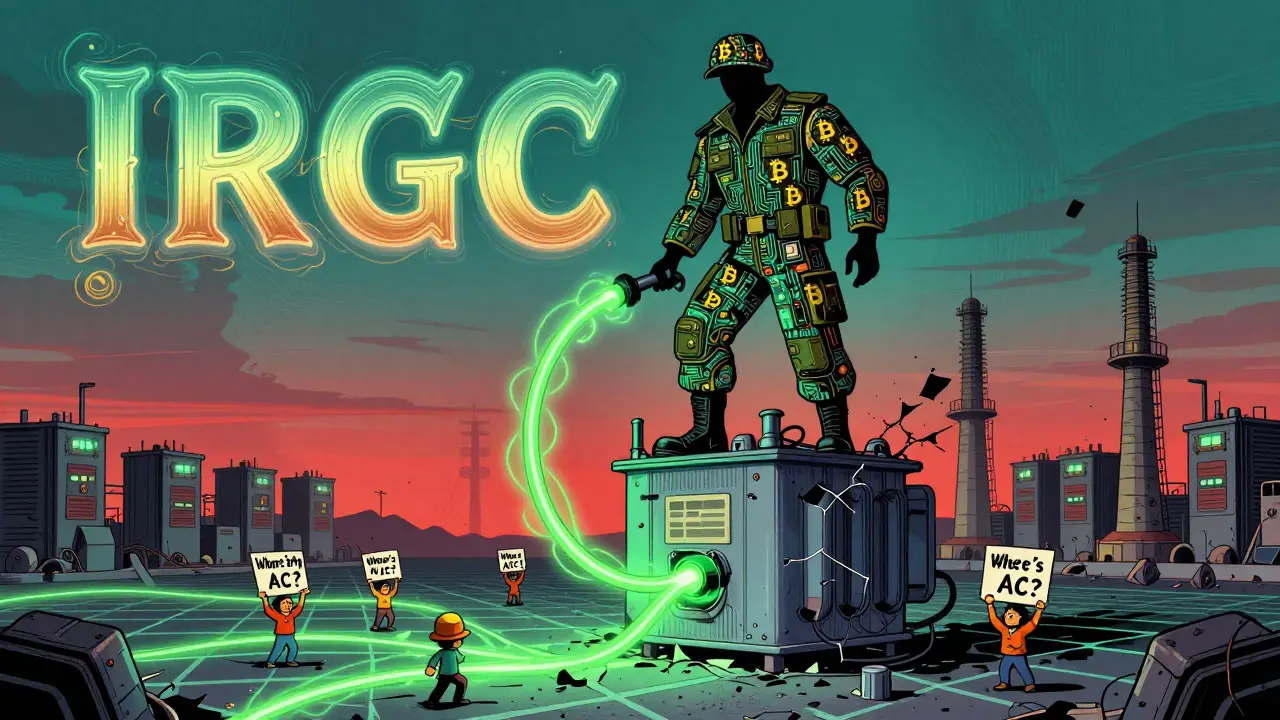
The Government’s Dilemma
Iran’s energy minister, Ali Akbar Mehrabian, defends the policy: “Regulated mining brings in $800 million in foreign exchange. It offsets the energy cost.” But former energy minister Reza Ardakanian warned in 2024 that crypto mining was using up to 10% of Iran’s total electricity generation. Dr. Saeed Laylaz, economic advisor to former President Khatami, put it bluntly: “The government has created a parallel economy where the IRGC controls both the energy supply and the cryptocurrency output.” The truth? Iran can’t afford to shut it down. The country is under crippling sanctions. Bitcoin mining is one of the few ways to earn hard currency without selling oil. But it’s also burning through the country’s last remaining energy reserves.How the System Works-And Why It’s Broken
To legally mine in Iran, you need:- Approval from the Ministry of Industry to import mining hardware (lead time: 4-6 months)
- A license from Tavanir for industrial electricity (rates: $0.04-0.07/kWh)
- CBI authorization to export Bitcoin (only allowed for trade settlement, not domestic use)
- Use of state-approved mining pools (they take 15-20% of your profits)

Why This Isn’t Sustainable
Iran’s power grid was built in the 1970s. It hasn’t been meaningfully upgraded since. Transformers overheat. Lines sag. Voltage drops are common. During peak summer months, electricity demand spikes by 30-40% because of air conditioning. That’s when the government shuts down legal mining operations-for a few weeks at a time. It’s a band-aid. The problem doesn’t go away. It just gets worse. The International Energy Agency predicts that without major grid upgrades, power shortages in Iran will increase by 25-30% by 2027. And mining will keep growing. The sector is expanding at 23.7% per year. There are now an estimated 3.5 to 4.2 million ASIC mining devices operating across the country. The CBI bans domestic crypto payments. So people trade Bitcoin on the black market-where it sells for 25-35% more than the official rate. That’s how the underground economy thrives. That’s how the IRGC stays flush with cash. And that’s how ordinary Iranians keep losing power.What’s Next?
Iran isn’t going to stop crypto mining. It’s too profitable. Too useful for bypassing sanctions. But it can’t keep burning through its grid. The government’s next move? Smart meters. Real-time monitoring. Mandatory registration of all mining equipment. New tariffs for illegal users. But none of this fixes the root problem: the state is using public energy to fund private, unaccountable wealth. For now, the pattern is clear: when Bitcoin’s price rises, blackouts follow. When the weather gets hot, the lights go out. When the IRGC needs dollars, Iran’s families go without. This isn’t innovation. It’s exploitation. And it’s happening right now, in real time, under the eyes of the world.Why does Iran subsidize electricity for crypto mining?
Iran subsidizes electricity for crypto mining because it generates hard currency-mainly U.S. dollars-that the country needs to import goods under international sanctions. Licensed miners are allowed to sell Bitcoin abroad for trade purposes, bringing in $800 million annually. The government sees this as a way to bypass financial restrictions without selling oil.
How much electricity does crypto mining use in Iran?
Crypto mining consumes nearly 2,000 megawatts of electricity in Iran, which is about 5% of the country’s total power output. But because the grid is fragile and underinvested, mining causes 15-20% of the nation’s electricity imbalance. Illegal mining alone uses up to 2 gigawatts daily-equal to the entire power demand of Tehran.
Is crypto mining legal in Iran?
Yes, but only under strict conditions. Miners must get licenses from the Ministry of Industry, register with the power grid operator (Tavanir), and receive approval from the Central Bank of Iran to export mined coins. Domestic crypto payments are banned. Most mining, however, is illegal-done using household electricity or hidden in industrial spaces without permits.
Who controls most of Iran’s crypto mining operations?
The Islamic Revolutionary Guard Corps (IRGC) controls an estimated 55-65% of all mining operations in Iran, either directly or through front companies. These operations generate $400-500 million annually in unreported revenue and bypass central bank oversight. Independent analysts and former officials have called this state-sanctioned theft of public energy resources.
Why do Iranians blame crypto mining for blackouts?
Iranians blame crypto mining because blackouts spike during summer months and Bitcoin price surges. During the 2025 heatwave, residents experienced 8-12 hours of daily outages while mining farms ran 24/7. A nationwide internet outage in mid-2025 caused power demand to drop by 2,400 MW-exactly the amount used by illegal mining rigs. Social media and citizen reports consistently link outage patterns to known mining locations.
Can Iran shut down crypto mining completely?
No-not without severe economic consequences. Crypto mining is one of the few ways Iran earns foreign currency under sanctions. Shutting it down would cut off $1.5 billion in annual revenue and cripple imports of medicine, food, and industrial equipment. Instead, the government uses temporary bans during peak demand, cracks down on illegal operations, and tries to regulate the legal sector-while letting the IRGC keep its share.
Doreen Ochodo
December 8, 2025 AT 19:41Yzak victor
December 9, 2025 AT 03:18Holly Cute
December 10, 2025 AT 03:40Tisha Berg
December 11, 2025 AT 11:10Billye Nipper
December 11, 2025 AT 15:50Roseline Stephen
December 13, 2025 AT 03:53Jon Visotzky
December 13, 2025 AT 04:32Isha Kaur
December 14, 2025 AT 12:39Glenn Jones
December 14, 2025 AT 12:51Tara Marshall
December 15, 2025 AT 00:59Joe West
December 16, 2025 AT 19:05