How Long Do Crypto Bear Markets Last? Historical Data and What’s Changing in 2026
When Bitcoin crashed from $69,000 to under $17,000 in late 2022, thousands of investors panicked. They watched their portfolios shrink by half, or even two-thirds. Many sold. Others held on, hoping the pain would end. But how long does this kind of pain actually last? If you're asking how long do crypto bear markets last, the answer isn't simple - but history gives us a clear pattern.
Most crypto bear markets last between 9 and 14 months. The 2021-2023 bear market, which followed Bitcoin's all-time high, lasted exactly 14 months. That’s not unusual. The previous one, after the 2017 bull run, lasted about 13 months. Even the shorter ones - like the 2018-2019 dip - still dragged on for 8 months. This isn’t a random fluctuation. It’s a rhythm.
Why Bear Markets Happen in the First Place
A crypto bear market isn’t just about prices dropping. It’s when sentiment turns sour, trading volume fades, and fear takes over. The technical definition is simple: if an asset falls 20% or more from its recent peak and stays there for a while, you’re in a bear market. But in crypto, it’s usually worse. Bitcoin doesn’t just drop 20% - it often drops 60%, 70%, even 80%.
Why? Because crypto is still young, and most buyers are speculators, not long-term holders. When prices rise fast, people jump in hoping to get rich quick. When they fall, those same people panic and sell. That creates a feedback loop: falling prices → more selling → deeper drop → more panic.
But there’s another force at work: Bitcoin’s halving. Every four years, the reward for mining Bitcoin is cut in half. That usually triggers a bull run 6-12 months later. Then, after 12-18 months of rising prices, the market overheats. That’s when the bear market starts. The pattern has held for three cycles now: 2013-2015, 2017-2019, and 2021-2023.
How Long Did Past Bear Markets Last?
Let’s look at real numbers, not guesses.
- 2017-2018 Bear Market: Bitcoin peaked at $19,800 in December 2017. It hit bottom at $3,100 in December 2018 - 13 months later, a 84% drop.
- 2021-2023 Bear Market: Bitcoin hit $69,000 in November 2021. It bottomed at $16,500 in January 2023 - 14 months later, a 76% drop.
- 2018-2019 Dip: After the 2017 crash, prices recovered slightly in early 2019, then dropped again. This mini-bear lasted about 8 months before a new rally began.
The average? Around 10 months. The shortest? About 4-5 months. The longest? One stretch hit 1 year and 8 months - the 2011-2012 bear market, when Bitcoin was still a niche experiment.
Compare that to the stock market. The S&P 500’s 2022 bear market lasted 9 months with a 25% drop. The 2008 crash? It took 17 months and a 57% plunge. Crypto bear markets are shorter but far more violent.
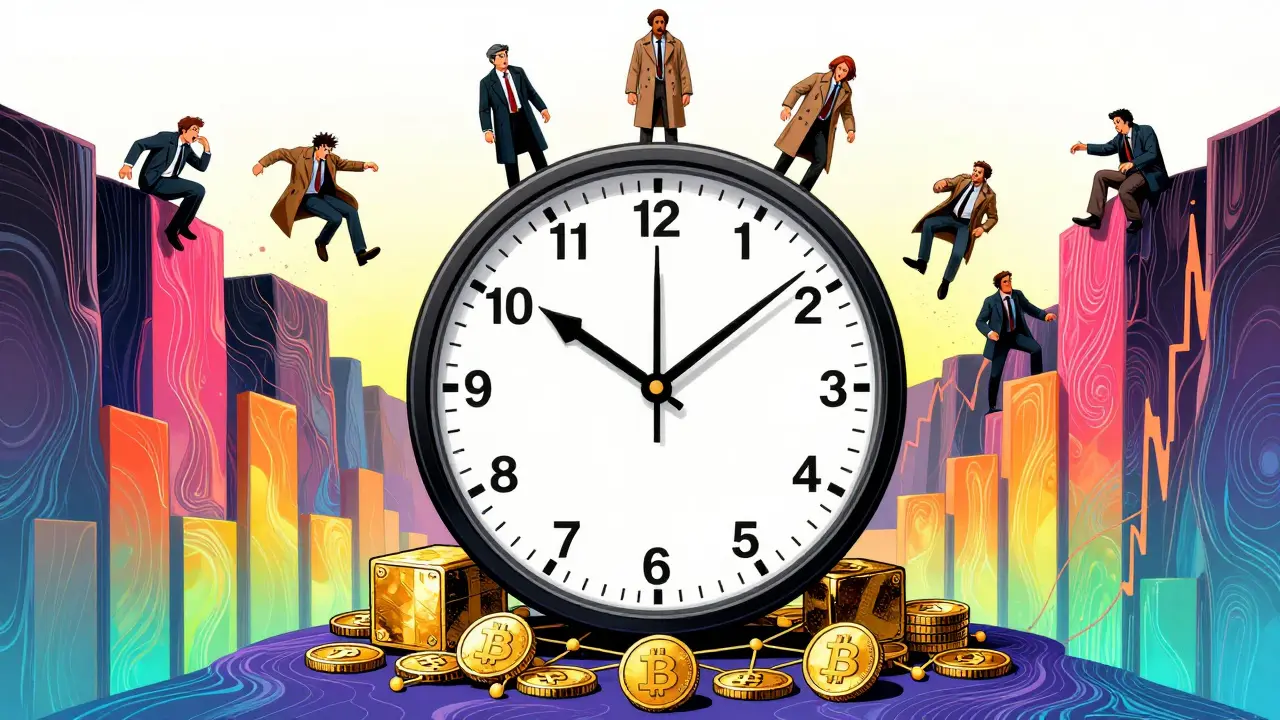
What’s Different Now? The Rise of Institutional Money
Here’s where things start to shift. Before 2020, crypto was mostly retail traders - people buying with their spare cash on Coinbase or Binance. Now, big players are in the game.
BlackRock, Fidelity, and Grayscale now hold over 27% of Bitcoin’s total supply. That’s up from just 8% in 2020. These institutions don’t panic-sell. They buy during dips. They hold for years. That’s changing the game.
In 2024, after Bitcoin’s halving, prices didn’t crash like before. Instead of a 75% drop, we saw a 35% correction - and prices held above $50,000. Why? Because institutional buyers stepped in and kept demand steady. That’s not something we saw in 2018 or 2022.
ETFs are another factor. The approval of spot Bitcoin ETFs in the U.S. in January 2024 created a new source of steady buying. Every day, millions flow into these funds. That’s like a safety net. Even when retail traders are scared, institutional money keeps the floor from collapsing.
How Long Will the Next Bear Market Last?
Some analysts say the next bear market could be shorter - maybe just 6 to 8 months. Why? Because:
- Institutional buyers are more stable than retail traders.
- Regulation is clearer now. The SEC’s framework and MiCA in Europe reduce uncertainty.
- Blockchain usage is growing. Ethereum processed 37% more transactions in 2023 than in 2021 - even during the bear market.
- Derivatives markets are more mature. Futures and options help absorb volatility.
But don’t get fooled. This doesn’t mean crypto is safe. The market still reacts hard to Fed rate hikes, inflation data, or regulatory crackdowns. If the SEC sues another major exchange and wins, we could see another 6-month drop. History shows crypto doesn’t grow up overnight.
Still, the trend is clear: bear markets are getting less brutal. The 2022 crash was brutal because nobody was prepared. Now, more people know what to expect. More tools exist to protect capital. More institutions are stepping in to stabilize prices.
What Should You Do During a Bear Market?
If you’re holding crypto right now and prices are low, here’s what actually works:
- Don’t sell out of fear. 68% of retail traders panic and sell too early, according to Kraken’s 2024 behavioral report. That’s the biggest mistake.
- Dollar-cost average. Buy a little every week, no matter the price. That’s what most successful long-term holders do. One Reddit user lost 60% in 2022, then recovered by buying $100 a week for 18 months.
- Keep stablecoins on hand. Hold 3-6 months of living expenses in USDT or USDC. That way, when prices hit bottom, you have cash to buy more.
- Avoid leverage. Over 87% of liquidations during the 2022 bear market happened to people using 10x or higher leverage. Don’t gamble with borrowed money.
- Learn. Use this time to study on-chain metrics like NUPL and MVRV. Follow what real investors are doing, not influencers.
The best time to buy crypto isn’t at the top. It’s when everyone else is scared. That’s when prices are lowest. And historically, that’s when the recovery starts.
Recovery Takes Longer Than the Drop
Here’s the twist: while bear markets last 9-14 months, recovery takes much longer. Bitcoin took 1,000 days - over two years - to climb back to its 2021 peak. That’s because bull markets are slow to build. It takes time for trust to return, for institutions to increase allocations, and for new users to join.
So if you’re waiting to get back to even, don’t expect it in 6 months. Plan for 18-24 months. That’s the real timeline.
But here’s the good news: if you bought during the 2022 bear market at $18,000, you’re now up over 260%. That’s the power of patience.
How long do crypto bear markets usually last?
Crypto bear markets typically last between 9 and 14 months. The average over the last three cycles is about 10 months. The shortest lasted 4-5 months, while the longest reached 1 year and 8 months. The most recent one, from November 2021 to January 2023, lasted 14 months.
Is the next crypto bear market going to be shorter?
Yes, experts expect the next bear market to be shorter - possibly 6 to 8 months. That’s because institutional investors now hold over 27% of Bitcoin’s supply, and they don’t panic-sell. ETFs, clearer regulations, and deeper liquidity are smoothing out price swings. The 2024 post-halving drop was only 35%, compared to 75%+ in previous cycles.
Can you make money during a crypto bear market?
Absolutely. Many successful investors buy during bear markets. The strategy is called "dollar-cost averaging" - buying small amounts regularly no matter the price. Others wait for fear & greed indices to drop below 20, then buy in bulk. One user accumulated 2.5 BTC during the 2022 bear market at an average price of $18,000 - today, that’s worth over $65,000.
What causes a crypto bear market to end?
Bear markets usually end when three things happen: (1) Bitcoin’s halving triggers new mining incentives, (2) institutional investors start accumulating again, and (3) retail sentiment turns from fear to cautious optimism. On-chain data like NUPL (Net Unrealized Profit/Loss) and MVRV (Market Value to Realized Value) often signal a bottom before prices rise.
Should I sell my crypto if the market keeps falling?
No - unless you need the cash. Selling during a bear market locks in your losses. History shows that crypto recovers, but only if you hold. The average investor who sold in 2022 missed the 2023-2024 rally. The key is to stay calm, avoid leverage, and keep buying small amounts over time.
Bitcoin’s journey has always been about cycles. Bear markets are painful, but they’re also necessary. They weed out speculation and build the foundation for the next boom. If you’re in it for the long term, don’t fear the winter - prepare for it.
Aileen Rothstein
February 18, 2026 AT 22:12Been holding since 2021 and honestly? This bear market felt different. Not because prices didn’t drop hard, but because I didn’t panic. I kept buying $50 a week like clockwork. Now I’m up over 200% from my average cost. Patience isn’t sexy, but it’s the only thing that works.
Stop chasing pumps. Start building stacks.
JJ White
February 19, 2026 AT 13:11Oh please. "Institutional money stabilizes the market"? That’s the fairy tale they feed retail to keep you buying at $60K. BlackRock doesn’t care about you. They’re front-running your ETF buys, manipulating the order book, and cashing out when you’re too scared to sell. The halving? A distraction. The real cycle is controlled by hedge funds and algo traders who own 80% of the liquidity. You think you’re playing chess? You’re the pawn.
Nicole Stewart
February 20, 2026 AT 23:2014 months average? Source? Data? Link? This reads like a Medium post written by someone who Googled "crypto bear market duration" and called it a day. Also "87% of liquidations"? Where’s the Kraken report? I’m not buying this without citations.
Alan Enfield
February 21, 2026 AT 04:22Agree with the institutional angle. ETF inflows are the new floor. The 2022 crash had zero institutional support. This time? We had institutional buyers stepping in at $45K, $40K, even $38K. That’s structural now. It’s not just sentiment - it’s capital allocation. This isn’t 2018 anymore.
Also, on-chain metrics like NUPL are way more reliable than fear & greed now. We’ve got real data.
Jennifer Riddalls
February 22, 2026 AT 04:49Hey, just wanted to say thank you for this post. I’ve been scared since November and kept wondering if I should sell. Reading this helped me breathe. I started DCAing again last week - $25 every Monday. Doesn’t feel like much, but it’s something. I’m not rich, but I’m not giving up either.
You’re right - the winter is coming. But we can prepare.
Kyle Tully
February 23, 2026 AT 08:42Look, the whole "bear market lasts 9-14 months" thing is just a narrative. It’s not a law. It’s a story people tell to make themselves feel better. What if the next one lasts 2 years? What if BTC goes to $10K? You think institutions will save you? They’ll dump on you first. The only truth is: if you don’t control your emotions, you lose. Period.
Stop trusting patterns. Trust yourself.
kieron reid
February 24, 2026 AT 09:01Another feel-good crypto article. All stats are cherry-picked. The 2011-2012 bear market lasted 20 months, not 1 year 8 months. The 2018-2019 dip was a sideways range, not a bear market. And who says ETFs are stable? They’re just new vehicles for pump-and-dump. You’re ignoring the fact that 90% of crypto projects are dead. This isn’t a market - it’s a casino with better PR.
Avantika Mann
February 25, 2026 AT 05:14I’ve been teaching crypto basics to new learners in India, and this post is perfect for them. The part about dollar-cost averaging? That’s the golden rule. I showed my students how one person bought $20 a week during the 2022 crash and now owns over 0.8 BTC. They didn’t believe it until I showed them the wallet history.
You don’t need to be rich. You just need to be consistent.
yogesh negi
February 25, 2026 AT 13:15Bro, this is so true! I remember in 2022 I was crying every night looking at my portfolio, but I kept buying 0.001 BTC every Friday. Now I have 0.08 BTC at $68K. That’s like $5,400 profit. And I’m not even rich! Just someone who listened to the basics.
Also, stablecoins are your best friend. Keep 3 months’ rent in USDT. Then when everyone’s panicking, you’re the one with the gun. Not the one running.
Nikki Howard
February 25, 2026 AT 22:54The notion that institutional involvement reduces volatility is empirically unsound. Market depth does not equate to stability; it merely redistributes risk. Furthermore, ETFs are subject to redemption pressures and regulatory arbitrage. The 35% correction in 2024 was not a sign of resilience - it was a controlled de-leveraging event orchestrated by centralized exchanges and custodians.
Do not mistake liquidity for safety.
Tarun Krishnakumar
February 26, 2026 AT 20:09Everyone’s talking about halvings and institutions like they’re magic. But here’s the truth: the Fed printed $5 trillion after 2020. Crypto didn’t rise because of tech - it rose because cash had nowhere else to go. When interest rates go back up? All this "institutional stability" evaporates. The ETFs will be liquidated faster than meme coins. The halving? A distraction. The real trigger is the U.S. debt ceiling, the dollar’s collapse, or a BlackRock bankruptcy. We’re not in a new era - we’re in the calm before the storm. And they’re selling you a life jacket made of tissue paper.
Sasha Wynnters
February 27, 2026 AT 08:46The bear market isn’t a market - it’s a ritual. A blood sacrifice for the gods of speculation. Every cycle, the same faces scream, sell, cry, and vanish. Then the new ones arrive, wide-eyed, clutching their first Bitcoin like a newborn. They don’t know it yet, but they’re not buying crypto - they’re buying into a myth. The myth that this time is different. That the institutions are saviors. That the halving is a divine event.
It’s not. It’s repetition. A dance of fear and greed, written in blockchain, performed by ghosts.
And yet… we keep showing up.
Because even in the dark, the light feels real.
Charrie VanVleet
March 1, 2026 AT 06:13Just wanted to say - if you’re reading this and you’re scared, you’re not alone. I’ve been there. Lost 70% in 2022. Thought I was done. But I kept reading, kept learning, kept buying $10 a week. Now I’m up over 300%.
It’s not about timing the market. It’s about showing up. Every week. No matter what.
You got this. I believe in you. 🙌
Rajib Hossaim
March 2, 2026 AT 14:44The historical data presented is largely accurate. However, the assumption that future bear markets will be shorter due to institutional involvement overlooks systemic risks such as geopolitical instability, regulatory fragmentation, and the potential for algorithmic trading cascades. While liquidity has increased, so has leverage. The market’s resilience is conditional - not structural.
Caution remains prudent.