Is Crypto Regulated in India? Tax Rules, Legal Status, and What You Need to Know in 2026
Is crypto regulated in India? The short answer: yes, but not how you might expect. You can buy, sell, and hold Bitcoin, Ethereum, and other digital assets legally. But the government isn’t cheering you on-it’s watching closely, taxing heavily, and keeping strict control. There’s no outright ban, but there’s also no official approval. It’s a middle ground built on rules that make crypto feel more like a taxable commodity than an investment.
What’s Legal and What’s Not
As of 2026, you won’t go to jail for owning crypto in India. The government doesn’t ban private cryptocurrencies anymore. But here’s the catch: cryptocurrency is not legal tender. You can’t use Bitcoin to pay for groceries, rent, or your phone bill. The Indian rupee is the only official money. That’s a key distinction. The law treats crypto as a Virtual Digital Asset (VDA), not currency. This definition, written into the Income Tax (No. 2) Bill, 2025, covers everything from Bitcoin and Ethereum to NFTs and tokens built on blockchain networks. It doesn’t include rupees, dollars, or other government-backed money. So if you’re trading crypto, you’re not breaking the law-but you’re also not getting any legal protection if things go wrong. No consumer rights. No dispute resolution. Just taxes and reporting.The 30% Tax That Changes Everything
India’s crypto rules are defined by one thing: taxes. The government doesn’t care if you’re mining, trading, or holding. If you make money, they take 30% of your profit. No deductions. No offsetting losses. Even if you lost money on 10 trades but made a profit on one, you still pay 30% on that single win. This is one of the highest crypto tax rates in the world. Compare it to the U.S., where long-term capital gains can be as low as 0% or 15%, depending on income. In India, it’s flat 30%, no matter how long you held your crypto. And there’s no exemption for small gains. Even a ₹500 profit gets taxed ₹150. On top of that, there’s a 1% Tax Deducted at Source (TDS). Every time you buy or sell crypto on an exchange, 1% of the transaction value is automatically taken out and sent to the government. So if you sell ₹100,000 worth of Bitcoin, ₹1,000 disappears before you even see the cash. This applies to every single trade, even if you’re breaking even or losing money. The system doesn’t care about your intent. You’re not a trader or an investor-you’re a taxpayer with a digital asset. The rules treat crypto like gambling winnings: pure profit, no costs allowed.Who’s Watching You?
It’s not just the Income Tax Department. Multiple agencies are tracking your crypto activity:- Income Tax Department and CBDT: Enforce the 30% tax and TDS rules. They get transaction data from exchanges and can match your wallet addresses to your PAN card.
- FIU-IND: The Financial Intelligence Unit monitors for money laundering. If you’re moving large sums between wallets or using privacy coins, they’ll flag it.
- RBI: Still doesn’t like crypto. They’ve never endorsed it and are focused on launching their own digital rupee (e-Rupee). They’ve told banks not to promote crypto services.
- SEBI: Has suggested crypto trading should be under securities regulation. They’re pushing for licensing and oversight, but no rules are in place yet.
The History: From Ban to Tax
India’s crypto journey has been chaotic. In 2018, the RBI banned banks from serving crypto businesses. That killed most exchanges overnight. People couldn’t deposit rupees. Withdrawals froze. The market collapsed. Then came the Supreme Court in 2020. In a landmark ruling, the court struck down the RBI’s ban, calling it disproportionate. Crypto companies bounced back. Trading volume surged. New platforms popped up. For a while, it felt like the door was wide open. But the government didn’t change its mind. It just changed its tactic. Instead of banning crypto, they started taxing it. In 2022, the Union Budget introduced the 30% tax and 1% TDS. That was the real turning point. The message was clear: we won’t stop you, but we’ll make sure you pay for every move. The proposed Banning of Cryptocurrency & Regulation of Official Digital Currency Bill, 2019 still hasn’t been passed. That means there’s no comprehensive law. Just tax rules. That’s why lawyers call it a legal grey area. You’re not illegal-but you’re not protected either.What Happens If You Don’t Report?
The tax department already has your data. Exchanges are legally required to share transaction histories. If you didn’t report your crypto gains in 2023 or 2024, they know. You’ll get a notice. Not a warning. A notice. In 2019, before the formal tax law, the IT department sent out hundreds of notices to crypto traders asking for proof of income. Today, it’s automated. Algorithms scan exchange data, match it to PAN numbers, and flag mismatches. If your bank account suddenly has ₹5 lakhs from an unknown source and you didn’t declare it as crypto profit? You’re on their radar. Penalties can include:- 100% to 300% of unpaid tax
- Interest at 1% per month
- Prosecution for tax evasion (if income exceeds ₹10 lakhs)
What About NFTs and Other Tokens?
Yes, NFTs are included. If you sell an NFT for ₹2 lakh and make a ₹1.5 lakh profit, you pay ₹45,000 in tax. Same rules as Bitcoin. Same TDS. Same reporting. Even tokenized real estate or DeFi rewards are treated as VDAs. Staking rewards? Taxable. Airdrops? Taxable. Mining income? Taxable. The definition is broad. If it’s digital, cryptographic, and not rupees-it’s taxed.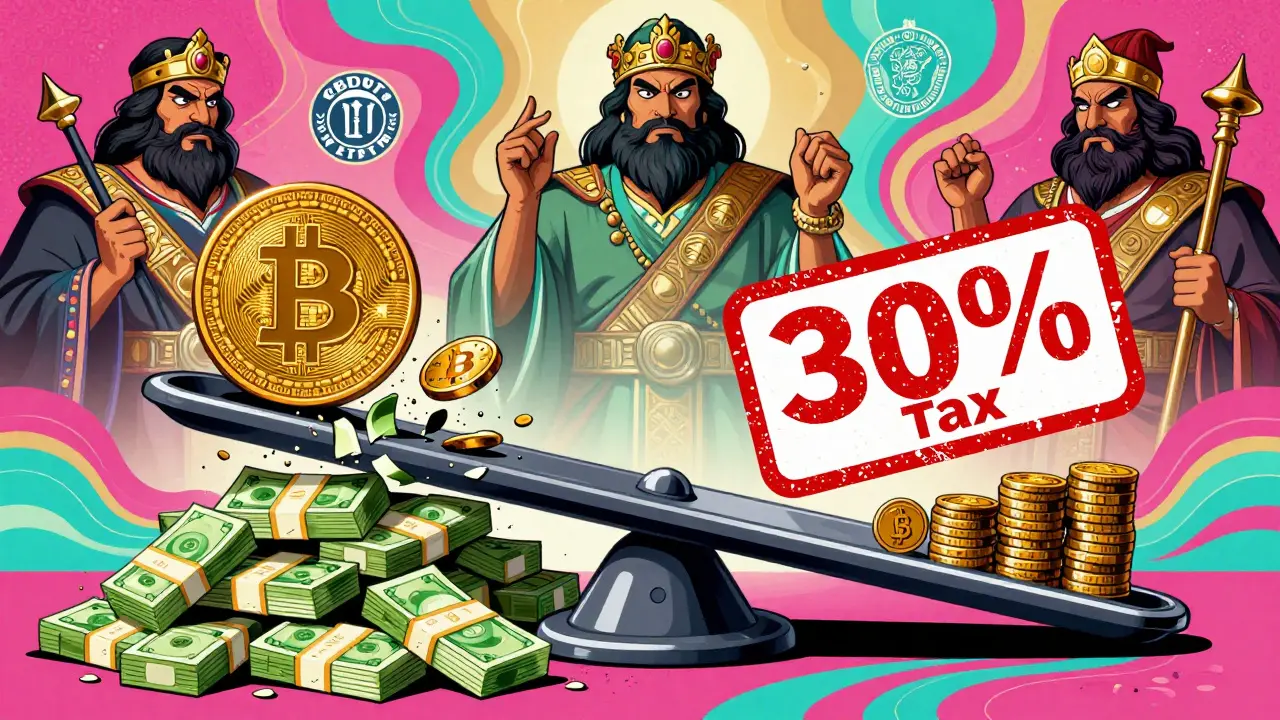
How Is This Different From Other Countries?
The U.S. taxes crypto like property. You can offset losses. You get lower rates if you hold for over a year. The EU has a patchwork of rules, but many countries cap rates below 30%. Singapore doesn’t tax capital gains at all. India is an outlier. It’s not trying to be crypto-friendly. It’s not trying to ban it. It’s trying to capture revenue. The 30% tax and 1% TDS are designed to make crypto unattractive as a speculative asset-and to ensure the government gets its cut no matter what.What Should You Do Now?
If you own crypto in India:- Keep detailed records of every transaction: buy price, sell price, date, platform, and fees.
- Use a crypto tax calculator that supports Indian rules. Many global tools don’t handle 30% flat tax or TDS correctly.
- Report all gains-even small ones. Don’t wait for a notice.
- Don’t assume privacy coins or peer-to-peer trades are hidden. FIU-IND tracks those too.
- Consider holding long-term. Even with 30% tax, holding longer reduces trading frequency and TDS impact.
What’s Next?
The government is watching global trends. The G20’s Crypto-Asset Reporting Framework (CARF) will force India to share crypto data with other countries starting in 2027. That means your transactions could soon be visible to tax authorities in the U.S., UK, or EU. SEBI might push for licensing exchanges. The RBI is testing its own digital rupee. And the Finance Ministry is still considering a new law. But for now, the tax rules are the law. And they’re here to stay. The bottom line: crypto isn’t banned in India. But it’s not free either. You’re allowed to trade-but only under strict, expensive rules. If you’re in, know the costs. If you’re out, understand why the government doesn’t want you in without paying up.Is it legal to buy Bitcoin in India in 2026?
Yes, it’s legal to buy, sell, and hold Bitcoin and other cryptocurrencies in India. However, they are not recognized as legal tender. You can’t use them to pay for goods or services officially. The government treats them as Virtual Digital Assets (VDAs) and taxes any gains at 30%.
Do I have to pay tax on crypto even if I didn’t sell it?
No, you only pay tax when you sell, trade, or convert crypto into rupees or another digital asset. Holding crypto without selling doesn’t trigger a tax event. But if you use Bitcoin to buy something, that counts as a sale and is taxable.
What happens if I don’t report my crypto gains?
The tax department already has your transaction data from exchanges. If you don’t report, you’ll likely receive a notice demanding payment of unpaid tax, plus interest and penalties. Penalties can be up to 300% of the tax owed. In serious cases, you could face prosecution for tax evasion.
Is staking crypto taxable in India?
Yes. Rewards from staking, lending, or earning interest on crypto are treated as income and taxed at 30%. Even if you don’t sell the reward, the moment you receive it, it’s taxable based on its fair market value in rupees at that time.
Can I offset crypto losses against other income?
No. India does not allow crypto losses to be offset against other income or even against future crypto gains. If you lose money on trades, you can’t use that loss to reduce your tax bill on other investments or salary. Each gain is taxed separately at 30%.
Are NFTs taxed the same as Bitcoin in India?
Yes. NFTs are classified as Virtual Digital Assets under Indian tax law. Any profit from selling an NFT is taxed at 30%, and a 1% TDS applies to every transaction. Whether it’s a digital artwork, game item, or tokenized real estate, if it’s on a blockchain, it’s taxed like crypto.
Will India ban crypto in the future?
It’s unlikely. The government has moved past banning crypto and now relies on taxation and monitoring to control it. While a formal law hasn’t been passed yet, the current tax framework shows they prefer regulation over prohibition. Future rules may add licensing or trading limits, but a full ban is not the direction they’re heading.
Do I need to report crypto if I only bought and didn’t sell?
No, you don’t need to report crypto if you only bought and held it without selling, trading, or converting it. Tax is only triggered on disposal. However, keep records of your purchase cost and date. You’ll need them when you eventually sell.
Is 1% TDS applied to peer-to-peer crypto trades?
Yes. If you trade via a registered exchange, TDS is automatically deducted. For peer-to-peer trades, the buyer is legally responsible to deduct 1% TDS and deposit it with the government. If you’re selling crypto P2P, you should ask the buyer for proof of TDS payment. Otherwise, you risk being held liable for unpaid tax.
Can I use foreign exchanges like Binance in India?
Yes, you can use foreign exchanges, but you’re still required to report all gains to Indian tax authorities. The government can track transactions linked to your PAN or bank account. Even if you use a foreign platform, Indian tax laws still apply to you as a resident. Not reporting is risky-your data may be shared under international agreements like CARF.
HARSHA NAVALKAR
January 23, 2026 AT 02:55They tax everything here, but at least you can still hold it. I’ve seen people lose their minds over this, but honestly? I just keep my receipts and move on.
Worst part? TDS on every tiny trade. Even if you’re just swapping one token for another, they take 1% before you even blink.
Ryan Depew
January 24, 2026 AT 12:11India’s crypto policy is basically ‘you can play, but we’re the house.’ 30% flat tax? That’s not regulation, that’s extortion. In the US, you get long-term rates, deductions, loss offsets. Here? You’re a cash cow.
And yet people still trade. Human nature, I guess.
Mathew Finch
January 25, 2026 AT 11:37Let’s be real - this isn’t regulation. It’s a revenue grab disguised as policy. Countries like Singapore and Portugal treat crypto like real assets. India? They treat it like a slot machine you’re forced to play.
And don’t even get me started on TDS. That’s not taxation, that’s theft with paperwork.
Shamari Harrison
January 27, 2026 AT 04:28If you're holding crypto in India, here’s what actually matters: document everything. Buy price, sell price, wallet addresses, exchange names - even if it’s just ₹500 profit.
Use a local tax tool like KoinX or CoinTracker with India mode enabled. Most global tools miss the 30% flat rule and TDS logic.
Also, don’t ignore staking rewards. Even if you don’t sell, the moment you get them, they’re taxable at FMV in INR. I’ve seen people get notices over ₹2000 in staking income.
Keep backups. Use Excel or Google Sheets. Don’t trust apps that auto-delete history. Tax season comes fast, and the IT dept doesn’t care if you ‘forgot.’
And yes - P2P trades still need TDS. The buyer’s legally responsible. Ask for proof. If they say ‘it’s just a friend,’ that’s not a defense. The law doesn’t care about relationships.
Foreign exchanges? Still report. CARF is coming. Your Binance history will show up in your PAN-linked file in 2027. Better to file early than get a 300% penalty notice.
It’s not freedom. But it’s not a ban either. It’s a cage with a tax collector at the gate. Learn the rules. Play smart.
Nadia Silva
January 27, 2026 AT 13:31It’s funny how people call this a ‘grey area.’ It’s not grey. It’s black ink on white paper: 30% tax, 1% TDS, no deductions. The government didn’t leave a loophole - they built a wall with a cash register in the middle.
And if you think privacy coins will save you, you’re delusional. FIU-IND tracks on-chain patterns. They don’t need your private key. They just need your PAN linked to an exchange you used three years ago.
Roshmi Chatterjee
January 28, 2026 AT 22:06Just started trading last year and I was terrified of taxes. But once I got my records straight, it wasn’t that bad. I use a simple Google Sheet - date, platform, buy price, sell price, profit.
Even if I lost money on 5 trades, I just report the one win. No point stressing over losses - they don’t matter here.
And yeah, TDS hurts. But I just factor it in. If I’m selling ₹50k, I know ₹500 is gone before I touch it. So I plan accordingly.
It’s not ideal. But it’s liveable. And at least we’re not banned.
Deepu Verma
January 30, 2026 AT 04:04Look, I know it feels unfair. But think of it this way - if India banned crypto, you’d have zero chance. Now you’ve got a path. It’s expensive, yeah. But you can still build.
Keep your records. Don’t gamble with unreported gains. The system’s watching, but it’s not out to ruin you - it just wants its cut.
And hey - if you’re holding long-term, you’re already winning. Less trades = less TDS. Less stress. Less paperwork.
You got this. Just stay smart.
MICHELLE REICHARD
February 1, 2026 AT 02:41People act like this is some oppressive regime. It’s not. It’s common sense. You can’t have a currency that’s untraceable, untaxable, and unregulated and expect to be taken seriously.
India isn’t the outlier. The U.S. and EU are the outliers - letting people dodge taxes on digital assets while collecting GST on bread.
And don’t tell me about ‘financial freedom.’ If you’re using crypto to avoid taxes, you’re not a pioneer. You’re a tax cheat.
Julene Soria Marqués
February 1, 2026 AT 08:20Wait, so if I buy crypto on Binance and never touch it, I’m fine? But if I swap BTC for ETH on CoinDCX, I get taxed even if I break even? That’s insane.
Why not just ban it and be done? This system feels like a trap designed to catch people who don’t read the fine print.
Abdulahi Oluwasegun Fagbayi
February 1, 2026 AT 13:57India’s approach is cold but clear. No emotion. No ideology. Just math.
They don’t care if you believe in decentralization. They care if you made rupees.
It’s not freedom. It’s fiscal realism.
And honestly? For a country with so many informal economies, this might be the only way to bring crypto into the light without chaos.
Andy Marsland
February 2, 2026 AT 00:37Let me break this down for the people who still think this is some kind of crypto revolution - because it’s not. This isn’t a free market. It’s a state-controlled revenue stream with a side of surveillance. The 30% tax isn’t a policy, it’s a weapon. And the 1% TDS? That’s not a fee, that’s a chokehold on liquidity. Every single trade, no matter how small, gets siphoned. Even if you’re just moving from BTC to ETH to avoid a paper loss, they take 1% of the entire transaction value. That’s not taxation, that’s transactional terrorism. And the fact that you can’t offset losses means your entire portfolio could be underwater and you still owe money on one lucky trade. That’s not economic policy - that’s psychological warfare disguised as fiscal responsibility. Meanwhile, the RBI pushes its own digital rupee while pretending crypto is a threat, and SEBI sits on its hands waiting for the perfect moment to jump in and regulate the whole thing into oblivion. And yet, people still trade. Why? Because they’re addicted to the gamble. But let’s be honest - this isn’t investing. It’s paying for the privilege of gambling under the watchful eye of a government that wants your money but doesn’t want your freedom. And if you think foreign exchanges like Binance are safe? Wake up. Your PAN is linked to your bank. Your email is tied to your wallet. Your IP address was logged the moment you signed up. The G20’s CARF is coming in 2027 and your entire trading history will be shared with the IRS, HMRC, and every other tax agency on Earth. You think you’re anonymous? You’re not. You’re just a data point in a spreadsheet that’s already been flagged. So stop pretending this is about freedom. It’s about control. And the government has already won.