KYC Requirements on Crypto Exchanges: What You Need to Know in 2025
When you sign up for a crypto exchange today, you’re not just creating an account-you’re going through a digital identity check that’s as strict as opening a bank account. That’s because KYC (Know Your Customer) requirements on crypto exchanges are no longer optional. As of 2025, they’re the law in most major economies and the baseline expectation for anyone serious about using crypto safely.
Why KYC Is Mandatory Now
The crypto world started with a promise: fast, anonymous, borderless transactions. But that same freedom made it a target for fraud, money laundering, and terrorist financing. In 2019, the Financial Action Task Force (FATF) changed everything by requiring all virtual asset service providers-like crypto exchanges-to follow the same AML/CFT rules as banks. That meant KYC wasn’t just a good idea anymore; it was legally required. Today, 92% of centralized crypto exchanges globally are fully compliant. In the U.S., the Bank Secrecy Act forces exchanges to verify your identity before you can trade or withdraw. The EU’s AMLD6 does the same. If you try to deposit $500 into Binance, Coinbase, or Kraken without ID, you’ll hit a wall. No ID, no access. Simple as that. Even decentralized platforms are feeling the pressure. In 2024, only 25% of DeFi protocols offered KYC. By 2025, that number jumped to 41%. Regulators aren’t targeting just exchanges-they’re closing every loophole.What KYC Actually Requires
It’s not just asking for your name and email. Modern KYC on crypto exchanges has three core parts:- Identity verification: You’ll need to upload a government-issued ID-passport, driver’s license, or national ID card. The system uses AI to check if it’s real, not photoshopped, and matches your face via a live selfie. No blurry screenshots. No expired documents.
- Address confirmation: You’ll need to prove where you live. A recent utility bill, bank statement, or tax document with your name and full address. Some exchanges accept digital versions; others still require PDFs.
- Screening: Your name and address get checked against global sanctions lists, Politically Exposed Persons (PEP) databases, and adverse media sources. If you’re flagged-even by accident-you might get a manual review. That can add hours or days.
It sounds intense, but it works. According to a 2025 CipherTrace report, exchanges with strong KYC see 38% less fraud. That’s not just about stopping criminals-it’s about protecting your funds.
How Fast Is KYC Now?
In 2023, getting verified on a crypto exchange could take up to 7 minutes. Today? The average is 3.5 minutes. Some platforms, like Kraken and Gemini, get you through in under 90 seconds if your documents are clear and you’re in a supported country. That speed comes from AI. Machine learning algorithms now handle 90% of verifications automatically. They detect fake IDs, spot mismatched faces, and flag suspicious patterns faster than any human. Fuzzy matching helps too-it catches typos like “Jon Smith” instead of “John Smith” without rejecting you outright. Biometrics are making it even smoother. Some exchanges now use facial recognition that works even in low light. Others ask you to blink or turn your head during the selfie check. It’s not invasive-it’s just designed to make spoofing impossible.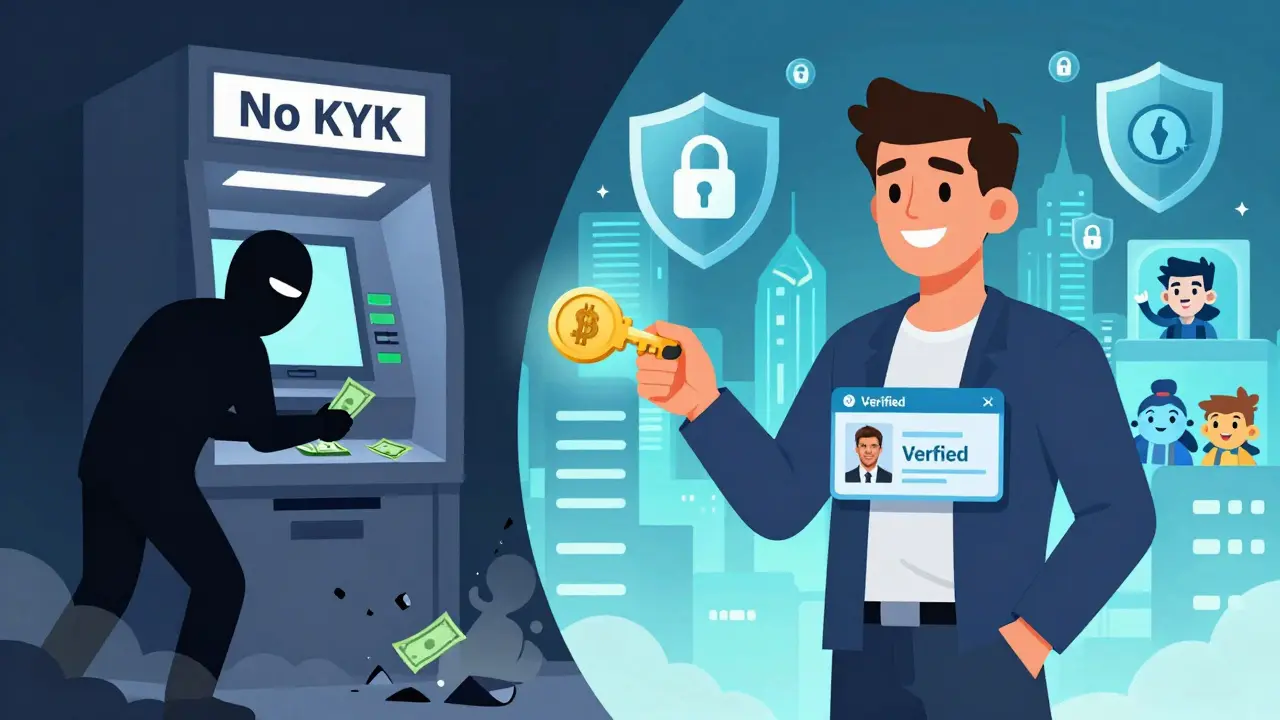
Why Users Are Choosing KYC Exchanges
You might think crypto users hate KYC. But the data says otherwise. In the U.S., 58% of crypto users prefer platforms that require identity verification. Why? Because they feel safer. They know their funds aren’t sitting on a shady exchange that could vanish overnight. Institutional investors are even more clear-cut: 67% say strong KYC is a dealbreaker when picking a platform. KYC isn’t just about rules anymore-it’s a trust signal. Exchanges that skip it are seen as risky. Those that do it well get labeled as professional, reliable, and serious. That’s why even big names like Coinbase and Binance invest millions in their verification systems. It’s not compliance-it’s marketing.The Dark Side of KYC: Privacy and Friction
It’s not all smooth sailing. Many users still complain about KYC. Privacy concerns are real. You’re handing over sensitive documents to a private company. What if they get hacked? What if they sell your data? While most reputable exchanges encrypt and store this info securely, the fear lingers. International users often get stuck. If your ID isn’t from the U.S., EU, Canada, UK, Australia, or Japan, the system might not recognize it. You could be stuck waiting for manual review for days. People in Latin America, Africa, or Southeast Asia often report longer delays. And then there’s the friction. If your photo is too dark, your address doesn’t match your ID, or your name is spelled differently on your bank statement, you get rejected. No explanation. Just “verification failed.” That’s frustrating when you’re trying to buy Bitcoin in a hurry.
Who Provides KYC Tech for Exchanges?
Most exchanges don’t build KYC from scratch. They buy it from specialists. The big names in this space are:- Sumsub: Offers global document support, AI verification, and real-time fraud detection. Used by Binance and Kraken.
- KYC-Chain: Focuses on blockchain-integrated compliance, linking on-chain behavior to verified identities.
- iProov: Specializes in biometric liveness detection-making sure it’s really you, not a photo or video.
These companies don’t just verify IDs-they connect your identity to your wallet activity. That’s the next level: knowing not just who you are, but what you’re doing on-chain. Tools like Chainalysis help exchanges monitor for suspicious transfers, like sending crypto to a known darknet market.
What’s Coming Next
Regulators aren’t slowing down. Here’s what’s on the horizon:- Standardized KYC data sharing: Imagine one verified identity you can use across multiple exchanges-no re-uploading documents every time.
- Privacy-preserving KYC: New tech like zero-knowledge proofs lets you prove you’re over 18 or not on a sanctions list without revealing your name or ID.
- DeFi KYC mandates: Regulators are already testing rules that would require KYC on decentralized protocols. If you’re using a DEX with more than $100k in volume, you might soon need to verify your identity.
- AI risk scoring: Instead of just saying “approved” or “rejected,” systems will give you a risk score. Low risk? Fast access. High risk? Extra checks.
One thing’s clear: anonymous crypto is fading. The future belongs to platforms that balance security, speed, and user experience.
What You Should Do
If you’re new to crypto:- Choose an exchange that requires KYC. It’s not a bug-it’s a feature.
- Have your ID and a recent utility bill ready before signing up.
- Use good lighting for your selfie. No hats, sunglasses, or shadows.
- Don’t use a nickname or alias. Your name must match your government ID exactly.
If you’ve been rejected:
- Check if your document is expired or damaged.
- Make sure your address matches what’s on your bank statement.
- Try a different browser or device-sometimes the app glitches.
- Contact support. Don’t just resubmit. Ask what specifically failed.
And if you’re still worried about privacy? Use a burner email and a separate phone number. Your identity is still protected-you’re just proving you’re not a criminal.
Do all crypto exchanges require KYC?
Most centralized exchanges require KYC, especially those operating in the U.S., EU, UK, Canada, and Australia. As of 2025, 92% of major exchanges are fully compliant. However, some unregulated or offshore platforms still allow anonymous trading-but these carry high risks, including scams, frozen funds, and no legal recourse. Even some DeFi platforms now require KYC for higher transaction limits.
Can I trade crypto without KYC?
Technically, yes-but with major limits. Peer-to-peer (P2P) platforms like LocalBitcoins or Bisq let you trade without KYC, but you’re dealing directly with other users, which increases fraud risk. Some crypto ATMs allow small purchases under $3,000 without ID. However, if you want to deposit more than $1,000, withdraw funds, or trade on any major exchange, KYC is mandatory. Avoiding KYC means avoiding most of the crypto market.
How long does KYC verification take?
On most top exchanges, it takes under 5 minutes if your documents are clear and you’re in a supported country. In 2025, the average verification time is 3.5 minutes thanks to AI automation. But if you’re using a non-standard ID (e.g., from a country with limited digital records), or if there’s a mismatch in your address, it can take 1-5 business days for manual review. Always submit high-quality, unedited documents to avoid delays.
Is KYC safe? Can exchanges steal my identity?
Reputable exchanges use enterprise-grade encryption, store your data separately from trading accounts, and comply with global data protection standards like GDPR. They’re legally required to protect your information. That said, no system is 100% hack-proof. To reduce risk, use strong passwords, enable two-factor authentication, and avoid using your primary email or phone number for crypto accounts. Never upload sensitive documents to unverified third-party sites.
Why do I need to prove my address?
Proving your address helps exchanges confirm you’re not using fake or stolen identities. It also helps them comply with geographic restrictions-some countries ban crypto trading, and exchanges must block users from those regions. A utility bill or bank statement with your full name and current address is the standard proof. Digital statements from your bank or government portal are usually accepted.
What happens if my KYC gets rejected?
If your KYC is rejected, you’ll usually get a generic message like “verification failed.” Common reasons include expired documents, blurry photos, mismatched names, or address inconsistencies. Don’t just resubmit the same file. Contact customer support, ask for the specific reason, and fix it. Some exchanges allow you to appeal or submit alternative documents. If you’re repeatedly rejected, try a different exchange-some are more forgiving with international IDs.
Will KYC ever go away in crypto?
No. KYC is here to stay. Regulators worldwide are tightening rules, not loosening them. Even decentralized platforms are being forced to adopt KYC for higher-volume users. The future isn’t anonymous crypto-it’s verified, transparent, and secure crypto. The industry is moving toward privacy-preserving tech like zero-knowledge proofs, which let you prove you’re compliant without revealing your personal data. That’s the real goal: compliance without compromise.
Amit Kumar
December 25, 2025 AT 06:50Yo, if you're in India and trying to verify on Binance, good luck. My passport got rejected three times because they said my address 'didn't match the system' - but my bill was from the same damn house for 5 years! They don't even recognize Indian documents properly. Meanwhile, my cousin in Germany got verified in 40 seconds. This isn't compliance - it's digital colonialism.
Helen Pieracacos
December 25, 2025 AT 12:28Oh wow, so now I have to send my driver’s license to a tech company so I can buy Dogecoin? Next they’ll ask for my birth certificate and my zodiac sign. I’m just here to flip memes, not become a government dossier.
Dustin Bright
December 26, 2025 AT 08:50fr fr i get why people hate kyc but like… imagine if your crypto got stolen and you had zero proof it was even yours 😭 no id = no recourse. i lost $2k on a sketchy exchange last year bc they didn’t verify me. now i only use coinbase. yeah it’s annoying to take a selfie but at least my coins are safe 🙏
chris yusunas
December 27, 2025 AT 12:03They say KYC is the future but in Nigeria we call it ‘digital handcuffs’. You work hard for your naira, convert to crypto to escape inflation, then some Silicon Valley AI says your ID is ‘unverifiable’? Bro, my national ID card is handwritten in places. You want me to bring my village chief to Zoom to vouch for me? 😅
Sophia Wade
December 28, 2025 AT 07:54The philosophical underpinning of KYC is not regulatory compliance - it is the surrender of anonymity as a precondition for participation in a monetized digital society. The crypto ethos was rooted in libertarian ideals of financial sovereignty, yet here we are, trading privacy for perceived security, unwittingly replicating the very institutions we sought to dismantle. Is this evolution… or capitulation?
Brian Martitsch
December 29, 2025 AT 23:49If you can't handle KYC, you shouldn't be in crypto. Period. You're not a rebel - you're a liability. Real investors don't whine about selfies. They verify, move on, and focus on alpha. 🤷♂️
Rebecca F
December 30, 2025 AT 18:39They say KYC protects you but really it just makes you a data point in a corporate surveillance matrix. Your face, your address, your bank statement - all bundled and sold to the highest bidder. You think you’re safe? You’re just the product
vaibhav pushilkar
December 31, 2025 AT 09:51Pro tip: Use your bank statement as address proof - it’s accepted everywhere. And make sure your name is spelled EXACTLY like your ID. No nicknames. No middle initials unless they’re on the ID. I helped 12 people in my Discord group fix their KYC with this.
SHEFFIN ANTONY
December 31, 2025 AT 18:3692% compliant? LOL. That’s just the ones that didn’t get shut down yet. Half the ‘compliant’ exchanges are just using Sumsub to tick a box while quietly letting wash traders in through the backdoor. KYC is theater. The real criminals? They’re the ones writing the rules.
Lloyd Yang
January 2, 2026 AT 05:24I used to hate KYC too - until I had a friend get scammed out of $80k on a no-KYC P2P platform. No trace, no recourse, no nothing. Now I treat KYC like a seatbelt. Annoying? Yeah. Worth it? Absolutely. The speed is insane now - I got verified on Kraken while waiting for my coffee. AI did it. No humans involved. That’s wild. And honestly? Kinda comforting. I’d rather a robot check my ID than some guy in a basement in Moldova.
Zavier McGuire
January 2, 2026 AT 20:00they say privacy is dead but they dont say who killed it. its not the criminals its us. we gave up our data for convenience and now we wonder why we cant trust anyone
Jordan Renaud
January 4, 2026 AT 17:23It’s not about giving up privacy - it’s about building trust. The fact that you can now withdraw from Binance in 3 minutes because the system knows you’re not a bot? That’s progress. We don’t have to choose between freedom and safety. We can have both - if we design it right.
Luke Steven
January 6, 2026 AT 03:20Zero-knowledge proofs are the real win here. Imagine proving you’re over 18 without showing your ID. Proving you’re not on a sanctions list without revealing your name. That’s the future. KYC doesn’t have to mean surveillance - it can mean empowerment. We just need to demand better tech, not just accept what’s handed to us.
Ellen Sales
January 6, 2026 AT 10:55so i tried to verify on coinbase and they said my address was ‘invalid’ but i live in the same house for 12 years?? my utility bill has my name and address but they said ‘not recognized’… i think their ai just hates my zip code 😂
Sarah Glaser
January 8, 2026 AT 03:14The normalization of identity verification in financial systems represents a profound cultural shift. We have moved from a paradigm of distrust - where anonymity was a virtue - to one of institutionalized accountability. Whether this is an advancement in financial integrity or an erosion of civil liberty depends entirely on who controls the infrastructure and how it is governed.
Steve B
January 9, 2026 AT 14:32Why are we even discussing this? The entire crypto experiment was a failure. KYC is just the final nail. If you need to prove who you are to use money, you’re already in the system. You lost.
Jacob Lawrenson
January 10, 2026 AT 13:01Just got verified on Kraken in 52 seconds. AI was so fast I thought it was a glitch. Then I got a text saying ‘Welcome to the future, Jacob’. I felt like Iron Man. 🤖💥
Sheila Ayu
January 12, 2026 AT 04:13Wait - so if I use a burner email and a fake name, I’m still ‘protected’? But they’re collecting my face, my address, my phone number, my device fingerprint, my IP, my browser type, my location, my transaction history, my social media, my biometrics, my bank account, my tax ID, my passport number, my mother’s maiden name, my pet’s name, my favorite color, my shoe size, and my zodiac sign? So… what exactly is ‘protected’ here?!
Janet Combs
January 13, 2026 AT 19:49my kyc got rejected bc my selfie had a shadow on my face… i retook it in the bathroom with the light on and it worked. just sayin - lighting matters. also dont wear a hat. i learned the hard way lol