Risk Management Through Diversification in Blockchain Investing
When you put all your money into one cryptocurrency, you're not being bold-you're being vulnerable. Bitcoin might surge, but what happens when Ethereum crashes? Or when a new regulation shuts down a whole class of tokens? That’s the trap most new investors fall into. The truth is, blockchain isn’t a single asset. It’s a whole ecosystem of networks, tokens, protocols, and use cases-and treating it like one thing is how people lose big. The answer isn’t to chase the next moonshot. It’s to spread your risk across different parts of the ecosystem. That’s diversification, and in crypto, it’s not optional-it’s survival.
Why Diversification Matters More in Crypto Than Traditional Markets
Stock markets have rules, regulators, and decades of data. Crypto? It’s wild. A single tweet from a CEO can wipe out $10 billion in market value. A smart contract bug can freeze funds for months. Regulatory crackdowns in one country can ripple across global exchanges. In this environment, holding just Bitcoin or even Bitcoin and Ethereum isn’t enough. You need to break your exposure into pieces.
Think of it like building a house. You wouldn’t use only one type of wood, one nail, and one foundation. You’d mix materials to handle weather, weight, and time. Crypto works the same way. Different assets react differently to the same event. When interest rates rise, Bitcoin might dip, but a stablecoin protocol that earns yield could thrive. When DeFi gets hacked, centralized exchanges might suffer, but a privacy-focused chain could see increased adoption. That’s the power of low correlation-and it’s what makes diversification work.
How to Diversify Your Blockchain Portfolio
You can’t just throw coins into a bag and call it diversified. Real diversification in blockchain means hitting five key areas:
- Asset types: Don’t just hold tokens. Mix Bitcoin (store of value), Ethereum (smart contract platform), stablecoins (cash alternative), and utility tokens (DeFi, gaming, AI). Each behaves differently under pressure.
- Chain ecosystems: Ethereum isn’t the only game. Solana, Polygon, Avalanche, and Cosmos each have unique strengths. If Ethereum goes through a 3-month upgrade slowdown, you don’t want all your gains tied to it.
- Use cases: DeFi, NFTs, Web3 infrastructure, tokenized real-world assets, and blockchain gaming aren’t the same. One can boom while another collapses. Spread across them.
- Market caps: Large-cap coins (BTC, ETH) are stable but slow. Mid-cap (ATOM, FIL) offer growth. Small-cap (emerging protocols) are risky but can 10x. Balance all three.
- Geographic exposure: Some chains are heavily used in Asia, others in the U.S. or Europe. Regulatory shifts hit regions differently. Holding assets with global user bases reduces single-country risk.
For example, a balanced portfolio might look like:
- 40% Bitcoin and Ethereum (core holdings)
- 20% Stablecoins (USDC, DAI) for liquidity and yield
- 15% Mid-cap chains (Solana, Polygon)
- 15% NFTs and gaming tokens (e.g., MANA, SAND)
- 10% Emerging protocols (AI blockchain, decentralized storage)
This isn’t about guessing winners. It’s about making sure if one part fails, the rest hold steady.
The Hidden Danger: Correlation in Crises
Here’s the ugly truth: during market crashes, everything drops-even the stuff you thought was uncorrelated. In 2022, Bitcoin, Ethereum, DeFi tokens, and even gold-backed tokens all fell together. Why? Because panic overrides logic. Investors flee risk, sell everything, and liquidity dries up. That’s when diversification looks like it failed.
But here’s the catch: it didn’t. It just got tested. The difference? Recovery speed. Bitcoin bounced back in 4 months. Some DeFi tokens took 18. Stablecoins? They barely budged. Your portfolio didn’t collapse-it just slowed down. That’s the win. You didn’t lose 80% of your money. You lost 40%. And you still had cash (stablecoins) to buy the dip.
True diversification isn’t about avoiding drops. It’s about avoiding total ruin. And that’s exactly what spreading across asset types, chains, and use cases gives you.
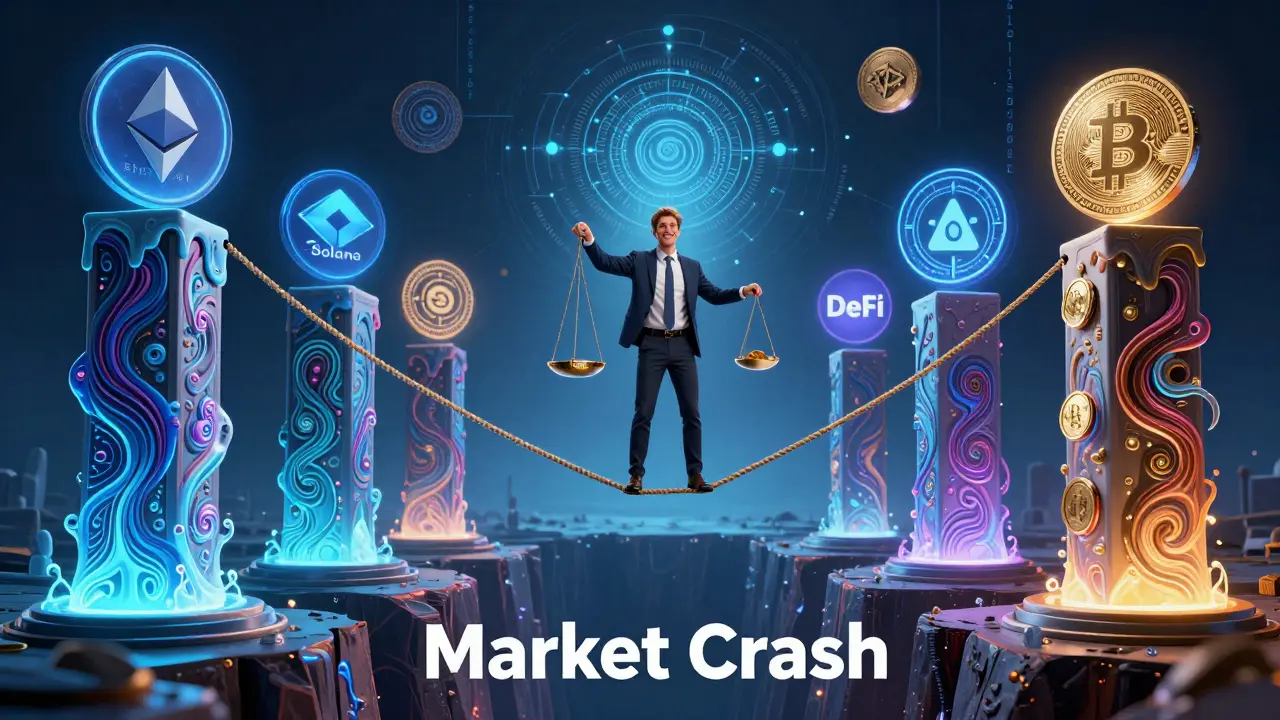
What Diversification Doesn’t Do
Let’s get real: diversification isn’t magic. It won’t stop you from losing money if the whole market tanks. It won’t protect you from scams. It won’t fix bad research. If you invest in a token with no team, no code, and no users-no amount of diversification will save you.
Diversification also doesn’t mean buying 50 different coins because “more is better.” That’s just gambling with labels. You need strategy. Focus on quality, not quantity. Pick 8-12 assets across the five categories above. Track them. Understand why you own each one. If you can’t explain the use case in 10 seconds, you shouldn’t hold it.
Tools and Tactics for Smart Diversification
You don’t need a hedge fund to do this right. Here’s what works today:
- Use portfolio trackers: Tools like Nansen, DeFiLlama, or CoinGecko show where your holdings are concentrated. If 70% of your portfolio is on Ethereum, you’re not diversified.
- Automate rebalancing: Platforms like Rebalance.io or TokenSets let you set rules. Example: “Sell 5% of BTC if it rises above 50% of portfolio, buy more stablecoins.”
- Allocate by risk tier: Put 60% in low-risk (BTC, ETH, stablecoins), 30% in medium (layer-2s, mid-cap chains), 10% in high-risk (new DeFi, meme coins). This keeps you disciplined.
- Monitor correlation: Use free tools like CryptoCorrelation.com. If two assets move in lockstep 90% of the time, they’re not diversifying-you’re just holding duplicates.

The Future of Diversification in Blockchain
AI is changing how we manage risk. Platforms now use machine learning to predict how new tokens might behave based on historical patterns, developer activity, and on-chain metrics. Some even auto-adjust your portfolio when a chain’s network congestion spikes or a major protocol’s governance vote fails.
ESG factors are creeping in too. A blockchain with high energy use might face regulatory pressure. A privacy chain might get targeted. Smart investors now consider these as risk layers-not just technical ones.
And don’t ignore non-crypto blockchain exposure. Companies building blockchain solutions for supply chains, healthcare, or real estate are quietly growing. Some ETFs now let you invest in those firms. That’s diversification beyond tokens-into the real economy.
Final Rule: Diversify Before You Need To
You don’t wait for a hurricane to build a flood barrier. You build it before the rain starts. Same with crypto. Most people wait until they’ve lost 60% to realize they need diversification. By then, it’s too late to fix it without selling at a loss.
Start now. Even if you only have $500. Put $200 in Bitcoin, $100 in Ethereum, $100 in a stablecoin, $50 in a layer-2 token, and $50 in a gaming token. Check it in 6 months. Adjust. Learn. Repeat.
The goal isn’t to be right all the time. It’s to survive long enough to be right when it counts. That’s the only way you win in blockchain.
Can diversification protect me from a total crypto market crash?
No, diversification can’t prevent losses if the entire market collapses. But it can prevent total ruin. A portfolio with Bitcoin, Ethereum, stablecoins, and a few altcoins will drop less sharply than one holding only one coin. Stablecoins hold value, Bitcoin often recovers fastest, and mid-cap assets may rebound sooner. Diversification doesn’t stop the fall-it softens the landing.
Is holding multiple Ethereum-based tokens considered diversification?
Not really. If all your tokens run on Ethereum, you’re still exposed to one network. If Ethereum goes down due to congestion, fees, or a security flaw, all your assets drop together. True diversification means spreading across different blockchains-like Solana, Polygon, or Cosmos-not just different tokens on the same chain.
How many assets should I hold for proper diversification?
Between 8 and 12 is ideal for most investors. Fewer than 5 leaves you exposed. More than 20 makes tracking impossible and dilutes your best ideas. Focus on quality across categories: 2-3 core coins, 2-3 stablecoins, 2-3 mid-cap chains, 1-2 NFT or gaming tokens, and 1-2 emerging protocols.
Should I diversify into non-crypto blockchain investments?
Yes, if you want deeper risk reduction. Companies using blockchain for logistics, identity, or supply chain tracking are less tied to crypto speculation. ETFs or stocks like IBM, Oracle, or Ripple’s partners offer exposure without direct crypto volatility. This is called “between-risk diversification”-spreading risk across different industries, not just different assets.
Is it better to diversify across many small coins or a few big ones?
A mix of both. Big coins (BTC, ETH) provide stability and liquidity. Small coins offer growth potential. But don’t overdo small caps-they’re risky. A 70/30 split (big to small) works well for most. Never put more than 5% of your portfolio in any single small-cap token.
Michael Teague
February 27, 2026 AT 21:04Look, I get it. Diversify. Blah blah. But let's be real-most of these 'strategies' are just fancy ways to say 'don't put all your eggs in one basket.' I've seen this same advice since 2017. And guess what? People still lose everything. Why? Because they don't actually follow it. They buy 10 coins, then panic-sell nine of them when Bitcoin dips 5%.
It's not about the number of assets. It's about discipline. And most folks? They don't have any.
kati simpson
March 1, 2026 AT 20:02i think diversification is important but not because of chains or tokens or whatever
it's because you need to sleep at night
if you're up at 3am checking prices because one coin is down 30% you're not investing you're gambling
spread it out so your brain doesn't turn to jelly
Colin Lethem
March 3, 2026 AT 16:56Wait wait wait-so you’re saying if I hold BTC, ETH, SOL, USDC, and a gaming token I’m diversified? What about if all those are on Ethereum? Or if SOL crashes because of a bug and then everyone runs to ETH? That’s not diversification, that’s just buying more stuff.
True diversification means assets that don’t move together. Like maybe a privacy coin when DeFi is getting crushed? Or a real-world asset token when inflation spikes? I need more than a checklist.
lori sims
March 4, 2026 AT 02:37I love how this post doesn’t just say 'spread your money' but actually breaks it down like a recipe. It’s not magic, it’s math with heart.
My portfolio used to be 90% meme coins because I thought 'vibes' mattered. Then I lost my rent money. Now I’ve got BTC, ETH, a stablecoin, a layer-2, and one NFT I actually like. It’s not sexy. But I slept last night. And that’s worth more than any moonshot.
Reggie Fifty
March 5, 2026 AT 19:18This whole 'diversify' thing is a Western capitalist fantasy. In China, they don’t need 10 different chains. They have one government-approved blockchain and that’s it. Why are we wasting time on this decentralized nonsense? If you want real stability, buy gold. Or real estate. Or just keep your cash. Crypto is a scam built on hype and whitepapers written by teenagers.
Kristi Emens
March 6, 2026 AT 17:59I’ve been holding crypto for five years. I started with Bitcoin only. Then Ethereum. Then I added a few others. I didn’t know what I was doing. But I kept reading. I kept adjusting. I didn’t panic. I didn’t chase. I just stayed. And now I have a portfolio that’s weird but steady.
I don’t need to be rich. I just want to not lose everything. This post nailed it.
Deborah Robinson
March 7, 2026 AT 17:56Hey everyone, just wanted to say-this post made me feel seen.
I’m a single mom who started with $100 in crypto last year. I put $50 in BTC, $30 in USDC, $10 in Polygon, $5 in a gaming token, and $5 in a privacy coin. I didn’t know what I was doing, but I followed the advice here. Now my portfolio is up 20%. Not life-changing. But enough to pay for my kid’s school supplies this month.
You don’t need to be rich to do this right. Just consistent.
Michelle Mitchell
March 8, 2026 AT 15:22diversification is just a word people use to feel better about losing money
the market is rigged anyway
why bother
also i think ethereum is a bubble
but i still hold it
lol
Kaitlyn Clark
March 9, 2026 AT 21:17OMG YES THIS 🙌
I was holding 17 different coins and thought I was diversified. Then I realized 14 of them were on Ethereum and 3 were just copy-paste clones. I deleted 12 of them. Now I have 8. And guess what? My portfolio is way less stressful. I actually check it now. Not because I’m hoping for a moon, but because I know what I own. And I’m proud of it.
Also-stablecoins are your best friend. Seriously. Buy some. You’ll thank me later 💖
christopher luke
March 10, 2026 AT 22:28I used to think diversification was boring. Then I lost 70% of my portfolio in 2022. Now I have a system. 60% BTC/ETH. 20% stablecoins. 15% mid-cap. 5% wild cards.
It’s not exciting. But it’s mine. And I sleep like a baby.
Don’t wait for a crash to start. Start today. Even if it’s $20. Just start.
Mary Scott
March 11, 2026 AT 03:58Who’s really behind this 'diversification' advice? Big exchanges? Wallet providers? They want you to hold more assets so they can charge more fees. This isn’t about safety-it’s about profit for them.
Real investors don’t need 10 coins. They wait for the one real opportunity. Everything else is noise.
Shannon Holliday
March 12, 2026 AT 17:15As someone who grew up in India and now lives in the U.S., I’ve seen how crypto is treated differently.
In India, people treat it like lottery tickets. In the U.S., people treat it like stocks. But the truth? It’s neither.
This post got it right. It’s an ecosystem. And ecosystems need balance. Not just coins. But culture, geography, use cases. I’ve learned so much from this. Thank you.
Amanda Markwick
March 14, 2026 AT 05:26What’s missing here is the emotional component. People think diversification is about numbers. But it’s about mindset.
When you hold one asset, every price drop feels personal. Like you failed. But when you hold a balanced portfolio, a drop in one part doesn’t define your entire journey. It’s just a weather pattern.
That shift-from emotional gambler to calm gardener-is the real win. The assets are just the seeds.
Arya Dev
March 15, 2026 AT 17:50Who wrote this? A crypto influencer? This is so overcomplicated. You don’t need five categories. You don’t need trackers. You don’t need AI. Just buy Bitcoin. Hold it. Don’t touch it. That’s it. Everything else is a scam. Why make it harder? Because they want you to trade more. And pay more fees. And get addicted. Wake up.
Leslie Cox
March 16, 2026 AT 03:58It’s funny how people think they’re so clever with their 'five categories' and 'correlation metrics.'
But the truth? Most of these so-called 'diversified' portfolios are just a collection of low-quality tokens with no real utility.
If you’re holding a 'gaming token' because it has a cute NFT collection, you’re not investing-you’re collecting digital baseball cards.
Real value comes from infrastructure. Not memes.
Andrew Hadder
March 16, 2026 AT 14:26good post. i think i needed to hear this.
i had 90% in btc. then i added eth. then i added a few others. i didn't know what i was doing. but now i'm slowly learning.
thanks for the clarity
Derek Sasser
March 17, 2026 AT 19:52One thing this post didn’t mention: time horizon.
Diversification only works if you’re in it for the long haul. If you’re trying to flip coins in 30 days, you’re not diversifying-you’re gambling. But if you’re holding for 5+ years? Then yes, spreading across asset types, chains, and use cases makes all the difference.
Also-track your holdings monthly. Not daily. That’s how you stay sane.