Smart Contracts for Conditional Donations: How Blockchain Ensures Your Charity Money Is Used Right
What if you could donate to a charity and know, with absolute certainty, that your money would only be spent on what you intended? Not just promised - guaranteed. That’s the power of smart contracts for conditional donations.
Traditional charity donations often feel like throwing money into a black box. You give $100, get a thank-you email, and hope most of it goes to the cause. But studies show only 23% of donors truly trust charities to use funds as promised. Smart contracts fix that. They’re self-executing programs on the blockchain that release money only when specific, verifiable conditions are met. No guesswork. No middlemen. Just code doing exactly what it’s told.
How Smart Contracts Actually Work for Donations
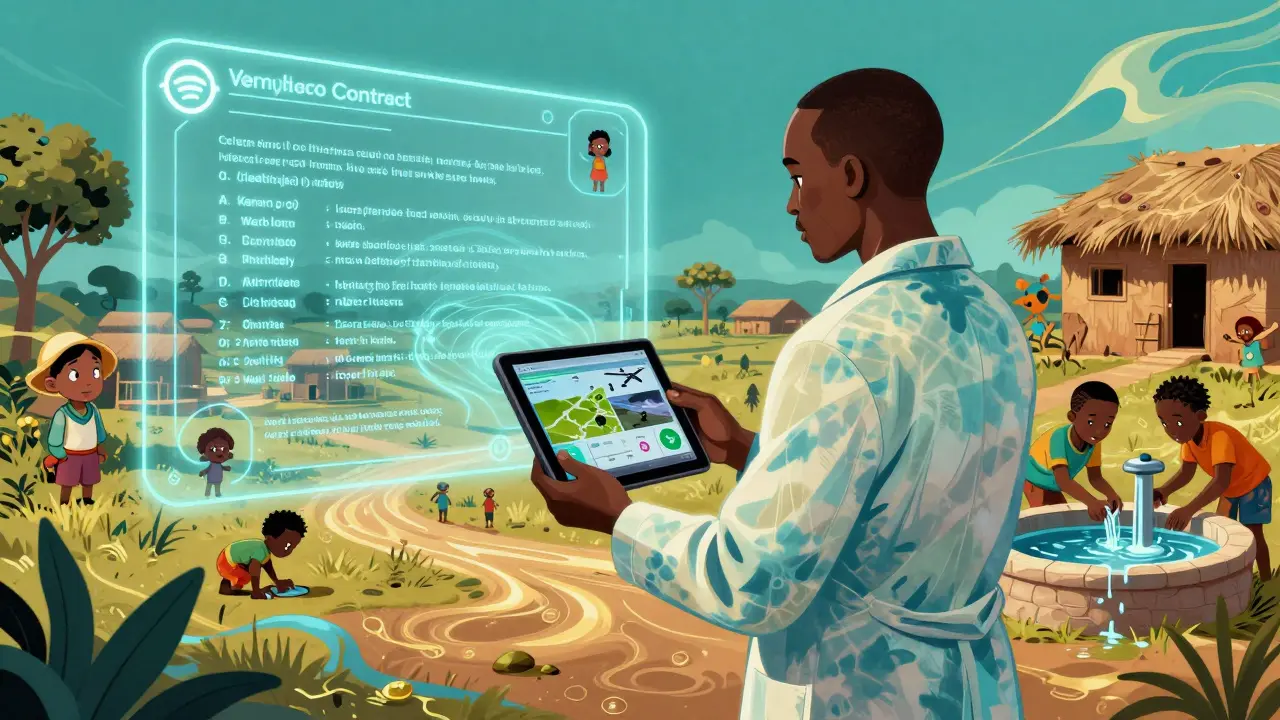
Think of a smart contract like a digital vending machine for charity. You insert your cryptocurrency - say, ETH or XDC - and set the rules: "Release $5,000 to build a well in Kenya only after satellite images confirm the well is dug and water is flowing." The contract waits. It doesn’t move a single cent until that condition is proven.
These contracts run on blockchains like Ethereum, which handles 68% of all charitable smart contracts as of 2024. They’re built using code - usually Solidity - and deployed directly on the network. Once live, no one can change them. Not the donor. Not the charity. Not even the developer. That’s the point.
Real-world triggers come from oracles - trusted data feeds that connect the blockchain to real life. Chainlink is the most common. If a charity claims they’ve delivered food after a disaster, an oracle checks weather reports, drone footage, or GPS logs from delivery trucks. If the data matches the condition, the contract automatically sends the next payment. Donors get real-time updates. No more waiting months for a newsletter with blurry photos.
Why This Beats Traditional Charity Systems
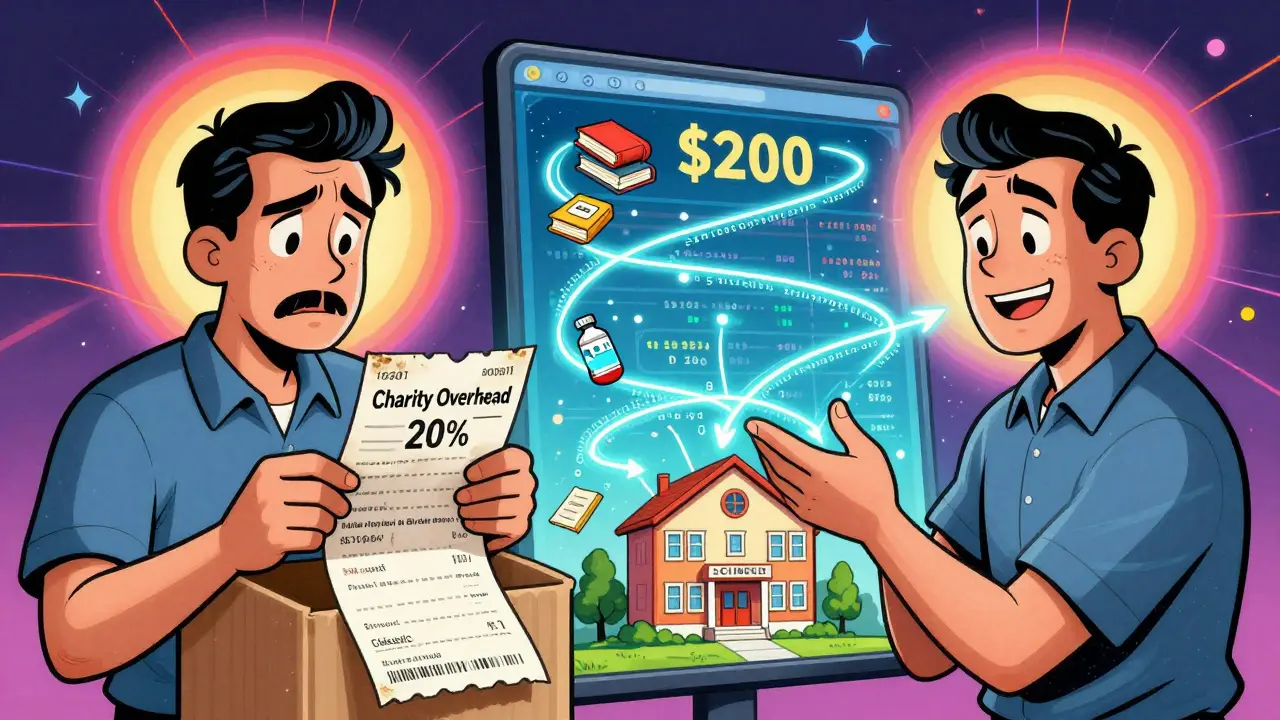
Traditional donations go through banks, payment processors, and charity admin teams. Each step takes time and cuts into the money. Charity Navigator reports that 15-25% of donations get eaten up by overhead. That means $75-$85 of every $100 reaches the cause.
Smart contracts cut that to 2-5%. Firefly Giving’s 2024 case studies show nonprofits receive 95-98% of every dollar donated via smart contracts. Why? No banks. No intermediaries. No manual reconciliation. The code handles everything.
Speed is another huge win. A matching gift program in the old system might take 60 days to verify and pay out. With a smart contract, it happens in 15 minutes - as long as the condition is met. The United Way tested this in 2023 and saw instant payouts when donors matched contributions after a charity hit a fundraising milestone.
And the transparency? Unmatched. Every transaction is recorded on a public ledger. You can track your $200 donation from wallet to well, step by step. XDC Network shows that donors using these systems report 37% higher confidence in how their money is used - a massive jump from the 23% baseline.
Where It’s Working: Real Success Stories
The Malala Fund used conditional smart contracts in 2023 to fund girls’ education in Pakistan. Donors could choose to fund a scholarship only after proof of enrollment was uploaded by a local partner. The system verified documents through encrypted uploads and issued payments automatically. Donor retention jumped 42% - people kept giving because they could see the impact.
Another example: a clean water project in Kenya. A donor set up a contract to release $500 per well, but only after IoT sensors confirmed water quality met WHO standards. The donor received weekly updates via a simple app - real-time sensor data, location pins, and photos. On Reddit, user EthGiver87 wrote: "I saw the well go from dirt to water in real time. I’ve never felt this connected to a cause."
These aren’t outliers. They’re proof that when trust is built into the system, giving increases.
The Hidden Problems: Why It’s Not Everywhere Yet
Smart contracts aren’t magic. They’re code. And code can’t handle everything.
Take the 2022 UNICEF pilot during the Pakistan floods. They set up a contract to release funds only when aid reached specific villages. But when the floods shifted and villages were cut off, the contract couldn’t adapt. The money was locked. They couldn’t redirect it to a nearby town that needed help more. $220,000 sat idle while people suffered. That’s the danger of rigidity.
Then there’s the tech gap. A 2024 TechSoup survey found 68% of small charities can’t set up smart contracts because they lack the staff or budget. Hiring a blockchain developer costs $120/hour. Setup can run $8,000-$25,000. For a charity with a $300,000 annual budget, that’s a huge barrier.
Donors aren’t immune either. A 2024 NTEN report found 72% of global donors don’t own cryptocurrency or know how to use a wallet like MetaMask. One nonprofit reported 12 potential donors walked away during a campaign because they couldn’t get past wallet setup. The user experience is still clunky for non-tech people.
Legal uncertainty is another hurdle. Courts are only now starting to recognize smart contracts as binding. The January 2025 *Bryant v. JPMorgan Chase Bank* ruling said conduct - like clicking "I agree" - can count as acceptance. But what if the terms are buried in code? No one reads Solidity. Legal experts warn: if a donor didn’t clearly understand what they agreed to, the contract could be challenged.
Who Should Use This - And Who Should Wait
Smart contracts for conditional donations are perfect for:
- Donors who want total control over how their money is used
- Charities with clear, measurable goals (building wells, delivering vaccines, funding education)
- Corporate foundations and high-net-worth donors who want verifiable impact
- Projects with real-time data sources (satellite images, IoT sensors, verified reports)
They’re NOT ideal for:
- Charities with tight budgets under $500,000 - the setup cost is too high
- Crisis response where flexibility is critical (floods, wars, sudden emergencies)
- Organizations serving populations without digital access
- Donors who just want to give and forget
If your charity runs a food pantry and needs cash tomorrow, skip the smart contract. If you’re funding a five-year girls’ education program with quarterly milestones? This is your tool.
The Future: What’s Coming Next
Things are moving fast. In February 2024, Ethereum launched ERC-7217 - a new standard for charitable smart contracts. It cuts development time by 40% and makes it easier for nonprofits to plug in without coding.
Regulators are catching up, too. The ISO is finalizing ISO 23026, a global standard for blockchain in social impact, due out in late 2025. That’ll help charities know what’s legal and safe.
Platforms like Firefly Giving, Bloom Solutions, and CharityChain are making donor interfaces simpler. XDC Network’s 2023 tests showed 82% of users could complete a conditional donation with just a phone and a link - no tech background needed.
Gartner predicts that by 2027, 35% of charities with budgets over $1 million will use some form of conditional smart contract. The market is projected to hit $940 million by then.
But the biggest challenge isn’t tech - it’s inclusion. If we build a system that only works for people with crypto wallets and high-speed internet, we’re leaving behind 3.5 billion unbanked people. That’s not progress. That’s exclusion.
The real win won’t be when smart contracts replace traditional giving. It’ll be when they make traditional giving better - by forcing every charity to be more transparent, more accountable, and more results-driven.
How to Get Started (If You’re Ready)
If you’re a donor and want to try this:
- Get a crypto wallet (MetaMask, Trust Wallet, or Coinbase Wallet)
- Buy a small amount of ETH or XDC (under $50 to start)
- Visit a platform like Firefly Giving or CharityChain
- Choose a verified charity with a smart contract option
- Read the conditions clearly - don’t skip this step
- Send your donation and track it live
If you’re a charity:
- Start small - pick one program to pilot
- Partner with a platform like Firefly Giving to avoid building from scratch
- Work with a lawyer who understands blockchain and nonprofit law
- Use clear, plain-language summaries of your contract terms - don’t bury them in code
- Train your team - 40-60 hours of learning is typical
Don’t try to do it all at once. Test one condition. One project. One donor. See what works.
Frequently Asked Questions
Can I cancel a smart contract donation once it’s sent?
No. Once a smart contract is deployed and funded, the transaction is permanent. That’s the point - it can’t be tampered with. But you can set conditions that allow for partial refunds or pauses if something goes wrong. Always review the contract terms before sending funds.
Do I need to know how to code to use smart contracts for donations?
No. As a donor, you just need a wallet and access to a platform like Firefly Giving. As a charity, you don’t need to code either - you can use pre-built platforms. But you do need to understand what conditions you’re setting and how they’ll be verified.
Are smart contract donations tax-deductible?
Yes, in the U.S. and many other countries, if the charity is a registered nonprofit, cryptocurrency donations are treated like property donations. You can claim a tax deduction based on the fair market value at the time of donation. Platforms like Firefly Giving generate IRS-compliant receipts automatically.
What happens if the oracle gives wrong data?
Oracles are trusted third parties, but they can fail. Most charitable contracts use multiple oracles (like Chainlink) and require consensus - if two out of three sources confirm the condition, the payment releases. If data is clearly wrong, donors can challenge the payout through dispute mechanisms built into some platforms.
How much do gas fees cost for a conditional donation?
On Ethereum, fees can spike to $50+ during busy times, which can make small donations impractical. XDC Network and other blockchains offer fees under $0.10. Many platforms now auto-select the cheapest network or batch transactions to reduce costs. Always check the fee estimate before confirming.
Can smart contracts replace all forms of charitable giving?
No. They’re powerful for structured, measurable goals - but not for urgent, flexible needs like disaster relief where conditions change hourly. They also exclude people without digital access. The best charities will use smart contracts for specific programs while keeping traditional methods for broader support.
Josh V
January 13, 2026 AT 15:13Dustin Secrest
January 14, 2026 AT 21:13Telleen Anderson-Lozano
January 15, 2026 AT 15:54Sarah Baker
January 17, 2026 AT 09:46Shaun Beckford
January 17, 2026 AT 14:20Chris Evans
January 18, 2026 AT 23:57Rod Petrik
January 20, 2026 AT 14:53Ashlea Zirk
January 22, 2026 AT 05:20Chris O'Carroll
January 24, 2026 AT 04:04Vinod Dalavai
January 24, 2026 AT 13:06Tony Loneman
January 25, 2026 AT 05:19Josh V
January 25, 2026 AT 13:17