US CBDC Halt: Why There Is No Digital Dollar
Imagine walking into a coffee shop in Raleigh and paying with a government-issued digital token that’s backed by the Federal Reserve. For years, economists debated whether this would happen. Then, in early 2025, the conversation stopped dead in its tracks. President Donald Trump signed Executive Order 14178, halting all U.S. efforts to create a central bank digital currency (CBDC). This move didn’t just pause research; it effectively killed the idea of a "digital dollar" or "FedCoin" under the current administration.
This isn’t a minor tweak to policy. It’s a hard pivot away from the path laid out by the previous administration. While the rest of the world races toward digital sovereignty, the United States has stepped off the track. If you’ve been wondering why your bank account doesn’t have a direct line to the Fed yet, or if you’re worried about what this means for crypto and stablecoins, you’re asking the right questions. Here is exactly what happened, why it matters, and where the money goes next.
The Sudden Stop: What Executive Order 14178 Did
To understand the halt, you need to look at what came before. In 2022, President Biden issued Executive Order 14067, which urged agencies to prioritize research into a U.S. CBDC. The goal was to ensure America didn’t fall behind China’s digital yuan or Europe’s digital euro. Agencies like the Treasury and the Federal Reserve formed working groups to study how this would work. They looked at privacy, financial stability, and payment efficiency.
Executive Order 14178 reversed this completely. It ordered federal agencies to stop promoting or developing a CBDC. The message was clear: the government does not want to issue its own digital currency. This aligns with statements from Federal Reserve Chair Jerome Powell, who previously said he would never support a CBDC without explicit approval from Congress and the President. With the new executive order, that approval is gone.
The legal basis here rests on the definition of money. A CBDC is a liability of the central bank. By stopping development, the U.S. government is choosing to keep physical cash and commercial bank deposits as the primary forms of money. This decision reflects a deep skepticism about giving the government more power over individual spending habits through programmable money.
Global Context: The U.S. Becomes an Outlier
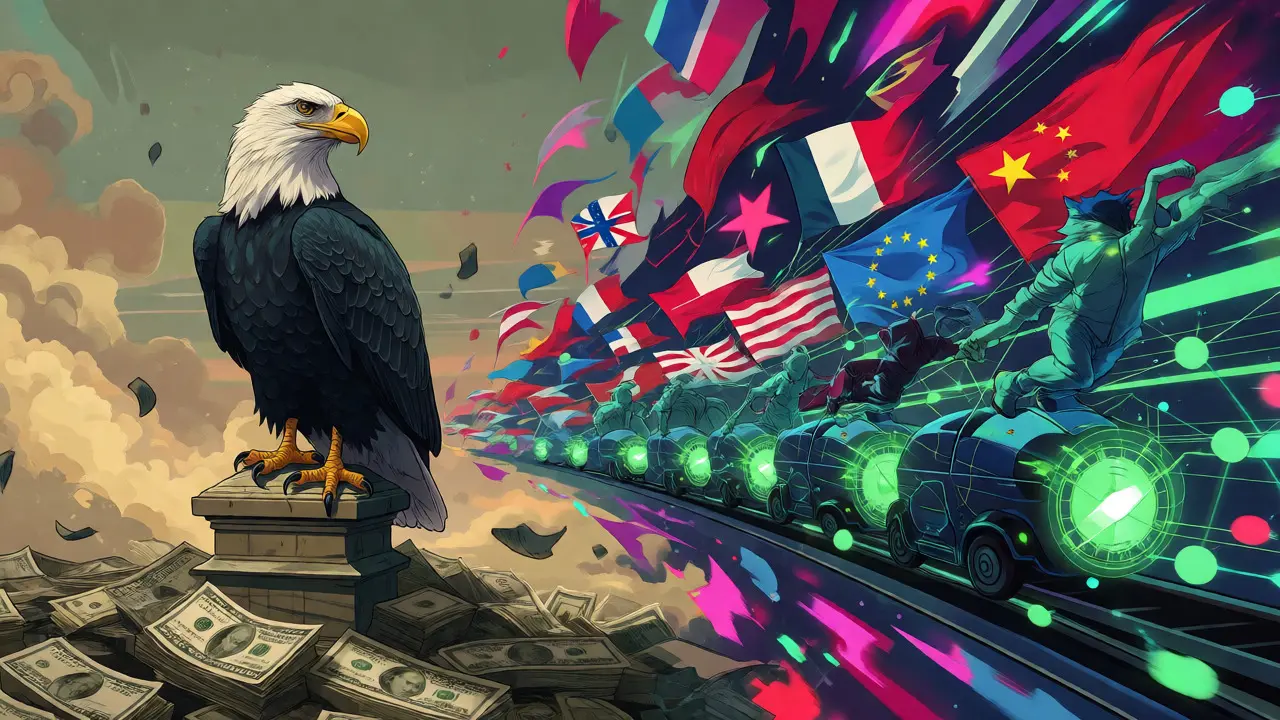
While Washington hits the brakes, the rest of the world is pressing the gas. As of early 2025, 134 countries are actively working on CBDCs. That’s up from about 114 in 2023. Of those, 72 are in advanced stages-meaning they are testing, piloting, or launching their currencies.
Consider the G-20 nations. Nineteen of them are exploring CBDCs. Sixteen are already in pilot or development phases. Countries like Brazil, Russia, India, China, and South Africa-the BRICS bloc-are all moving forward. Even traditional allies like Japan, Australia, and members of the European Union are advancing their projects. The Bank for International Settlements notes that wholesale CBDCs could enable new features like programmability and tokenization in the global financial system.
| Region/Country | Status | Key Driver |
|---|---|---|
| United States | Halted (EO 14178) | Skepticism of gov't control |
| China | Advanced Pilot/Launch | Financial inclusion, surveillance |
| Eurozone | Pilot Phase | Payment efficiency, sovereignty |
| Brazil | Development/Pilot | Modernizing legacy systems |
| Nigeria/Bahamas | Launched | Financial access |
The U.S. stands alone among major economies in fully abandoning the project. This creates a strange dynamic. On one hand, the U.S. dollar remains the world’s reserve currency. On the other, the infrastructure supporting it is aging. Other nations are building new rails for digital money while the U.S. sticks to the old ones.
Why the Halt? Privacy, Politics, and Power
You might ask: why stop something that seems efficient? The answer lies in politics and civil liberties. Critics of CBDCs argue that a digital dollar gives the government too much visibility into private transactions. Currently, banks file over 26 million reports annually on customer activity. A CBDC could theoretically allow real-time monitoring of every purchase.
There is also fear of "programmability." Imagine if the government could set expiration dates on stimulus checks or restrict what you can buy with certain funds. While proponents see this as a tool for better fiscal policy, opponents see it as a step toward controlled economies. The Trump administration leaned heavily into this latter view, prioritizing individual freedom and market innovation over state-led monetary modernization.
Furthermore, there is institutional inertia. The Federal Reserve has always been cautious. Chair Powell’s stance was always conditional. When political winds shifted, the condition wasn’t met. Instead of pushing for legislative approval, the administration chose to withdraw support entirely. This avoids the messy congressional battles that likely would have occurred had the Fed pushed harder.
The Rise of Private Alternatives: Stablecoins Fill the Void
If the government won’t provide digital dollars, the private sector will. This is where stablecoins come in. These are cryptocurrencies pegged to the value of the U.S. dollar. Companies like Tether and Circle issue tokens that circulate on blockchains like Ethereum and Solana. They offer speed and programmability without direct Federal Reserve issuance.
Major financial institutions are betting on this route. State Street, a giant in custody services, noted that high-quality digital cash assets are crucial for scaling institutional interest in tokenized assets. Without a FedCoin, firms like Fnality International-a consortium involving major banks-are building private settlement layers. These systems aim to do what a wholesale CBDC would have done: settle large transactions instantly and securely.
This shift puts regulatory pressure on Congress. Lawmakers now face tight deadlines to create clear rules for stablecoins. The focus shifts from "how do we build a government coin?" to "how do we regulate private coins so they don’t crash the economy?" This approach favors innovation but introduces risk. If a major stablecoin issuer fails, the fallout could be significant since there is no direct backstop from the Fed.
What This Means for You and Your Money
For the average American, life looks mostly unchanged. You still use credit cards, debit cards, and Venmo. Physical cash remains king in many circles. However, the long-term implications touch on international trade and tech leadership.
- Cross-Border Payments: Sending money abroad might remain slower and more expensive compared to countries with integrated CBDC corridors. The U.S. relies on SWIFT and correspondent banking, which are being challenged by newer digital networks.
- Financial Inclusion: About 62% of central banks cite financial inclusion as a key reason for CBDCs. Without a public option, unbanked Americans rely on private fintech apps, which often charge fees that a free government wallet wouldn’t.
- Investment Opportunities: Crypto markets may benefit. With no competition from a government coin, private stablecoins and blockchain platforms retain dominance in the digital asset space. Investors should watch regulatory news closely, as clarity could boost adoption.
Businesses need to adapt. If you run an e-commerce site, integrating stablecoin payments might become more attractive than waiting for a government solution. Developers should focus on building tools that work within existing banking frameworks rather than assuming a universal digital dollar will appear soon.
Frequently Asked Questions
Is the US CBDC permanently cancelled?
Not necessarily permanently, but it is halted indefinitely under the current administration. Executive Order 14178 stops active development and promotion. A future president could reverse this order, but it would require significant political capital and likely new legislation to overcome institutional resistance.
Will I lose my money because there is no digital dollar?
No. Your money in banks and savings accounts is safe. The halt only affects the creation of a new type of digital currency issued directly by the Federal Reserve. Commercial bank deposits remain insured by the FDIC up to $250,000 per depositor.
How does this affect cryptocurrency prices?
It removes a potential competitor. Many investors feared a CBDC would drain liquidity from private cryptos. With the U.S. stepping back, private stablecoins and decentralized finance (DeFi) protocols maintain their role in the digital economy. This could be seen as bullish for established crypto assets.
Can I still use Bitcoin or Ethereum in the US?
Yes. The halt applies specifically to a government-issued Central Bank Digital Currency. It does not ban private cryptocurrencies. In fact, the administration's focus on regulatory clarity suggests a preference for allowing private digital assets to flourish under defined rules.
What happens to the digital dollar pilots already running?
Federal agencies have ceased funding and coordinating these efforts. Some academic or localized experiments might continue independently, but they lack the official backing and scale needed for national implementation. The interagency working group established in 2023 has effectively disbanded.
Next Steps for Investors and Consumers
Don’t panic. The dollar isn’t going anywhere. But the landscape of digital money is shifting. Keep an eye on stablecoin regulation in Congress. Watch how major banks integrate blockchain technology for settlements. And remember, while the U.S. paused its digital currency train, the rest of the world hasn’t stopped theirs. Staying informed helps you navigate the gaps between traditional banking and the emerging digital frontier.
Ellie Probus
October 23, 2026 AT 03:21FINALLY!!!
I am literally screaming right now because this is the BEST news I have heard all year. 🇺🇸❤️ The idea of a government watching every single penny I spend was giving me actual nightmares, you guys. It’s like they wanted to turn us into ants in a colony where the Queen decides if we can buy bread or not. NO THANK YOU.
We don’t need FedCoin. We don’t need their surveillance state money. We have cash, we have our freedom, and that is enough for me. Let the other countries play with their little digital tokens while we keep our liberty intact. This is a victory for common sense and for every American who just wants to buy a coffee without the Feds knowing about it! YAY!! 🎉🎉
Andrew Ellison
October 24, 2026 AT 16:09This seems like a pragmatic move given the current political climate. While efficiency is often cited as a benefit of CBDCs, the privacy concerns are indeed significant and shouldn't be dismissed lightly. It allows private sector innovation to take the lead, which historically has been more agile than government initiatives.
Manish Pudasaini
October 25, 2026 AT 16:06The author fails to acknowledge the severe economic inefficiencies introduced by maintaining an outdated banking infrastructure. By halting the CBDC, the United States is voluntarily ceding financial sovereignty to nations that embrace modern monetary tools. This is not merely a policy shift; it is a strategic blunder that will result in long-term stagnation for the US dollar's global dominance. The reliance on private stablecoins introduces systemic risk that public currency would have mitigated through direct central bank backing. One must consider the moral imperative of providing citizens with a secure, low-cost payment system, which this decision abandons in favor of corporate interests. The lack of foresight here is palpable, and the consequences will be borne by future generations who will wonder why America chose convenience over security.
Mark Regan
October 26, 2026 AT 03:58Oh, please. Spare me the drama, Ellie. 🙄 You think 'liberty' matters when your Venmo gets frozen because you bought something weird? A CBDC isn't some boogeyman; it's just code. But sure, let's pretend sticking with SWIFT-which takes days and costs a fortune-is somehow 'freedom.' It’s hilarious how people celebrate being left behind technologically while claiming it’s a moral victory. The rest of the world is laughing at us, but hey, at least we can buy gas with paper while China settles trade deals instantly. How quaint. How utterly, painfully quaint. 💅
jackie hernandez
October 26, 2026 AT 07:14Mark, you’re totally missing the point!! 😤 It’s not about speed, it’s about CONTROL! Who wants Big Brother seeing my grocery list?! 🛒👀 If the gov can freeze my wallet because I didn’t recycle, I’m done. We don’t need their 'efficiency' if it costs our soul. And stop acting so superior about China-they spy on everyone anyway! At least here we have choices. Or... we had choices before this whole mess started. Anyway, glad Trump stopped it. USA! USA! 🦅
Hailey Phillips
October 26, 2026 AT 23:29It is wonderful to see such passionate engagement from everyone! ❤️ I think there is truth on both sides here. On one hand, Mark makes a valid point about cross-border efficiency, and on the other, Ellie raises crucial concerns about personal privacy. Perhaps the ideal solution lies somewhere in between? Maybe we could have a hybrid model that protects user data while still updating our payment rails? We should strive to understand each other's perspectives rather than fighting. Every voice matters in this conversation, and I believe we can find a path forward that respects both innovation and individual rights. Let’s keep the dialogue open and kind! ✨
Caleb Lok
October 27, 2026 AT 21:14Hailey, that is such a naive take. 😂 You can't just 'compromise' on physics and economics. Either you have programmable money or you don't. There is no middle ground where the government doesn't have the keys. Also, Manish is right about the strategic loss, even if he sounds like a robot. The US is becoming irrelevant in fintech. Stablecoins are great until Tether goes bankrupt, then what? No backstop. It’s a ticking time bomb, but sure, let’s call it 'innovation.' 📉💀
Raman Tiwari
October 29, 2026 AT 06:18I agree with Caleb! 😲 The stability issue is huge. If a private company issues the dollar, and they fail, do we lose everything? With a CBDC, the government backs it. That is safety. But also, imagine the possibilities! Smart contracts could automate taxes, reduce fraud, and help small businesses instantly. Why are we afraid of progress? It feels like we are choosing fear over opportunity. I hope Congress acts quickly to regulate stablecoins so we don't get hurt later. We need clarity, not just celebration of the halt!
Samantha McClafferty
October 30, 2026 AT 05:36Raman, you are absolutely right to worry about the risks! Listen, I know change is scary, but we have to look at the bigger picture. If we ignore these technological shifts, we leave vulnerable populations behind. Financial inclusion is key here. Many unbanked Americans rely on expensive check-cashing services. A well-designed public option could help them save money. We need to push for regulations that protect consumers while allowing banks to innovate. Don't give up hope! We can shape this future together. Let's focus on solutions, not just problems. You've got this! 💪
Tonya Dowell
October 30, 2026 AT 05:58i honestly dont care anymore. its all gonna crash soon anyway. whether its fedcoin or tether or whatever. i just want to go home and sleep. tired of arguing about money online. lol. bye.