Vietnam's New Crypto Framework: What Directive 05/CT-TTg Means for Traders and Exchanges
On September 9, 2025, Vietnam’s government dropped a bombshell: Directive 05/CT-TTg - officially known as Resolution No. 05/2025/NQ-CP - became the country’s first binding legal framework for cryptocurrency exchanges. It didn’t just tweak the rules. It rewrote them. Overnight, thousands of small crypto platforms were told they had to raise nearly $400 million in capital or shut down. Retail traders learned they could no longer trade Bitcoin for USDT. And foreign investors found their door to Vietnam’s $1.2 billion crypto market slammed shut at 49% ownership.
What Exactly Is Directive 05/CT-TTg?
Directive 05/CT-TTg is not a suggestion. It’s a mandate. Signed by Deputy Prime Minister Ho Duc Phoc, it’s part of Vietnam’s broader Digital Technology Industry Law passed in June 2025. The goal? To bring order to a wild west market. Before this, an estimated 21 million Vietnamese people traded crypto - mostly on unregulated platforms. Many of them lost money when exchanges vanished without warning. In 2022 alone, 15 platforms collapsed, wiping out over half a billion dollars in user funds.
The resolution creates a five-year pilot program (2025-2030) that officially recognizes cryptocurrency as a regulated asset class - but only under extreme conditions. The Ministry of Finance is now the sole gatekeeper. No license? No operation. Period.
The $379 Million Barrier
The most shocking part? The minimum charter capital requirement: 10 trillion VND - about $379 million USD. That’s not a typo. It’s more than 27 times what Thailand requires and over 27 times what Singapore demands for top-tier payment providers. This isn’t about safety. It’s about control.
At least 65% of that capital - $246 million - must come from Vietnamese institutional investors. Foreign ownership is capped at 49%. That means no Coinbase, no Binance, no Kraken can run their own exchange in Vietnam. They can only be minority partners in a Vietnamese-owned company that meets the capital threshold.
Think about that. A small exchange in Hanoi with $200,000 in capital and 5,000 users? Gone. A local startup that spent two years building a user-friendly app? Irrelevant. The only players who can even apply are deep-pocketed conglomerates - banks, state-linked funds, or massive Vietnamese tech firms.
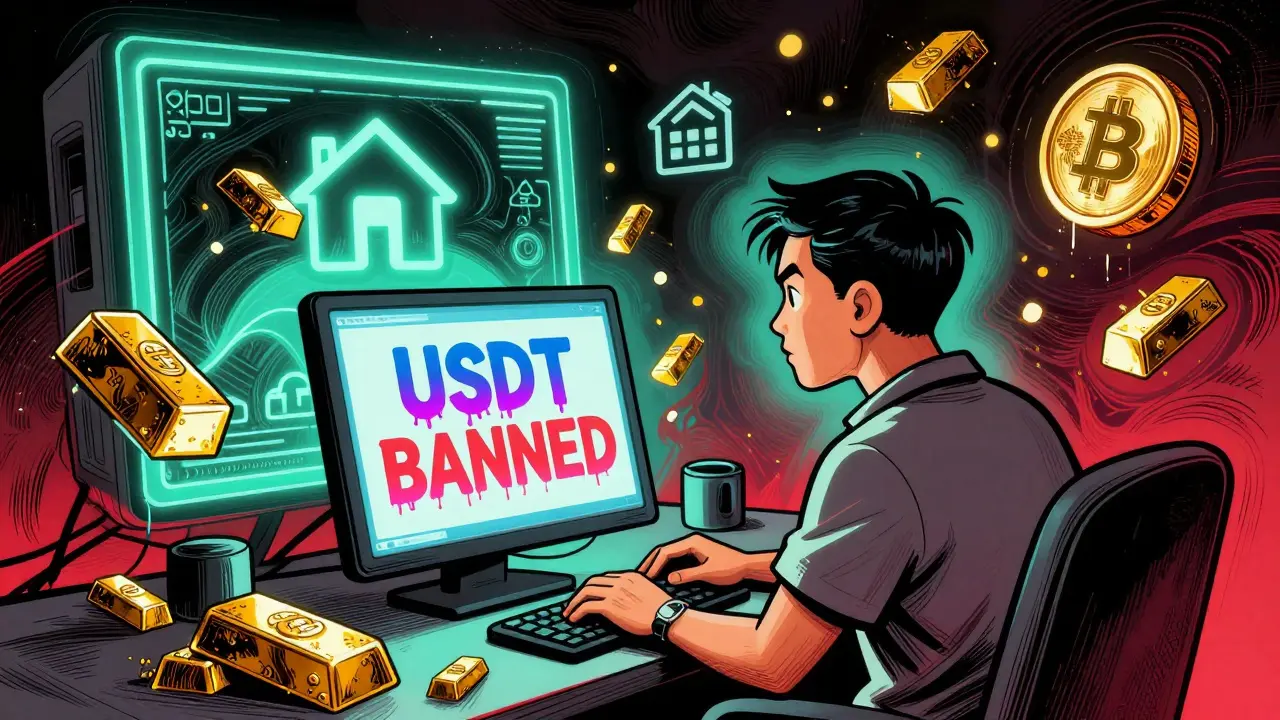
VND-Only Trading: No USDT, No USD, No Escape
Even if you somehow raised $400 million, you still can’t trade in Bitcoin or Ethereum for dollars. Every trade must happen in Vietnamese dong (VND). That’s a huge deal.
Before this rule, over 63% of all crypto transactions in Vietnam involved stablecoins - mostly USDT. Traders used them to avoid VND inflation, hedge against currency swings, and move money internationally. Now, those tools are banned. Platforms must replace stablecoins with tokens backed by “real underlying assets” - like gold, agricultural commodities, or real estate. But no fiat-backed tokens. No Tether. No USDC.
This makes Vietnam’s market nearly useless for international traders. Why would someone from Singapore or the U.S. bother trading VND? The liquidity is low. The exchange rates are volatile. And the withdrawal process is now locked into a national blockchain system only accessible through licensed Vietnamese platforms.
Compliance Isn’t Cheap - It’s a Fortune
Meeting the capital requirement is just the start. You also need to rebuild your entire tech stack.
- Integrate with the State Bank of Vietnam’s real-time transaction monitoring system.
- Adopt Vietnam’s National Cryptography Standard (TCVN 13057:2025) for blockchain infrastructure.
- Upgrade KYC/AML systems to meet the 2023 Anti-Money Laundering Law amendments.
- Switch from foreign payment processors to VND-only gateways.
Legal firms estimate compliance costs between $1.9 million and $7.6 million per exchange. That’s on top of the $379 million capital. Few startups have that kind of cash. Even many mid-sized firms don’t.
Who Wins? Who Loses?
On paper, this looks like a win for consumers. No more scam exchanges. No more disappearing funds. The government says it’s protecting users. And there’s truth to that. In 2024, the average withdrawal delay on unlicensed platforms was nearly 19 hours - more than four times the global average. Users complained about frozen accounts and fake customer service.
But the cost is massive. According to a CoinGeek survey of 1,500 Vietnamese crypto users, 79.6% think the capital requirement is way too high. 41.2% said they’d move to offshore exchanges if local options become too restricted. That’s over 8 million people potentially leaving the domestic market.
Meanwhile, institutional investors are cheering. One user on Reddit, calling themselves “SaigonVC,” wrote: “Finally some regulation! Last year I lost $455,000 when BitViet vanished. This will stop those scams.”
But here’s the catch: those institutional investors are now the only ones who can play. And they’re not here to serve retail traders. They’re here to control the market.
What About Stablecoins?
This might be the biggest mistake in the whole framework.
Stablecoins make up 73.2% of global crypto volume. They’re the bridge between traditional finance and digital assets. By banning fiat-backed stablecoins, Vietnam is cutting off its own nose to spite its face. Retail users can’t hold value without them. Traders can’t hedge. Businesses can’t settle payments.
Instead, platforms must create tokenized assets backed by real estate or gold. But who’s going to verify those assets? Who’s going to store them? Who’s going to trust them? There’s no infrastructure for this. No legal precedent. No market liquidity.
It’s like banning cash and forcing everyone to pay with IOUs signed by local farmers.

The Bigger Picture: Vietnam’s Digital Economy Bet
Why go so far? Because Vietnam wants to be a tech powerhouse.
By 2030, the government wants digital tech to make up 20% of GDP - up from 9.5% in 2024. Crypto is part of that plan. Blockchain is listed as one of 11 priority technologies, alongside AI and semiconductors.
But Vietnam isn’t trying to be Singapore. It’s not trying to attract global capital. It’s trying to keep control. The goal isn’t innovation - it’s capture. The government wants to tax crypto transactions, monitor every trade, and prevent capital flight. In 2025, an estimated $10.2 billion in crypto moved through Vietnam - 87.4% of it unregulated. That’s money leaving the country. And the State Bank of Vietnam doesn’t like that.
So now, they’re forcing it back in - under their rules.
What Happens Next?
The first licenses are expected within 90-120 days after applications open - likely by December 2025. But only 3 to 5 exchanges will qualify in Year One. That means 21 million users will be squeezed into a market that can only serve 5 million.
What happens to the rest? Some will leave. Some will go dark. Some will try to operate illegally. Others will wait for the government to soften the rules.
The resolution includes mandatory reviews at 12, 24, and 36 months. That’s the only hope for change. If the market collapses, if users flee, if tax revenue doesn’t come in - the government might lower the capital requirement. But don’t count on it.
Meanwhile, tax rules are coming. By November 15, 2025, capital gains will be taxed at 0.1% for trades under 100 million VND ($3,900) and 0.3% for larger ones. That’s low - but it’s still a tax. And it’s another layer of control.
Final Reality Check
Directive 05/CT-TTg isn’t about innovation. It’s about control. It’s about stopping capital flight. It’s about creating a state-approved monopoly. It’s about protecting the financial system - even if it breaks the market.
For traders, it means fewer options, higher fees, and less freedom. For exchanges, it means either a billion-dollar investment or a quiet exit. For Vietnam, it’s a high-stakes gamble: sacrifice short-term growth for long-term control.
Will it work? Maybe. But the human cost? Millions of users will be left behind. And that’s the real price of the framework.
Rishav Ranjan
December 20, 2025 AT 20:44Tyler Porter
December 21, 2025 AT 11:52Mmathapelo Ndlovu
December 23, 2025 AT 02:18Earlene Dollie
December 24, 2025 AT 13:28Grace Simmons
December 26, 2025 AT 05:37Collin Crawford
December 27, 2025 AT 08:19Aaron Heaps
December 28, 2025 AT 01:53Jayakanth Kesan
December 28, 2025 AT 17:03chris yusunas
December 29, 2025 AT 20:27Megan O'Brien
December 29, 2025 AT 21:01Tristan Bertles
December 30, 2025 AT 20:06Dusty Rogers
January 1, 2026 AT 09:21Steve B
January 3, 2026 AT 05:48Kevin Karpiak
January 4, 2026 AT 22:43Rachel McDonald
January 5, 2026 AT 02:11