What Are Exchange Tokens in Cryptocurrency? A Clear Guide to Platform-Specific Crypto Assets
When you trade crypto, you’re probably familiar with Bitcoin, Ethereum, or Solana. But have you ever noticed a token like BNB, OKB, or HT showing up on your exchange’s homepage? These aren’t just random coins-they’re exchange tokens, and they play a bigger role in your trading than you might think.
What Exactly Is an Exchange Token?
An exchange token is a digital asset created and issued by a cryptocurrency exchange. Unlike Bitcoin or Ethereum, which exist independently on their own networks, exchange tokens are tied directly to the platform that made them. Think of them like loyalty points-but instead of getting a free coffee after ten purchases, you get lower trading fees, early access to new coins, or even a say in how the exchange runs.
The first major one was Binance Coin (BNB), launched in July 2017. Since then, nearly every big exchange has followed suit. Today, there are about 15 major exchange tokens, with a combined value over $52 billion. BNB alone makes up nearly 87% of that total. That’s not just popular-it’s dominant.
How Do Exchange Tokens Work?
Exchange tokens aren’t just for show. They’re built with real functions that affect your trading experience. Here’s how they typically work:
- Fee discounts: If you hold the token, you pay less to trade. On Binance, holding 17.85 BNB gets you a 25% discount on trading fees. On KuCoin, holding 666 KCS gives you up to 40% off.
- Token burns: Many exchanges, like Binance, regularly destroy a portion of their tokens. Binance burns BNB every quarter using 20% of its profits. In Q1 2023 alone, over 2 million BNB were destroyed-worth roughly $597 million. This reduces supply, which can push prices up over time.
- Staking and rewards: Some exchanges let you lock up your tokens to earn interest. For example, holding OKB on OKX can earn you up to 10% APY.
- Governance voting: Some tokens let you vote on platform changes-like which new coins to list or how to spend treasury funds. But here’s the catch: in practice, these votes often don’t change anything. Real decisions are still made by the exchange’s internal team.
- Access to exclusive features: You might get early access to token sales, NFT drops, or even travel deals. BNB can be used to book hotels on Travala.com, for example.
Most exchange tokens started as ERC-20 tokens on Ethereum, then moved to their own blockchains. BNB moved to BNB Chain. HT went from Ethereum to Huobi Chain. This shift helps them process transactions faster and cheaper.
Top Exchange Tokens Compared
Not all exchange tokens are the same. Here’s how the biggest ones stack up:
| Token | Exchange | Market Cap (Q3 2023) | Key Utilities | Fee Discount Max | Token Burn |
|---|---|---|---|---|---|
| BNB | Binance | $45 billion | Trading fees, BNB Chain payments, travel, staking, governance | 25% | Quarterly, 20% of profits |
| OKB | OKX | $4.8 billion | Trading fees, staking, insurance fund, governance | 20% | Quarterly, part to security fund |
| HT | Huobi | $2.1 billion | Trading fees, lottery entries | 20% | Monthly, variable amount |
| KCS | KuCoin | $1.1 billion | Trading fees, staking, dividend payouts | 40% | None |
| FTT | FTX (defunct) | $0 (collapsed) | Trading fees, staking, governance | 20% | None |
BNB stands out because it’s not just a fee discount tool-it’s the backbone of BNB Chain, a blockchain used by thousands of apps. OKB is trying to catch up by tying token burns to a security fund that covers users if the exchange gets hacked. HT and KCS are more limited, mostly focused on fee cuts and lottery draws.
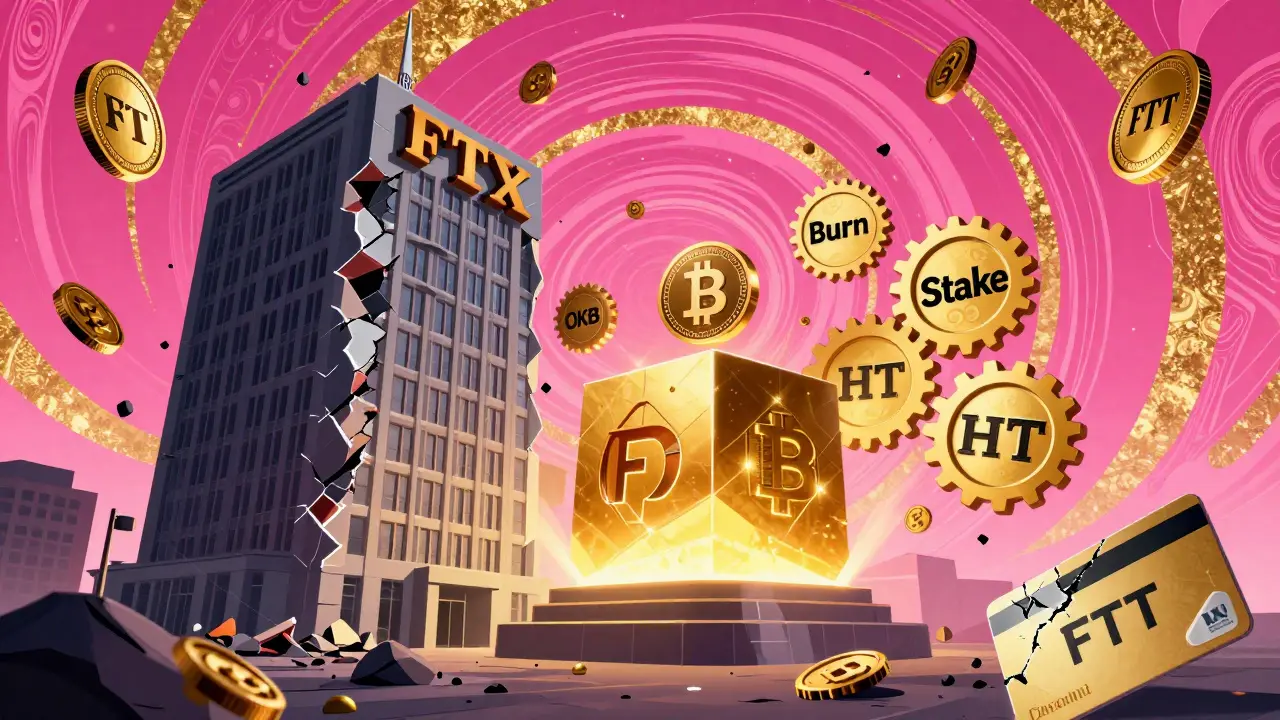
And then there’s FTT-the ghost in the machine. When FTX collapsed in November 2022, FTT’s value crashed from $8 billion to under $10 million in three days. It’s the starkest warning: your token’s value depends entirely on the exchange’s survival.
Why People Hold Exchange Tokens
People hold these tokens for three main reasons:
- Cost savings: If you trade $10,000 a month, a 25% fee cut saves you $250 a month. That’s $3,000 a year-just for holding a few tokens.
- Speculation: BNB rose over 1,200% in 2021 because Binance’s user base exploded. People bought BNB not just to save on fees, but because they believed in the exchange’s growth.
- Convenience: If you’re already on Binance, it’s easy to buy BNB. Why hold five different tokens when one covers your main exchange?
A CoinGecko survey of over 5,000 users found that 62% hold exchange tokens primarily for fee discounts. Only 15% care about governance. And 78% of those who hold any exchange token own BNB.
The Risks You Can’t Ignore
Exchange tokens aren’t risk-free. Here’s what can go wrong:
- Single-point failure: If the exchange gets hacked, shuts down, or gets shut down by regulators, your token becomes worthless. FTX proved this.
- Centralization: Binance controls BNB’s supply, burns, and smart contracts. Even though BNB runs on a blockchain, the power isn’t decentralized. In fact, CoinDesk rated BNB a 3.2 out of 5 for decentralization.
- Regulatory trouble: In June 2023, the U.S. Securities and Exchange Commission (SEC) sued Binance and its CEO, claiming BNB was an unregistered security. If courts agree, BNB could face major restrictions.
- Over-reliance: If you put 30% of your portfolio into BNB because it’s convenient, you’re betting your entire crypto wealth on one company’s future.
Academic research from the University of Cambridge found that exchanges with native tokens had 37% higher user retention-but also 22% more price volatility tied to exchange problems. In other words: you stick around because the perks are good… but the token crashes harder if things go wrong.
How to Get Started
If you want to try exchange tokens, here’s how:
- Create an account on an exchange that issues its own token (Binance, OKX, KuCoin, etc.).
- Complete KYC-this usually takes 15-30 minutes.
- Buy the token on the exchange’s spot market. You can’t buy BNB on Coinbase unless they list it (they don’t).
- Hold it in your exchange wallet to get fee discounts. Some platforms let you stake it for extra rewards.
- Learn the burn schedule. Binance burns BNB every quarter. Knowing when helps you anticipate price moves.
Most users take 2-3 hours to fully understand how it works. The biggest mistake? Thinking you need to hold a ton to get the discount. Binance doesn’t require you to own $10,000 in BNB-you just need 17.85 coins. That’s less than $10,000 at current prices.
What Experts Say
Changpeng Zhao, CEO of Binance, says exchange tokens create a "flywheel effect": more trading → more token demand → higher token value → more users. It’s a self-reinforcing loop.
But Dr. Garrick Hileman from Blockchain.com warns: "Exchange tokens represent concentrated risk vectors. Their value is entirely dependent on the solvency of a single company." That’s not a minor concern-it’s the core flaw.
And users? On Reddit, one trader said: "Held BNB since 2018. Saved $2,300 in fees last year. But I keep only 20% of my portfolio in exchange tokens. FTX trauma." That’s a common sentiment.
Where Is This Headed?
The market is changing. Binance is pushing BNB Chain’s new Layer 2 solution, opBNB, to handle 4,000 transactions per second. OKX is using OKB burns to fund a hack insurance pool. Huobi and KuCoin are trying to add more real-world use cases.
But the big question remains: can these tokens survive regulatory crackdowns? The SEC’s lawsuit against Binance isn’t isolated. More agencies are watching. If regulators decide these tokens are securities, exchanges may have to stop offering them-or face fines and shutdowns.
Most analysts agree: exchange tokens aren’t going away. But their role will change. The future might see fewer tokens, more consolidation, and stricter rules. Users who treat them as utility tools-not investments-will likely fare better.
Final Thoughts
Exchange tokens are powerful-if you understand them. They can save you money, give you early access, and even earn you rewards. But they’re not free money. They’re a bet on the exchange that issued them.
If you’re a high-volume trader, holding BNB or OKB makes sense. If you’re just dabbling, skip it. Don’t let the discount blind you to the risk. And never, ever put more than 10-15% of your portfolio into exchange tokens. The FTX lesson was brutal: when the exchange falls, the token dies.
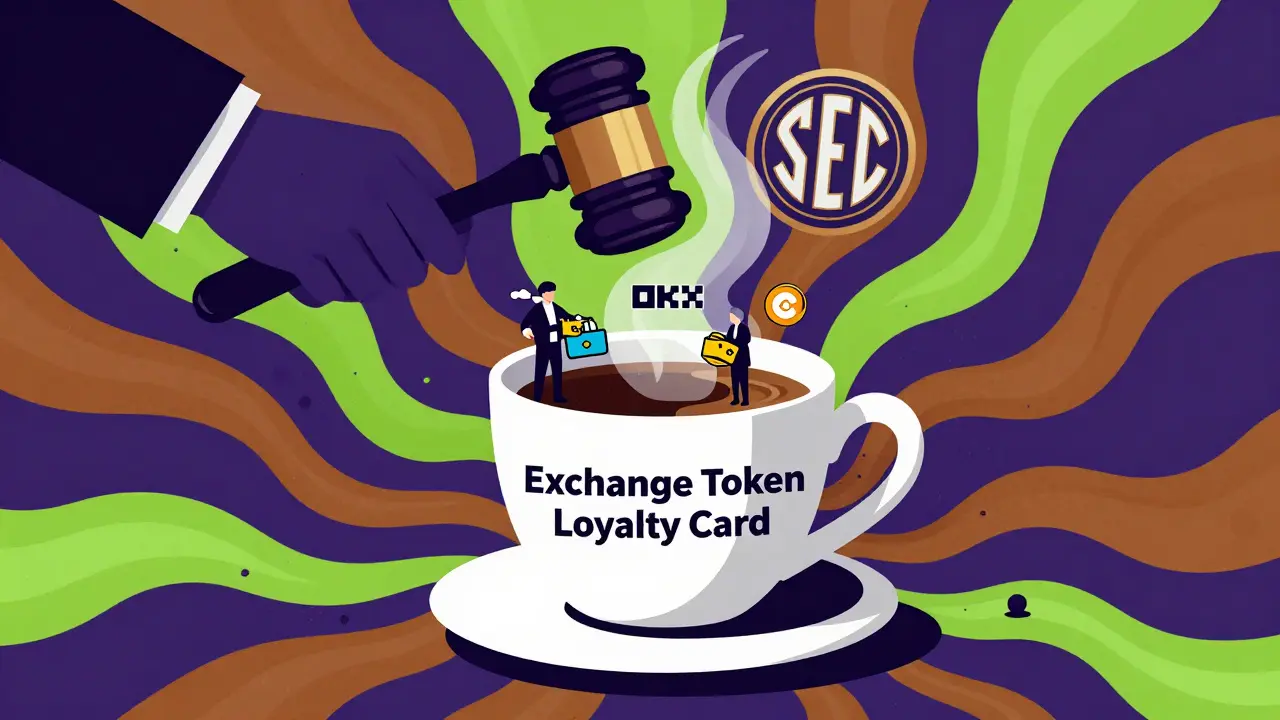
Think of exchange tokens like a loyalty card from your favorite coffee shop. It gives you discounts, but if the shop closes, the card is useless. Keep it handy. Don’t bet your life on it.
Prakash Patel
March 18, 2026 AT 11:33Elizabeth Kurtz
March 20, 2026 AT 06:54john peter
March 21, 2026 AT 06:58Marc Morgan
March 22, 2026 AT 20:11Kira Dreamland
March 24, 2026 AT 13:03shreya gupta
March 26, 2026 AT 07:10Derek Lynch
March 26, 2026 AT 23:13Dionne van Diepenbeek
March 27, 2026 AT 23:50Graham Smith
March 28, 2026 AT 12:35Katrina Smith
March 29, 2026 AT 00:00Lauren J. Walter
March 30, 2026 AT 12:02Carol Lueneburg
April 1, 2026 AT 08:34Brenda White
April 1, 2026 AT 23:01Tobias Wriedt
April 2, 2026 AT 04:23Ernestine La Baronne Orange
April 2, 2026 AT 13:36Manali Sovani
April 2, 2026 AT 20:33Konakuze Christopher
April 3, 2026 AT 06:46S F
April 5, 2026 AT 01:08Angelica Stovall
April 6, 2026 AT 05:26