What is EverRise (RISE) crypto coin? A clear breakdown of its tech, tokenomics, and market reality
EverRise (RISE) isn’t just another crypto coin. It’s a hyper-deflationary token built to solve real problems in decentralized finance - but it’s also one of the most volatile and misunderstood assets out there. If you’ve seen headlines claiming RISE could turn a $1,000 investment into $7 million, you’re not alone. But here’s the truth: the numbers don’t tell the whole story. Let’s cut through the noise and explain exactly what EverRise is, how it works, and what you’re really signing up for.
What is EverRise (RISE)?
EverRise (RISE) is a multi-chain cryptocurrency token designed to stabilize DeFi markets through automatic buybacks and staking rewards. Launched on June 15, 2021, it’s not a standalone blockchain - it runs on five major networks: BNB Chain, Ethereum, Polygon, Fantom, and Avalanche. That means you can hold, trade, or stake RISE on any of these chains, and your balance stays synced across all of them.
Unlike most tokens that just sit on one chain, EverRise was built to move. Its core goal? To make DeFi safer and more accessible. It does this by combining smart contract automation with a unique economic model that rewards holders for holding - not selling.
The RISE Token: Numbers That Matter
RISE has a total supply of 1 quadrillion tokens (1,000,000,000,000,000). That sounds insane - and it is. But here’s the twist: only about 778 trillion are in circulation right now. The rest? Locked, burned, or reserved for protocol use. As of February 2026, around 98% of all RISE tokens have been upgraded to the latest contract version (v3), which improved security and automated functions.
The price? It’s messy. On CoinMarketCap, RISE trades at roughly $0.00001942. On CoinCodex, it’s listed at $0.00005843. Why the difference? Because trading volume is tiny - sometimes under $50 in 24 hours. That’s not a mistake. It’s a sign that RISE is a micro-cap asset, meaning even small trades can swing its price wildly. One day it’s up 15%, the next it’s down 12%. There’s no stable floor, no big institutional buyers. Just retail traders and bots.
The Kraken: How EverRise Auto-Buys Back Its Own Token
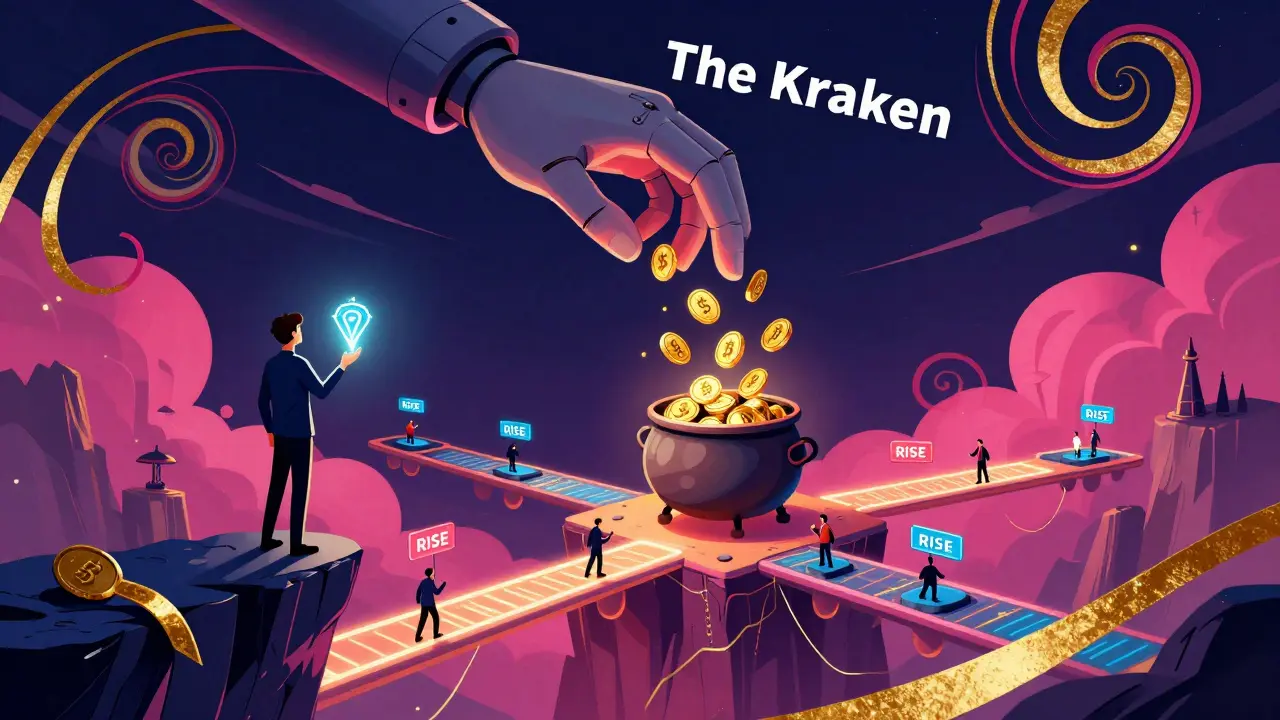
This is where EverRise gets interesting. Every time someone buys, sells, or transfers RISE, a 5% fee is taken. Not sent to a team wallet. Not used for marketing. It goes into something called The Kraken - a smart contract that automatically uses that fee to buy RISE tokens on the open market.
Here’s how it works:
- You sell 1 million RISE tokens.
- A 5% fee ($0.000000971) is pulled from the transaction.
- The Kraken uses that money to buy RISE back from other sellers.
- Those bought tokens are instantly added to the staking reward pool.
This system is designed to reduce sell pressure. Instead of people dumping RISE and crashing the price, a chunk of every sale gets used to buy it back. It’s like having a silent buyer in the market - and it’s happening on all five chains at once.
Staking Rewards: Earn More Just by Holding
When The Kraken buys RISE tokens, they don’t sit idle. They go into a staking pool. If you hold RISE in your wallet, you don’t earn anything. But if you stake it - lock it into an on-chain NFT called an NFT Stake - you start earning a share of every buyback.
Here’s the catch: your reward is weighted. The more RISE you stake, and the longer you hold it, the bigger your slice of the reward pie. These NFT Stakes aren’t locked forever. You can move them between chains, trade them, or even sell them. But if you do, you lose your reward eligibility until you re-stake.
This isn’t just a gimmick. It’s a real incentive. People who believe in RISE are rewarded for not selling. And that’s rare in crypto, where panic dumping is the norm.
The EverRise Ecosystem: More Than Just a Token
RISE isn’t floating alone. It’s the engine behind a whole suite of DeFi tools:
- EverSwap: Lets you swap tokens across chains with 0% slippage. Most cross-chain swaps lose value because of price changes during the transfer. EverSwap avoids that by using RISE as the middleman.
- EverBridge: The tech behind EverSwap. It connects all five blockchains so RISE moves seamlessly between them.
- Wallet Security dApp: Lets you check and revoke token approvals across all five chains from one dashboard. A huge win for safety - many users get hacked because they don’t know which contracts have access to their wallet.
- Anti-Bot Launchpad: Helps new projects launch without getting crushed by bots. Instead of letting bots front-run trades, EverRise’s system charges fees in native coins (like BNB or ETH), not in RISE. That keeps the token price from getting hammered.
- Liquidity Lock DAO: Instead of locking liquidity for a fixed time (like 1 year), this system lets the community vote on when to unlock it. More transparency. Less rug-pull risk.
These aren’t just features. They’re tools solving real pain points in DeFi. And they all depend on RISE working as the backbone.

Market Reality: Speculation vs. Substance
Some sites claim RISE could hit $0.415 - a 700,000% gain. Others say it’s heading to $0.000019. Both can’t be right.
Here’s what we know for sure:
- RISE’s 24-hour trading volume is often under $50. That’s not enough to support real price stability.
- Its market cap hovers around $15 million - tiny compared to Bitcoin’s $1 trillion.
- Price swings of 10-15% in a day are normal. In February 2026, it dropped 12.5% in a week while the broader market only fell 7.1%.
- The Fear & Greed Index shows "Greed" sentiment, but that’s mostly from hype, not fundamentals.
RISE has real tech. It’s not a meme. But it’s also not a stablecoin or a payment coin. It’s a speculative asset with a clever mechanism. The tokenomics are solid. The ecosystem is active. But the market? It’s a casino.
Who Is RISE For?
RISE isn’t for everyone.
If you’re looking for a long-term store of value? Look elsewhere. Bitcoin or Ethereum have real adoption, liquidity, and history.
If you’re a DeFi enthusiast who wants to:
- Support a project with real utility (not just promises)
- Use cross-chain tools without paying high fees
- Stake and earn rewards from automated buybacks
- Accept high risk for a chance at high reward
Then RISE might be worth exploring.
But if you’re hoping to get rich quick? You’re already late. The pump phases are over. What’s left is a slow, technical experiment - and only those who understand the mechanics will survive the next bear market.
Final Thoughts
EverRise (RISE) is one of the few crypto projects that actually built something useful - not just a token with a whitepaper. Its auto-buyback system, cross-chain integration, and staking rewards are real innovations. But none of that matters if no one trades it. And right now, trading volume is dangerously low.
RISE isn’t dead. But it’s not thriving either. It’s surviving - and that’s more than most micro-cap tokens can say.
Is EverRise (RISE) a good investment?
It depends on your risk tolerance. RISE has a solid, functional ecosystem with real use cases like cross-chain swaps and automated buybacks. But it’s a micro-cap token with extremely low liquidity and wild price swings. It’s not a safe investment - it’s a speculative bet on DeFi infrastructure. Only invest what you can afford to lose.
Can I stake RISE on any blockchain?
Yes. RISE is deployed on five blockchains: BNB Chain, Ethereum, Polygon, Fantom, and Avalanche. You can stake your RISE tokens as an NFT Stake on any of them, and your rewards are automatically calculated across all chains. You can even move your stake between chains using EverBridge.
How does the 5% transaction fee work?
Every RISE transaction - whether buying, selling, or transferring - triggers a 5% fee. Half of that fee (2.5%) goes to The Kraken to buy back RISE tokens. The other half (2.5%) goes directly into the staking reward pool. All of this happens automatically. No one controls it. No team can turn it off.
Why is the RISE price so different on different exchanges?
Because trading volume is extremely low. On CoinMarketCap, RISE trades for $0.00001942, but on CoinCodex, it’s listed at $0.00005843. The difference comes from which exchange is reporting the price. Since there are so few trades, even one large order can swing the price dramatically. Always check multiple sources.
Is EverRise a scam?
No, it’s not a scam. The code is open-source, the team has been active since 2021, and the ecosystem is fully operational. The Kraken contract has executed millions of buybacks. Wallet security tools are live. But it’s still a high-risk asset. Low liquidity, high volatility, and speculative price claims make it dangerous for inexperienced investors.
RISE isn’t a miracle. But it’s not a ghost either. It’s a working experiment - and that’s more than most tokens can claim.
Santosh kumar
February 12, 2026 AT 20:11RISE’s auto-buyback system is one of the few DeFi mechanics that actually makes sense. Most tokens are just pump-and-dump schemes, but this? It’s like having a quiet buyer at every trade. Not flashy, but solid. I’ve held since 2022 and never sold - not because I’m dumb, but because the Kraken does the work for me.
Low volume? Yeah. But that’s why it’s still undervalued. Wait for the next bull run - when liquidity finally flows, this could be a sleeper.
Just don’t expect miracles. This isn’t a lottery ticket. It’s a slow-burn tech play.
Claire Sannen
February 13, 2026 AT 12:52For anyone new to RISE: the 5% fee breakdown is critical. Half goes to buybacks, half to staking rewards. That’s not a gimmick - it’s a structural incentive to hold. Most projects take the fee and vanish. EverRise? It’s automated, transparent, and chain-agnostic.
Staking via NFT Stake? Brilliant. It lets you move your position across chains without losing reward eligibility. That’s rare. And the wallet security dApp? Lifesaver. I’ve seen too many wallets drained because users didn’t revoke approvals.
Christopher Wardle
February 13, 2026 AT 21:53It’s not about whether RISE is good or bad. It’s about whether its mechanics are self-sustaining. The Kraken doesn’t need trust. It runs on code. That’s the real innovation.
Market cap is tiny. Volume is negligible. But that’s not a flaw - it’s a feature. Small markets can pivot faster. When DeFi shifts toward cross-chain utility, RISE’s architecture was built for that world. Most others weren’t.
Donna Patters
February 13, 2026 AT 22:22Oh, another "real utility" token. How quaint. Let me guess - you’re also convinced that "decentralized governance" means 3 devs voting on a Discord poll.
RISE trades under $50 a day. That’s not a feature. It’s a death rattle. If you think this is "infrastructure," you’ve never used a real blockchain.
Bitcoin doesn’t need 5 chains to move value. It just works. This? It’s a Rube Goldberg machine built by people who think complexity equals sophistication.
Michelle Cochran
February 15, 2026 AT 12:16People are so desperate to believe in something that they ignore the red flags. Low volume? Check. Wild swings? Check. No institutional backing? Check. And yet somehow, this is "real innovation?"
It’s not about the tech. It’s about the people behind it. Who are they? Where are they now? Why is the team still anonymous on GitHub? Why does the whitepaper sound like a marketing brochure written by a bot?
I’m not saying it’s a scam. I’m saying you’re deluding yourself if you think this is sustainable.
monique mannino
February 17, 2026 AT 10:27Yessss!! 🙌 RISE’s ecosystem is underrated AF. EverSwap? Zero slippage cross-chain? YES PLEASE. I’ve used it to swap from BNB to Polygon and it was smoother than butter. And the wallet security dApp? I caught a malicious approval before it drained my wallet. Saved me $2k.
Volume is low because most people are still chasing memecoins. But the real DeFi OGs? We know. This is the quiet giant. Keep staking. The Kraken is working. 💪
Ekaterina Sergeevna
February 18, 2026 AT 07:08Oh, so now "hyper-deflationary" means "burn 98% of supply and call it innovation?"
Let’s be real - a token with 1 quadrillion supply isn’t deflationary. It’s just inflationary with a fancy name. And staking via NFT? That’s not a feature. It’s a tax on liquidity.
The "anti-bot launchpad"? Cute. Except bots don’t care about RISE fees. They care about ETH and BNB. So you’re just taxing your own community while the real players laugh.
It’s not a project. It’s a spreadsheet with a logo.
Desiree Foo
February 20, 2026 AT 04:50Let me be clear: if you’re holding RISE because you think it’s going to $0.415, you’re not an investor - you’re a gambler. And if you’re telling others to "just hold," you’re being irresponsible.
This isn’t a store of value. It’s not even a utility token. It’s a speculative vessel built on fragile liquidity. And you’re encouraging people to risk their savings on a token with less than $50 in daily volume?
That’s not smart. That’s dangerous. And you should be ashamed.
krista muzer
February 20, 2026 AT 18:37Okay so i just wanna say i started staking RISE last year after reading this post and honestly? i was skeptical but the rewards kept coming. like, i staked 100k RISE and got like 12k back in 6 months just from buybacks. not life-changing, but it’s passive income without selling.
the cross chain thing is wild too. i moved my stake from bnb to polygon and it just worked. no drama. no fees. i didnt even have to think about it.
yeah volume is low. but that just means there’s room to grow. if you’re into tech that actually works, not just hype - this is it. i’m not rich. but i’m not broke either. and i sleep better knowing the kraken is working for me.
Tammy Chew
February 21, 2026 AT 16:30RISE’s biggest strength? It doesn’t pretend to be Bitcoin. It knows it’s niche. And that’s fine. The ecosystem tools are real. EverBridge is quietly one of the most elegant cross-chain solutions out there. No wrapped assets. No bridge hacks. Just synced balances.
Low volume? So what. Most DeFi tokens have zero liquidity. This one has a mechanism that actively fights decay. That’s more than 90% of projects can say.
It’s not for everyone. But for the right person? It’s quietly revolutionary.
Lindsey Elliott
February 21, 2026 AT 21:19Bro the price difference between CoinMarketCap and CoinCodex? That’s not a mystery. It’s because one exchange has 3 trades a day and the other has 5. One bot buys 10M RISE and boom - price jumps 300%.
Don’t fall for the "it’s a tech project" narrative. It’s a micro-cap with a clever marketing spin. Real utility? Maybe. Real adoption? Not even close.
Still, if you wanna gamble on a 1 in 1000 chance? Go ahead. Just don’t act like this is investing.
blake blackner
February 23, 2026 AT 15:02Y’all are overthinking this. RISE isn’t a revolution. It’s a tool. Like a hammer. If you need a hammer, use it. If you don’t? Don’t.
I use EverSwap every week. No slippage. No delays. Just works. The staking rewards? They’re real. I’ve pulled out more than I put in.
Low volume? Yeah. But that’s why it’s still cheap. Wait for the next DeFi surge - when everyone realizes cross-chain liquidity matters - RISE will be the quiet winner.
Just don’t buy because you think it’s gonna moon. Buy because it solves a real problem. And it does.
Andrea Atzori
February 25, 2026 AT 13:14As someone who’s worked in DeFi infrastructure for 8 years, I’ve seen dozens of "innovative" tokens come and go. RISE is one of the few where the tech actually delivers.
The Kraken isn’t just a buyback mechanism - it’s a liquidity sink that reduces sell pressure. That’s not theoretical. It’s been active for 5 years, executing millions of transactions across 5 chains.
Yes, volume is low. But that’s because adoption is still niche. Think of it like Ethereum in 2015 - no one understood it, but the code worked. RISE is the same. The infrastructure is there. The market just hasn’t caught up yet.
Joe Osowski
February 26, 2026 AT 02:58RISE? Sounds like a scammy meme coin with a PowerPoint deck. All this "cross-chain" nonsense? You think the average person cares? No. They want fast, cheap, simple. This? It’s overengineered. Overcomplicated. Overhyped.
And don’t get me started on "NFT staking." That’s just a way to lock people in so you can charge them more. You’re not helping DeFi. You’re monetizing confusion.
If this was real innovation, it’d be on Bitcoin. But it’s not. Because it’s not needed. It’s just noise.