What is Gecko Coin (GECKO) Crypto? The Truth Behind the Token
You type "Gecko Coin" into your search bar, expecting to find the next big thing in crypto. Maybe you saw a ticker symbol like GECKO flashing on a social media feed, promising 100x returns. You click, and suddenly you are confused. Is this the official token of CoinGecko, the massive data platform everyone uses? Or is it just another random meme coin popping up out of nowhere?
Here is the hard truth that might save you from making a bad investment: there is no single, dominant, universally recognized asset called "Gecko Coin." In fact, if you are looking for an official token issued by the famous data aggregator CoinGecko, you won't find one. As of late 2026, CoinGecko remains a service provider, not a token issuer. They track prices; they don’t mint coins.
So, what exactly is this GECKO you keep hearing about? It is likely one of three things: a small-cap meme coin with low liquidity, a scam project trying to piggyback on the CoinGecko brand name, or a very new experimental token that hasn't broken into the mainstream yet. This article breaks down exactly what these tokens are, why the confusion exists, and how to tell the difference between a legitimate project and a trap.
The CoinGecko Confusion: Service vs. Asset
To understand where the name comes from, you have to look at CoinGecko. It is a leading cryptocurrency data aggregation platform founded in 2014 and headquartered in Kuala Lumpur, Malaysia. Think of CoinGecko as the Bloomberg Terminal for crypto enthusiasts, but free and accessible to everyone. Founded by T.M. Lee, the platform tracks over 10,000 cryptocurrencies across hundreds of exchanges.
Because CoinGecko is so ubiquitous in the crypto space, many new projects try to borrow its credibility. They name their tokens "Gecko," "Geko," or "Lizard King" hoping that users searching for the data site will stumble upon their trading pair. This is a classic marketing tactic known as "brand squatting." If you see a token named GECKO, ask yourself: Does the whitepaper mention CoinGecko the company? If not, it’s just using the word gecko as a theme, likely because reptiles are popular in meme culture.
| Feature | CoinGecko (Platform) | Generic GECKO Tokens |
|---|---|---|
| Type | Data Aggregator & Analytics Tool | Meme Coins / Utility Tokens |
| Issuer | CoinGecko Sdn Bhd | Various Anonymous Developers |
| Primary Function | Price Tracking, Portfolio Management | Speculation, Community Engagement |
| Token Existence | No native exchange token (as of 2026) | Yes, multiple variations exist |
Anatomy of a Meme Coin: What Makes GECKO Tick?
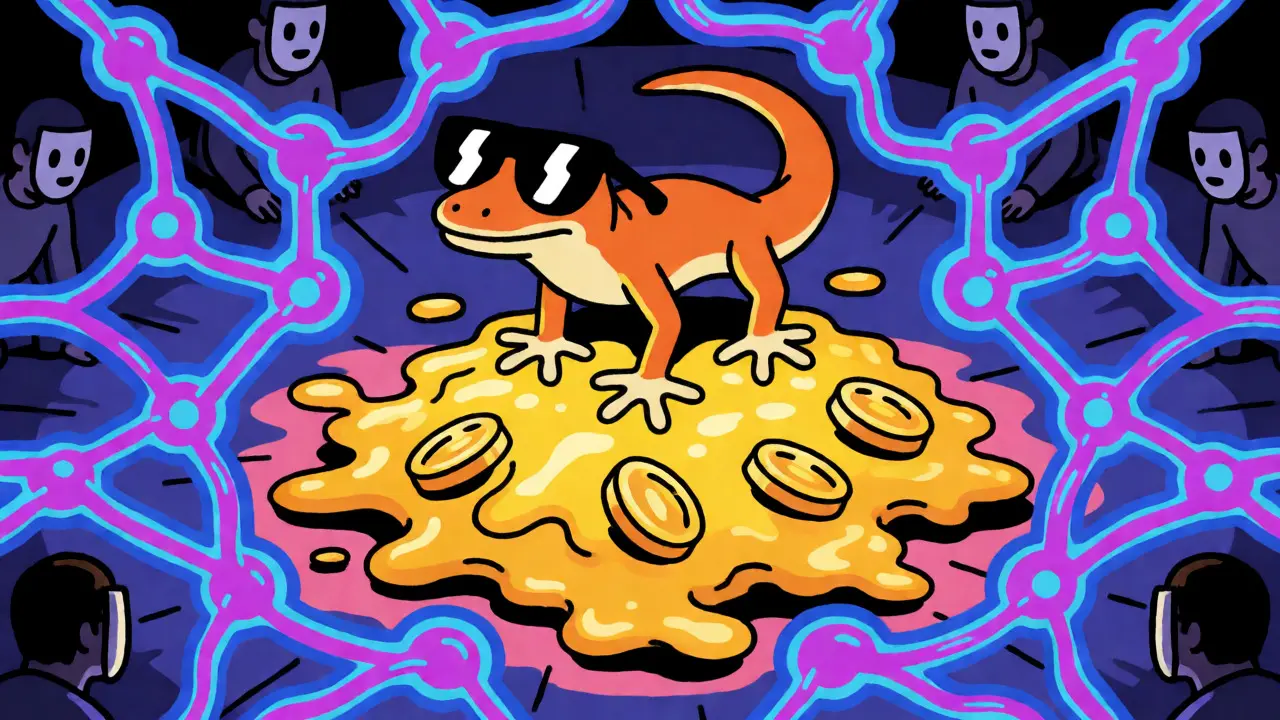
If you found a specific GECKO token on a decentralized exchange like Uniswap or PancakeSwap, you are almost certainly dealing with a meme coin. These tokens rarely have complex technology behind them. Instead, they rely on community hype, viral marketing, and the sheer power of internet culture.
Most GECKO-branded tokens follow a similar structure. They launch on Ethereum or Binance Smart Chain (BSC). Why? Because those chains have the highest volume of retail traders who love meme assets. The supply is usually massive-often in the trillions or quadrillions-to make the price per coin look cheap. Buying 1 million GECKO for $50 feels better psychologically than buying 0.00001 Bitcoin, even if the market cap is the same.
Let's look at typical attributes for these tokens:
- Total Supply: Often fixed at 1 trillion or more to encourage high transaction volumes.
- Contract Address: Unique to each blockchain network. A GECKO on Ethereum is different from a GECKO on Solana.
- Liquidity: Usually locked for a short period (1-3 months) to prevent immediate rug pulls, but often low overall.
- Tax Mechanism: Many include a buy/sell tax (e.g., 5% on transactions) that gets redistributed to holders or sent to a marketing wallet.
The value proposition here isn't utility. You can't pay for coffee with most GECKO tokens. You can't use them to govern a major protocol. Their value is entirely derived from sentiment. If the community believes the frog... er, gecko... is going to the moon, the price goes up. If interest fades, it crashes.
How to Verify a Legitimate GECKO Project
Since there are dozens of tokens with the ticker GECKO, you need a checklist to verify which one you are looking at. Don't trust the logo alone. Scammers copy logos all the time.
First, check the contract address. Go to a block explorer like Etherscan or BscScan. Paste the address. Look at the creation date. Was it created last week? Last year? Older tokens with consistent activity are generally safer bets than ones launched yesterday during a hype cycle.
Second, look at the holder distribution. If the top 10 wallets hold 80% of the supply, that is a red flag. One person could dump their entire position and crash the price by 90%. Ideally, you want to see broad distribution among thousands of small wallets.
Third, check the social proof. Do they have an active Twitter (X) account? A Telegram group with real people chatting, not just bots posting "LFG!"? Check CoinMarketCap or CoinGecko itself. If the token is listed there, it has passed basic verification checks regarding liquidity and trading volume. If it's not listed, it might be too new or too obscure to be trusted easily.
Risks Specific to Niche Tokens Like GECKO
Investing in a token named after a popular data site carries unique risks. The biggest one is confusion. You might buy a GECKO token thinking it gives you premium features on CoinGecko. It doesn't. There is no partnership unless explicitly stated in a verified press release.
Another risk is liquidity fragmentation. Because multiple tokens share the same name, your money is split across different networks. If you buy GECKO on Ethereum, you cannot easily sell it on Solana without bridging assets, which costs fees and takes time. This makes exiting a position harder during a market crash.
Then there is the "rug pull" risk. In meme coin land, developers sometimes hold back a portion of the supply. If they decide to cash out early, they drain the liquidity pool. Your GECKO tokens become worthless because there is no ETH or BNB left in the pool to swap them back. Always check if liquidity is locked using tools like Unicrypt or PinkSale.
Why People Buy Them Anyway
Despite the risks, people keep buying. Why? Because crypto is partly entertainment. For many, trading meme coins is like playing the lottery or watching sports. The thrill of seeing a green candle spike 500% in an hour is addictive.
Also, some GECKO variants do build actual communities. They organize giveaways, create NFT collections, or donate to wildlife conservation charities (playing on the gecko theme). If a token has a clear roadmap beyond just "going up," it stands a slightly better chance of surviving long-term. But remember: survival in meme coin land is rare. Most die within six months.
Final Thoughts on GECKO Crypto
There is no official "Gecko Coin" backed by the CoinGecko corporation. Any GECKO token you encounter is an independent project, likely a meme coin leveraging the recognizable name for visibility. Before you invest, treat it as speculative gambling rather than a fundamental investment. Check the contract, verify the team, and never put in more money than you can afford to lose completely.
Is GECKO the official token of CoinGecko?
No. As of 2026, CoinGecko does not have an official native cryptocurrency token. CoinGecko is a data aggregation platform that provides analytics and tracking services. Any token named GECKO is an independent third-party project, often a meme coin, that is not affiliated with the CoinGecko company.
Where can I buy Gecko Coin (GECKO)?
You typically buy GECKO tokens on decentralized exchanges (DEXs) like Uniswap (for Ethereum-based GECKO) or PancakeSwap (for Binance Smart Chain-based GECKO). Some smaller centralized exchanges may also list specific GECKO variants, but DEXs are the primary source due to the niche nature of these tokens.
Is GECKO a good investment?
It depends on your risk tolerance. GECKO tokens are generally considered high-risk, speculative assets. They lack strong utility and rely heavily on community hype. While they offer potential for high percentage gains, they also carry a significant risk of total loss. It is best suited for experienced traders who understand meme coin dynamics.
How do I distinguish between different GECKO tokens?
Always check the contract address. Different GECKO tokens exist on different blockchains (Ethereum, BSC, Solana, etc.). Use block explorers like Etherscan or BscScan to verify the contract details, creator history, and liquidity locks. Never rely solely on the ticker symbol or logo, as these can be copied by scammers.
Does CoinGecko support GECKO tokens?
CoinGecko lists many GECKO tokens in its database because it tracks over 10,000 cryptocurrencies. However, listing on CoinGecko does not imply endorsement or partnership. It simply means the token meets basic criteria for price tracking and has sufficient trading volume to be displayed.
Kathy Siew
September 7, 2026 AT 16:53omg finally someone said it. i spent like three hours last week trying to figure out if "gecko" was the coin or the website and i felt so stupid lol
the brand squatting thing is real though. scammers are lazy as hell and just copy paste names they think sound legit. if you see a token with a gecko logo on uniswap, run. fast.
also that part about the liquidity being locked for only 1-3 months? yeah that's basically nothing. rug pulls happen in days sometimes not months. be careful out there fam.
Brittany Ross
September 8, 2026 AT 01:00This is such a helpful breakdown! 🦎✨ I honestly get confused by all these similar names too 😅
The point about checking the contract address is super important. I always forget to do that when I'm excited about a new coin. Thanks for reminding us to look at the holder distribution too! 👀📉
Maegan Rust
September 9, 2026 AT 12:36I love how this article breaks down the psychological aspect of meme coins. It’s not just about money; it’s about community and vibes.
When I first started investing, I fell into the trap of thinking every shiny new token had deep utility. But really, some are just digital collectibles wrapped in hype. The comparison to playing the lottery is spot on.
We need to support each other in learning these lessons. Don’t feel bad if you’ve bought a dud before. We’re all learning together. 💚
Also, the wildlife conservation angle mentioned at the end is a nice touch. It gives me hope that some projects actually care about more than just profit.
Jennifer Brosnan
September 11, 2026 AT 02:42It’s funny how everyone acts shocked by this. CoinGecko has never issued a token. Ever. Why would they? They make money from ads and API subscriptions. Issuing a token dilutes their brand equity. It’s basic economics.
The fact that people still fall for this suggests a lack of critical thinking skills in the retail market. We are seeing a massive wave of incompetence.
Also, the table provided is simplistic. It ignores the nuanced relationship between data providers and asset issuers in traditional finance. But whatever, it’s Reddit. Keep chasing those 100x returns while the whales dump on you. 🙄
lea terrade
September 11, 2026 AT 05:55its wild how much trust we place in names rather than substance
i wonder if this reflects a broader societal issue where branding matters more than utility. like why do we believe a company named after a reptile tracks crypto better than a generic spreadsheet?
maybe its because humans are pattern seeking animals. we want simple stories. gecko = safe tracker. gecko coin = magic internet money.
its fascinating and sad at the same time. we crave certainty in an uncertain world so we attach ourselves to symbols.
Rachel Leet
September 11, 2026 AT 08:52Actually, the premise is slightly flawed. While true that CoinGecko doesn't issue a token, several projects have attempted partnerships or integrations that blur the lines.
However, the core argument holds: ticker confusion is rampant.
People buy based on FOMO, not fundamentals. That is the eternal truth of speculative markets.
Those who claim to know which GECKO is "the one" are usually selling something themselves. Trust no one. Especially not influencers pushing low-cap gems.
Sophie Fitzgerald
September 13, 2026 AT 04:39Good info. I was looking at a GECKO token yesterday and couldn't tell if it was legit. Checking the contract address helped. It wasn't listed on CMC so I skipped it.
Ritchie Grogg
September 14, 2026 AT 16:29Oh man, I remember when I bought my first meme coin. I thought I was gonna be rich overnight. I ended up losing like $200 but hey, at least I learned something right? 😂
It’s kinda heartbreaking watching newbies jump in blindly. You just wanna hug them and say "please wait, please read." But nobody listens until they get burned. It’s like watching a car crash in slow motion.
Anyway, thanks for writing this. Maybe it’ll save someone’s wallet today. ❤️
Alexander James
September 16, 2026 AT 02:53It is morally bankrupt to sell dreams to the desperate without disclosing the risks. These projects prey on the vulnerable.
Imagine telling a single mother that her retirement depends on a JPEG of a lizard. It is tragic.
We must advocate for transparency. Not just for profits, but for justice. The current system favors the insiders and punishes the outsiders. It is a rigged casino dressed up as innovation.
Let us demand better standards. Let us refuse to participate in the charade until proper regulations are in place.
Mary Burnett
September 16, 2026 AT 21:46I appreciate the clarity of this post. It is essential for investors to distinguish between service providers and asset issuers.
The distinction regarding CoinGecko's role as a data aggregator versus a potential token issuer is crucial for due diligence.
Furthermore, the advice on verifying contract addresses and holder distributions provides a practical framework for risk assessment.
Thank you for contributing to a more informed community.
Stephen McElreavy
September 17, 2026 AT 11:12From a cultural perspective, the naming convention here taps into the global ubiquity of the gecko motif, heavily influenced by pop culture icons like Gecko from Lizard King fame or even the Geico insurance mascot.
In the decentralized finance (DeFi) ecosystem, semantic saturation occurs rapidly. When a term becomes synonymous with a platform, it creates a 'semantic vacuum' that opportunistic developers fill with derivative assets.
This phenomenon, often referred to as 'naming arbitrage,' exploits the cognitive biases of retail investors who suffer from availability heuristics. They associate the name with reliability rather than conducting fundamental analysis.
Moreover, the fragmentation across Layer 1 protocols (Ethereum, BSC, Solana) exacerbates the liquidity issues mentioned. Cross-chain interoperability remains a significant friction point for retail users attempting to exit positions during high-volatility events.
We must educate our communities on the difference between infrastructure layers and application-layer speculation. Only then can we mitigate the systemic risks inherent in meme-driven capital flows.
Indu Nair
September 18, 2026 AT 21:16Hey everyone! Great discussion going on here! 🌟
I think we need to balance the skepticism with some optimism. Yes, most meme coins fail, but the ones that succeed create massive wealth and community engagement.
Instead of just saying "run," maybe we should teach people HOW to dig deeper. Like, show them step-by-step guides on using Etherscan. Make it accessible!
Let's not discourage newcomers entirely. Encourage them to start small. Start with $10 instead of $1000. Learn the ropes slowly.
And to J Brock, calm down! 😂 We get it, check the contract! But shouting helps no one. Let's be supportive coaches, not drill sergeants. We can guide them gently toward better habits.
Keep sharing knowledge, folks! We rise by lifting others. 🚀💪