What is Gochujangcoin (GOCHU) Crypto Coin? The Meme Coin With Zero Real Utility
GOCHU Value Calculator
Let’s cut to the chase: Gochujangcoin (GOCHU) is not an investment. It’s not a technology breakthrough. It’s not even a serious project. It’s a meme coin built around Korean chili paste - and it’s dying quietly on the blockchain.
If you’re wondering whether GOCHU is worth your time, money, or attention, the answer is simple: no. Not because it’s evil or fake - it’s technically real - but because it has zero substance behind the flashy marketing. It’s a digital novelty with no real use, no community, and no future.
What Exactly Is Gochujangcoin?
Gochujangcoin (GOCHU) is an ERC-20 token launched in 2023 that ties itself to gochujang, the thick, spicy Korean fermented red chili paste. The idea? Use blockchain to promote Korean food culture. Sounds cute, right? Except there’s no actual food business behind it. No restaurants. No partnerships. No product sales. Just a token contract on Ethereum with the address 0x9aAaE745cf2830FB8DDc6248B17436dC3a5E701C.
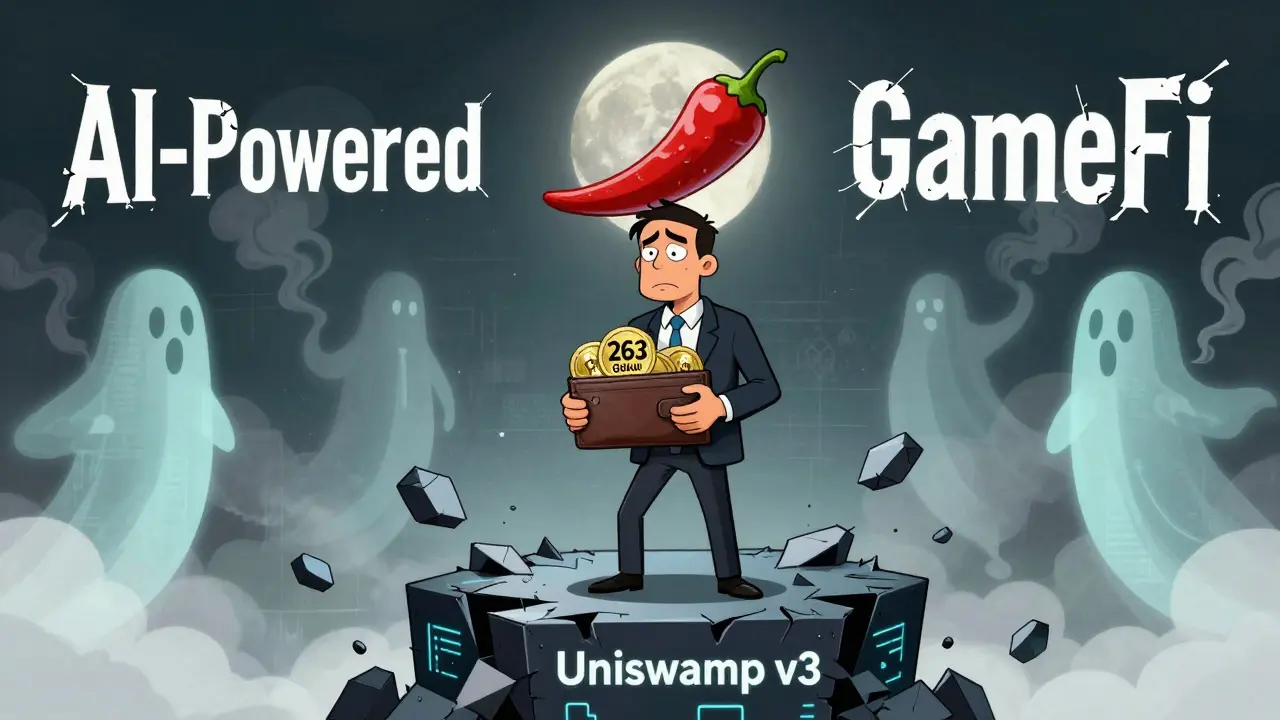
The team behind it is anonymous. No names. No LinkedIn profiles. No public interviews. Just a website with a 3-page “litepaper” full of buzzwords like “GameFi,” “DeFi,” and “AI-powered Web3 solutions.” None of those things exist. No apps. No smart contracts for gaming. No DeFi staking pools. No AI tools. Just promises.
How Much Is GOCHU Worth?
The price of GOCHU is all over the place because no one is trading it seriously. CoinLore says it’s worth $0.0000006. LiveCoinWatch says $0.000000375. CoinGecko shows a 6% drop over seven days - while the rest of the crypto market barely moved.
Here’s the weirdest part: its market cap is listed between $3 million and $6.6 million. That sounds like a lot - until you realize it’s based on a circulating supply of over 263 billion tokens. That’s more than 263,000,000,000 coins. So each one is practically worthless. You’d need millions of them to buy a coffee.
Compare that to Dogecoin, which has a 140 billion supply and a $12 billion market cap. GOCHU’s entire value is less than 0.05% of Dogecoin’s. And Dogecoin has Elon Musk tweeting about it. GOCHU has… a Telegram group with 873 members, and only two messages posted per day.
Where Can You Buy GOCHU?
You can only buy GOCHU on Uniswap v3 (Base). That’s it. No Coinbase. No Binance. No Kraken. Not even Bitget, which lists it but admits: “The value of GOCHU is not widely recognized by the market.”
Buying it means you need a Web3 wallet like MetaMask or Trust Wallet. You need ETH to pay gas fees - around $2.37 per transaction. Then you have to manually enter the token contract address. Most beginners get lost here. And even if you buy it, you can’t easily sell it.
Why? Because daily trading volume is around $5,500. That’s less than the cost of a decent laptop. Try to sell $1,000 worth of GOCHU? The price will crash. Slippage will eat your profits. You’ll end up selling for pennies. Users on CryptoSlate’s forums report the same thing: “Impossible to sell without massive slippage.”
Who Holds GOCHU?
There are only 128 known wallets holding GOCHU, according to Etherscan. The top 10 wallets control 73.6% of the total supply. That’s extreme centralization. One person could dump their holdings and crash the price in minutes.
There’s no transparency. No audits. No public roadmap. The team posted a “Q4 2024 update” on X (formerly Twitter) promising “AI integration.” Nothing happened. No code. No demo. No GitHub repository. No developer activity. Just a tweet.
Reddit’s r/CryptoCurrency has a thread from October 2024 that calls the whitepaper “marketing-heavy with minimal technical substance.” The consensus? It’s a vanity project.
Why Does GOCHU Even Exist?
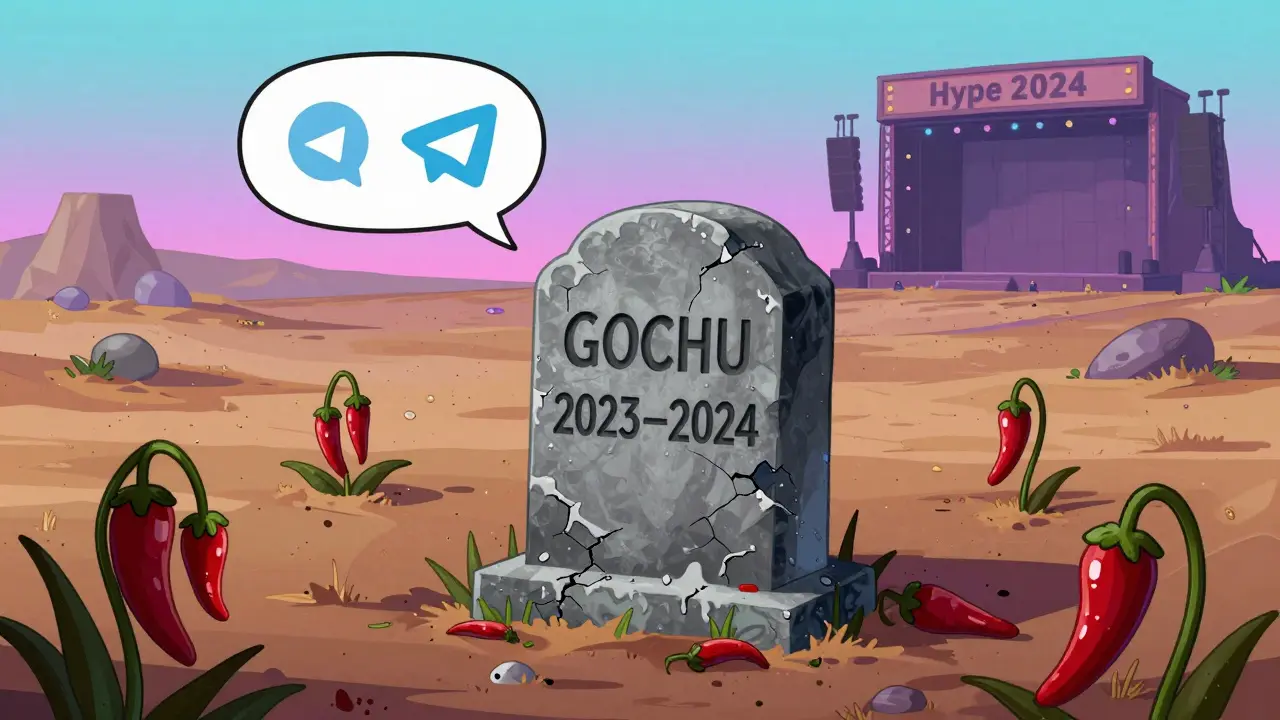
It exists because someone thought a meme coin based on spicy paste could go viral. And for a few weeks in early 2024, it did. A handful of Korean food bloggers shared it. A few crypto influencers posted about “cultural tokens.” Then the hype faded.
There’s no utility. No real-world use case. No business model. The project claims to reward users for sharing gochujang recipes. But how many people are actually doing that? Zero verified examples exist. No receipts. No photos. No follow-up stories.
It’s a cultural gimmick with no cultural impact. Unlike Dogecoin, which became a symbol of internet humor and community charity, GOCHU doesn’t even have a mascot. No dog. No shiba. No meme. Just a jar of chili paste.
Experts Say It’s Doomed
Dr. Elena Rodriguez, a blockchain analyst at Delphi Digital, wrote in her November 2024 newsletter: “Culturally-themed meme coins like GOCHU typically have 90-day lifespans unless they establish genuine utility beyond novelty.” She pointed to Kimchi Token (KIMCHI), a similar project that vanished after six months.
Messari’s 2025 Crypto Theses report calls projects like GOCHU “high-risk speculative assets with >95% failure probability within 18 months.” Bitget’s December 2024 analysis says it has “extremely limited prospects.”
And here’s the kicker: the SEC’s February 2024 guidance on meme coins warns that tokens with massive initial supplies and vague utility claims could be classified as unregistered securities. GOCHU fits that description perfectly.
Should You Invest in GOCHU?
No.
Not because it’s a scam - though it’s dangerously close - but because it has no future. You’re not buying a technology. You’re not buying a community. You’re not even buying a joke with legs. You’re buying a digital artifact that’s already forgotten.
If you’re looking for meme coins with real traction, look at Dogecoin or Shiba Inu. They have exchanges, wallets, apps, communities, and even charity projects. GOCHU has a website with broken contact forms and a Telegram group that hasn’t had a meaningful conversation in months.
Even if you’re just curious, don’t waste your time or money. The gas fee alone to buy one token is more than its value. And when you try to sell, you’ll lose money.
What Happens Next?
Nothing.
GOCHU is a dead project walking. No updates. No new features. No team activity. No media coverage. No exchange listings. No community growth. The only thing growing is the number of holders who realize they made a mistake.
If you already own GOCHU, your best move is to cut your losses. If you’re thinking about buying it - don’t. It’s not a gamble. It’s a trap dressed up as a cultural movement.
The crypto world is full of wild ideas. Most fail. GOCHU isn’t even trying to win. It’s just floating there - a spicy footnote in blockchain history.
Is Gochujangcoin (GOCHU) a real cryptocurrency?
Yes, technically. GOCHU is a real ERC-20 token on the Ethereum blockchain with a verified contract address. But being "real" doesn’t mean it’s valuable, functional, or legitimate. It has no utility, no team transparency, and almost no trading activity - making it a dead asset in all practical senses.
Can I buy GOCHU on Coinbase or Binance?
No. GOCHU is only available on decentralized exchanges like Uniswap v3 (Base). It is not listed on any major centralized exchanges including Coinbase, Binance, Kraken, or Bitget. You need a Web3 wallet like MetaMask and ETH for gas fees to even attempt a purchase.
Why is the GOCHU price so low?
The price is low because there are over 263 billion GOCHU tokens in circulation. Even with a $5 million market cap, each token is worth less than a fraction of a cent. The tokenomics are designed for volume, not value - a common trap in meme coins where supply is inflated to make market cap numbers look impressive.
Is GOCHU a good investment?
No. GOCHU has no real-world use, no team accountability, no liquidity, and no community growth. Experts and exchanges classify it as a high-risk, low-probability asset. The chances of it gaining value are near zero. Any money spent on it is likely lost.
Does GOCHU have any AI or GameFi features?
No. The project claims to use AI-SaaS tools and GameFi applications, but there is zero public evidence of these features. No apps, no code on GitHub, no demos, no user reports. These claims appear to be marketing fluff with no technical backing.
How many people hold GOCHU?
Only about 128 wallets hold GOCHU, according to Etherscan data. The top 10 wallets control over 73% of the total supply, meaning a small group could manipulate the price at any time. This level of centralization is a major red flag in crypto.
What happened to the GOCHU team?
The team is anonymous and has been silent since late 2024. Their last public update was a vague Twitter post promising "AI integration" - which never materialized. Their website has no contact form, no blog, and no developer updates. They’ve effectively abandoned the project.
Is GOCHU at risk of being shut down by regulators?
Yes. The SEC’s 2024 guidance on meme coins flags tokens with massive initial supplies and unverified utility claims as potential unregistered securities. GOCHU fits that profile exactly. While it hasn’t been targeted yet, its obscurity doesn’t protect it - regulators monitor even the smallest projects.
Scot Sorenson
December 13, 2025 AT 04:54So let me get this straight - someone made a crypto coin out of spicy paste and thought it’d go viral? Bro, I’ve seen worse, but this is like naming a stock ‘KetchupCoin’ and expecting Warren Buffett to invest. The only thing this project is fermenting is regret.
Sarah Luttrell
December 13, 2025 AT 08:07Oh my god. 🤦♀️ This isn’t a meme coin - it’s a cultural slapstick routine. You can’t just slap ‘Korean food’ on a token and call it ‘innovation.’ We’re not in 2021 anymore where you could pump a JPEG of a monkey and call it a DAO. This is just… sad. Like, ‘I spent $200 on this and now I’m crying into my kimchi’ sad.
Sue Gallaher
December 15, 2025 AT 06:29Why are people still talking about this I mean come on it's just a jar of chili sauce on a blockchain what's next SrirachaCoin
Stanley Machuki
December 16, 2025 AT 04:03Bro if you bought GOCHU you're already rich in memes
Rakesh Bhamu
December 18, 2025 AT 03:13Interesting case study in how cultural symbolism without real utility collapses under its own weight. The team clearly misunderstood blockchain’s role - it’s not a magic wand for branding, it’s a tool for decentralization. This is like trying to use a microscope to toast bread.
Tiffany M
December 18, 2025 AT 15:57As a Korean-American, I’m actually offended. We have real food culture - gochujang is sacred, not a marketing gimmick. This coin doesn’t honor our heritage, it exploits it. If you want to support Korean food, buy from actual restaurants. Not some anonymous dev with a 3-page PDF.
Hari Sarasan
December 18, 2025 AT 20:36Let us analyze the tokenomics through a systemic lens: the hyperinflationary supply curve, combined with the absence of verifiable smart contract functionality and the non-existence of any DeFi liquidity layer, creates a pathological arbitrage vacuum. The project exhibits all hallmarks of a speculative entropy sink - a black hole of capital with zero entropy return. This is not a coin. It is a cryptographic entropy paradox.
Lloyd Cooke
December 19, 2025 AT 03:28There’s a quiet tragedy here - not in the collapse of value, but in the delusion of meaning. We’ve turned culture into a ticker symbol, and now we’re surprised when the symbol evaporates. GOCHU isn’t dead because it failed - it died because we never gave it life. We only gave it a name and a contract address and called it art.
Kurt Chambers
December 20, 2025 AT 08:13USA best crypto nation bro why are we letting some koreans make meme coins outta food i mean come on this is america we make coins outta doge and pepe not chili paste
Kelly Burn
December 20, 2025 AT 19:17Imagine if we had a Web3 AI-powered gochujang recipe NFT marketplace with DeFi staking rewards and GameFi cooking battles 🤖🔥🌶️ Imagine the potential!!! Wait… that’s not real? 😭
John Sebastian
December 22, 2025 AT 16:34People who invest in this deserve to lose everything. This isn’t risk. It’s stupidity dressed up as innovation.
Jessica Eacker
December 23, 2025 AT 21:53You know what? It’s okay to laugh at this. But don’t laugh at the people who bought it. They just believed in something weird. Maybe next time they’ll believe in something better.
Madison Surface
December 25, 2025 AT 08:17Can we talk about how wild it is that someone thought this would work? Like, I get meme coins - Dogecoin had Elon, Shiba had a whole ecosystem. But GOCHU? There’s no joke. No mascot. No community. Just a jar of paste and a prayer. It’s not even a bad meme. It’s just… empty.
Eunice Chook
December 26, 2025 AT 16:15Market cap of $6M with 263B tokens? That’s not a coin, that’s a math error. Someone’s clearly trying to inflate the number to make their LinkedIn profile look good. The only thing this project is ‘integrating’ is delusion.
Ian Norton
December 27, 2025 AT 00:08Let’s not sugarcoat this. The top 10 wallets hold 73% of supply. That’s not decentralization - that’s a rug pull waiting to happen. And the fact that the team hasn’t posted since late 2024? Classic. I’ve seen this script before. The only thing that’s changed is the sauce.
Joey Cacace
December 28, 2025 AT 07:21Thank you for this incredibly thorough breakdown. I appreciate the clarity and care you’ve taken to expose the reality behind this project. It’s easy to get swept up in the noise of crypto, but posts like this remind us to prioritize substance over spectacle. Truly well-researched and deeply appreciated. 🙏
Kurt Chambers
December 29, 2025 AT 08:44u/JoeyCacace you sound like a corporate lawyer who just found out crypto exists. chill. it’s a joke. not a thesis. we’re not here to build a museum for spicy paste.