ASIC Resistance in Cryptocurrencies: How to Keep Mining Decentralized
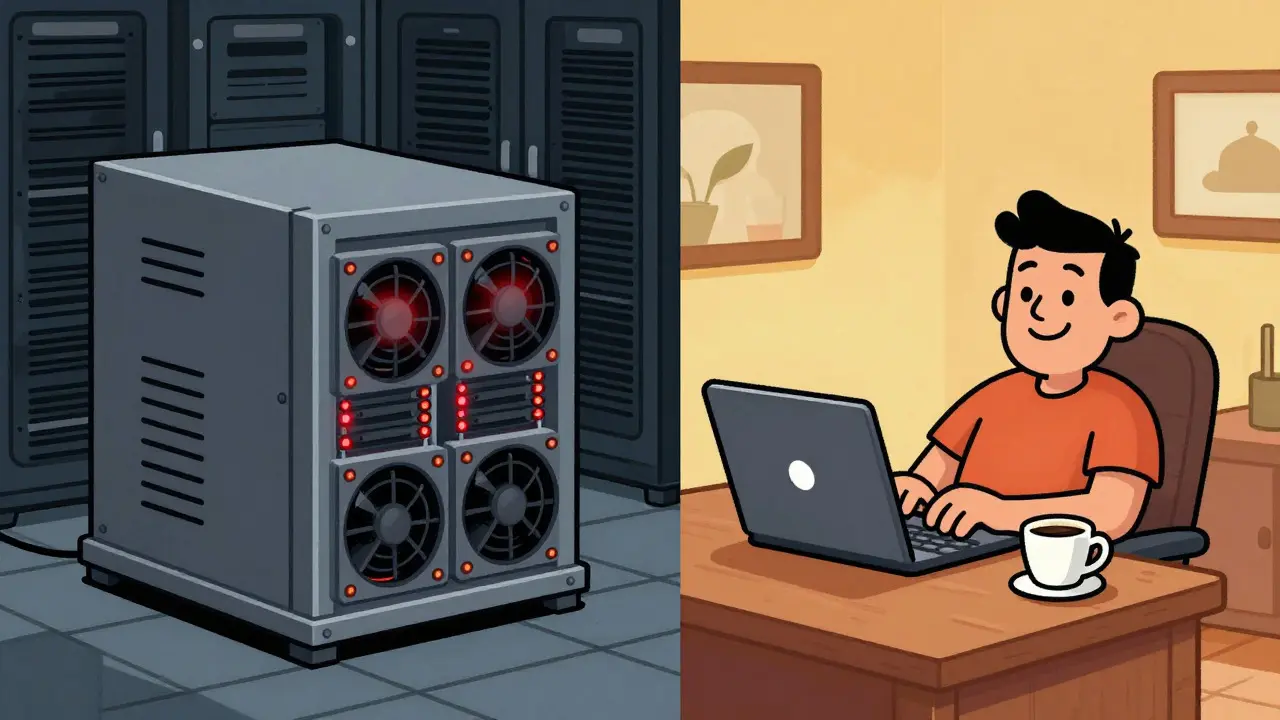
Imagine trying to win a race where the other runners are on jet skis. That’s what it feels like for regular people trying to mine Bitcoin today. The network is dominated by specialized machines called ASICs (Application-Specific Integrated Circuits) that crush general-purpose hardware. But not all cryptocurrencies play by these rules. Some are built with a specific feature designed to level the playing field: ASIC resistance.
ASIC resistance is a deliberate design choice in a blockchain's mining algorithm. Its goal? To make those super-efficient, expensive chips less useful or even obsolete, allowing everyday computers and graphics cards to stay competitive. If you've ever wondered why some coins can be mined on your laptop while others require an industrial farm, this is the answer.
Why Do We Need ASIC Resistance?
To understand the "why," we have to look at what happens when one type of hardware takes over. When Bitcoin introduced its SHA-256 algorithm, it was easy to mine on CPUs. Then GPUs took over. Finally, around 2013-2014, ASICs arrived. These chips do one thing: solve the SHA-256 puzzle incredibly fast. Today, an ASIC miner is roughly a million times faster than a desktop PC for Bitcoin mining.
This creates a centralization problem. Only companies with deep pockets can afford thousands of these machines. Individual miners get pushed out. The result? Mining power concentrates in a few large operations, which contradicts the core idea of a decentralized network. ASIC resistance aims to prevent this monopoly by ensuring that no single piece of hardware has an overwhelming advantage.
| Coin / Algorithm | Hardware Type | Efficiency Advantage | Accessibility |
|---|---|---|---|
| Bitcoin (SHA-256) | ASIC | ~1,000,000x vs CPU | Very Low (Industrial only) |
| Ethereum Classic (Etchash) | GPU / ASIC | Moderate (ASICs emerging) | Medium (High-end GPUs) |
| Monero (RandomX) | CPU | Low (CPU optimized) | High (Any modern PC) |
How Algorithms Defeat Specialized Chips
So, how do you trick a chip into being inefficient? It usually comes down to memory. Most basic hashing algorithms are simple math problems. ASICs are great at math. But if you add a requirement for massive amounts of random data access-specifically RAM bandwidth-the game changes.
Building a chip with enough high-speed memory is expensive and technically difficult. This makes the cost of producing an ASIC skyrocket, often making it unprofitable compared to just using off-the-shelf computer parts. This concept is known as a "memory-hard function."
- Memory-Hard Functions: Algorithms like CryptoNight (used by Monero) require significant RAM to solve puzzles. Since adding huge amounts of RAM to a small ASIC chip is costly, regular CPUs remain competitive.
- Algorithm Variability: Some coins change their hashing process periodically. If the rule changes every month, building a dedicated chip becomes risky because it might become useless next quarter.
- Storage-Focused Mechanisms: Projects like Chia use proof-of-space, requiring users to allocate hard drive space rather than compute power, effectively bypassing traditional mining hardware entirely.
The Standout: Monero and RandomX
If there is one coin synonymous with ASIC resistance, it’s Monero, often abbreviated as XMR. Monero is a privacy-focused cryptocurrency that has made decentralization its top priority. In November 2019, the team switched to a new algorithm called RandomX.
RandomX is fascinating because it doesn't just rely on memory; it uses virtualization technology to create unpredictable execution paths. This makes it nearly impossible to optimize for with static hardware logic. The result? You can mine Monero on any modern x86-64 computer. You don’t need a fancy graphics card. You don’t need a server room. A standard laptop with 4GB of RAM can participate in securing the network.
According to recent data, a mid-range CPU like an Intel i7-12700K can generate between $0.45 and $0.85 daily mining Monero. It’s not a fortune, but it’s not zero. For Bitcoin, that same CPU earns exactly nothing. This accessibility keeps Monero’s network highly distributed, with thousands of active nodes worldwide contributing to its security.
The Arms Race: Is Resistance Permanent?
Here’s the catch: ASIC resistance isn’t a permanent shield. It’s a defensive stance. As soon as a coin gains value, engineers start looking for ways to beat the algorithm. This creates an ongoing arms race.
We’ve seen this happen before. Zcash started with Equihash, which was considered ASIC-resistant. But eventually, specialized miners appeared, sparking debate in the community. Ethereum Classic (ETC), which continued using the Ethash algorithm after Ethereum moved to Proof-of-Stake, also faced challenges. By 2023, new ASIC models began targeting ETC, causing profitability for GPU miners to drop significantly overnight.
Experts are divided on the long-term viability of this approach. Andreas Antonopoulos, a prominent Bitcoin educator, has argued that if a coin is valuable enough, someone will build an ASIC for it. On the other side, Monero developers argue that constant updates and hard forks can keep the network safe. They view ASIC resistance as critical to maintaining a truly democratic currency.
Practical Steps for Miners
If you want to try your hand at mining an ASIC-resistant coin, here is what you need to know. The barrier to entry is much lower than for Bitcoin or Ethereum (pre-merge).
- Check Your Hardware: For Monero, you need a 64-bit processor and at least 2GB of RAM (4GB recommended). For older GPU-based coins, you’ll need graphics cards with 4GB+ of VRAM.
- Download Official Software: Avoid shady third-party tools. Use the official wallet or well-known open-source miners. For Monero, the official GUI software allows you to start mining within 30 minutes.
- Join a Pool (Optional):strong> Solo mining is possible but luck-dependent. Joining a mining pool guarantees smaller, more frequent payouts. Pools like MinerGate support multiple ASIC-resistant coins.
- Monitor Updates: This is crucial. When a project performs a hard fork to update its algorithm (like Monero did in 2019), you must update your software quickly. Failure to do so means your hardware stops working until you fix it.
Profitability depends heavily on electricity costs. In regions with cheap power, mining Monero or similar coins can cover your energy bill. In high-cost areas, it might be more of a hobby than a revenue stream. Always use a calculator to check current rates before plugging in your rig.
Market Context and Future Outlook
As of late 2023, the combined market capitalization of major ASIC-resistant coins like Monero, Ethereum Classic, Vertcoin, and Ravencoin sits around $3.2 billion. While this is a small fraction of the total crypto market, it represents a dedicated segment of investors who prioritize decentralization over raw speed.
Monero leads this group with a market cap exceeding $2 billion. It has consistently ranked in the top 30 cryptocurrencies since 2017, proving that there is sustained demand for privacy and accessible mining. However, regulatory scrutiny is increasing. Authorities sometimes target these coins because they are harder to trace and easier for individuals to mine without leaving a digital footprint typical of large corporate farms.
Looking ahead, analysts suggest that ASIC resistance will remain most relevant for privacy coins and smaller networks. For massive, high-value networks, the economic incentive to build powerful ASICs is too strong to ignore permanently. Yet, for projects committed to grassroots participation, the fight continues. New technologies like ProgPoW (Programmatic Proof-of-Work) are being developed to further entrench GPU advantages, showing that innovation in this space is far from over.
What is the best ASIC-resistant cryptocurrency to mine in 2026?
Monero (XMR) remains the most popular choice due to its RandomX algorithm, which is optimized for CPUs and requires minimal setup. Ethereum Classic is another option for GPU owners, though it faces increasing competition from newer ASIC models. Always check current profitability calculators before starting.
Can I mine Monero on my laptop?
Yes, absolutely. As long as your laptop has a 64-bit processor and at least 2GB of RAM, it can run the RandomX algorithm. Just ensure your laptop is well-ventilated, as mining puts a load on the CPU and can increase temperatures.
Is ASIC resistance guaranteed to last forever?
No. It is a continuous battle. If a coin becomes extremely valuable, ASIC manufacturers will likely develop specialized hardware to overcome the resistance. Projects must regularly update their algorithms through hard forks to maintain fairness.
What is the difference between ASIC-friendly and ASIC-resistant coins?
ASIC-friendly coins, like Bitcoin, use algorithms that are easily optimized for specialized chips, leading to centralized mining by large corporations. ASIC-resistant coins use complex algorithms that favor general-purpose hardware like CPUs and GPUs, keeping mining accessible to individuals.
Do I need a mining pool to mine ASIC-resistant coins?
It is not strictly necessary, but it is recommended. Solo mining relies on luck to find blocks, which can take weeks or months for individual miners. Pools combine the power of many miners to provide consistent, smaller rewards.
Dina Lazarova
August 25, 2026 AT 05:51One must observe the sheer audacity of this narrative. It is, quite frankly, a tedious attempt to romanticize what is essentially a dying technology. The premise that we need to keep mining decentralized for the sake of 'democracy' is a pretentious notion held by those who refuse to accept that efficiency is the only metric that matters in modern economics. We are not building a commune; we are participating in a global financial infrastructure where speed and finality reign supreme. The idea that a laptop owner should have an equal say in network security as a multi-gigawatt facility is, at best, charmingly naive and, at worst, dangerously inefficient. Let us not confuse moral posturing with engineering reality.
Alexander Scheel
August 27, 2026 AT 02:46Sarcasm aside, the centralization argument is the only one that holds water here. If you look at the hash rate distribution, it’s laughable how much power sits in the hands of three or four entities. ASIC resistance isn’t just about fairness; it’s about survival. Without it, the network becomes a single point of failure controlled by whoever has the deepest pockets. It’s a moral imperative to prevent oligarchy from taking over the ledger, no matter how 'inefficient' the solution might seem to your elitist sensibilities.
manish jha
August 28, 2026 AT 10:10You speak of morality, but you ignore the economics. In my experience, when you force hardware inefficiency, you do not create democracy; you create instability. The market will always seek the most efficient path. Trying to hold back progress with algorithmic tweaks is like trying to stop the tide with a bucket. The true guru knows that adaptation, not resistance, is the key to longevity in any system, biological or digital.
Ashley Snyder
August 30, 2026 AT 07:57I think there's a middle ground here. I don't think we need to be super purists about it. For me, the biggest win is just knowing that if I want to try mining, I don't need to drop $50k on a rig. It's nice to have options. Plus, privacy coins feel important right now with all the data breaches happening. So yeah, maybe it's not perfect, but it keeps the door open for regular people.
alex fordy
September 1, 2026 AT 03:07Absolutely! 🌟 It’s fascinating how the definition of 'mining' has shifted from a race for speed to a battle for accessibility. I’ve been thinking a lot about this lately-how does decentralization actually serve the individual user? It’s not just about the tech specs; it’s about who gets to participate in the consensus. When you lower the barrier to entry, you aren’t just changing the hardware requirements; you’re changing the social contract of the network. It makes the system feel less like a corporate machine and more like a community effort. And honestly, that human element is what gives these networks their resilience. 💪
Marco Maldonado
September 2, 2026 AT 06:09Let's be real. This whole thing is a US problem because we're too soft on regulation. Look at China. They banned mining for years and guess what? The industry didn't die, it just moved. But here in America, we're worried about laptops mining while the big boys are buying up land in Texas. It's about national strength. If we want to lead in crypto, we need to let the best hardware win. Why would we punish efficiency? It's stupid. Just use the best chips. That's how we build things. Stop crying about decentralization and start winning.
Dianne Ritter
September 2, 2026 AT 14:36While the national angle is interesting, I think the technical reality is simpler. If the algorithm changes, the old hardware becomes e-waste. That's a huge environmental cost that often gets ignored in these debates. We talk about decentralization, but we rarely talk about the lifecycle of the machines themselves. A GPU lasts longer than an ASIC that becomes obsolete in six months. So, in a way, ASIC resistance might actually be better for the planet, even if it's slower.
Calliope Clio
September 3, 2026 AT 07:00Dramatic sighs all around. 😩 One would think that by now, we would have moved past the primitive notion that 'anyone' can mine. It’s a quaint fantasy, really. The era of the bedroom miner is dead, buried under the weight of industrial-scale efficiency. Yet, here we are, pretending that a CPU with 4GB of RAM is a meaningful participant in the global economy. It’s adorable, in a tragic sort of way. We cling to these relics of decentralization like children holding onto a security blanket, refusing to see that the future belongs to the optimized, the fast, and the cold. 📉
Kelsey Anne
September 5, 2026 AT 02:53You're wrong. Efficiency isn't everything. Security is. If one company controls 51% of the hash rate, they can double spend. That's a fact. ASIC resistance prevents that monopoly. It's not about being slow. It's about being safe. Don't argue with math.
Rod Sidoroff
September 5, 2026 AT 23:06The math is simple, yet so many miss the point. Centralization is a risk vector. Period. Whether you like it or not, the concentration of hashing power creates a single point of failure that is both economic and political. When you look at the history of Bitcoin, every major shift in hardware capability led to a consolidation of power. ASIC resistance is merely a tool to delay that consolidation, buying time for the ecosystem to mature. It is not a permanent solution, but it is a necessary friction. To dismiss it as 'inefficient' is to misunderstand the fundamental trade-offs of distributed systems. You are trading raw throughput for resilience, and in a world of adversarial actors, resilience is worth far more than speed.
Jennifer Ulmer
September 6, 2026 AT 05:10I agree with the idea that we need different types of tools for different jobs. I don't think one size fits all. Some people want the fastest coin, some want privacy, some want to just tinker with their computer. Having options is good. It keeps the space interesting. I just hope the energy costs stay down for everyone, because that's the part that worries me most.
Stephanie Millar
September 8, 2026 AT 00:38It is, however, rather important to note that the cultural context varies significantly across borders. In the UK, for instance, the electricity rates have made home mining somewhat prohibitive, regardless of the hardware used. Therefore, the debate on ASIC resistance must also consider the socio-economic factors of the region in question. One cannot simply assume that low barriers to entry translate directly into high participation rates without accounting for local utility costs. It is a nuanced issue, indeed. Furthermore, the regulatory landscape in Europe tends to be stricter regarding energy consumption, which adds another layer of complexity to the equation. Thus, the 'global' nature of these networks is often a misnomer, as local conditions dictate the practical viability of such activities. We must remain mindful of these disparities.