Benefits of Blockchain Interoperability
Imagine you own a digital asset on Ethereum, but you want to use it in a game built on Solana. Or maybe you have Bitcoin tokens and need to pay for a service on a blockchain that doesn’t even recognize Bitcoin. Without blockchain interoperability, you’d be stuck. You’d need to sell your asset, move it through a centralized exchange, wait for confirmation, then buy something new on the other chain. It’s slow, expensive, and risky. That’s why blockchain interoperability isn’t just a tech buzzword-it’s the missing link that’s turning fragmented blockchains into a connected ecosystem.
Seamless Cross-Chain Transactions
Before interoperability, moving assets between blockchains meant jumping through hoops. You had to trust a custodian, pay high fees, and wait hours for settlements. Now, with protocols like Chainlink’s CCIP and Cosmos’ IBC, you can send tokens directly from one chain to another without a middleman. A user in Tokyo can send USDC from Polygon to a DeFi protocol on Avalanche in under a minute, with fees under $0.10. This isn’t theoretical-it’s happening right now. Projects like Polkadot’s XCM and LayerZero are making cross-chain swaps as simple as sending an email. No more bridging through centralized exchanges. No more slippage from manual swaps. Just direct, trustless transfers.Fostering Innovation with Multi-Chain dApps
Developers aren’t stuck choosing one blockchain anymore. With interoperability, they can build apps that use Ethereum for its security and smart contract tools, Solana for fast, cheap transactions, and Filecoin for decentralized storage. A DeFi platform might use Arbitrum for low-cost lending, while its NFT marketplace runs on Polygon for faster minting. This mix-and-match approach lets developers pick the best tool for each job. The result? Apps that are faster, cheaper, and more reliable than anything built on a single chain. We’re already seeing this with protocols like Synapse and Stargate, which let users interact with liquidity pools across 20+ chains from one interface.Enhancing Scalability Through Distributed Workloads
Ethereum’s congestion in 2021 taught us a hard lesson: one blockchain can’t handle everything. Interoperability solves this by spreading the load. Instead of forcing all DeFi, gaming, and enterprise apps onto Ethereum, each can run on its own optimized chain. A supply chain app might use a private Hyperledger network. A gaming platform could run on a dedicated chain with 10,000 TPS. These chains talk to each other through interoperability hubs, so users still experience a unified system. This isn’t just theory-Cosmos and Polkadot were built from the ground up for this model. They’re already handling over 1.2 million cross-chain messages daily. The blockchain ecosystem is no longer a single highway-it’s a network of specialized roads that connect seamlessly.Greater Liquidity Across DeFi Markets
Liquidity is the lifeblood of DeFi. But right now, liquidity is scattered. Ethereum has $20 billion in locked value. Solana has $3 billion. Polygon has $1.8 billion. These pools are isolated. Interoperability changes that. When assets can move freely, liquidity pools merge. A user can stake ETH on Aave, borrow USDT on Compound, then instantly use that USDT to trade on a DEX on Binance Smart Chain-all without leaving their wallet. This creates deeper pools, tighter spreads, and less slippage. A 2025 report from Messari showed that interoperable DeFi protocols saw 40% higher trading volume and 30% lower price impact than isolated ones. That’s not a small edge-it’s a game-changer for traders and liquidity providers alike.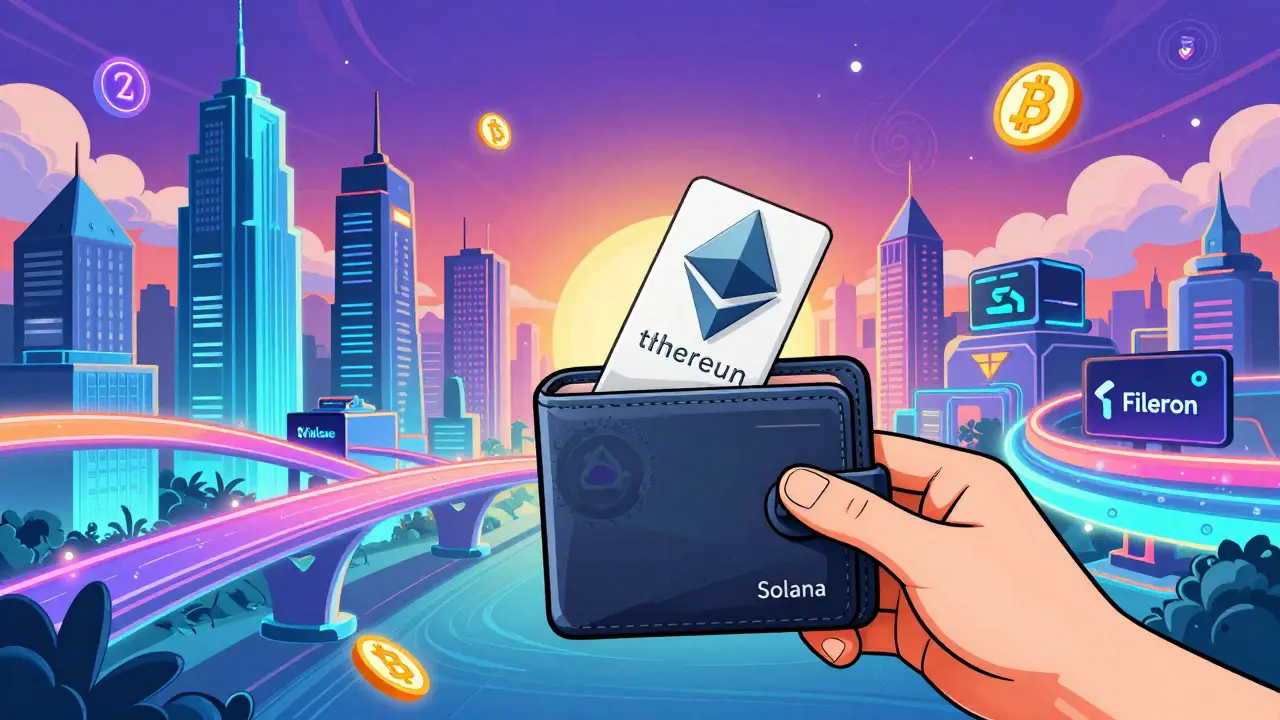
Improved User Experience
Most people still find crypto confusing. Why? Because every chain feels like a different app. You need different wallets, different keys, different gas tokens. Interoperability fixes that. Wallets like Phantom and MetaMask now support native cross-chain transfers. You can send an NFT from Ethereum to Solana with one click. Smart contracts can trigger actions across chains-like releasing funds when a payment is confirmed on a different network. No more switching between 10 apps. No more memorizing chain-specific rules. The experience is starting to feel like using the internet: you don’t care if a site runs on React or Angular-you just use it.Resilience and Reduced Single-Point Failure Risk
If Ethereum goes down, a lot of DeFi stops. If Solana crashes, NFT markets freeze. Interoperability eliminates this vulnerability. When chains are connected, a failure on one doesn’t mean total collapse. Users can shift assets to other chains. Applications can reroute logic. A lending protocol on Arbitrum can temporarily pause and resume operations on Base if needed. This redundancy makes the whole system more stable. In 2024, when a major bridge was exploited, interoperable protocols were able to isolate the damage and keep services running on other chains. That kind of resilience isn’t optional anymore-it’s essential.Customizable Web3 Services
Think of interoperability like Lego blocks for blockchains. You can snap together a payment system from one chain, a data oracle from another, and a voting mechanism from a third. This lets industries build tailored solutions. A hospital could use a private blockchain to store patient records, but allow insurance providers to verify claims on a public chain. A real estate firm could tokenize property on Ethereum and settle payments in stablecoins on Polygon. This level of customization was impossible before. Now, enterprises aren’t forced to adopt one-size-fits-all blockchain models. They can pick and choose components that fit their needs.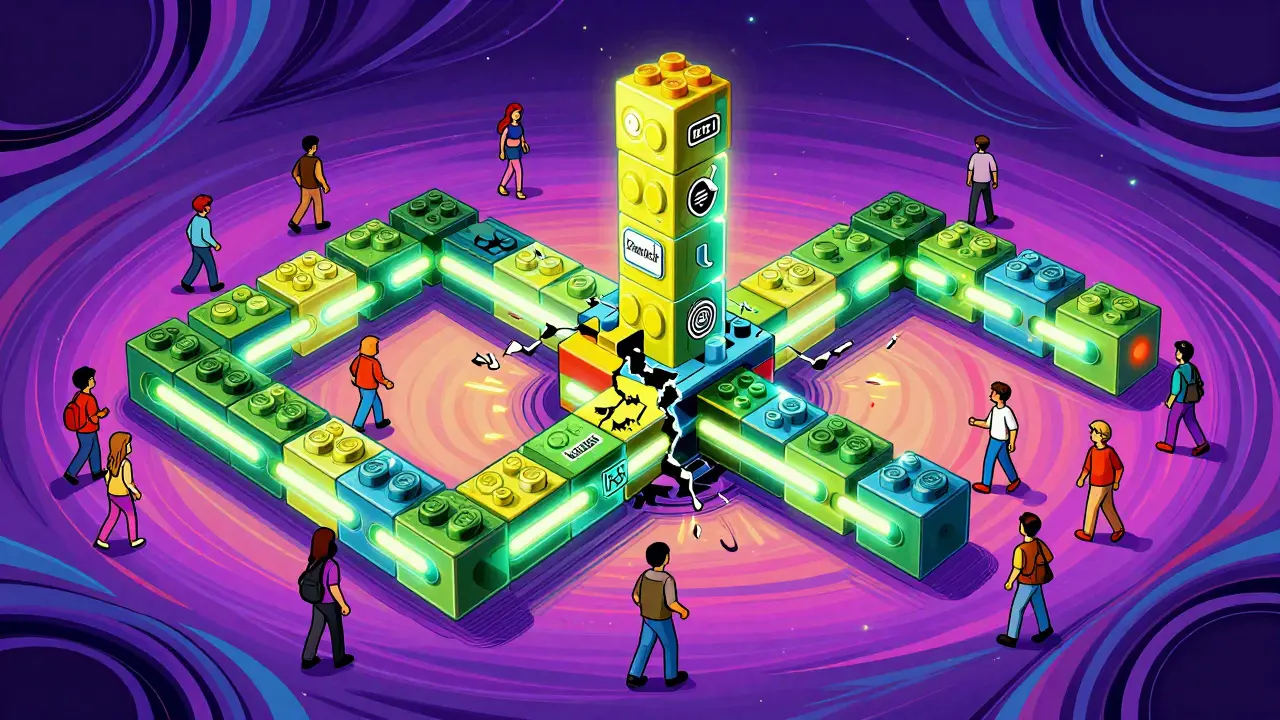
Enhanced Cross-Industry Collaboration
Blockchain isn’t just for crypto anymore. Supply chains, healthcare, logistics, and legal services are all testing blockchain solutions. But if each industry runs on its own isolated network, they can’t talk to each other. Interoperability changes that. A manufacturer’s blockchain can verify a product’s origin, then send that data to a logistics blockchain for shipping tracking, and finally to a financial blockchain for automated payments. No manual data entry. No reconciliation delays. This is already happening in pilot programs by Maersk and IBM. When blockchains can communicate across industries, innovation explodes. New business models emerge. Partnerships form that were never possible before.Increased Efficiency and Reduced Redundancy
Right now, many blockchains duplicate the same functions. Everyone builds their own oracle, their own bridge, their own identity system. Interoperability eliminates this waste. Instead of reinventing the wheel, chains can reuse each other’s tools. A chain can use Chainlink’s price feeds instead of building its own. Another can use Polygon’s zk-rollup for scaling. This creates a network effect: the more chains connect, the more valuable each one becomes. Efficiency isn’t just about speed-it’s about not wasting resources. The global blockchain ecosystem saves billions annually by avoiding redundant development.Driving Mainstream Adoption
Businesses won’t adopt blockchain if it’s fragmented. Why would a bank integrate with a system where every partner uses a different chain? Interoperability makes blockchain enterprise-ready. It turns a confusing patchwork into a unified platform. Companies like JPMorgan and Walmart are already testing interoperable systems. JPMorgan’s Onyx network connects with other private blockchains for cross-border settlements. Walmart’s food traceability system uses blockchain data that’s shared across suppliers, regulators, and retailers-all on different chains. Interoperability isn’t just for crypto traders. It’s the backbone of real-world adoption.What’s Holding It Back?
None of this is perfect yet. Security remains a big concern. Cross-chain bridges have lost over $2 billion to hacks since 2020. Different consensus mechanisms make integration complex. Governance is messy-how do you agree on rules when one chain is DAO-governed and another is corporate-controlled? Speed still lags. Some bridges take 10-15 minutes to settle. But progress is rapid. New protocols like LayerZero and Axelar are reducing settlement times to under 10 seconds. Security audits are becoming standard. Standards like IBC and XCM are gaining adoption. The challenges aren’t dead ends-they’re just hurdles we’re clearing faster than ever.What does blockchain interoperability actually do?
Blockchain interoperability lets different blockchains communicate and exchange value directly. It removes the need for centralized exchanges or bridges by enabling trustless transfers of assets, data, and smart contract calls between chains like Ethereum, Solana, and Polygon.
Is blockchain interoperability secure?
It can be, but not all solutions are equal. Early bridges were hacked because they relied on centralized validators. Newer protocols use decentralized networks of nodes, cryptographic proofs, and consensus mechanisms like ZK-SNARKs to verify cross-chain actions. Projects like Chainlink CCIP and Cosmos IBC are designed with security-first principles and have undergone multiple audits. Still, always research the specific protocol you’re using.
Which blockchains support interoperability today?
Major blockchains like Ethereum, Solana, Polygon, Avalanche, Cosmos, and Polkadot have built-in or third-party interoperability layers. Cosmos uses IBC (Inter-Blockchain Communication) to connect its ecosystem of over 70 chains. Polkadot uses XCMP for message passing between parachains. Ethereum supports cross-chain bridges via LayerZero, Chainlink CCIP, and Synapse. Even Bitcoin is starting to connect through sidechains like Liquid and RSK.
How does interoperability affect DeFi?
It multiplies DeFi’s power. Instead of liquidity being locked on one chain, it flows freely across all connected networks. This creates deeper pools, better prices, and fewer slippage issues. Users can earn yield on Ethereum, borrow on Solana, and trade on Arbitrum-all from one wallet. Protocols like Stargate and Multichain have already unlocked over $15 billion in cross-chain liquidity.
Will interoperability make one blockchain obsolete?
No. Interoperability doesn’t replace blockchains-it enhances them. Each chain still has unique strengths: Ethereum for security, Solana for speed, Cosmos for customization. Interoperability lets them work together, not compete. The future isn’t one chain to rule them all. It’s a web of specialized chains, each doing what they do best, connected by trustless bridges.
Sarah Hammon
March 16, 2026 AT 11:21So many people still think blockchain is just about crypto trading, but this? This is the real deal. I’ve been using cross-chain swaps for months now and honestly? It’s changed everything. I staked ETH on Aave, borrowed USDC on Compound, then traded it on Polygon-all in one wallet. No more juggling 10 different apps. No more gas fee nightmares. It just works. I’m not even a tech person and I get it now.
Also, the fact that you can send an NFT from Ethereum to Solana with one click? Mind blown. This isn’t future tech-it’s here. And it’s beautiful.
iam jacob
March 17, 2026 AT 20:24idk why everyone’s acting like this is some revolutionary breakthrough. bridges have been hacked for billions. you think just because some startup says ‘trustless’ it’s safe? lol. i’ve lost money twice because of ‘interoperability.’ it’s just a fancy word for ‘more attack surface.’
Jesse Pals
March 19, 2026 AT 06:01bro this is the OG web3 dream come true 🤯 imagine if every blockchain was a different instrument and now they’re all jamming together. ethereum’s the bass, solana’s the lead guitar, polygon’s the drums, and we’re all just vibin’ in this massive digital orchestra. no more silos, no more ‘your chain sucks’ drama. we’re finally building the internet of value. and it’s lit. 🚀🔥
also side note: i just sent a token from avalanche to cosmos and it took 3 seconds. 3. seconds. i cried. not joking.
Diane Overwise
March 19, 2026 AT 20:16While I find the technical implications of blockchain interoperability profoundly compelling, I must respectfully observe that the prevailing discourse often neglects the sociological ramifications of such a paradigm shift. The notion that users may now seamlessly traverse disparate consensus mechanisms without awareness of underlying architecture-while undeniably convenient-risks fostering a dangerous complacency regarding security posture. One might argue that the very abstraction which enables usability simultaneously obscures accountability. And yet, one cannot deny the elegance of a system wherein liquidity, data, and trust converge across heterogeneous networks. The future is not merely interconnected-it is symbiotic.
Dionne van Diepenbeek
March 21, 2026 AT 15:06why do we need this again? i just want to buy a shirt with crypto. why do i care if ethereum talks to solana? its overcomplicated. just let me send money. that’s it.
Marie Vernon
March 23, 2026 AT 13:33I love how this is making crypto feel less like a cult and more like a toolkit. Seriously. Before, it felt like you had to pick a religion: Ethereum or Solana or Cardano. Now? You can use the best parts of each. I’ve got friends who mine on one chain, trade on another, and store NFTs on a third. And they don’t even think about it anymore. It just… works. It’s like the internet in 1995-no one understood TCP/IP, but they still sent emails. This is that moment for Web3. We’re not there yet, but we’re close. And I’m here for it.
Ross McLeod
March 24, 2026 AT 18:28Let’s be honest. Interoperability sounds great until you realize how many new attack vectors it creates. Every time you add a bridge, you add a point of failure. The math doesn’t lie: more connections = more complexity = more bugs. And let’s not pretend the governance models are coherent-how do you coordinate security upgrades across a DAO on Ethereum and a corporate chain on Hyperledger? You don’t. You just hope the auditors didn’t miss anything. And don’t get me started on the energy waste from syncing multiple consensus layers. This isn’t innovation. It’s technical debt with a marketing budget.
Cheri Farnsworth
March 26, 2026 AT 01:24The transformation in DeFi liquidity dynamics is nothing short of revolutionary. The aggregation of capital across chains enables unprecedented depth in trading pools and dramatically reduces slippage. This is not merely an enhancement-it is a structural evolution of market mechanics. The implications for institutional adoption are profound. When liquidity is no longer fragmented but fluid, the foundation for institutional-grade financial infrastructure is laid. The future of finance is not centralized. It is interconnected. And it is here.
Gene Inoue
March 27, 2026 AT 11:36you people are so naive. ‘trustless’? lol. every bridge has a central admin key. every ‘decentralized’ oracle has 3 companies behind it. you think layerzero is magic? it’s just a new way for venture capitalists to charge 0.1% on every transfer. and don’t even get me started on the devs who built these systems-half of them are ex-bankers with no idea how real crypto works. this isn’t freedom. it’s rebranded centralization. and you’re all drinking the kool-aid.
Tony Weaver
March 28, 2026 AT 08:42It’s ironic how the same people who scream about decentralization now cheer for protocols that rely on centralized relayers, multisig admin keys, and opaque incentive structures. Interoperability is not a solution-it’s a compromise. You trade one centralized point of failure for ten. And then you call it ‘innovation.’ The fact that users are now blissfully unaware of the underlying risks is not progress. It’s manipulation. The blockchain ecosystem is not becoming more resilient. It’s becoming more opaque. And the more complex it gets, the more it resembles the very legacy systems it was supposed to replace.
Patty Atima
March 28, 2026 AT 17:27one click. that’s all it takes now. i’m done.