Coinbase Commerce vs Non-Custodial Alternatives: Control, Fees, and Bitcoin Support
You built a product. You want to accept crypto. You sign up for Coinbase Commerce because it’s the big name in town. It feels safe. It feels easy. Then, six months later, you realize your business is sitting on someone else’s balance sheet. Worse yet, that same provider just quietly removed native Bitcoin support for self-managed accounts, forcing you into their custodial loop.
If you are a founder who cares about sovereignty, this shift isn't just an annoyance-it's a strategic risk. The choice between a hosted platform like Coinbase Commerce and a true non-custodial alternative isn't about which UI looks prettier. It is a choice between convenience with dependency and sovereignty with responsibility. Let's look at why the industry is shifting toward self-hosted models and what that actually means for your bottom line.
The Custody Trap: Who Holds the Keys?
To understand the friction, we need to define the core entity here: Custodial vs. Non-Custodial Payment Gateways. In simple terms, custody determines who controls the private keys to the funds you receive.
Coinbase Commerce operates as a hybrid model that has increasingly tilted toward custodial architecture. When a customer pays you through Coinbase Commerce, the funds often land in a pooled account controlled by Coinbase. You see a balance in your dashboard, but you cannot move those funds without Coinbase's permission and internal processing systems. This creates a counterparty risk. If Coinbase faces regulatory pressure, changes its policy, or simply decides your business is "high-risk," they can freeze your assets. They have done exactly this by removing native Bitcoin options for users trying to maintain control.
In contrast, a Non-Custodial Gateway never touches your money. It acts purely as a notification service. It watches the blockchain for incoming transactions and tells your website when payment has arrived. The funds go directly from the buyer's wallet to yours. No intermediary holds them. No intermediary can freeze them. Even if the software provider disappears tomorrow, your node continues to process payments because the logic is decoupled from fund custody.
Fee Structures: The Hidden Cost of Convenience
Let's talk numbers, because fees eat margins faster than any technical debt. Here is how the major players stack up as of 2026:
| Provider | Transaction Fee | Custody Model | Native Bitcoin Support |
|---|---|---|---|
| Coinbase Commerce | 1% | Custodial / Hybrid | Limited (Self-managed removed) |
| BitPay | Up to 2.9% + fixed | Custodial | Yes |
| BTCPay Server | 0% | Non-Custodial | Yes |
| TxNod | $20/mo flat (0% take-rate) | Non-Custodial | Yes (Multi-chain) |
| Blockonomics | 1% | Non-Custodial | Yes |
Look closely at the spread. BitPay charges nearly 3%, which is brutal for high-volume merchants. Coinbase Commerce sits at a flat 1%. That sounds reasonable until you scale. If you process $100,000 a month, you pay $1,000 to Coinbase just to hold your own money.
Now look at BTCPay Server. It charges 0%. Since you host the infrastructure, there is no middleman taking a cut. For founders prioritizing pure Bitcoin economics, this is hard to beat.
Then there is the modern subscription model seen in tools like TxNod. Instead of taxing every transaction, TxNod charges a flat monthly fee ($20) with a 0% take-rate on volume. As your revenue grows, the cost per transaction drops to near zero. This aligns the provider's incentive with your growth rather than penalizing it.
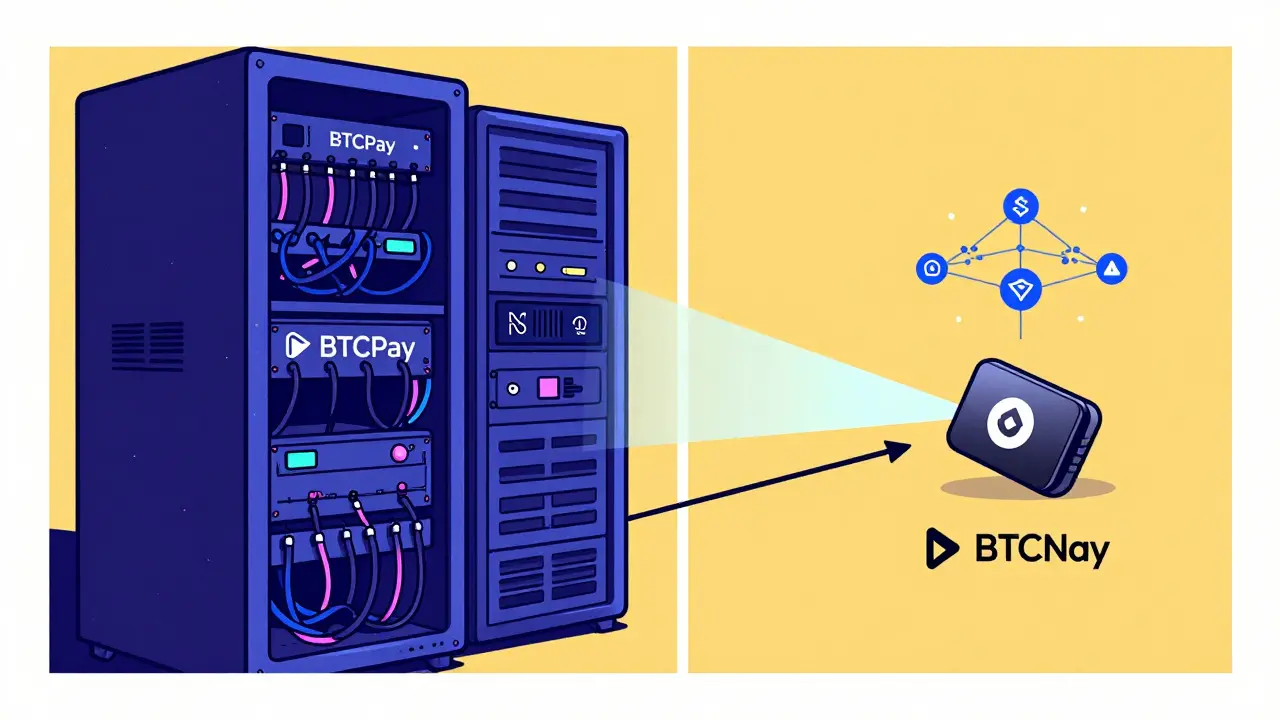
Technical Architecture: Infrastructure as Code vs. SaaS
The biggest barrier to non-custodial solutions has always been complexity. Founders ask: "Do I really want to manage a server?" The answer depends on which non-custodial path you choose.
BTCPay Server is the gold standard for open-source, self-hosted infrastructure. It is powerful, robust, and completely free. However, it requires DevOps knowledge. You are responsible for the server, the security patches, and the uptime. If you don't know how to configure a Linux VPS, BTCPay will frustrate you.
This is where newer, managed non-custodial gateways fill the gap. Platforms like TxNod offer the non-custodial benefits-direct settlement to your hardware wallet, no KYC, no freezes-but remove the server management headache. You connect your Ledger or Trezor via the dashboard, and the system derives payment addresses from your extended public keys (xpubs). Your private keys never leave your device. The gateway simply watches the chain and notifies you.
For solo founders and indie hackers, this distinction matters. You want the sovereignty of non-custodial tech without the operational overhead of maintaining a full node. Modern SDKs, like the TypeScript-first approach used by TxNod, allow developers to integrate these gateways in minutes, not days. You get the security of self-custody with the ease of a hosted API.

Security and Censorship Resistance
Security in custodial models relies on the provider's ability to protect pooled funds. History shows us that centralized exchanges and payment processors are prime targets for hackers. When Coinbase Commerce holds your funds, you are exposed to their hot/cold storage vulnerabilities. You also rely on their compliance teams. If regulators pressure Coinbase to block certain jurisdictions or business types, Coinbase Commerce will comply. Your account gets frozen. Your customers stop paying.
Non-custodial architectures eliminate this third-party risk. Because the provider never accesses your private keys, they cannot be hacked to steal your funds. More importantly, they cannot censor you. Blockonomics, for instance, offers direct-to-wallet functionality with no KYC requirements. This appeals to privacy-conscious merchants and those operating in gray areas of traditional finance.
Furthermore, non-custodial platforms enable real-time on-chain tracking. With Coinbase Commerce, you often can't verify your funds until they are settled into your fiat bank account or moved out of their pool. With a non-custodial setup, you see the transaction confirm on the blockchain instantly. You own the asset the moment it hits your address.
Who Should Choose What?
Not every business needs the same solution. Here is a practical decision tree for founders:
- Choose Coinbase Commerce if: You are a small, low-risk merchant primarily seeking fiat settlement. You don't care about crypto philosophy. You want the easiest possible setup and are willing to pay a 1% fee for the convenience of having Coinbase handle compliance and conversion. Accept that you do not truly own your crypto assets while they sit in their system.
- Choose BTCPay Server if: You are technically proficient. You want 0% fees. You prioritize native Bitcoin support above all else. You are willing to manage your own server infrastructure to gain total sovereignty.
- Choose a Managed Non-Custodial Gateway (e.g., TxNod) if: You are a scaling business, indie hacker, or high-risk merchant. You want 0% transaction fees (via subscription). You need multi-chain support (Bitcoin, Ethereum, TON, etc.). You demand non-custodial security and censorship resistance but lack the time or expertise to self-host a complex node. You value developer experience and rapid integration.
The market is moving. As of 2026, the trend among serious crypto-native operations is clear: founders are rejecting custodial dependencies. They are choosing tools that respect their ownership of assets. Whether you self-host with BTCPay or use a modern managed gateway like TxNod, the goal is the same. Keep your keys. Keep your cash flow. Keep your freedom.
Why did Coinbase Commerce remove native Bitcoin support?
Coinbase Commerce recently restricted native Bitcoin support for self-managed accounts to push users toward its custodial ecosystem. This move simplifies compliance and regulatory monitoring for Coinbase but reduces user control. It forces merchants to rely on Coinbase's internal systems for fund access, increasing dependency and potential censorship risk.
What is the difference between custodial and non-custodial?
In a custodial model, the payment provider holds your private keys and funds in a pooled account. They control access and can freeze assets. In a non-custodial model, the provider only monitors the blockchain for payments. Funds go directly to your wallet, and you retain full control of your private keys. The provider cannot freeze or access your funds.
Is BTCPay Server difficult to set up?
BTCPay Server is powerful but requires technical expertise. You must host your own server, manage security updates, and ensure uptime. It is ideal for developers comfortable with Linux and DevOps tasks. For those wanting non-custodial benefits without server management, managed solutions like TxNod offer a simpler interface.
Can my account be frozen on a non-custodial gateway?
Structurally, no. Because non-custodial gateways never hold your funds or private keys, they have no mechanism to freeze your assets. Payments settle directly to your wallet on-chain. While the software provider could potentially shut down their service, your funds remain safe in your wallet, and you can switch providers or run your own node if necessary.
Which option is cheaper for high-volume sales?
For high volumes, non-custodial options are significantly cheaper. Coinbase Commerce charges 1% per transaction, and BitPay charges up to 2.9%. BTCPay Server charges 0% but requires self-hosting. Managed non-custodial gateways like TxNod charge a flat monthly subscription (e.g., $20/month) with 0% transaction fees, making them highly cost-effective as revenue scales.