Crypto Exchange Restrictions for Iranian Citizens: 2026 Guide
Living in Iran while trying to access global financial systems feels like navigating a maze that changes its walls every day. For Iranian citizens interested in cryptocurrency, the landscape has shifted dramatically from a period of relative tolerance to one of strict control and severe penalties. If you are looking to trade, hold, or move digital assets from within Iran right now, you need to understand that the rules have hardened significantly since early 2025.
The era of easy access to international exchanges is effectively over. The Central Bank of Iran (CBI) has tightened its grip, citing tax evasion and national security as primary reasons for cracking down on domestic platforms. Simultaneously, international enforcement agencies are freezing funds linked to Iranian addresses with unprecedented speed. This article breaks down exactly what these restrictions mean for you, how they impact your daily trading habits, and what legal pathways-if any-remain open.
The Shift from Tolerance to Control
To understand where things stand today, we have to look at how quickly the situation changed. Just a few years ago, cryptocurrency was often viewed by Iranians as a necessary tool to bypass heavy economic sanctions. It allowed people to send money abroad, receive payments for freelance work, and protect savings against hyperinflation. However, this utility came with blind spots that regulators could no longer ignore.
In January 2025, the Central Bank of Iran is the regulatory authority responsible for monetary policy and banking oversight in Iran made a decisive move. They ordered the immediate closure of rial payment gateways for all cryptocurrency exchanges operating within the country. This wasn't a minor adjustment; it was a fundamental break between the traditional banking system and the crypto world.
The reason behind this crackdown was largely financial transparency. Crypto exchanges in Iran had processed billions of dollars in transactions, yet many operators failed to comply with tax obligations. Their financial statements were opaque, making it difficult for the government to track capital flows. By cutting off the fiat on-ramps-the ability to convert Iranian Rials into crypto using local bank cards-the CBI aimed to force compliance or push the activity entirely underground.
| Date | Action Taken | Impact on Users |
|---|---|---|
| Jan 2025 | Closure of Rial Payment Gateways | Cannot buy crypto directly with local bank cards |
| June 2025 | Nobitex Hack & Trading Hour Bans | Trading restricted to 10 AM - 8 PM only |
| July 2025 | Tether Freezes Iranian Addresses | Loss of access to USDT holdings for many users |
| Aug 2025 | Capital Gains Tax Law Enacted | Profits from crypto trading are now taxable |
The Nobitex Incident and Operational Limits
If there was one event that defined the current climate, it was the cyberattack on Nobitex is Iran's largest domestic cryptocurrency exchange serving millions of users. On June 18, 2025, this major platform suffered a politically motivated hack resulting in losses exceeding $90 million. With over 11 million users relying on Nobitex, the breach shook confidence in the entire domestic ecosystem.
The government’s response was swift and restrictive. Rather than just investigating the security failure, the Central Bank implemented unprecedented trading hour restrictions. Domestic exchanges were prohibited from operating between 8:00 PM and 10:00 AM local time. This means you can only trade during a 14-hour window each day. While framed as a "security protocol," analysts view this as a method to limit the volume of transactions and make monitoring easier for authorities.
This restriction creates significant challenges for traders who rely on global market movements, which happen 24/7. You might miss critical price dips or spikes because the exchange is legally shut down for half the day. Additionally, the panic following the hack caused Tether (USDT) prices to surge locally, reaching over 12,000 Tomans at one point, further eroding user trust in domestic platforms.
International Enforcement and Frozen Funds
Domestic restrictions are only half the story. The other half involves intense pressure from international entities, particularly the United States Treasury Department and blockchain intelligence firms. In July 2025, Tether is the issuer of the USDT stablecoin, widely used for cross-border transfers executed its largest-ever freeze of Iranian-linked funds. They targeted 42 specific cryptocurrency addresses associated with Nobitex and other local services.
Why did this happen? Blockchain analysis firms like Elliptic and TRM Labs had identified these wallets as part of a broader network involved in sanctions evasion. Some of these funds were linked to the Islamic Revolutionary Guard Corps (IRGC), Iran's military branch. When Tether froze these accounts, it didn't just affect large bad actors; it disrupted the transaction patterns of regular users who had interacted with those addresses.
The consequence was immediate chaos. Many ordinary Iranians found their USDT balances locked. This forced a rapid adaptation strategy among the community. Users began migrating away from USDT toward alternative stablecoins like DAI, specifically using the Polygon network. DAI is decentralized and not issued by a single company that can be pressured by governments, making it a safer harbor for those trying to maintain liquidity without triggering freezes.
New Tax Laws and Legal Compliance
Beyond access and security, the financial burden on crypto users has increased. In August 2025, Iran enacted the Law on Taxation of Speculation and Profiteering. This legislation introduced a capital gains tax on cryptocurrency trading for the first time. Previously, profits from crypto were largely untaxed due to the informal nature of the market. Now, digital assets are treated similarly to gold, real estate, and foreign exchange.
This change signals a shift in the government's attitude. They no longer see crypto solely as a threat to be banned, but as an economic sector to be regulated and monetized. However, this comes with strings attached. To trade legally, you must obtain proper licenses from the Central Bank and provide transparent financial reporting. For most individual retail traders, this level of bureaucracy is prohibitive, pushing them back toward the gray market.
The taxation law also means that if you are caught trading through unlicensed channels, you face double jeopardy: penalties for illegal trading and back-taxes on any profits made. This has led to a decline in reported inflows, with TRM Labs documenting an 11% drop in cryptocurrency inflows to Iran in the first half of 2025.
Sanctions Evasion and Shadow Banking
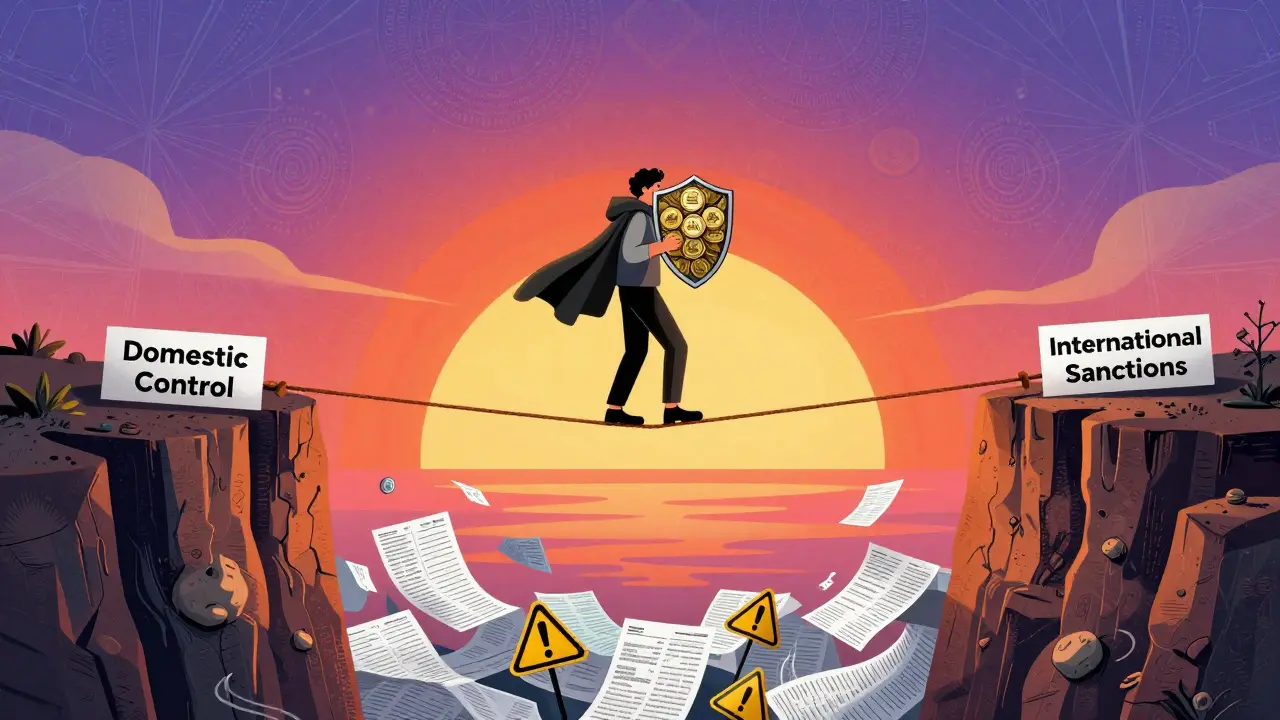
A complex dynamic exists where the Iranian government restricts civilian access to crypto while potentially utilizing it for state-level purposes. In September 2025, the U.S. Office of Foreign Assets Control (OFAC) sanctioned a $600 million Iranian shadow banking network. These facilitators used cryptocurrency to launder over $100 million in oil proceeds for Iran's military.
This highlights the "cat-and-mouse" game playing out in the background. While regular citizens struggle to buy Bitcoin for savings, sophisticated networks use complex chains of Ethereum and Tron transactions to move state funds globally. For the average user, this association is dangerous. Your wallet address might be flagged simply because it interacted with a node in this larger network, leading to sudden freezes or bans from international platforms.
Elliptic’s research characterizes platforms like Nobitex not just as exchanges, but as critical infrastructure within this sanctions evasion apparatus. This label makes them prime targets for both domestic regulation and international enforcement. As a result, the risk profile for anyone holding Iranian IP addresses or bank details on crypto platforms has skyrocketed.
Adapting to the New Reality
So, what does this mean for you in 2026? The days of casual, unrestricted crypto usage in Iran are gone. Here is how users are adapting:
- Diversify Stablecoins: Move away from centralized stablecoins like USDT if possible. DAI on Polygon or Arbitrum networks offers more resilience against corporate freezes.
- Respect Trading Hours: If you use domestic exchanges, plan your trades strictly between 10:00 AM and 8:00 PM local time to avoid technical blocks.
- Privacy First: Use non-custodial wallets where you control the private keys. Avoid keeping large sums on exchanges, given the history of hacks and regulatory seizures.
- Tax Awareness: Keep records of your transactions. Even if you operate in the gray market, understanding the new capital gains tax laws helps you assess potential liabilities if regulations tighten further.
The goal is no longer just profit; it is survival and accessibility. The intersection of domestic authoritarian control and international sanctions enforcement has created a high-risk environment. Staying informed about OFAC updates and CBI directives is not optional-it is essential for protecting your assets.
Is cryptocurrency legal in Iran?
Cryptocurrency mining is legal in Iran, but using digital assets for payments is strictly banned. Trading is technically permitted only through licensed entities under the supervision of the Central Bank of Iran, though practical access is severely restricted by payment gateway closures and trading hour limits.
Why were my USDT funds frozen?
Tether frequently freezes addresses linked to sanctioned entities or suspicious activities. If your wallet interacted with addresses associated with Iranian exchanges like Nobitex or entities linked to the IRGC, Tether may have flagged your account as part of sanctions evasion networks.
Can I still use Iranian banks to buy crypto?
No. Since January 2025, the Central Bank of Iran has ordered the closure of rial payment gateways for all cryptocurrency exchanges. You cannot directly convert Iranian Rials to crypto using local bank cards or transfers.
What are the trading hours for domestic exchanges?
Following the 2025 Nobitex hack, domestic exchanges are prohibited from operating between 8:00 PM and 10:00 AM local time. Trading is only allowed during the 14-hour window from 10:00 AM to 8:00 PM.
Do I have to pay taxes on crypto profits?
Yes. As of August 2025, the Law on Taxation of Speculation and Profiteering imposes capital gains tax on cryptocurrency trading. Digital assets are treated similarly to gold and foreign exchange for tax purposes.