Environmental Impact of Cryptocurrency Mining: Energy, Emissions & Solutions
Imagine a single digital transaction requiring the same amount of fuel as driving your car for 1,600 kilometers. That’s not a sci-fi scenario; it’s the reality of Bitcoin transactions today. As cryptocurrency becomes more mainstream, the question on everyone’s mind is simple: what does this digital gold rush cost our planet? The answer involves massive electricity usage, growing piles of electronic waste, and a complex debate about whether the tech can clean up its act.
The Energy Hungry Beast
Let’s look at the numbers, because they are staggering. By 2025, Bitcoin mining was consuming between 138 and 150 terawatt-hours (TWh) of electricity annually. To put that in perspective, that’s roughly 0.5% of the entire world’s electricity consumption. It’s comparable to the total energy usage of a small nation like Argentina or the Netherlands. Why so high? It comes down to Proof-of-Work, the consensus mechanism Bitcoin uses to secure its network. Miners race to solve complex mathematical puzzles using powerful computers. The winner gets to add the next block of transactions to the chain and earns new coins. This race requires immense computational power, which translates directly into heat and electricity.
This isn’t just about keeping the lights on in a data center. The International Monetary Fund warned in early 2025 that U.S. cryptocurrency and AI operations could consume 2% of global electricity by 2027. If you think that sounds expensive, consider that the cost isn’t just financial-it’s environmental. Each Bitcoin transaction generates approximately 672 kg of CO2. That’s equivalent to flying from New York to London and back. When you multiply that by millions of transactions, the carbon footprint balloons quickly.
Carbon Emissions and the Coal Connection
Not all electricity is created equal. A big part of the problem with cryptocurrency mining emissions is where the power comes from. In 2021, China banned cryptocurrency mining, forcing many miners to relocate. Unfortunately, many moved to regions dependent on fossil fuels, such as parts of Kazakhstan and certain U.S. states. According to Digiconomist, the average carbon intensity of Bitcoin mining rose from 478 grams of CO2 per kilowatt-hour in 2020 to over 557 grams by late 2021.
As of 2025, about 52% of Bitcoin’s electricity comes from "clean" sources, including hydroelectric, wind, solar, and nuclear power. However, critics argue this figure can be misleading due to "greenwashing," where companies buy renewable energy certificates without actually using physical renewable power. CoinShares analysis suggests the real renewable usage might be closer to 43.7%. Regardless of the exact percentage, the remaining nearly half often relies on coal and natural gas, contributing significantly to greenhouse gases. CarbonCredits.com estimates Bitcoin accounts for 0.7% of global CO2 emissions, while other sources place it lower, around 0.08%. Even the lower estimate is significant when compared to countries like Slovakia.

Beyond Carbon: Water, Waste, and Noise
Carbon isn’t the only concern. Mining rigs generate enormous amounts of heat, requiring cooling systems that guzzle water. University of New Mexico researchers calculated in 2024 that large-scale mining operations in Texas require approximately 637 gallons of water per Bitcoin mined. In drought-prone areas, this puts pressure on local water supplies already stressed by agriculture and residential use.
Then there’s the hardware itself. Application-Specific Integrated Circuits (ASICs) are specialized chips designed solely for mining. They are efficient but have a short lifespan-often just 2 to 4 years before becoming obsolete as newer, faster models hit the market. This creates a steady stream of electronic waste (e-waste). Unlike consumer electronics, these devices are rarely recycled effectively, ending up in landfills where toxic materials can leach into the soil.
And if you live near a mining facility, you know the noise. Cooling fans running at full speed create a constant roar. Residents in Rockdale, Texas, documented noise levels exceeding 70 decibels, prompting local ordinances requiring sound barriers. It’s a quality-of-life issue that often gets overlooked in the grand scheme of climate change, but it matters to communities hosting these facilities.
Health Impacts: The Invisible Cost
A groundbreaking study published in Nature Communications in March 2025 shed light on another hidden cost: public health. Researchers from Harvard T.H. Chan School of Public Health mapped 34 major U.S. Bitcoin mines and their supplying power plants. They found that these operations expose millions of Americans to fine particulate matter (PM2.5) air pollution. PM2.5 is linked to serious health issues, including cancer, heart disease, and dementia. The study used satellite imagery and land records to connect specific mines to local health outcomes, providing concrete evidence that the environmental impact of mining isn’t just abstract-it’s felt in people’s lungs and hearts.
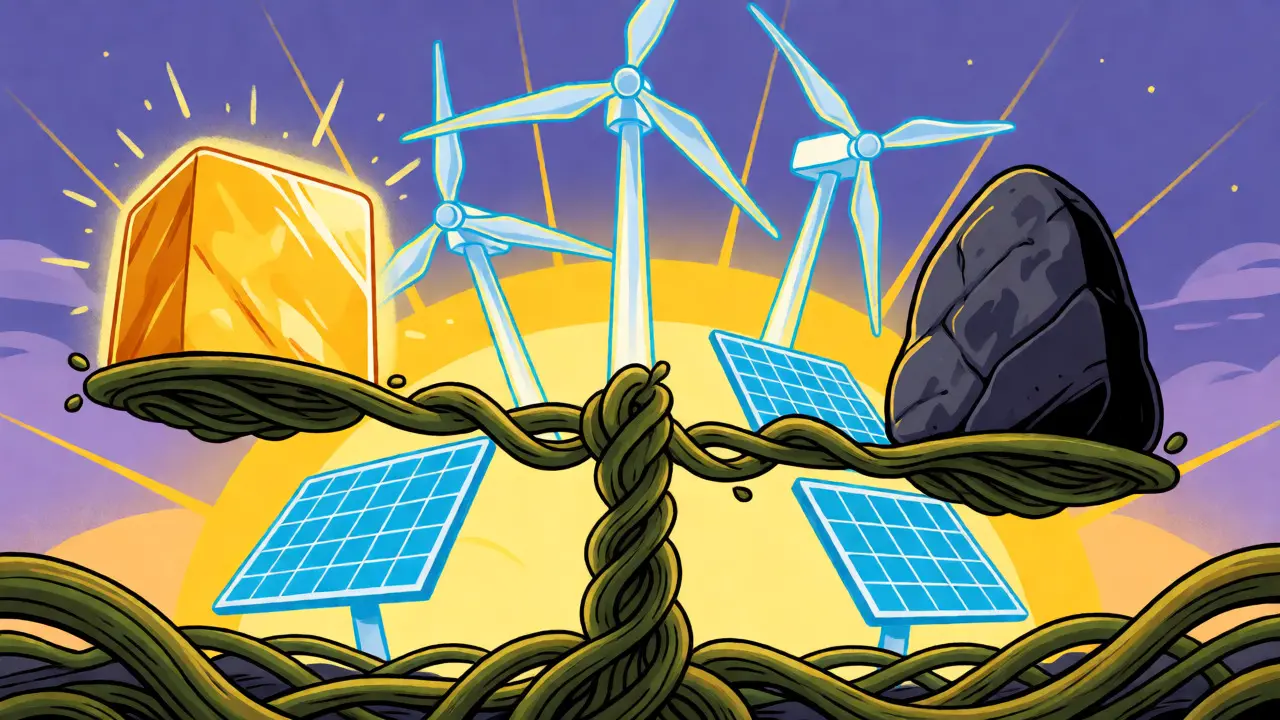
Is Green Mining Possible?
So, is all hope lost? Not necessarily. The industry is adapting, driven by both regulation and economics. Some miners are actively seeking out stranded renewable energy. For example, Crusoe Energy captures flared natural gas in North Dakota-methane that would otherwise escape into the atmosphere-and uses it to power mining rigs. This turns a waste product into a resource, reducing net emissions.
Technological improvements also play a role. Newer ASIC models, like Bitmain’s Antminer S21, achieve better efficiency, measured in joules per terahash (J/TH). Intel’s Bonanza Mine 5 chip, introduced in late 2025, reached 28 J/TH, a 17.6% improvement over previous models. However, there’s a catch known as the "rebound effect." As miners become more efficient, they can afford to run more machines, which can offset the energy savings. Zhang et al.’s 2025 study highlighted how increased hash rates propel higher spillover effects on carbon dioxide emissions, meaning efficiency alone doesn’t guarantee a smaller footprint.
Immersion cooling is another innovation gaining traction. Companies like Giga-Watt are using mineral oil to cool servers, which reduces noise by 60% and improves energy efficiency. While this requires higher upfront costs, it addresses both the noise and heat problems simultaneously.
Regulation and the Future
Governments are taking notice. Kuwait implemented a nationwide ban on mining in August 2025, citing strain on its national grid. In the U.S., New York State passed a moratorium on proof-of-work mining in 2024, though legal challenges have delayed enforcement. The European Union’s MiCA regulation now requires crypto service providers to disclose energy consumption metrics, pushing for greater transparency.
Looking ahead, the International Energy Agency forecasts Bitcoin’s energy consumption could reach 210 TWh annually by 2027 if current trends continue. But there’s an alternative scenario: with mandatory efficiency standards and accelerated renewable adoption, consumption could drop to 95 TWh. The United Nations Environment Programme has even proposed a global carbon tax on proof-of-work cryptocurrencies, potentially starting at $120 per metric ton of CO2 in 2028.
The biggest potential shift remains the debate over changing Bitcoin’s consensus mechanism. Ethereum successfully transitioned to Proof-of-Stake in 2022, cutting its energy use by 99.95%. Bitcoin developers remain skeptical, arguing that Proof-of-Work is fundamental to Bitcoin’s security and decentralization. Until that changes, or until regulations force a switch to renewables, cryptocurrency mining will likely continue to pose significant environmental challenges.
| Metric | Bitcoin Network (2025 Estimates) | Traditional Visa Network | Contextual Note |
|---|---|---|---|
| Annual Electricity Consumption | ~140 TWh | ~0.5 TWh | Bitcoin uses ~280x more energy than Visa. |
| CO2 Emissions per Transaction | ~672 kg | ~0.2 g | Visa transactions are negligible in comparison. |
| Renewable Energy Share | ~43-52% | N/A (Grid dependent) | Bitcoin's share varies by location and policy. |
| E-Waste Generation | High (Short-lived ASICs) | Low (Long-lived infrastructure) | Bitcoin hardware obsolescence drives waste. |
Why does Bitcoin mining use so much electricity?
Bitcoin uses a Proof-of-Work consensus mechanism. Miners compete to solve complex cryptographic puzzles using powerful hardware. This process requires continuous computation, which consumes vast amounts of electricity to keep the network secure and validate transactions.
How much CO2 does one Bitcoin transaction produce?
According to 2025 assessments by CarbonCredits.com, a single Bitcoin transaction generates approximately 672 kg of CO2. This is roughly equivalent to driving a gasoline-powered car for 1,600 kilometers.
Are all cryptocurrencies bad for the environment?
No. The environmental impact depends largely on the consensus mechanism. Proof-of-Work coins like Bitcoin are energy-intensive. However, Proof-of-Stake alternatives like Ethereum reduced their energy consumption by 99.95% after switching mechanisms in 2022.
What is the rebound effect in crypto mining?
The rebound effect occurs when improvements in mining hardware efficiency lead to increased overall energy consumption. As miners get more efficient, they can profitably run more machines or mine less profitable coins, offsetting the energy savings per unit of work.
Can Bitcoin mining help renewable energy?
Yes, proponents argue that miners can act as flexible loads, consuming surplus renewable energy that would otherwise be wasted (curtailed). Examples include using flared methane or excess hydro power, though critics note this often displaces human use of clean energy.
Charlotte Richardson
September 11, 2026 AT 06:48I really appreciate how this article balances the hard data with the human cost. It is easy to get lost in terawatt hours and forget that these facilities are sitting right next to people's homes. The section on health impacts was particularly moving for me because it connects abstract emissions to real lung issues. We need to keep having these inclusive conversations about who bears the burden of our digital convenience.
Abid Bhatti
September 11, 2026 AT 11:40They don't want you to know the truth about the grid stability claims. This is just another layer of control disguised as environmental concern. The numbers are manipulated by the same entities that profit from the chaos. Wake up to what is actually happening behind the curtain of 'green mining' initiatives. 🤔
Matthew O'Neill
September 13, 2026 AT 05:31The juxtaposition of Bitcoin's energy consumption against Visa's negligible footprint highlights a fundamental inefficiency in decentralized consensus mechanisms. While proponents argue for security via Proof-of-Work, the externalities imposed on the global commons-specifically carbon intensity and e-waste generation-are economically irrational when viewed through a strict utilitarian lens. Until the marginal cost of carbon is fully internalized into the hash rate economics, the market will continue to misallocate resources toward high-emission validation methods rather than optimizing for social welfare.
Edward Ogunfolaju
September 15, 2026 AT 04:01Stop waiting for perfect solutions! The tech is already here. Immersion cooling works. Stranded gas capture works. We have to push harder for adoption now instead of debating theory. Every day we wait is more CO2 pumped out. Let's get aggressive with regulations and force the industry to clean up its act immediately!
Liam Grimes
September 17, 2026 AT 02:25Good overview. Just wanted to add that the rebound effect mentioned is super important context. When chips get more efficient, miners often just buy more of them or mine lower-value coins, so total power use doesn't always drop. Its tricky to balance innovation with actual conservation goals. Also, typos in my head but hope this helps clarify why efficiency stats can be misleading sometimes.
Ferdinand Friday
September 18, 2026 AT 18:46To view cryptocurrency merely as a financial instrument is to ignore its profound ontological weight as a manifestation of pure computational effort converted into trust. The energy expenditure is not merely waste; it is the physical substrate of decentralization, a thermodynamic anchor preventing the arbitrary reordering of history. However, the ecological toll suggests a dissonance between our technological ambitions and our planetary stewardship, forcing us to confront whether the preservation of monetary sovereignty justifies the degradation of the biosphere. We stand at a precipice where the immateriality of digital assets clashes violently with the material reality of resource depletion, requiring a philosophical recalibration of what we value: convenience, purity, or survival.
Sasha Wilde
September 19, 2026 AT 07:21Bitcoin = dirty 💀
Eth switch was genius 👌
Keep mining coal? Nah ❌
Regulation needed NOW ⚡
Gabriela Gonzalez
September 20, 2026 AT 18:56Love seeing the focus on solutions like Crusoe Energy! 🌱 It gives me hope that we can turn waste into worth. Keep pushing for those green innovations! 💪🚀
Jess Emmerson
September 21, 2026 AT 17:00Hey everyone, good discussion. I think it's helpful to remember that not all mining operations are equal. Some are indeed powering up in remote areas with excess hydro, which is great. But the ones popping up near cities causing noise complaints are definitely problematic. Context matters a lot when looking at the aggregate data.
sri harni
September 22, 2026 AT 23:48In India too we see similar issues with power cuts due to heavy usage. Simple point: if tech uses more power than a country, it needs to change fast. Green sources are key.
Christian Pasamonte
September 23, 2026 AT 03:11The argument that renewable certificates validate the 'cleanliness' of mining is fundamentally flawed because it ignores the temporal mismatch between generation and consumption. You cannot simply offset instantaneous coal-fired load with intermittent solar production without accounting for the baseload requirements that remain fossil-fuel dependent. Therefore, any claim of sustainability based solely on annual averages obscures the peak-load emissions that actually drive climate forcing during critical operational windows.
Sheryl Nelsen Hutton
September 24, 2026 AT 08:01I find myself torn between the necessity of decentralized finance and the undeniable ecological footprint it leaves behind. The nuance regarding greenwashing versus genuine stranded energy utilization is critical, yet difficult for the average consumer to parse amidst conflicting reports. Perhaps a standardized, third-party audit of energy sourcing could provide the transparency required to make informed choices, rather than relying on corporate self-reporting which may lack rigorous verification protocols.
Rachel Aldaco
September 24, 2026 AT 15:41This whole thing is just drama. Who cares about the planet when we can have instant money? The trees don't vote. Let the machines burn.
liam & the bees
September 24, 2026 AT 15:47Great post! As someone who loves bees and nature, seeing the water usage stats hit hard. 637 gallons per coin is wild. But hey, if immersion cooling reduces noise and heat, maybe we can coexist better with these rigs? Let's encourage companies to go for the quieter, cleaner tech options! 🐝💧
John Martin
September 25, 2026 AT 17:59Agreed with the need for regulation. It’s not about banning crypto, it’s about making sure the true costs are paid. If they have to pay for their carbon and water use, the market will naturally shift toward greener solutions. Supportive approach here: let’s help them transition rather than just punishing them. 📉🌍
Ted Thoroughgood
September 26, 2026 AT 18:59Hey folks, nice thread. I think we gotta look at the big picture. Crypto isn't going away, so we need to work with the tech, not against it. Maybe tax breaks for miners who use 100% renewables could speed things up? Just a thought. Keep it positive and open-minded. 🤝
Paige Ray
September 27, 2026 AT 21:37Quietly reading along. The part about PM2.5 exposure really stayed with me. It feels personal somehow.