Foreign Exchange Violations for Crypto in Morocco: What You Need to Know in 2026
When Morocco banned cryptocurrency in 2017, it wasn’t just about stopping digital coins-it was about stopping money from leaving the country. The central bank, Bank Al-Maghrib Morocco's central bank responsible for monetary policy and foreign exchange control, saw crypto as a threat to its strict foreign exchange rules. These rules, in place since independence, were designed to control how much foreign currency leaves Morocco. Crypto transactions, especially peer-to-peer trades and offshore exchanges, made it easy for people to bypass traditional banking channels. That’s why, for nearly seven years, any crypto activity was treated as a serious violation of foreign exchange law.
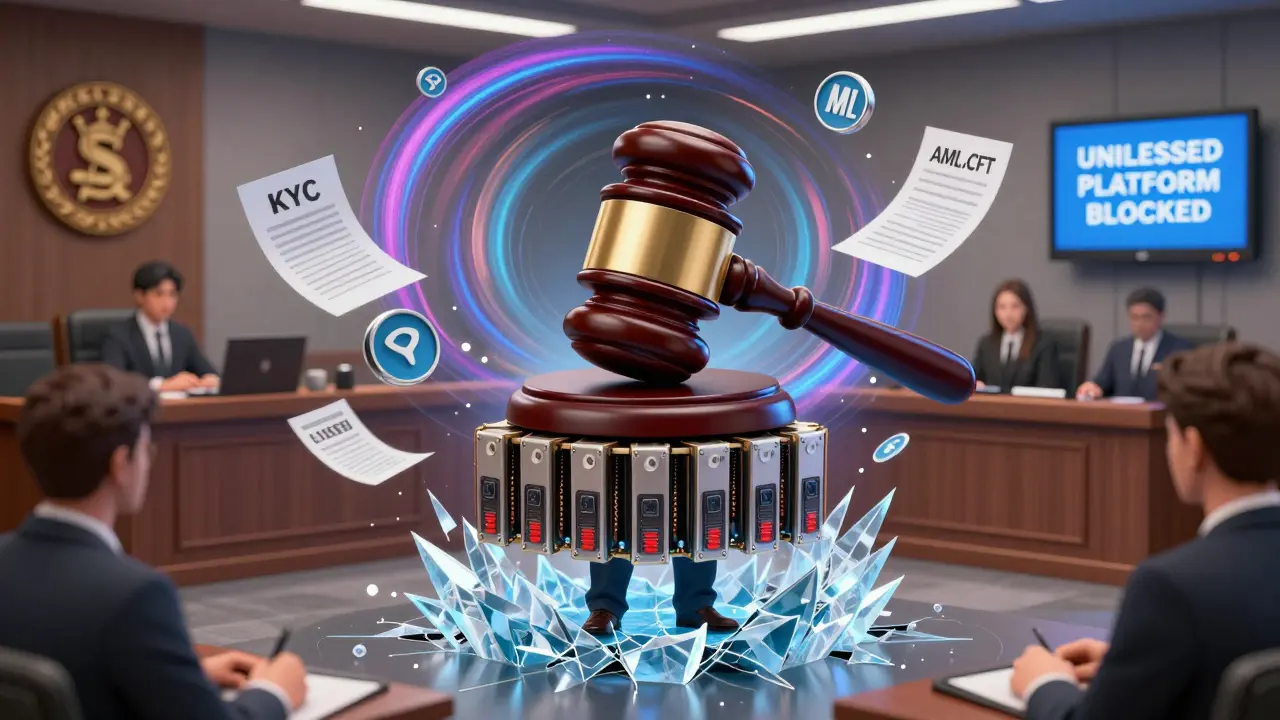
But things changed in 2025. After years of underground trading and growing global pressure, Morocco didn’t lift the ban-it rewrote it. The new law doesn’t say crypto is legal. It says crypto can be legal only if it follows strict rules. Now, you can trade Bitcoin or Ethereum, but only through platforms licensed by Bank Al-Maghrib. These platforms must follow Anti-Money Laundering (AML) Regulations designed to prevent criminals from using financial systems to hide illegal funds and Countering the Financing of Terrorism (CFT) Policies aimed at stopping financial support for terrorist activities rules. They also need to collect full Know Your Customer (KYC) data-names, IDs, addresses, bank details. No exceptions.
What Still Isn’t Allowed
Just because trading is now regulated doesn’t mean everything is open. Morocco still blocks crypto for real-world payments. You can’t use Bitcoin to pay for a hotel, a car, or even groceries. Businesses must use traditional banking for international payments. Trying to use crypto to settle cross-border trade? That’s still a foreign exchange violation.
And mining? Still completely illegal. Even though mining doesn’t involve buying crypto with dirhams, it still drains electricity and requires importing expensive hardware-both of which require foreign currency. The government doesn’t want Moroccan energy being used to power overseas crypto farms. If you’re caught mining, you’re not just breaking a rule-you’re risking criminal charges.
Penalties for Breaking the Rules
The penalties are steep, and they’re being enforced. If you’re an individual caught trading crypto on an unlicensed platform, you could pay between MAD 20,000 and MAD 100,000 (roughly $2,000 to $10,000 USD). That’s not a fine you can ignore-it’s equivalent to several months of salary for many Moroccans.
Businesses face even harsher consequences. Companies caught using crypto for payments or setting up unlicensed exchanges can be fined up to MAD 500,000 ($50,000 USD). Repeat offenders don’t just pay more-they can be prosecuted under Morocco’s financial crimes law. That means jail time.
Authorities are especially focused on platforms that operate without licenses. In 2025, Moroccan authorities shut down three major OTC trading networks and froze over 200 bank accounts linked to unregistered crypto operators. The message is clear: if you’re not licensed, you’re breaking the law.
How People Are Still Using Crypto
Despite the rules, crypto use hasn’t disappeared-it’s just gone underground. Many Moroccans still trade via peer-to-peer apps like LocalBitcoins or Paxful, using cash or bank transfers to buy and sell digital assets. Others use trusted intermediaries who act as brokers, matching buyers and sellers without ever touching the crypto directly. These methods avoid detection but still carry risk. If the bank notices unusual transfers, they can freeze accounts and report activity to the Foreign Exchange Office.
There’s also a growing trend of Moroccans holding crypto as a savings tool. With inflation rising and the dirham’s value under pressure, some see Bitcoin or Ethereum as a way to preserve wealth. But since these holdings aren’t protected by law, if a platform gets shut down or a wallet gets hacked, there’s no recourse. You lose everything.
What Businesses Must Do
If you run a company in Morocco and want to touch crypto at all, you have to play by the new rules. First, you need a license from Bank Al-Maghrib. That process takes months and requires submitting detailed financial records, security protocols, and audit trails.
Second, you must report all crypto transactions to the tax authorities. Profits from trading are taxed at 15% as capital gains. No one is exempt. Third, you need to integrate full KYC and AML systems into your operations. This isn’t optional-it’s mandatory. The Moroccan Capital Market Authority (AMMC) Regulatory body overseeing securities, ICOs, and tokenized assets in Morocco also requires approval for any token sale or ICO. No fundraising through crypto without their green light.
Many startups are walking away from crypto altogether. The cost of compliance, the risk of fines, and the slow approval process make it easier to avoid the space entirely.
The Bigger Picture: e-Dirham and Regional Strategy
Morocco isn’t just trying to control crypto-it’s building its own alternative. The central bank has finished the first phase of its e-Dirham Morocco’s sovereign digital currency being piloted to replace cash and streamline transactions project. This isn’t Bitcoin. It’s a government-controlled digital currency that tracks every transaction. Unlike crypto, the e-Dirham gives the central bank full visibility into money flows. That’s exactly what they wanted when they banned crypto in the first place.
The second phase of the e-Dirham pilot is already underway, working with Egypt and the World Bank to test cross-border digital payments. If this works, it could replace the need for private crypto entirely. Why use Bitcoin to send money to France when you can use a government-backed digital dirham that’s faster, cheaper, and fully monitored?
This strategy shows Morocco isn’t against innovation. It’s against uncontrolled innovation. They want digital money-but only if they control it.

How Morocco Compares to Other Countries
Compare Morocco to Canada or Kazakhstan, where mining is legal and crypto exchanges thrive. In those countries, crypto is seen as an economic opportunity. In Morocco, it’s seen as a risk to monetary sovereignty. That’s why Moroccan investors often move their mining rigs or trading activities abroad. Some set up shell companies in the UAE or use offshore wallets to avoid detection.
But this isolation has a cost. Morocco’s crypto market, though restricted, is still growing. Estimates put its value at nearly $280 million USD in 2025, and it’s expected to hit the same mark in 2026. That’s not because of openness-it’s because demand is too strong to stop.
What’s Next?
Looking ahead, Morocco’s approach will likely get tighter, not looser. The government is working with the International Monetary Fund (IMF) Global financial institution that provides policy advice and financial support to member countries and the World Bank International financial institution that provides loans and grants to developing countries for development projects to align its crypto rules with global standards. That means more reporting, more audits, and more surveillance.
For users, the message is simple: if you want to trade crypto in Morocco, do it through a licensed platform. If you want to mine, don’t. If you want to pay for goods or send money abroad using crypto, you’re breaking the law. And if you’re caught, the penalties aren’t just financial-they can be life-changing.
The future of crypto in Morocco won’t be about freedom. It’ll be about control. And for now, the government has all the cards.
Is cryptocurrency trading legal in Morocco in 2026?
Yes, but only through platforms licensed by Bank Al-Maghrib. All other forms of crypto trading-including peer-to-peer exchanges and unregulated platforms-are still illegal and subject to heavy fines.
Can I use Bitcoin to pay for goods or services in Morocco?
No. Morocco prohibits the use of cryptocurrency for any commercial payments or international settlements. Businesses must use traditional banking channels for all cross-border transactions.
What happens if I get caught mining cryptocurrency in Morocco?
Mining remains illegal. If caught, you could face criminal charges, equipment seizure, and fines up to MAD 100,000. Authorities actively monitor electricity usage patterns to detect mining operations.
Are crypto profits taxed in Morocco?
Yes. Profits from cryptocurrency trading are subject to a 15% capital gains tax. All licensed platforms are required to report transaction data to tax authorities, and individuals must declare crypto income on their annual tax returns.
Is the e-Dirham replacing cryptocurrency in Morocco?
Not replacing, but offering an alternative. The e-Dirham is Morocco’s government-controlled digital currency designed to provide the benefits of digital payments without the risks of unregulated crypto. It’s being tested for domestic and cross-border use, and may eventually reduce reliance on private cryptocurrencies.
Can foreign crypto exchanges operate in Morocco?
No. Only platforms licensed by Bank Al-Maghrib can legally operate in Morocco. Foreign exchanges are blocked, and Moroccan users accessing them risk violating foreign exchange laws and facing financial penalties.
How do authorities detect crypto violations?
Authorities monitor bank transfers, detect unusual patterns in foreign currency outflows, track electricity consumption for mining, and use financial intelligence units to investigate suspicious activity. Licensed platforms also report all transactions to regulators.
Are there any exemptions for small crypto users?
No. The law applies equally to everyone-individuals, businesses, and institutions. Even small trades on unlicensed platforms are considered violations and can trigger investigations.
For now, Morocco’s crypto space is a narrow path: licensed, taxed, monitored, and tightly controlled. The door is open-but only just.
Christopher Hoar
March 19, 2026 AT 05:36Bro this is peak authoritarian crypto policy. They're not banning crypto-they're banning freedom. If you can't trust people to manage their own money, why the hell are you letting them vote? This isn't regulation, it's digital serfdom. Bank Al-Maghrib is basically the Fed if the Fed had a 19th-century mindset and a vendetta against innovation.
Meanwhile, in Canada, we're letting teens mine Bitcoin in their basements and calling it a 'crypto hub.' Morocco's just scared their currency might actually mean something if people start using real money instead of paper.
Robert Kunze
March 20, 2026 AT 00:40im not a lawyer but i think this is wild. how can they stop mining if its just computers using electricity? like if i buy a fridge and use it to cool my house, is that illegal? this feels like banning solar panels because they reduce utility bills. also why tax crypto gains but not gold? double standard much??
Heather James
March 21, 2026 AT 05:59They’re not against crypto. They’re against chaos. And honestly? I get it. When your currency is shaky and your banks are fragile, letting people gamble with untraceable digital assets isn’t smart-it’s dangerous. This isn’t oppression. It’s damage control.
Sarah Hammon
March 22, 2026 AT 10:28Just wanted to say-this is actually one of the most balanced takes on crypto regulation I’ve seen. Most people scream 'freedom!' but forget that unregulated crypto fuels crime, scams, and capital flight. Morocco’s approach isn’t perfect, but it’s thoughtful. The e-Dirham could be a real win-if they avoid surveillance overreach.
Also, 15% tax on gains? That’s fair. Way better than the U.S. where you pay taxes on every tiny trade. They’re trying to build something sustainable here.
iam jacob
March 23, 2026 AT 22:26so like... if i just hold btc and never sell... do they still care? idk man. i just wanna keep my coins safe. why do they hate us so much? :(((
Jesse Pals
March 24, 2026 AT 01:42Love this. Morocco’s playing 4D chess while the rest of the world is playing checkers 🤔
They didn’t ban crypto-they redefined it. e-Dirham? That’s the future. Imagine a digital currency that’s fast, stable, and actually backed by a government that gives a damn. No volatility. No rug pulls. Just... money. 💪
Also, mining illegal? Makes sense. You don’t let people burn your grid to power a crypto farm in their garage. That’s not innovation-that’s theft.
Diane Overwise
March 25, 2026 AT 13:23Ohhh, so now we’re supposed to be impressed because they’re controlling innovation with a velvet glove instead of a steel one? 😏
Let me guess-their next move is mandatory facial recognition before you can send 100 dirhams to your cousin in France. Because nothing says 'financial freedom' like government-monitored digital hand-holding.
Also, 'e-Dirham' sounds like a rejected Pokémon name. 'I choose you, e-Dirham!'
Ann Liu
March 25, 2026 AT 17:00The 15% capital gains tax on crypto is actually quite reasonable compared to global standards. Most jurisdictions tax it as ordinary income, which can exceed 30%. Morocco’s approach-licensing, KYC, AML, and transparent reporting-is textbook compliance. It’s not draconian. It’s responsible.
The real issue isn’t regulation-it’s enforcement. If the system is implemented consistently, this could become a global model for emerging economies balancing innovation with financial stability.
Dionne van Diepenbeek
March 27, 2026 AT 02:51So they block mining because it uses electricity? Then why not ban air conditioners too? People use them to cool homes. But if you mine on one? Crime. That’s not logic. That’s fear. And fear doesn’t build economies. It kills them.
Graham Smith
March 28, 2026 AT 02:48Let’s be clear: Morocco isn’t regulating crypto. They’re performing macroeconomic triage. The central bank’s mandate is monetary sovereignty, not technological adoption. Crypto’s decentralized nature is antithetical to their institutional architecture. This isn’t Luddism-it’s institutional preservation.
The e-Dirham isn’t a replacement-it’s a strategic counterforce. A sovereign CBDC with full audit trails enables fiscal precision that Bitcoin could never offer. This is realpolitik in action.
Those calling it 'oppression' misunderstand the core function of central banking: control the medium of exchange, or lose control of the entire economy.
Jerry Panson
March 30, 2026 AT 01:52While I appreciate the nuanced approach taken by Moroccan authorities, I must respectfully point out that the legal framework remains inconsistent. The distinction between peer-to-peer trading and licensed platforms is legally sound, yet enforcement mechanisms appear disproportionately punitive toward individuals.
Moreover, the criminalization of mining without a clear energy policy framework raises questions about equity. Why is the state permitted to consume vast resources for state-led digital currency infrastructure, while private actors are penalized for doing the same? The asymmetry merits deeper scrutiny.
Katrina Smith
March 30, 2026 AT 04:19Oh wow. So crypto is legal now as long as you jump through 17 hoops and let the government watch you breathe. Congrats Morocco. You invented Bitcoin… but with a 1984 filter.
Also, e-Dirham? Sounds like a discount version of Dogecoin.
Anastasia Danavath
March 31, 2026 AT 18:35so mining = illegal 😭
but i can still buy btc with cash??
soooo... what's the point?? 🤷♀️
anshika garg
April 2, 2026 AT 02:04There is a quiet wisdom here. Morocco doesn't want to stop progress. It wants to protect its people from the storm that unregulated markets bring. In a land where inflation whispers through the markets like a ghost, crypto isn't freedom-it's a gamble with bread on the table.
The e-Dirham? It's not a weapon. It's a bridge. A way to walk into the future without losing your footing.
Maybe control isn't tyranny. Maybe it's care.
Bruce Doucette
April 2, 2026 AT 02:40Of course they banned mining. You think people are mining for 'innovation'? Nah. They're mining because they're broke and hoping to get rich while watching Netflix. And now they want to pay for kebabs with Bitcoin? Please. This isn't a financial revolution-it's a desperate cry for cash.
And don't get me started on 'savings in crypto.' That's not wealth preservation. That's gambling with your life savings. If you lose it, don't cry to me. You knew the risk.
Marie Vernon
April 2, 2026 AT 07:22As someone who’s lived in both the U.S. and Morocco, I’ve seen how fear shapes policy. But this? This is beautiful. Morocco isn’t rejecting innovation. It’s choosing maturity over chaos.
The e-Dirham isn’t about control-it’s about inclusion. Imagine a future where every Moroccan, from Casablanca to the Sahara, can send money instantly without fees, without middlemen, without fear. That’s not authoritarianism. That’s dignity.
And yes, the rules are strict. But they’re fair. And for once, that’s enough.
Ross McLeod
April 3, 2026 AT 05:04The entire regulatory framework presented here is structurally sound but fundamentally misaligned with the behavioral economics of informal crypto adoption. The assumption that licensing and KYC will deter underground activity ignores the fact that informal networks thrive precisely because formal systems are perceived as intrusive or unresponsive.
Furthermore, the taxation of capital gains at 15% appears progressive, yet the absence of loss-offsetting provisions creates an asymmetric burden-individuals who lose money are still taxed on paper gains, while those who profit are penalized without recourse. This creates a disincentive to participate, not a deterrent to evasion.
The true measure of success isn’t how many accounts are frozen-it’s whether the e-Dirham achieves adoption parity with cash within five years. Until then, this is theater dressed as policy.
Heather James
April 3, 2026 AT 20:28Actually, the e-Dirham might be the most important innovation here. If it works, it could become a template for other emerging economies. Imagine a digital currency that’s stable, fast, and owned by the people-not by tech billionaires or shady exchanges.
Morocco isn’t anti-crypto. It’s pro-stability. And sometimes, that’s the real revolution.