HEX (PulseChain) Crypto Coin: What Is It, How Staking Works, and Risks
Imagine a bank certificate of deposit that doesn't require you to visit a branch or trust a CEO with your money. That is the core promise behind HEX, an ERC-20 token on the Ethereum blockchain designed to function as a decentralized certificate of deposit where users stake tokens for fixed periods to earn interest without intermediaries. Created by Richard Heart in December 2018, HEX operates on a unique model where new tokens are minted to pay rewards rather than mined through energy-intensive computation. However, this innovation comes with significant controversy, including allegations of presale manipulation and debates over whether the high yields constitute a sustainable economic model or a Ponzi scheme.
Key Takeaways
- HEX is an ERC-20 token on Ethereum that functions as a decentralized certificate of deposit, rewarding holders who stake for specific durations.
- The project was created by Richard Heart, who also launched PulseChain, a Layer-1 blockchain intended to be a faster, cheaper alternative to Ethereum.
- Staking involves locking HEX for periods ranging from 1 to 5,555 days; longer commitments yield higher Annual Percentage Yields (APY), with average rates historically cited around 38%.
- Rewards are paid via token inflation (minting new HEX), meaning the total supply increases over time, which can dilute value if the price does not rise accordingly.
- The ecosystem faces persistent criticism regarding centralization, regulatory scrutiny from the SEC, and limited liquidity on major exchanges.
How HEX Staking Actually Works
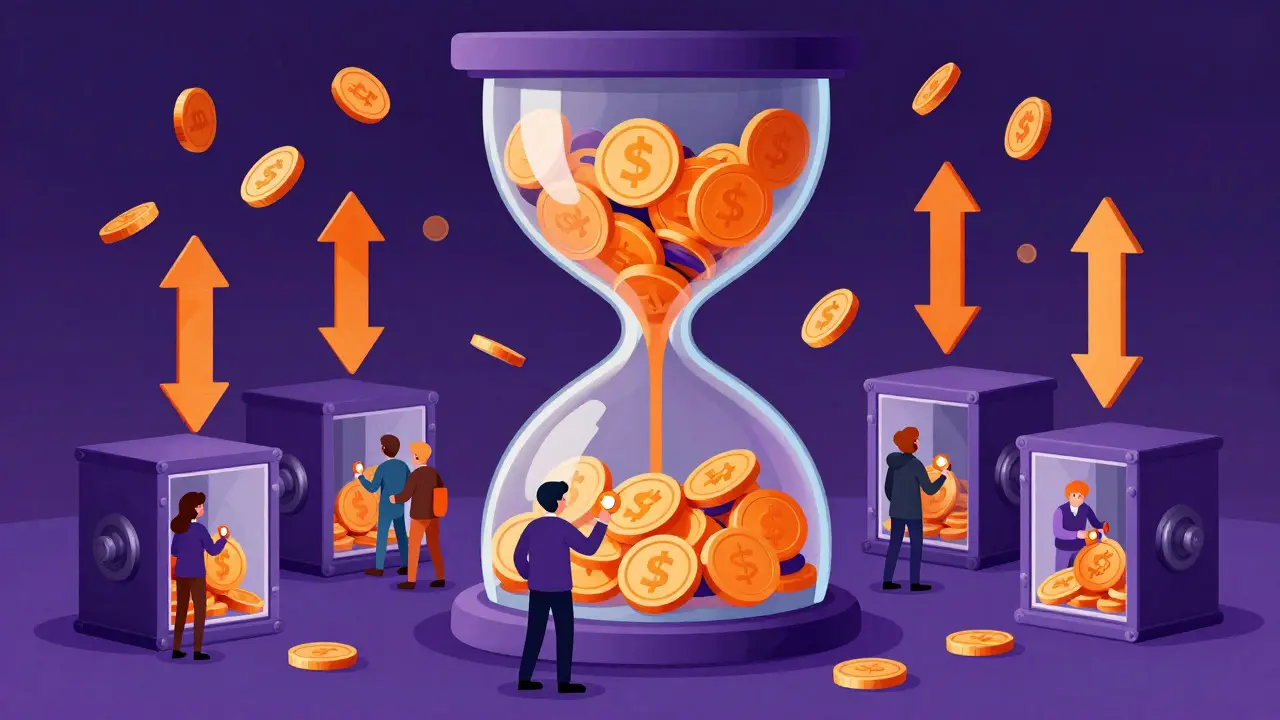
To understand HEX, you have to look at how it differs from traditional mining. In most cryptocurrencies, miners solve complex math problems to secure the network and earn rewards. In HEX, there is no mining in that sense. Instead, you "stake" your tokens. The process is surprisingly simple technically but requires patience strategically. You run a piece of code once on your computer or mobile device to lock up your HEX. During this step, you choose a commitment period. This range spans from just 1 day to a maximum of 5,555 days. The system follows a strict rule: "Longer Pays Better." If you lock your tokens for 30 days, you get a certain reward rate. Lock them for 365 days, and the rate jumps significantly. Lock them for the full 5,555 days, and you maximize your potential yield.
While your tokens are locked, they are effectively burned from circulation and converted into "T-Shares." These T-Shares accumulate daily interest denominated in HEX. When your commitment period ends, you run the code again to "mint" your accumulated rewards. This minting process creates new HEX tokens out of thin air to pay you. This is why HEX has a variable inflation rate. The protocol aims for a maximum annual inflation of approximately 3.69%, but this figure fluctuates based on market conditions. If the price of HEX goes up, fewer new tokens need to be minted to pay the same dollar amount of interest. If the price crashes, more tokens must be minted to cover the rewards, accelerating inflation. This mechanism ensures that early adopters are paid in a way that theoretically balances the books, though critics argue it relies heavily on continuous new capital entering the system.
PulseChain: The Layer-1 Extension
HEX didn't stay isolated on Ethereum. Its creator, Richard Heart, developed PulseChain, a separate Layer-1 blockchain network. Think of PulseChain as a parallel universe to Ethereum, built specifically to address Ethereum's historical pain points: high gas fees and slow transaction speeds. PulseChain uses a Proof-of-Stake (PoS) consensus mechanism, which is far more energy-efficient than the Proof-of-Work systems used by Bitcoin or pre-Merge Ethereum. The native currency of this network is PLS.
The launch of PulseChain was unconventional. Instead of a standard Initial Coin Offering (ICO), the team used a "sacrifice" mechanism. Users donated various cryptocurrencies or fiat currency to designated addresses or charities. The more you sacrificed, the more PLS tokens you received. This raised over $27 million according to project figures. Additionally, PulseChain took a snapshot of the entire Ethereum state. This meant that if you held ETH or other ERC-20 tokens on Ethereum at the time of the fork, you received free copies of those assets on PulseChain. A feature called "freemium PLS" allowed ETH holders to use their free PLS to pay for transactions on the new network without needing to buy anything, lowering the barrier to entry. Despite these innovative features, the launch faced hurdles, including difficulty securing listings on major exchanges and initial issues with transaction fees remaining higher than promised.
| Feature | HEX (Ethereum) | PulseChain (Layer-1) |
|---|---|---|
| Network Type | ERC-20 Token on Ethereum | Independent Layer-1 Blockchain |
| Consensus Mechanism | Ethereum PoS (post-Merge) | Proof-of-Stake (PoS) |
| Primary Function | Decentralized Certificate of Deposit (Staking Rewards) | General-purpose Smart Contract Platform (Low Fees) |
| Native Asset | HEX | PLS |
| Token Distribution | Presale and Staking Minting | "Sacrifice" Donation Model and Ethereum Fork Airdrop |
| Fee Structure | Standard Ethereum Gas Fees | EIP-1559 Fee Burning (Deflationary Pressure on PLS) |
The Controversy: Ponzi Scheme or Innovation?
You cannot discuss HEX without addressing the elephant in the room: the accusations. For years, skeptics in the crypto community have labeled HEX a Ponzi scheme. Their argument is straightforward. In a true Ponzi scheme, returns to early investors are paid from the capital of later investors rather than from actual profit. Critics point out that HEX pays out massive yields (often exceeding 30%) purely through token inflation. Since the rewards are funded by minting new tokens, the sustainability of the model depends on the token's price holding steady or rising. If the price drops, inflation accelerates, potentially devaluing the asset further. Proponents counter that HEX is fully decentralized because users control their own keys and mint their own rewards, removing the "middleman" risk typical of centralized finance.
The situation escalated when the U.S. Securities and Exchange Commission (SEC) brought claims against Richard Heart. The SEC alleged that the HEX presale was manipulated using a "Hex Flush Address." According to these allegations, while the presale appeared to attract $678 million worth of Ethereum, only about $34 million represented legitimate new investment. The rest was recycled funds that inflated the perceived success of the sale. This accusation suggested that Heart maintained disproportionate control over the token supply. However, legal battles in the crypto space are complex, and proponents cite subsequent legal developments as victories for decentralization. Regardless of the legal outcome, the reputational damage remains a significant factor for institutional investors and mainstream adoption.
Market Reality and Liquidity Challenges
As of mid-2026, the practical reality of trading HEX and PLS presents challenges for many users. Unlike Bitcoin or Ethereum, which trade on hundreds of global exchanges, HEX and PLS have limited exchange support. Major platforms like Coinbase or Binance do not list these tokens, forcing users to rely on smaller venues or decentralized exchanges (DEXs). This lack of liquidity means that buying or selling large amounts of HEX can result in significant slippage, where the price changes unfavorably during the execution of your trade. The primary trading volume for HEX often concentrates on a few specific pairs, such as HEX/USDT, with daily volumes sometimes in the tens of thousands of dollars rather than millions. For PulseChain, the absence of major exchange listings makes it difficult for casual users to enter or exit positions easily. Most activity occurs within the PulseChain ecosystem itself, particularly on its integrated decentralized exchange, PulseX. This creates a closed-loop economy where utility is high for active participants but low for passive holders looking for easy liquidity.

Who Should Consider HEX or PulseChain?
Given the technical complexity and controversial history, HEX and PulseChain are not suitable for everyone. They appeal to a specific type of investor: those who are comfortable with high-risk, high-reward strategies and who deeply understand the mechanics of tokenomics and inflation. If you believe in the long-term vision of a lower-fee Ethereum alternative and are willing to hold PLS for years, PulseChain might align with your portfolio. If you enjoy the concept of algorithmic interest payments and don't mind locking capital for extended periods, HEX staking offers a structured yield strategy. However, you must be prepared for volatility. The correlation between HEX price and its inflation rate means that market downturns can exacerbate losses. Diversification is key. Do not allocate a significant portion of your net worth to a single controversial asset. Monitor the regulatory landscape closely, as any new SEC actions could impact the legal status of these projects. Finally, verify all contracts and addresses before interacting with the network, as counterfeit tokens and scams are common in niche ecosystems.
Frequently Asked Questions
Is HEX a good investment in 2026?
Whether HEX is a good investment depends on your risk tolerance. It offers high yields through staking but carries risks related to token inflation, limited liquidity, and regulatory uncertainty. It is generally considered a high-risk speculative asset rather than a stable store of value.
What is the difference between HEX and PLS?
HEX is an ERC-20 token on the Ethereum blockchain focused on staking rewards. PLS is the native gas token of the PulseChain Layer-1 blockchain. While both were created by Richard Heart, they operate on different networks with different primary functions: HEX for yield generation, PLS for paying transaction fees on PulseChain.
How do I stake HEX?
To stake HEX, you need to connect your wallet to the official HEX interface. You select the amount of HEX to lock and choose a commitment period (ranging from 1 to 5,555 days). Once confirmed, your tokens are locked, and you begin accumulating T-Shares. After the period ends, you run the unstaking code to mint your rewards.
Is PulseChain better than Ethereum?
PulseChain aims to offer lower transaction fees and faster block times than Ethereum. It uses Proof-of-Stake and burns a portion of fees. However, it lacks the extensive developer ecosystem and institutional backing of Ethereum. Whether it is "better" depends on your priorities: cost efficiency vs. network security and adoption.
Can I lose my HEX if the price drops?
Yes. If the price of HEX drops significantly, the number of new tokens minted to pay your interest increases to maintain the same dollar-value payout. This increased inflation can dilute the value of your holdings. Additionally, since you cannot sell your HEX while it is staked, you are exposed to price volatility without the option to exit until your commitment period ends.