Legal Status of Privacy Coins Worldwide: A Global Regulatory Guide
Imagine sending a digital payment where no one-not the government, not the exchange, and not even your neighbor-can see who sent it, who received it, or how much changed hands. That is the promise of privacy coins, cryptocurrencies designed with enhanced cryptographic protocols to obscure transaction details like sender, receiver, and amount. For years, these assets have been the dark horses of the blockchain world, offering financial anonymity in an increasingly transparent digital economy. But that freedom comes with a heavy price tag: regulatory scrutiny.
If you are holding Monero (XMR), a cryptocurrency using ring signatures and stealth addresses for mandatory privacy, Zcash (ZEC), a cryptocurrency utilizing zk-SNARKs for selective privacy, or Dash (DASH), a cryptocurrency featuring optional PrivateSend mixing technology, you might be wondering if they are still legal in your country. The answer isn't a simple yes or no. It depends entirely on where you live, what year it is, and which regulator is watching over your shoulder.
Why Regulators Are Watching Privacy Coins
To understand the bans and restrictions popping up globally, you first need to know why regulators care so much. It all boils down to two acronyms: AML (Anti-Money Laundering) and CFT (Counter-Terrorist Financing).
In traditional banking, every transaction leaves a paper trail. If you wire money from New York to London, the banks know exactly who is involved. With Bitcoin, the trail is public but pseudonymous; anyone can trace the flow of funds if they dig deep enough. Privacy coins break this chain. They use complex cryptography to make transactions untraceable by design.
- Ring Signatures: Used by Monero, this technology mixes your transaction signature with others, making it impossible to identify the true sender.
- Zero-Knowledge Proofs (zk-SNARKs): Used by Zcash, this allows users to prove a transaction is valid without revealing any underlying data.
- Coin Mixing (CoinJoin): Used by Dash, this combines multiple transactions into one, obscuring the link between input and output.
The Financial Action Task Force (FATF), an intergovernmental body whose policies influence global anti-money laundering standards has been pushing hard since 2021. Their guidance suggests that countries should either ban privacy coins or force exchanges to apply "enhanced due diligence" when handling them. This created a domino effect. Exchanges, fearing massive fines, started delisting these coins preemptively. By 2023, major platforms like Bittrex, Kraken, and Huobi had removed many privacy assets from their order books.
The Ban Hammer: Countries Saying No
Some jurisdictions have taken the most aggressive stance possible: total prohibition. If you live in these places, buying, selling, or even holding privacy coins on a local exchange is effectively impossible.
| Country/Jurisdiction | Regulatory Action | Key Details |
|---|---|---|
| Japan | Complete Ban | The Financial Services Agency (FSA) prohibited all licensed exchanges from listing privacy coins in April 2018 under the revised Fund Settlement Law. |
| South Korea | Exchange Ban | The Financial Services Commission (FSC) directed licensed exchanges to delist privacy coins in January 2020, enforced via self-regulatory standards. |
| Australia | Travel Rule Conflict | The Anti-Money Laundering Amendment Rule 2021 requires sender/recipient info for all crypto transactions, making privacy coins incompatible with legal compliance. |
| Dubai (UAE) | Financial Center Ban | The Dubai Financial Services Authority (DFSA) issued Notice 128 in September 2023, banning DIFC institutions from dealing in privacy coins. |
| European Union | Upcoming Ban | The Anti-Money Laundering Regulation (AMLR) mandates a ban on privacy coins and anonymous wallets starting July 2027. |
Japan was the first major economy to pull the plug. In 2018, after several high-profile exchange hacks, the FSA decided that privacy coins were too risky for retail investors. South Korea followed suit in 2020, citing similar concerns about illicit finance. Australia’s approach is more subtle but equally effective. By enforcing the "Travel Rule"-which requires sharing user data for transactions over $1,000-they made it legally impossible for compliant exchanges to support coins that hide that very data.
Then there is Europe. The EU’s new Anti-Money Laundering Regulation (AMLR), passed in April 2023, is a game-changer. Article 49a explicitly bans privacy coins. While the implementation date is set for July 2027, this gives businesses and users four years to prepare. For now, you can still trade them in Europe, but the clock is ticking.
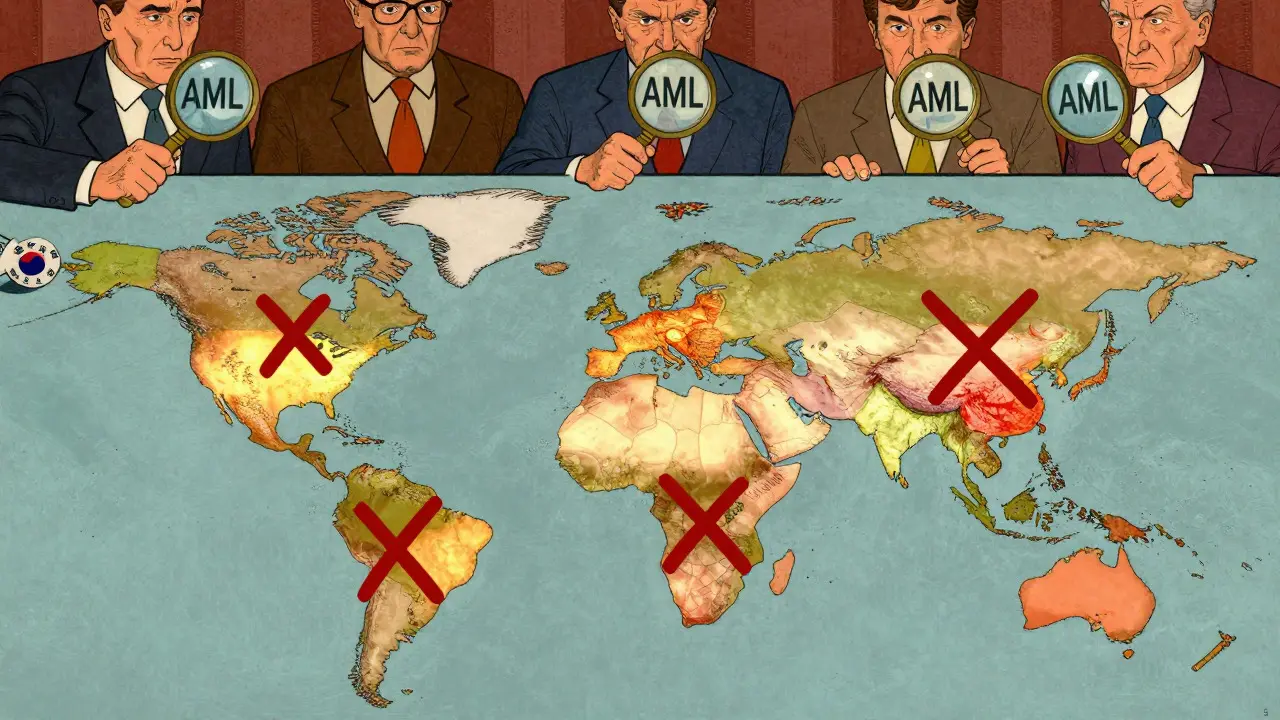
The Wild West: The United States Approach
The United States takes a different path. There is no federal law explicitly banning privacy coins. Instead, the U.S. relies on a patchwork of agency guidelines. The Treasury Department’s FinCEN, the Financial Crimes Enforcement Network, a bureau of the U.S. Department of the Treasury states that privacy coins are legal but subject to strict AML/CFT rules.
This means you can hold Monero or Zcash in the U.S. without going to jail. However, if you try to cash out at a regulated exchange, expect friction. Exchanges must perform "enhanced due diligence." In practice, this often means higher fees, longer verification times, or outright refusal to process large privacy coin withdrawals.
The tension became clear in August 2022 when the Office of Foreign Assets Control (OFAC) sanctioned Tornado Cash, a decentralized mixer. While Tornado Cash isn’t a coin itself, the move signaled that the U.S. government views privacy-enhancing tools with extreme suspicion. Since then, FinCEN has warned that privacy coins present "heightened risks," leaving exchanges to navigate a gray area where compliance is costly and mistakes are expensive.
Privacy-Friendly Havens
Not every country is cracking down. Some nations see privacy coins as a vital component of financial sovereignty and personal liberty. These jurisdictions offer a safer environment for users who prioritize anonymity.
El Salvador, a Central American country that adopted Bitcoin as legal tender in 2021 stands out. Its Bitcoin Law does not distinguish between types of cryptocurrencies. Whether you hold Bitcoin, Ethereum, or Monero, the law treats them equally. This makes El Salvador a haven for privacy advocates, though its small market size limits its global impact.
Similarly, the Central African Republic, a nation that enacted cryptocurrency laws permitting all digital assets including privacy coins explicitly permits all cryptocurrencies in its 2022 legislation. While infrastructure challenges remain, the legal clarity is welcome news for privacy coin holders.
Other regions, like parts of Southeast Asia and Latin America, lack specific regulations targeting privacy coins. This absence of law doesn’t mean a free-for-all; it just means regulators haven’t prioritized these assets yet. For now, users in these areas can often access privacy coins through decentralized exchanges (DEXs) or peer-to-peer networks.

What Does This Mean for You?
If you are a casual investor, the landscape is shifting against you. Major centralized exchanges are dropping privacy coins to avoid regulatory headaches. Your best option? Decentralized exchanges (DEXs). Platforms like Bisq or local Monero swaps allow you to trade without a middleman. However, this requires technical know-how and carries its own risks, such as smart contract vulnerabilities or counterparty fraud.
For businesses, compliance is key. If you accept privacy coins, you need robust internal controls. The TRM Labs 2022 Compliance Guide recommends implementing blockchain analytics tools capable of detecting privacy coin transactions. Even if the blockchain is opaque, metadata leaks (like IP addresses or timing patterns) can sometimes expose users. Enhanced customer due diligence (EDD) is no longer optional-it’s survival.
Don’t ignore the tax implications. Just because a transaction is private doesn’t mean it’s invisible to tax authorities. In the U.S., the IRS still expects you to report capital gains on crypto sales. Using privacy coins might make auditing harder, but it doesn’t exempt you from filing. Keep meticulous records of your purchases, sales, and holdings.
The Future Outlook: Survival or Extinction?
Where is this heading? The trend is clearly toward restriction. The Cambridge Centre for Alternative Finance predicts that privacy coins will be eliminated from regulated markets in 60% of major economies by 2030. The EU’s upcoming ban sets a precedent that other regions may follow.
However, extinction is unlikely. Privacy is a fundamental human right, and demand for financial anonymity will persist. As surveillance expands, more users may turn to privacy coins despite the risks. The Electronic Frontier Foundation argues that bans disproportionately harm legitimate users while criminals adapt to new technologies. History shows that suppressing privacy often drives it underground, not away.
We are likely entering an era of fragmentation. Privacy coins will thrive in decentralized ecosystems and privacy-friendly jurisdictions while fading from mainstream exchanges. Users will need to become more self-reliant, managing their own keys and navigating DEXs. The convenience of one-click trading on Coinbase or Binance may give way to the complexity of direct node interactions.
Stay informed. Regulations change overnight. What is legal today might be banned tomorrow. Follow updates from the FATF, local financial authorities, and industry groups. And remember: in the world of privacy coins, your security is your responsibility.
Are privacy coins illegal in the United States?
No, privacy coins are not illegal in the United States. However, they are subject to strict Anti-Money Laundering (AML) and Counter-Terrorist Financing (CFT) regulations enforced by FinCEN. Exchanges may impose additional scrutiny or fees when processing privacy coin transactions.
Which countries have completely banned privacy coins?
Japan, South Korea, and Australia have implemented de facto bans on privacy coins for licensed exchanges. Japan banned them in 2018, South Korea in 2020, and Australia’s Travel Rule amendments in 2021 made compliance impossible for privacy-focused assets.
When will the EU ban privacy coins?
The European Union’s Anti-Money Laundering Regulation (AMLR) mandates a ban on privacy coins and anonymous wallets starting in July 2027. This regulation was approved by the European Parliament in April 2023.
Can I still buy Monero or Zcash on major exchanges?
Availability varies by region. Many major exchanges like Kraken, Bittrex, and Huobi have delisted privacy coins in various jurisdictions due to regulatory pressure. In the U.S., some exchanges still list them but with limited functionality. Decentralized exchanges (DEXs) remain a reliable alternative.
Do I need to pay taxes on privacy coin transactions?
Yes. In most jurisdictions, including the U.S., privacy coins are treated as property for tax purposes. Capital gains taxes apply when you sell, trade, or spend them. The privacy feature does not exempt you from reporting obligations.
What is the FATF Travel Rule?
The Travel Rule is a recommendation by the Financial Action Task Force (FATF) requiring Virtual Asset Service Providers (VASPs) to share originator and beneficiary information for transactions above a certain threshold (often $1,000). This conflicts with the core privacy features of coins like Monero and Zcash.