Mining Crypto in Iran: Law and Restrictions in 2026
Bitcoin mining in Iran isn’t banned-but it’s not exactly legal either. Since 2018, the government has walked a tightrope: letting miners operate while constantly tightening the screws. By 2026, the rules have turned into a maze of shifting deadlines, hidden exceptions, and power blackouts that leave ordinary miners stranded. If you’re thinking about mining crypto in Iran, you need to know what’s real, what’s fake, and who’s really in control.
It’s Legal… But Only If the Government Says So
As of 2026, cryptocurrency mining is technically legal in Iran-but only if you have a license from the Central Bank of Iran (CBI). That sounds straightforward, but the reality is messier. The CBI took full control of crypto regulation in January 2025, replacing a patchwork of local rules with one central system. Now, every miner-individual or company-must apply for a license, prove they’re using approved hardware, and agree to pay the highest electricity rates in the country. Here’s the twist: the electricity rates for miners are higher than those for factories, hospitals, or even government buildings. Why? Because the government wants to make mining expensive enough to discourage it. But here’s the catch: they still haven’t fixed the grid. And when the power goes out, they blame miners.The Energy Trap: Power Outages and Blame Games
Iran’s electricity is cheap-around $0.004 per kWh for industrial users. That’s why, in 2021, Iran was responsible for nearly 5% of all Bitcoin mining worldwide. But cheap power doesn’t mean reliable power. In the summer of 2024, nationwide blackouts lasted for weeks. The government shut down all mining operations for four months. They claimed illegal miners were stealing 2,000 megawatts of electricity-enough to power a city the size of Tehran. But independent analysts say that’s exaggerated. Tavanir, Iran’s state power provider, admits the grid is old and poorly maintained. The real issue? The government hasn’t invested in upgrades. Instead, they use mining as a scapegoat. Every time the lights go out, they blame crypto miners. Then they ban mining. Then they lift the ban. Then they raise electricity rates. Rinse and repeat.Who’s Really Mining? The IRGC and Hidden Factories
While private miners scramble to get licenses, powerful groups operate openly without paying a dime. The Islamic Revolutionary Guard Corps (IRGC) runs at least one 175-megawatt mining farm in Rafsanjan, Kerman province. It’s a joint venture with Chinese investors. They don’t pay for electricity. They don’t report their profits. And they don’t need a license. This isn’t an exception-it’s the rule. State-linked entities control an estimated 65% of Iran’s total mining capacity. They use mosques, religious centers, and government buildings to tap into free power. Meanwhile, licensed miners pay 10 times more for electricity and still get cut off during peak hours. The system isn’t broken-it’s designed this way.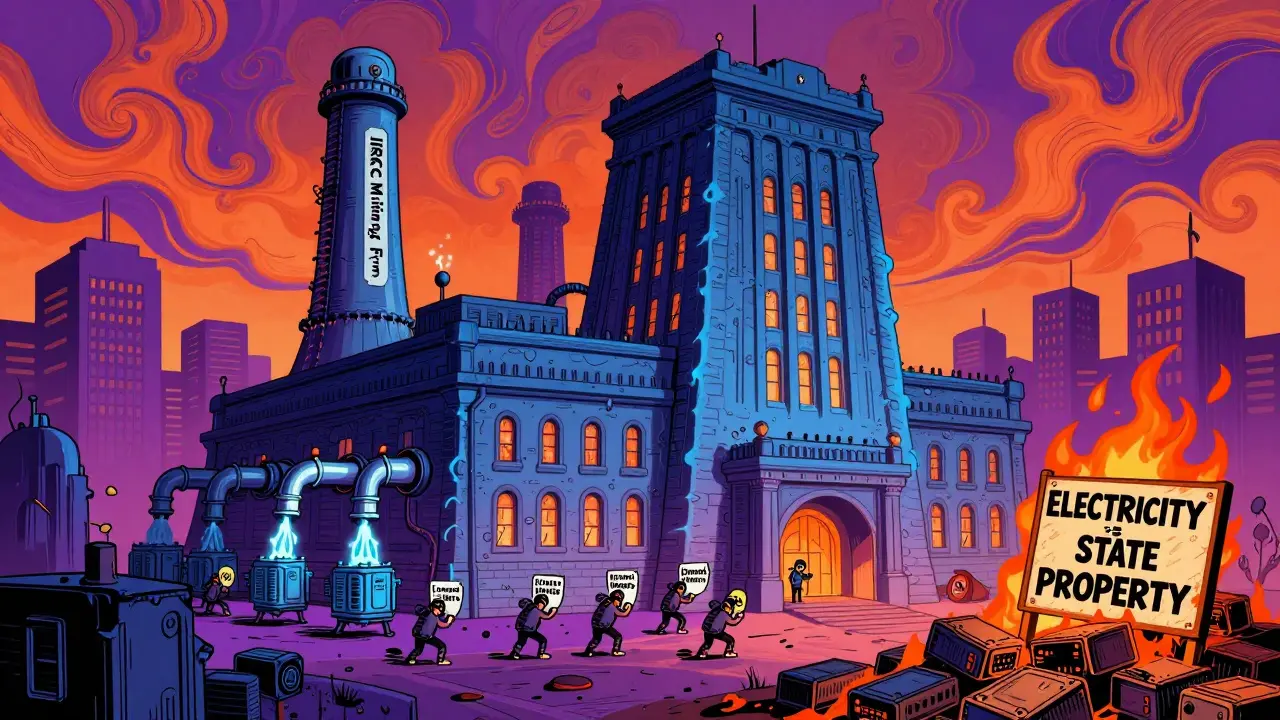
The Licensing Nightmare: Paperwork, Delays, and Dead Ends
Getting a license sounds simple: apply to the Ministry of Industry, Mine and Trade, then get approved by the CBI. But the process takes months. You need:- Proof of approved mining hardware (only specific ASIC models are allowed)
- A detailed energy consumption plan
- Proof of bank account with the CBI
- A financial audit from a government-approved firm
Advertising Is Now Illegal. So Is Public Use.
In February 2025, Iran banned all cryptocurrency advertising-online and offline. No more YouTube videos. No more billboards. No more Facebook posts. Even mentioning Bitcoin in public forums can get you fined. Trustpilot ratings for Iranian crypto exchanges dropped from 4.1 to 2.4 stars in two months. Users are angry. One Reddit user wrote: “I tried to buy Bitcoin to pay my rent. The app said ‘transaction failed.’ Then my phone showed a message: ‘You are not authorized to use this service.’” The government says this is to protect citizens from fraud. But it’s also to stop people from using crypto to bypass sanctions. And it’s working. TRM Labs reported an 11% drop in crypto inflows into Iran in the first half of 2025. Peer-to-peer trading is up-78% more on LocalBitcoins-but that’s not enough to keep the industry alive.
Why Foreign Investors Are Walking Away
Iran invited foreign investors in 2020 with promises of low costs and high returns. But the reality is brutal. You can’t open a bank account without a local partner. You can’t move money out without government approval. And if the power goes out next summer, your entire operation could vanish overnight. There’s no legal recourse. No arbitration. No protection. A Canadian mining company tried to set up shop in Shiraz in 2023. They spent $2 million on equipment. Six months later, the government froze their account, citing “unverified transaction patterns.” They lost everything. No one was punished. No one was held accountable.The Future: A State-Run Digital Currency
Iran isn’t trying to become a crypto hub. It’s trying to kill decentralized money. The Central Bank’s digital currency, called the “Rial Currency,” is already being tested. It’s not blockchain-based. It’s not transparent. It’s not mineable. It’s a centralized digital rial-controlled entirely by the government. You can’t trade it. You can’t send it abroad. You can only use it to pay for state-approved goods. This is the endgame: replace Bitcoin with a state-controlled token. Make mining irrelevant. Make crypto useless. And make sure only the regime benefits.What This Means for Miners in 2026
If you’re a private miner in Iran, you’re playing Russian roulette. The rules change every month. The power cuts every season. The government watches everything. Your license can be revoked without warning. Your equipment can be seized. Your money can disappear. The only people winning are those with political connections. Everyone else is just a footnote in a system that doesn’t care if you survive.The truth? Mining crypto in Iran isn’t about profit anymore. It’s about survival.
Jessica Carvajal montiel
February 26, 2026 AT 11:44Let me get this straight-Iran’s government is using crypto miners as a convenient scapegoat for their own infrastructure failures? Classic. They don’t fix the grid because they’d rather blame a decentralized technology than admit they’ve spent decades mismanaging public utilities. And let’s not forget the IRGC’s 175-megawatt farm running on free power while ordinary citizens get fined for using a Bitcoin app to pay rent. This isn’t regulation-it’s theft dressed up as policy. The whole thing is a performance for foreign observers who still think Iran is ‘open for business.’
Nicki Casey
February 27, 2026 AT 14:43It is not merely ironic-it is profoundly pathological that a regime so obsessed with centralized control would attempt to suppress a technology inherently resistant to such control. The CBI’s licensing regime is not a regulatory framework; it is a surveillance mechanism disguised as bureaucratic procedure. Every ASIC model approved, every energy consumption plan scrutinized, every bank account monitored-this is not about fiscal prudence. It is about dominance. The Rial Currency is not a digital currency-it is a digital leash. And the fact that foreign investors are being systematically expropriated without recourse speaks volumes about the nature of the state’s economic sovereignty: it is not sovereign at all-it is predatory.
maya keta
March 1, 2026 AT 00:34Okay but like… why are people even trying? 😅 I get that electricity is cheap in Iran but the grid’s held together with duct tape and prayers. You spend months getting a license, then BOOM-power outage for 3 months. And now you can’t even advertise your mining rig? That’s not regulation, that’s a cult. Meanwhile, the IRGC is out here running a crypto factory in a mosque like it’s a Sunday service. 🤡 I just don’t understand how anyone thinks this is sustainable. It’s not a business-it’s a hostage situation.
Paul Reinhart
March 2, 2026 AT 03:50The tragedy here isn’t just the corruption or the hypocrisy-it’s the human cost buried under layers of policy theater. People are using crypto not for speculation, but for survival. Rent. Medicine. Food. And when the government blocks transactions because it fears sanctions evasion, it’s not protecting national security-it’s weaponizing poverty. The fact that peer-to-peer trading has surged by 78% tells us something: people are finding ways to survive despite the state. But that’s not a victory-it’s a cry for help. And instead of listening, they double down on control. That’s not governance. That’s fear.
Samantha Stultz
March 2, 2026 AT 22:08Wait, so the CBI is the one issuing licenses now? But didn’t they also freeze all crypto-to-rial transactions for 23 days? That’s not regulation-that’s whiplash. You can’t have a ‘legal’ system that shuts down access to money for weeks then says ‘oh, we’re back, but now we’re tracking every coin.’ This isn’t policy. This is psychological warfare. And the fact that they’re pushing a centralized digital rial? That’s the endgame. They don’t want to regulate crypto-they want to kill it so they can replace it with something even more oppressive. Blockchain? No thanks. We’ll take state-controlled surveillance tokens. 🙃
Colin Lethem
March 3, 2026 AT 10:13So let me get this straight: Iran wants to ban crypto advertising but lets the IRGC run a massive mining farm on free power? Bro. That’s not a policy. That’s a meme. And the fact that foreign companies lose millions with zero recourse? That’s not a business environment. That’s a trap. I’ve seen shady regimes before, but this is next-level nonsense. You don’t invite investors with ‘low costs’ and then make it illegal to move money out. That’s not capitalism. That’s a horror movie with a spreadsheet.
Curtis Dunnett-Jones
March 4, 2026 AT 01:02It is imperative to recognize that the Iranian government’s approach to cryptocurrency mining is not merely inconsistent-it is structurally incoherent. The imposition of exorbitant electricity tariffs on licensed miners, while simultaneously permitting state-linked entities to operate without cost, constitutes a violation of the principle of equitable treatment under the rule of law. Furthermore, the absence of legal recourse for foreign investors who suffer total asset loss due to arbitrary account freezes demonstrates a systemic failure of institutional integrity. To characterize this as a regulatory environment is to misrepresent the nature of state power in Iran: it is not governed by rules, but by caprice.
kati simpson
March 5, 2026 AT 01:55I just feel bad for the people trying to mine. They’re stuck between a broken grid and a government that hates them for trying to survive. I mean, electricity is cheap but it keeps cutting out. You get a license, spend months on paperwork, then one day your rig just goes dark because the government says ‘oops, we need the power for hospitals.’ And you can’t even sell your Bitcoin because the app says ‘not authorized.’ It’s like they want you to suffer but not enough to quit. Why? Just… why?
Alyssa Herndon
March 6, 2026 AT 17:45There’s something deeply tragic about a nation that has the technical capability to mine a significant portion of Bitcoin’s hash rate but chooses to turn its people into collateral damage instead of empowering them. The real innovation here isn’t in the ASICs or the mining farms-it’s in the way the state has weaponized scarcity. By making crypto a tool of survival and then punishing those who use it, they’ve created a paradox: the more people rely on it, the more the state tries to destroy it. And yet, people still try. That’s not stupidity. That’s resilience.
bella gonzales
March 8, 2026 AT 01:00ugh i just scrolled through this and now i’m depressed. like… why does everything have to be so complicated? i just wanted to know if i could mine in iran. now i feel like i need a law degree and a backup generator.
Patrick Streeb
March 9, 2026 AT 17:27While the narrative presented is compelling, one must consider the geopolitical context in which these policies are enacted. Sanctions have forced Iran into a position of economic isolation, and the state’s actions-however regressive-may be interpreted as attempts to preserve monetary sovereignty. The centralized digital rial, for instance, may not be a tool of oppression, but rather a defensive mechanism against external financial coercion. The irony lies not in the hypocrisy of the regime, but in the fact that its very survival necessitates the suppression of the very technologies that could liberate its people.
Cory Derby
March 9, 2026 AT 19:48If you’re thinking about mining in Iran, here’s what you need to know: don’t. Not because it’s impossible, but because the cost isn’t just financial-it’s existential. Every dollar you invest is a gamble against a system designed to fail you. The government doesn’t want you to succeed. They want you to try, fail, and blame yourself. That’s the real trap. And the worst part? The people who actually need crypto to survive are the ones getting crushed. You can’t fix a broken system by making it more complicated. You fix it by being honest. And Iran isn’t being honest.
Michael Teague
March 11, 2026 AT 16:18so like… if the irgc is mining for free and regular people are getting shut down… isn’t that just… stealing? like, why is this even a thing? they’re not even trying to hide it. it’s like they’re proud of it.
Vishakha Singh
March 11, 2026 AT 19:09It is heartening to witness the resilience of individuals who continue to pursue decentralized financial tools despite systemic oppression. The fact that peer-to-peer trading has increased by 78% is not merely a statistic-it is a revolution in microcosm. Each transaction, each transfer, each attempt to bypass state control is an act of quiet defiance. The Iranian state may control the grid, the banks, and the APIs-but it cannot control the will of its people to seek freedom, even in small, digital forms. This is not the end of crypto in Iran. It is the beginning of something deeper.
Mae Young
March 12, 2026 AT 01:44Oh, so now it’s ‘survival’? Let me guess-the next article will be titled: ‘How I Used Bitcoin to Buy a Single Bag of Rice in Tehran.’ This isn’t a revolution. It’s a tragedy with a hashtag. The government isn’t evil-it’s incompetent. And the miners? They’re not heroes. They’re just people who didn’t get the memo that capitalism in Iran is a haunted house with no exit. The IRGC has a 175-megawatt farm? Of course they do. They’ve got the whole country on life support and they’re still charging the power bill to the guy with the ASIC in his garage. This isn’t policy. It’s performance art for the UN.
Danny Kim
March 14, 2026 AT 00:41So the government bans advertising… but the IRGC is running a mining farm in a mosque? That’s not hypocrisy. That’s comedy. And the fact that they’re pushing a digital rial that can’t be sent abroad? That’s not innovation-that’s a prison with Wi-Fi. You don’t create a state currency to ‘protect citizens.’ You do it so you can track every dollar they touch. And then you wonder why people are using LocalBitcoins. Because they’d rather be tracked by strangers than by their own government.
Nadia Shalaby
March 15, 2026 AT 10:12i’m just here for the memes tbh. like… iran: ‘you can’t mine crypto’ also iran: *builds 175-megawatt mining farm in a religious building* the energy crisis? totally the miners’ fault. the blackout? totally the miners’ fault. the fact that the government has zero infrastructure investment? totally… not the government’s fault. i love it.
Trenton White
March 16, 2026 AT 19:34I’ve seen this pattern before-not in Iran, but in Venezuela, in Zimbabwe, in Argentina. When a state loses legitimacy, it turns to technology not to empower, but to control. Crypto isn’t the problem. The problem is that the state sees freedom as a threat. The Rial Currency isn’t a currency-it’s a confession. They’re admitting they can’t compete with Bitcoin. So they’re trying to erase it. But you can’t erase something that’s already out there. People still talk. Still send. Still survive. And that’s the real story.
Cheryl Fenner Brown
March 18, 2026 AT 09:34so like… if the irgc is mining for free and i have to pay 10x for electricity and still get cut off… is that… illegal? or just… really really unfair? 🤔😭
Amanda Markwick
March 19, 2026 AT 05:04What’s happening in Iran isn’t about crypto. It’s about power. The state doesn’t care if you mine Bitcoin. It cares that you can send value outside its control. That’s why they ban advertising, freeze accounts, and track every transaction. They’re terrified of people building networks they can’t monitor. And the Rial Currency? It’s not the future-it’s a last-ditch effort to keep the past alive. But history doesn’t care about your fear. People will keep finding ways to connect. Even if it’s through a single, smuggled ASIC and a midnight Wi-Fi signal.