Nepal Crypto Ban Explained: Foreign Exchange Act 1962 & Penalties
Buying Bitcoin in Nepal isn't just risky-it's illegal. If you are sitting in Kathmandu or Pokhara thinking about swapping your Nepali Rupees for Ethereum or trading on Binance, you need to stop and read this. Unlike most countries that are figuring out how to tax crypto, Nepal has drawn a hard line in the sand. The government doesn't just dislike digital assets; it actively prosecutes anyone who touches them.
This isn't a vague suggestion from a local official. It is a strict federal prohibition backed by decades-old banking laws. For expats, tourists, and locals alike, understanding the Nepal crypto ban under the Foreign Exchange (Regulation) Act of 1962 is critical. One wrong transaction could lead to frozen bank accounts, heavy fines, or even prison time. Here is exactly what the law says, why it exists, and how it affects you today in 2026.
The Legal Backbone: Foreign Exchange Act 1962
To understand why crypto is banned, you have to look at the specific laws Nepal uses to enforce it. The primary weapon in the government's arsenal is the Foreign Exchange (Regulation) Act, 1962 (also known as 2019 BS in the Nepali calendar). This act was designed to control the flow of money in and out of the country to protect national reserves.
Under Section 12 of this Act, any transaction involving foreign currency must be conducted through authorized banks. Since cryptocurrencies like Bitcoin are not issued by any central authority and are not recognized as legal tender, they fall outside the scope of authorized transactions. When you buy crypto, you are essentially moving value across borders without going through the regulated banking system. The Nepal Rastra Bank (NRB), which serves as Nepal's central bank, views this as a direct violation of foreign exchange regulations.
The NRB made its stance clear in August 2017 when it issued Notice No. 37/074/075. This notice explicitly prohibited all banks and financial institutions from facilitating any transactions related to virtual currencies. Later, in September 2021, the Government of Nepal expanded this ban to include mining, trading, and promoting cryptocurrencies. So, whether you are trying to mine Bitcoin in your basement or trade Dogecoin on an app, you are violating the Foreign Exchange Act.
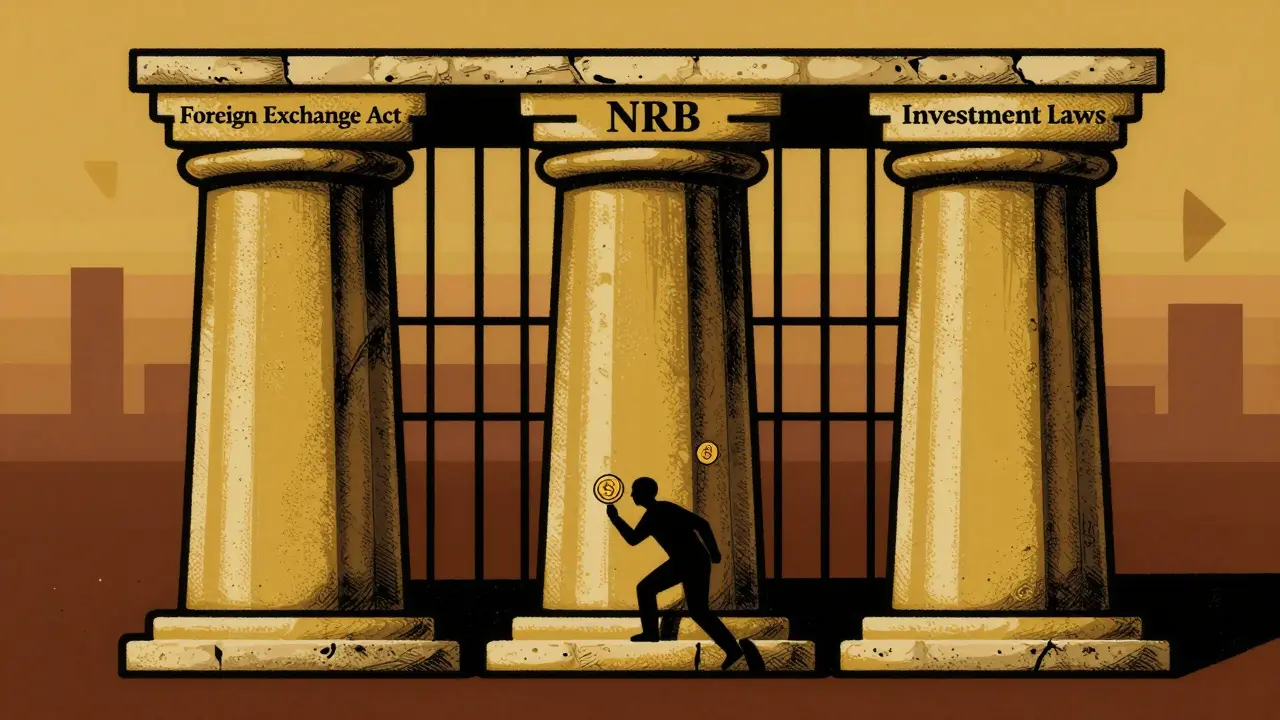
Supporting Laws and the "Three-Pillar" Prohibition
The Foreign Exchange Act is the main pillar, but it’s not standing alone. The legal framework rests on three key pieces of legislation that work together to crush crypto activity:
- Nepal Rastra Bank Act, 2002 (Sections 52(1) and 61): These sections give the central bank the power to regulate all financial institutions. Banks are legally required to monitor customer accounts for suspicious activities. If a bank detects funds being sent to a crypto exchange, they must freeze the account and report it to authorities.
- Act Restricting Investment Abroad, 1964 (Section 3): This law limits how much capital can leave Nepal. Investing in crypto is seen as an unauthorized investment abroad because most exchanges are located outside the country. This makes buying crypto a dual offense: violating exchange rules and breaking investment caps.
- Foreign Exchange (Regulation) Act, 1962 (Section 9(c)): This section specifically penalizes those who bypass authorized channels for foreign exchange transactions. Using a VPN to access a US-based exchange falls squarely under this provision.
These laws create a net that is difficult to escape. Even if you don't use a bank card directly, using peer-to-peer (P2P) methods or third-party payment processors can still trigger investigations under these acts.
Punishments: Fines, Jail Time, and Frozen Assets
What happens if you get caught? The consequences are severe and immediate. Under the Foreign Exchange (Regulation) Act, penalties are calculated based on the value of the transaction. You are looking at imprisonment for up to three years. Additionally, the fine imposed is typically three times the amount involved in the illegal transaction.
Let’s put that in perspective. If you illegally traded $1,000 worth of Bitcoin, you could face a $3,000 fine plus potential jail time. In January 2022, the Department of Revenue Investigation filed a case against four individuals for misappropriating Rs376.41 million through illegal crypto investments. Those cases resulted in significant legal battles and asset seizures.
It is also important to note that ownership itself is a gray area that leans heavily toward illegality. While some argue that holding crypto bought abroad might be technically permissible, the NRB considers any possession linked to unapproved transactions as illegal. There is no "safe harbor" for holding crypto in Nepal. If authorities link your assets to an unapproved purchase, you risk losing everything.
| Country | Status | Taxation | Key Enforcement Body |
|---|---|---|---|
| Nepal | Banned | N/A (Illegal) | Nepal Rastra Bank |
| India | Legal (Restricted) | 30% Tax on Gains | Reserve Bank of India |
| Bangladesh | Banned | N/A (Illegal) | Bangladesh Bank |
| Pakistan | Restricted/Registered | Varies | State Bank of Pakistan |
Why Is Nepal So Strict?
You might wonder why Nepal is one of only a handful of countries with a total ban. The answer lies in economics and stability. Nepal relies heavily on remittances-money sent home by workers abroad-which make up about 22-23% of the country's GDP. The Nepal Rastra Bank fears that cryptocurrencies provide an easy way for citizens to move large sums of money out of the country without oversight.
In 2021-2022, Nepal saw a sharp decline in foreign exchange reserves, dropping from $11.75 billion to $10.03 billion in just a few months. Officials directly linked part of this drop to capital flight via crypto. Dr. Shanker Sharma, a former governor of the NRB, argued that allowing crypto would destabilize the already fragile financial system. They view crypto not as an innovation, but as a threat to national security and economic sovereignty.
Furthermore, there is a concern about consumer protection. Without regulation, scams and frauds run rampant. Reports from local forums show many young Nepalis losing thousands of dollars in P2P scams or fake investment schemes. The government argues that a total ban protects citizens from these predatory practices, even if it stifles innovation.

The Underground Reality: Mining and P2P Trading
Laws are one thing; reality is another. Despite the ban, crypto activity persists in the shadows. Nepal has abundant hydropower, making electricity cheap (around Rs5.50 per kWh in some districts). This has led to a surge in underground Bitcoin mining operations, particularly in areas like Kavrepalanchok and Nuwakot. Estimates suggest that 15-20% of mining operations continue despite the prohibition.
Users also rely on Peer-to-Peer (P2P) platforms and Virtual Private Networks (VPNs) to access international exchanges like Binance or Kraken. A 2023 survey indicated that nearly 19% of tech-savvy Nepalis aged 18-35 had engaged in crypto transactions. However, this comes with high risks. Banks are increasingly sophisticated in detecting these patterns. Circular No. 12/078 issued by the NRB requires banks to flag any transaction exceeding Rs500,000 that looks suspicious. Many users have reported sudden account freezes after attempting to deposit fiat currency into crypto wallets.
Future Outlook: Will the Ban Lift?
As we move through 2026, the landscape remains tense but shows signs of slow evolution. The NRB has stated that the ban will likely remain in place for several more years. However, there is growing internal debate. Some economists, like Dr. Bhola Nath Ghimire, argue that the ban ignores the potential for crypto to reduce remittance costs, which currently average 6.5%.
There is also talk of a Central Bank Digital Currency (CBDC). Governor Maha Prasad Adhikari mentioned in 2023 that development is underway. A CBDC would allow the government to digitize the rupee while maintaining full control, potentially reducing the allure of decentralized cryptos like Bitcoin. Until such a system is fully integrated and trusted, the blanket ban on private cryptocurrencies is unlikely to disappear.
For now, the message from Kathmandu is clear: stay away. The risks of legal prosecution, financial loss, and account freezing far outweigh any potential gains from trading.
Is it legal to own Bitcoin in Nepal?
Technically, ownership exists in a gray area, but in practice, the Nepal Rastra Bank considers any possession of cryptocurrency acquired through unapproved channels as illegal. Since buying crypto violates the Foreign Exchange Act, owning it can lead to investigation and asset seizure. There is no legal pathway to hold Bitcoin in Nepal.
Can I use a VPN to trade crypto in Nepal?
Using a VPN to access foreign exchanges does not make the transaction legal. The Nepal Rastra Bank monitors financial flows, and using a VPN to bypass restrictions is considered an aggravating factor in legal proceedings. Banks are instructed to report suspicious activities, including those linked to VPN usage, to the Department of Revenue Investigation.
What are the penalties for crypto trading in Nepal?
Under the Foreign Exchange (Regulation) Act, penalties include imprisonment for up to three years and a fine equal to three times the value of the transaction. Additionally, your bank accounts may be frozen, and assets seized during the investigation.
Why did Nepal ban cryptocurrency?
Nepal banned crypto primarily to protect its foreign exchange reserves and prevent capital flight. The government fears that unregulated crypto transactions undermine the stability of the Nepali Rupee and facilitate money laundering. Remittances are crucial to Nepal's economy, and officials worry crypto offers an unchecked alternative for moving money abroad.
Is crypto mining allowed in Nepal?
No, crypto mining is strictly prohibited. The Government of Nepal expanded the ban in 2021 to include mining activities. Despite this, underground mining operations persist due to cheap hydroelectric power, but participants risk severe legal consequences if discovered.