OKX Crypto Exchange Review: Fees, Security, and Is It Safe in 2026?
Remember the chaos of 2022? When FTX collapsed and Terra Luna vanished overnight, trust in centralized exchanges hit rock bottom. You didn't just lose money; you lost faith that anyone was actually holding your coins. Since then, the standard for picking a cryptocurrency exchange is a platform where users buy, sell, and trade digital assets like Bitcoin and Ethereum has shifted from "who has the most features" to "who can prove they have the money." Enter OKX, which is a global cryptocurrency exchange founded in 2017 that offers spot trading, derivatives, and DeFi integration. Founded by Star Xu and headquartered in Seychelles, OKX has climbed to become one of the top four exchanges globally by volume. But does it actually deserve your trust in 2026?
Who Is OKX For (And Who Should Stay Away)?
Before you sign up, let's get real about eligibility. OKX operates in over 100 countries, but it is not available everywhere. If you live in the United States, Canada, Japan, or several other restricted jurisdictions including Iran, North Korea, and Cuba, you are out of luck. The platform accepts nine major fiat currencies-USD, EUR, GBP, AUD, BRL, AED, SGD, CAD, and JPY-but if you are in a restricted zone, even having those currencies won't help.
For everyone else, OKX positions itself as a hybrid platform. It appeals to two very different groups:
- The Bitcoin Maximalist: OKX maintains over 100% reserve backing specifically for Bitcoin. They publish regular Proof of Reserves reports, appealing to traders who want institutional-grade security without giving up control entirely.
- The Altcoin Hunter: With support for over 400 cryptocurrencies and 739 trading pairs, OKX is a playground for those looking for the next big thing beyond BTC and ETH.
If you are a complete beginner who wants to set and forget, OKX might feel overwhelming due to its sheer number of features. However, if you are an intermediate trader interested in staking, futures, or automated bots, this platform is built for you.
Fees and Costs: What Will You Actually Pay?
Trading fees eat into profits faster than bad trades. OKX uses a maker-taker fee model, which is standard across the industry. Here is the breakdown for standard users:
| User Level | Maker Fee | Taker Fee | Requirements |
|---|---|---|---|
| Standard | 0.08% | 0.10% | Default for new accounts |
| VIP 1 | 0.06% | 0.08% | $50k 30-day volume or 50 OKT balance |
| VIP 2+ | Lower | Lower | Higher volume/balance thresholds |
Makers provide liquidity (limit orders), while takers remove it (market orders). These rates are competitive, often beating out larger rivals like Binance on certain tiers. Additionally, holding OKB, which is the native utility token of the OKX ecosystem used for fee discounts and governance allows you to reduce these fees further. Currently, promotional offers include up to 30% fee discounts, though these terms change frequently, so always check the current promotions page before depositing.
Deposit fees vary by method. Bank transfers and credit card purchases via third-party providers may incur network or processing fees ranging from $1 to $10 depending on the currency. Crypto deposits are generally free unless the blockchain network itself charges high gas fees during congestion.
Security and Proof of Reserves
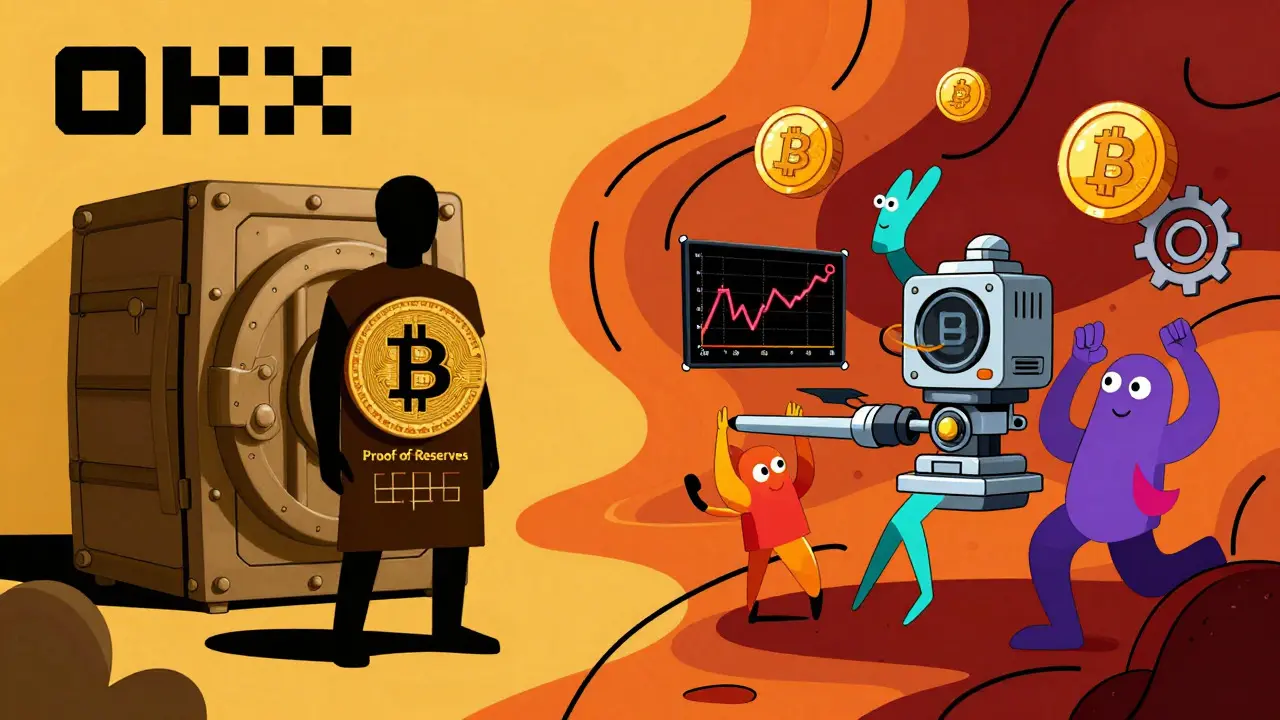
In the post-FTX era, "trust us" isn't enough. OKX addresses this with monthly Proof of Reserves, which is a cryptographic verification method allowing users to audit exchange holdings independently. This system lets you verify that your assets are backed 1:1 by checking the Merkle Tree on their website. For Bitcoin, they claim over 100% backing, which is a strong signal for conservative investors.
Beyond audits, the technical security stack includes:
- Cold Storage: The majority of user funds are kept offline in multi-signature cold wallets, inaccessible to hackers.
- Risk Fund: OKX maintains a $700 million risk fund to cover auto-deleveraging events in futures trading. While untested in a total collapse scenario, it provides a buffer against market volatility.
- User Protections: Two-factor authentication (2FA), anti-phishing codes, and withdrawal whitelists are mandatory for advanced security.
However, a critical caveat exists: OKX is headquartered in Seychelles. While they hold licenses in the UAE, Australia, Europe, Brazil, Singapore, and the Netherlands, the Seychelles base means limited formal protection compared to exchanges regulated by top-tier authorities like the SEC or FCA. In a worst-case legal dispute, your recourse is significantly more complex than if you were using a US-based entity.
Features: More Than Just Spot Trading
OKX distinguishes itself through its comprehensive product suite. It is not just a place to buy Bitcoin; it is a full financial ecosystem.
Derivatives and Futures
Advanced traders love OKX for its derivatives market. It offers perpetual swaps, quarterly futures, and options contracts. The interface supports sophisticated strategies like hedging and arbitrage. The leverage options go up to 125x on some pairs, which is both a powerful tool and a significant risk factor for inexperienced users.
DeFi and Web3 Wallet
One of OKX's strongest selling points is its integrated Web3 Wallet, which is a non-custodial wallet allowing users to interact with decentralized applications and multiple blockchains. Unlike traditional exchange wallets where the platform holds your keys, the Web3 wallet gives you full control. It supports cross-chain transactions, NFT management, and direct access to decentralized finance protocols. This bridges the gap between centralized ease-of-use and decentralized freedom.
Automated Trading Bots
For those who don't want to stare at charts all day, OKX offers built-in trading bots. These include grid trading bots, DCA (Dollar-Cost Averaging) bots, and auto-arbitrage tools. They run 24/7, executing trades based on predefined parameters. This feature democratizes algorithmic trading, allowing retail users to implement strategies previously reserved for institutional quant teams.
User Experience and Mobile App
Design matters when you are making split-second decisions. OKX scores high here, with app store ratings of 4.4 on Android and 4.6 on iOS. The interface is clean, intuitive, and logically organized. Navigation between spot trading, staking, futures, and the Web3 wallet is seamless.
The mobile app mirrors the desktop experience closely, meaning you aren't missing out on critical features when trading on the go. Charting tools are robust, supporting indicators and drawing tools comparable to TradingView. However, some users report occasional lag during periods of extreme market volatility, a common issue across many platforms but worth noting if you rely on millisecond precision.
Customer Support: The Weak Link?
This is where the glow-up stops. Despite the stellar tech, customer support remains a consistent pain point for OKX users. Reports on Reddit and Twitter highlight delays in response times, particularly for complex issues like frozen deposits or KYC disputes. While basic queries are handled quickly by chatbots, human support can be slow. If you are moving large sums or dealing with urgent withdrawals, have a backup plan and ensure your account details are flawless before initiating transactions.
How OKX Compares to Competitors
To make an informed decision, you need context. How does OKX stack up against the giants?
| Feature | OKX | Binance | Coinbase |
|---|---|---|---|
| Regulatory Status | Seychelles (Global Licenses) | Cayman Islands (Global Licenses) | USA (SEC Registered) |
| Available in USA? | No | Limited (Binance.US) | Yes |
| Fee Structure | 0.08%/0.10% | 0.10%/0.10% | Variable (Spread + Fees) |
| DeFi Integration | Strong (Web3 Wallet) | Moderate | Weak |
| Beginner Friendliness | Moderate | Low (Complex Interface) | High |
Binance offers deeper liquidity and a proven safety net (SAFU fund), but its regulatory troubles have made it less accessible in some regions. Coinbase is the safest bet for US residents but comes with higher fees and fewer advanced features. OKX sits in the middle: cheaper than Coinbase, more feature-rich than Binance.US, but with less regulatory clarity than either.
Final Verdict: Is OKX Worth It?
OKX is a powerful, technologically sophisticated platform that excels in low fees, diverse asset selection, and innovative features like its Web3 wallet and trading bots. It is an excellent choice for intermediate to advanced traders outside the US who want a balance of centralized convenience and decentralized access.
However, it is not perfect. Customer support is inconsistent, and the regulatory structure, while improving, still carries more risk than fully regulated entities. Do not put all your eggs in one basket. Use OKX for active trading and yield generation, but consider keeping long-term holdings in a self-custody hardware wallet. Always start with small amounts to test the waters, verify your Proof of Reserves, and never invest more than you can afford to lose.
Is OKX safe for beginners?
OKX is relatively safe due to its Proof of Reserves and security features, but its complexity may overwhelm true beginners. The platform offers demo accounts and copy trading, which help new users learn without risking capital. However, the availability of high-leverage derivatives requires caution. Start with spot trading only until you understand the interface.
Can I use OKX in the United States?
No, OKX is currently restricted for users residing in the United States. If you are a US citizen, you will need to look at alternatives like Coinbase, Kraken, or Binance.US, which are compliant with local regulations.
What are the minimum deposit requirements on OKX?
Minimum deposits vary by method and currency. For fiat bank transfers, it typically ranges from $1 to $10. Cryptocurrency deposits depend on the network's minimum transaction size, but generally, you can start with very small amounts. There is no minimum balance required to keep an account open.
Does OKX offer a referral bonus?
Yes, OKX has an aggressive referral program. New users can often receive sign-up bonuses such as $10,000 USDT in rewards or trading fee discounts, depending on current promotions. Existing users earn commissions on the trading fees generated by their referrals.
How does OKX compare to Binance?
OKX generally offers lower fees and a more modern interface with better Web3 integration. Binance has higher overall liquidity and a longer track record of handling crises with its SAFU fund. Both are global leaders, but OKX is often preferred by traders who value DeFi accessibility and slightly better pricing structures.
What happens if OKX goes bankrupt?
Since OKX is headquartered in Seychelles, there is no government insurance scheme like FDIC for crypto assets. Your protection relies on their Proof of Reserves and the $700 million risk fund. To mitigate this risk, experts recommend withdrawing large profits to a personal hardware wallet rather than leaving them on any exchange long-term.
Does OKX support staking?
Yes, OKX has a dedicated 'Earn' section offering flexible and fixed-term staking products for various cryptocurrencies. Users can earn annual percentage yields (APYs) by locking up their assets. The platform also supports liquid staking derivatives, allowing you to earn rewards while maintaining liquidity.
Is KYC mandatory on OKX?
Yes, Know Your Customer (KYC) verification is mandatory for most functions, including fiat deposits, withdrawals, and higher trading limits. The process involves submitting ID documents and facial recognition, which is usually approved within minutes to hours. Unverified accounts face strict withdrawal limits.
Dominic Greco
August 12, 2026 AT 06:10They are watching you through the screen right now 🧐 The Seychelles connection is a dead giveaway for shell company money laundering schemes 💸 They want your data and your soul 😈 Don't let them steal your digital identity 👻
Sean Rowland
August 12, 2026 AT 21:11The premise that regulatory clarity equates to safety is fundamentally flawed within the current macroeconomic paradigm. One must consider the systemic risk inherent in centralized custodial models regardless of jurisdictional nuances. Furthermore, the assertion that Proof of Reserves provides absolute security ignores the potential for double-spending vulnerabilities in complex ledger structures. It is imperative to scrutinize the underlying liquidity pools rather than relying on superficial compliance metrics.
Sus Sawyer
August 13, 2026 AT 20:52hey guys just wanted to say that i use the web3 wallet feature all the time and its super cool! you can move stuff around without giving up control which is huge. the bots are also pretty neat if you dont want to stare at charts all day long. just make sure you do your own research before diving into futures tho because leverage can wreck ya fast lol.
amy miranda
August 14, 2026 AT 00:46It is morally reprehensible how these platforms continue to operate with such impunity while promising security that clearly does not exist. The lack of proper oversight is a disgrace to the financial system we are trying to build. We deserve better than offshore entities hiding behind cryptographic jargon to avoid accountability.
Pernelia Wahkan
August 14, 2026 AT 05:15The integration of DeFi protocols directly into the exchange interface is a fascinating development. It effectively bridges the gap between traditional finance and decentralized autonomy. I have been experimenting with the cross-chain transactions and the latency is surprisingly low compared to other aggregators. This could be a game changer for institutional adoption if they maintain this level of technical proficiency.
Billy Cunningham
August 14, 2026 AT 05:30My account got frozen for three weeks over a simple KYC update 😩 Support never replied to my emails just automated responses. Lost so much sleep worrying about my funds being stuck there. Not worth the stress honestly.
Ed Wallace
August 15, 2026 AT 18:35One must ponder the philosophical implications of trusting an algorithm with one's livelihood. Is it truly freedom if the keys are held by a corporation in the Seychelles? Or is it merely a different form of servitude disguised as innovation? The Web3 wallet offers a sliver of hope but the centralization remains pervasive.
Joshua Hofford
August 16, 2026 AT 12:31I think people are sleeping on the trading bots feature seriously. You can set it and forget it while you focus on other things. The community here is growing fast and everyone seems happy with the new updates. Keep pushing forward and don't let the FUD get you down!
Amor Jordan
August 17, 2026 AT 08:48I understand the skepticism surrounding offshore exchanges but we have to look at the facts objectively. The Proof of Reserves is transparent and verifiable by anyone with basic blockchain knowledge. It is important to stay informed and not just react emotionally to every news headline. Let us support platforms that are actually trying to improve the ecosystem.
Matthew Smith
August 18, 2026 AT 15:08the moral decay of society is evident in our reliance on these digital casinos. yet here we are discussing fees as if it matters when the whole structure is built on sand. wake up sheeple.