Pact Crypto Exchange Review: Is This Algorand DEX Worth Your Assets in 2026?
Most people searching for a "Pact" crypto exchange are actually looking at two very different things. One is the smart contract language on Kadena (which has nothing to do with trading), and the other is Pact, the decentralized exchange (DEX) built on the Algorand blockchain. If you’re holding ALGO or interested in the Algorand ecosystem, you’ve likely seen Pact’s name pop up as one of the primary venues for swapping assets. It positions itself as "The home of liquidity on Algorand," but does it live up to that claim in 2026?
This review breaks down what Pact actually offers, how it compares to its main rival Tinyman, and whether its mobile-first design makes it the right choice for your portfolio. We’ll look at fees, security, user experience, and the real-world risks involved in using a non-custodial platform.
What Exactly Is Pact?
Pact is a permissionless, non-custodial automated market maker (AMM) that allows users to swap Algorand Standard Assets (ASAs) directly from their wallets without intermediaries. Launched in 2021, it was one of the first AMMs on the Algorand network. Unlike centralized exchanges like Coinbase or Binance, you don’t deposit funds into an account held by a company. Instead, your tokens stay in your wallet until the moment of trade, where they interact with smart contracts on the blockchain.
The core technology behind Pact was developed with heavy support from Ulam Labs, a tech provider that helped build the platform from scratch. This partnership ensures ongoing maintenance and feature updates. The platform relies on Algorand’s fast block times (around 4.3 seconds) to offer near-instant settlements. This speed is crucial because it reduces price slippage-the difference between the expected price and the final execution price-especially during volatile market moves.
Pact supports any token that exists on Algorand. This includes major stablecoins like USDC and USDT, wrapped assets, and the native ALGO token. Because it’s permissionless, anyone can create a new liquidity pool for a trading pair, which means the asset selection grows organically as new projects launch on the chain.
User Experience: Mobile-First Design
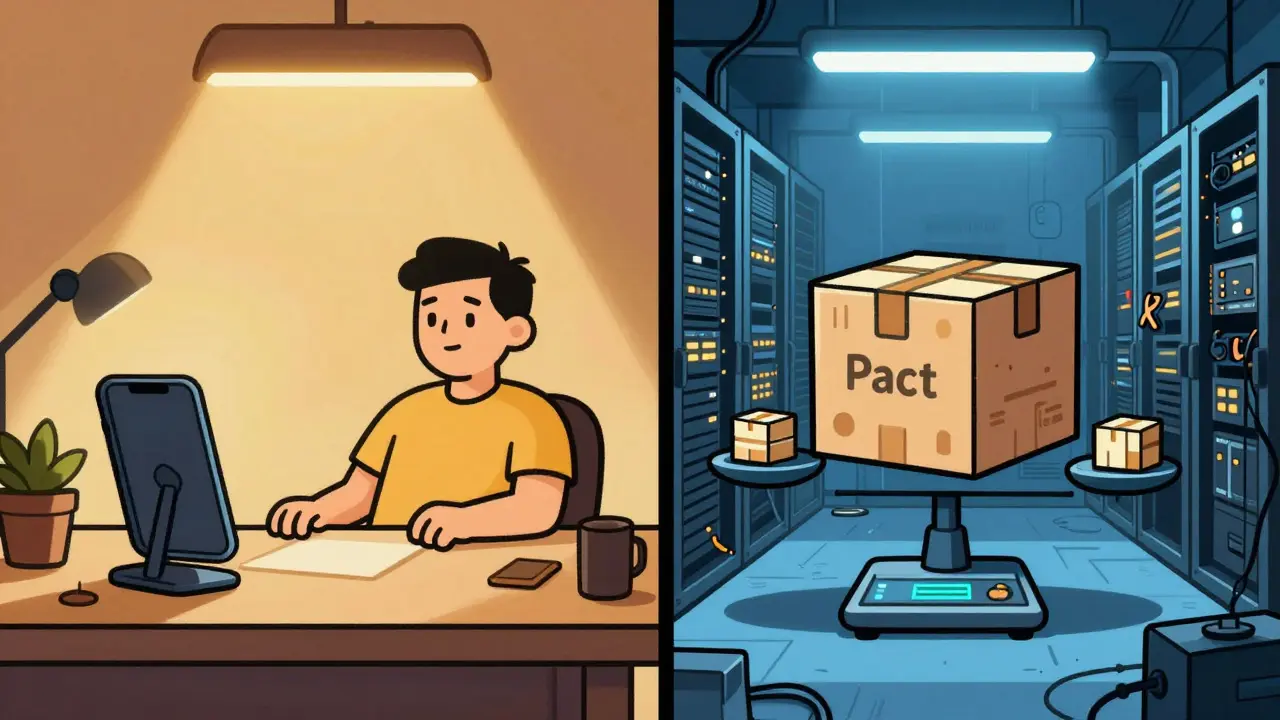
One of Pact’s strongest selling points is its interface. While many DeFi platforms feel clunky on smartphones, Pact was designed mobile-first. If you trade primarily from your phone, this is a significant advantage. The layout is clean, avoiding the clutter often found in web-based dApps.
Getting started is straightforward if you already have an Algorand-compatible wallet. You need to connect one of the supported options:
- Pera Wallet
- My Algo
- AlgoSigner
- Fireblocks
- Defly
Once connected, executing a trade takes just a few clicks. According to usability testing conducted in Q2 2023, most new users complete their first trade within 15 to 30 minutes. That’s fast for a DeFi protocol. However, beginners might find the concept of "impermanent loss" confusing if they decide to provide liquidity rather than just swap tokens. The documentation covers the basics, but it doesn’t go as deep into advanced strategies as some larger ecosystems.
Fees and Transaction Costs
Cost is a major factor when choosing a DEX. Pact leverages Algorand’s infrastructure, which is known for low transaction fees. On average, you’ll pay roughly $0.001 per transaction in gas fees, paid in ALGO. Compare that to Ethereum-based DEXs, where fees can spike to several dollars or even hundreds during peak congestion.
Beyond gas fees, Pact charges a trading fee, but it’s not one-size-fits-all. The platform uses Multiple Fee Tiers. This means the fee percentage adjusts based on the volatility of the specific liquidity pool. Highly volatile pairs might have higher fees to compensate liquidity providers for risk, while stable pairs have lower fees. There is also a dedicated StableSwap mechanism optimized for stablecoin pairs, ensuring tighter spreads and lower costs when swapping between assets like USDC and USDT.
Security and Trust
In crypto, trust is earned through transparency and audits. Since Pact is non-custodial, neither the Pact team nor Ulam Labs can freeze your assets or steal them directly from a central vault. Your funds are controlled by smart contracts. But what about bugs in those contracts?
Pact’s smart contracts have undergone professional audits by Kudelski Security. Additionally, the platform partners with Immunefi, a leading bug bounty platform. As of late 2023, there have been no major publicly disclosed security incidents or hacks affecting Pact users. This clean record is vital for building confidence, especially after the high-profile failures of centralized exchanges in previous years.
However, "non-custodial" also means "no recourse." If you send tokens to the wrong address or sign a malicious transaction, there is no customer support team to reverse the trade. You are responsible for your own security.
Pact vs. Tinyman: The Main Comparison
If you’re on Algorand, you’re probably aware of Tinyman. It has historically dominated the local DEX market, holding around 65% of the volume share in mid-2023. So, why choose Pact over the market leader?
| Feature | Pact | Tinyman |
|---|---|---|
| Primary Strength | Mobile-first UX, Low Fees | Liquidity Depth, Market Share |
| Interface | Clean, Optimized for Mobile | Standard Web dApp Layout |
| Fee Structure | Dynamic/Multiple Tiers | Standard Flat Rate |
| Liquidity Pools | Growing, Strong Major Pairs | Deep, Dominant Volume |
| Best For | Mobile Traders, Beginners | High-Volume Institutional Trades |
Tinyman wins on raw liquidity depth for obscure tokens. If you’re trading a low-cap project with thin order books, Tinyman might offer better prices due to higher volume. Pact, however, excels in usability. Its dynamic fee tiers and mobile optimization make it more accessible for retail traders who want a smooth experience without digging through complex dashboards.
Risks and Limitations
No platform is perfect. Here are the main drawbacks to consider before committing funds to Pact:
- Ecosystem Dependence: Pact only works on Algorand. If Algorand loses market share to competitors like Solana or Avalanche, Pact’s utility decreases. It lacks cross-chain functionality compared to aggregators.
- Liquidity Depth: While sufficient for major pairs like ALGO/USDC, less popular tokens may suffer from higher slippage. Always check the pool size before executing large trades.
- Impermanent Loss: If you become a liquidity provider, you face impermanent loss. This is a standard risk in AMMs, but Pact’s educational resources are basic. Do your own math or use external calculators.
- Name Confusion: Don’t mix up Pact (the DEX) with Pact (the Kadena smart contract language). They are unrelated. This confusion can lead to mistakes in research or wallet interactions.
Is Pact Right for You?
Pact is a solid choice if you are already invested in the Algorand ecosystem and prefer trading from a mobile device. Its low fees, clean interface, and strong security partnerships make it a reliable option for daily swaps. If you are a beginner, the simple setup process is a plus, though you should spend time understanding how liquidity pools work before providing capital.
For high-volume traders or those needing access to thousands of cross-chain assets, Pact might feel limited. In that case, you might stick with Tinyman for deeper Algorand liquidity or use a multi-chain aggregator. But for the average Algorand holder looking for a safe, fast, and easy way to swap assets, Pact delivers on its promise of being a user-friendly home for liquidity.
Is Pact a centralized or decentralized exchange?
Pact is a fully decentralized exchange (DEX). It operates via smart contracts on the Algorand blockchain. Users retain custody of their funds in their own wallets, and there is no central authority controlling the platform's operations or user assets.
What wallets are compatible with Pact?
Pact supports major Algorand wallets including Pera Wallet, My Algo, AlgoSigner, Fireblocks, and Defly. You must hold ALGO in your wallet to pay for transaction gas fees.
How much do transactions cost on Pact?
Transaction costs are very low, typically around $0.001 per trade, thanks to Algorand's efficient infrastructure. Additionally, Pact charges a variable trading fee based on the volatility of the specific liquidity pool used.
What is the difference between Pact and Tinyman?
Both are DEXs on Algorand. Tinyman generally has higher total trading volume and deeper liquidity for niche tokens. Pact focuses on a superior mobile-first user experience and dynamic fee structures, making it more appealing for retail users trading on smartphones.
Can I lose my money on Pact due to a hack?
While no platform is immune to risk, Pact has undergone audits by Kudelski Security and partners with Immunefi for bug bounties. As of 2026, there have been no major reported hacks. However, since it is non-custodial, user error (like sending to wrong addresses) cannot be reversed by support teams.
Abigail Sparks
August 20, 2026 AT 04:26Okay, let’s cut through the noise! If you are still using Tinyman for your daily swaps in 2026, you are literally leaving money on the table. The dynamic fee tiers on Pact are a game-changer because they actually reward stability instead of just punishing volume like the old flat-rate models did.
I’ve been running my liquidity pools there for over a year now and the slippage is basically non-existent for major pairs. It’s not just about the tech; it’s about the UX. Trying to do complex swaps on a clunky web interface while holding your phone is a nightmare, but Pact feels native to the device.
Don’t get me wrong, Tinyman has its place for institutional heavy hitters who need that raw depth, but for the rest of us? Pact is the way to go. Stop overthinking it and start optimizing your portfolio!
Ashley Snyder
August 20, 2026 AT 07:10Honestly, I think this review misses a huge point about the community aspect. The Algorand ecosystem is so tight-knit that having a DEX that feels 'friendly' matters more than people realize. I switched from a centralized exchange after the last big hack scare and honestly, the peace of mind of knowing my keys are mine is worth the slight learning curve.
Pact made that transition feel less scary because the interface was so clean. No ads, no confusing pop-ups, just the tools I needed. It’s nice to see a platform that prioritizes user experience over trying to upsell you on some new token or service.
Sarah Hafner
August 21, 2026 AT 13:43For anyone struggling with the concept of impermanent loss, I highly recommend checking out external calculators before you dive in. It’s a real risk, especially if you’re providing liquidity to volatile pairs. :)
I started small, just swapping USDC for ALGO, and once I got comfortable with how the gas fees worked (they really are tiny!), I tried adding to a pool. The key is to start with stable pairs where the price doesn't swing wildly. Once you understand the math, it’s much less intimidating. Good luck everyone! 🚀
Calliope Clio
August 22, 2026 AT 18:58Meh. Another one of those 'revolutionary' platforms that is actually just a wrapper around basic AMM logic. 😒 The fact that they charge different fees based on volatility is clever, sure, but it also means your costs are unpredictable. Why can't we just have a simple, transparent fee structure?
And don't get me started on the mobile-first design. It's great if you're a teenager scrolling TikTok, but for serious analysis? You need a desktop view. This is why DeFi is still stuck in the sandbox. We need institutional-grade interfaces, not cute little apps. 💅
Tasha Davis
August 24, 2026 AT 05:21Omg wait, so the fees change?? That sounds kinda wild! 😲 I usually just use whatever is easiest and I haven't really thought about the difference between Pact and Tinyman until now.
But yeah, I trade mostly on my phone so the mobile thing is definitely a plus for me. I hate when websites look broken on my screen. I’m gonna try it out this weekend. Thanks for the info! 🙌
Claudio Perrone
August 25, 2026 AT 15:45the whole point of defi is freedom right? so why does pact feel so... curated? it's like a gated community for algo holders. i dont trust smart contracts that are too pretty. beauty is the enemy of transparency. also the name confusion with kadena is a red flag, shows they dont care about branding integrity. just my two cents from the trenches. 🍺
Aaron Morrissey
August 27, 2026 AT 08:40One must consider the philosophical underpinning of such platforms: the tension between utility and abstraction. While the mobile-first approach is undeniably pragmatic, it risks reducing the profound complexity of decentralized finance to a mere consumer product. Is this the future of financial sovereignty, or merely a sophisticated vending machine?
Nevertheless, the low transaction costs are a testament to Algorand’s efficient consensus mechanism, which deserves recognition in any serious discourse on blockchain scalability.
Patrick Quairoli
August 28, 2026 AT 02:46you guys are all sleeping on the real issue here. ulam labs controls the narrative. they built it, they maintain it, they profit from it. it's not really 'decentralized' if one company holds the keys to the kingdom. i bet if you looked at the codebase, you'd find backdoors for 'emergency stops'. typical tech bro move. wake up sheeple. 👁️
Phelan Deihl
August 28, 2026 AT 04:21I think that's a bit extreme, but fair point about the centralization of development. Most protocols have a core team, even if they aim for decentralization later. As long as the contracts are audited and open source, it's probably fine for most users. Just keep an eye on their governance roadmap.
Ami Elizabeth
August 29, 2026 AT 21:17just used it for the first time today. super easy to set up with pera wallet. took like 5 mins. the swap went through instantly which was cool. didnt notice any weird fees either. seems legit so far. will keep using it for my small trades.
Alexander Scheel
August 31, 2026 AT 00:13It is rather amusing to observe the gullibility of the retail investor base. They praise 'user experience' as though it were a moral virtue, ignoring the fundamental truth that in crypto, convenience is often the precursor to exploitation. One should never trust a platform that makes things 'too easy.' Complexity is safety. Simplicity is a trap. Do not be fooled by the shiny interface.
Evelyn Kula
August 31, 2026 AT 10:09Finally, someone said it! The US needs to stop letting these foreign chains dominate our digital assets. Algorand is barely American, Solana is better, and frankly, we should be building our own national blockchain infrastructure. Pact is just another example of how global DeFi ignores US regulations. Stay safe, folks, but keep your eyes on Washington. 🇺🇸
manish jha
August 31, 2026 AT 11:25The review is adequate but lacks depth on the technical side. For those seeking true wisdom, understand that liquidity is not just a number; it is a state of mind. Do not follow the herd to Tinyman. Follow your intuition. The market rewards those who are disciplined and patient. Rest is also important. Namaste.
Mohamed Shoaeb
September 1, 2026 AT 18:30i think the comparison with tinyman is very useful. personally i prefer pact because the app feels smoother on my android phone. the fee structure is a bit confusing at first but once you get used to it its fine. good writeup overall. thanks for sharing this information. it helps a lot for beginners like me who are just starting out in the algo ecosystem.