Pakistan's Crypto Boom: Why 20-27 Million Users Defy Restrictions
Imagine a country where the government has repeatedly threatened to ban digital assets, yet millions of citizens are buying them every single day. That is the reality in Pakistan today. Recent estimates suggest that between 20 and 27 million people in Pakistan are actively using cryptocurrency. This isn't just a hobby for tech enthusiasts; it’s a survival strategy for freelancers, a hedge against inflation for families, and a lifeline for cross-border commerce.
The numbers are staggering. In 2025 alone, Pakistan added over 5.4 million new verified users. When you factor in peer-to-peer (P2P) transactions that don’t show up on exchange ledgers, some industry reports push that total closer to 40 million. This places Pakistan firmly in the top ten countries globally for crypto adoption. But how does this happen under such heavy regulatory pressure? And what does it mean for the future of finance in South Asia?
The Real Numbers Behind the Hype
To understand the scale, we need to look at the data without the noise. The discrepancy between "verified" users and "total" holders is significant. Verified users are those who have completed KYC (Know Your Customer) checks on major exchanges like Binance or local platforms. As of late 2025, this number sits around 18.2 million. However, the ecosystem is vast. Many users trade directly via P2P networks, using WhatsApp groups or local forums to swap Pakistani Rupees (PKR) for USDT (Tether) or Bitcoin. These off-ledger activities inflate the real user base, leading analysts to project a range of 20 to 27 million active participants by the end of 2026.
| Country | Estimated Users | Adoption Rate (% of Pop.) | Primary Driver |
|---|---|---|---|
| Pakistan | 20-27 Million | ~4.1% - 9% | Inflation Hedge & Freelancing |
| India | 97.5 Million | 7.1% | Speculation & Tech Adoption |
| Nigeria | 22 Million | 10.3% | Currency Instability |
| Vietnam | 13.5 Million | 13.5% | Gaming & Trading |
Why does this matter? Because unlike in developed nations where crypto is often treated as a speculative asset class, in Pakistan, it is functional money. It solves immediate problems. The growth rate here is explosive, with a compound annual growth rate (CAGR) nearing 99% in recent years, far outpacing traditional banking expansion.
Why Pakistanis Are Turning to Crypto Despite Bans
You might wonder why anyone would risk breaking regulations to use crypto. The answer lies in economic necessity. The Pakistani Rupee has faced severe volatility and high inflation rates in recent years. For a young professional in Karachi or Lahore, holding savings in PKR means watching their purchasing power evaporate. Cryptocurrencies like Bitcoin and stablecoins like USDT offer a way to preserve value. It’s not about getting rich quick; it’s about keeping what you already have.
Then there is the massive freelance economy. Pakistan is one of the world’s largest hubs for remote workers. Developers, designers, and writers earn dollars from clients in the US and Europe. Traditional banking channels for receiving these funds are slow, expensive, and often capped by strict foreign exchange controls. Crypto offers a faster, cheaper alternative. A freelancer can receive payment in USDT within minutes, convert it to PKR via P2P, and access their funds without waiting days for bank clearing. This utility drives daily engagement more than any price chart ever could.
Peer-to-Peer (P2P) Trading is a decentralized method of exchanging cryptocurrencies directly between individuals without an intermediary institution. In Pakistan, P2P has become the backbone of crypto adoption, allowing users to bypass formal banking restrictions while maintaining liquidity.
The Regulatory Gray Zone: Threats vs. Reality
The relationship between the Pakistani government and cryptocurrency is complicated. On paper, the stance has been hostile. In 2022, the government considered a comprehensive ban, and the State Bank of Pakistan (SBP) has frequently warned citizens about the risks. Internet Service Providers (ISPs) have occasionally blocked access to popular exchange websites. Yet, enforcement has been inconsistent and largely ineffective against the grassroots movement.
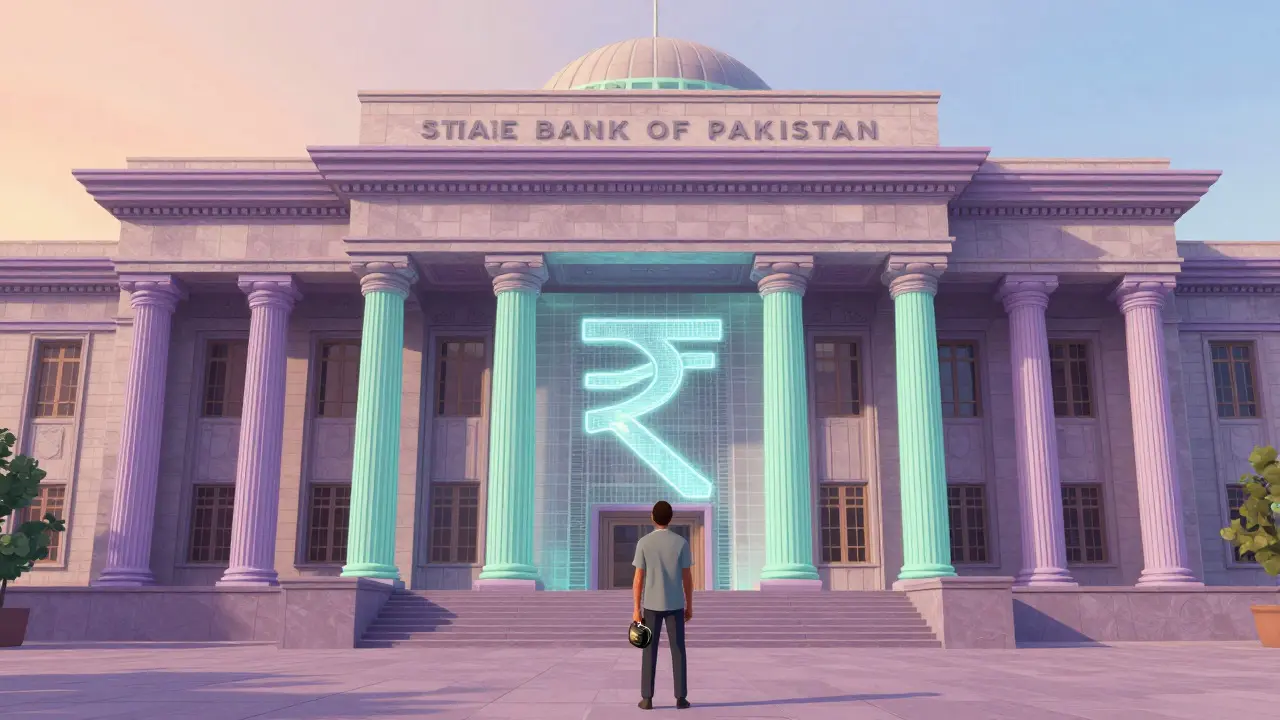
This creates a legal gray area. Technically, crypto isn't legal tender, but it isn't explicitly criminalized for personal holding either. This ambiguity allows the market to thrive in the shadows. Meanwhile, the SBP is working on its own Central Bank Digital Currency (CBDC). This move signals that the state recognizes the inevitability of digital payments. Instead of fighting blockchain technology entirely, they may eventually seek to control it through a state-backed digital rupee. Until then, private crypto continues to fill the gap left by traditional financial inefficiencies.
Infrastructure Challenges: The Digital Divide
Adoption isn't uniform across the country. While urban centers like Islamabad, Lahore, and Karachi see high activity, rural areas lag behind. Only about 45.7% of the population has reliable high-speed internet access. Without connectivity, accessing blockchain networks is difficult. This digital divide limits mass adoption potential, confining the majority of users to educated, urban demographics who can afford smartphones and data plans.
Furthermore, customer support remains a pain point. When an exchange blocks a Pakistani IP address or freezes an account due to compliance fears, users often find themselves with no recourse. There are no consumer protection laws for crypto victims in Pakistan. If you get scammed or lose your keys, the government won't help you. This lack of safety net forces users to be highly vigilant, relying on community forums and social media groups for advice and dispute resolution.
How to Navigate the Market Safely
If you are looking to participate in this growing market, understanding the mechanics is crucial. Here is how most users operate:
- Use Reputable Exchanges: Platforms like Binance remain popular despite occasional ISP blocks. Users often rely on VPNs to maintain access, though this adds a layer of complexity.
- Leverage P2P Markets: For converting PKR to crypto, P2P is king. Always check the merchant’s completion rate and number of orders. Stick to traders with high ratings to avoid scams.
- Secure Your Assets: Don't leave large sums on exchanges. Use hardware wallets or reputable software wallets where you control the private keys. Remember: if you don't hold the keys, you don't hold the coin.
- Stay Informed on Regulations: Keep an eye on announcements from the State Bank of Pakistan. Policy shifts can happen overnight, affecting liquidity and access.
The Future Outlook: Growth Amidst Uncertainty
Industry projections suggest that the number of crypto users in Pakistan will exceed 27 million by the end of 2025, with revenue hitting $1.6 billion. This growth is driven by structural factors that aren't going away anytime soon: inflation, the need for remittances, and a young, tech-savvy population. Even if the government imposes stricter bans, history shows that prohibition often fuels underground innovation rather than stopping it.
The long-term scenario likely involves a hybrid model. We may see the introduction of a regulated CBDC coexisting with a tolerated, albeit restricted, private crypto market. For now, the momentum is undeniable. Pakistan has proven that when traditional systems fail to meet people's needs, technology finds a way. Whether through official channels or P2P handshakes, the digital currency revolution is already here.
Is cryptocurrency legal in Pakistan in 2026?
Cryptocurrency exists in a legal gray zone in Pakistan. It is not recognized as legal tender, and the State Bank of Pakistan has issued warnings against its use. However, there is no explicit law criminalizing the possession or trading of crypto for individuals. Enforcement varies, and ISPs occasionally block exchange sites, but widespread usage continues.
How do Pakistanis buy and sell crypto?
Most Pakistanis use Peer-to-Peer (P2P) platforms integrated into major exchanges like Binance. They connect directly with other users to trade Pakistani Rupees (PKR) for cryptocurrencies like USDT or Bitcoin. Payments are typically made via bank transfer or mobile wallets like JazzCash or EasyPaisa, while the crypto is released automatically upon confirmation.
Why is crypto adoption so high in Pakistan?
High adoption is driven by economic necessity. Factors include high inflation eroding the value of the Rupee, difficulties in receiving international freelance payments through traditional banks, and the desire for capital preservation. Crypto offers a faster, cheaper, and more accessible alternative to the traditional financial system.
What are the risks of trading crypto in Pakistan?
Key risks include regulatory changes that could freeze accounts or block access, lack of consumer protection in case of fraud or exchange failure, internet connectivity issues, and the volatility of cryptocurrency prices. Users must also beware of P2P scams where sellers promise crypto but never deliver.
Will Pakistan launch its own digital currency?
Yes, the State Bank of Pakistan has announced plans to launch a Central Bank Digital Currency (CBDC). This aims to provide a state-controlled digital payment option. However, the timeline has shifted, and it is intended to complement rather than immediately replace private cryptocurrency usage in the short term.