RadioShack (Ethereum) Crypto Exchange Review: A Dying DeFi Project with No Liquidity or Trust
The name RadioShack brings back memories of beepers, headphones, and DIY electronics. But in 2026, RadioShack (Ethereum) is anything but nostalgic. It’s a barely alive decentralized exchange (DEX) with a $83 daily trading volume, a token worth pennies, and zero real users. If you’re thinking of trading RADIO or staking ETH for it, stop. This isn’t a platform - it’s a cautionary tale.
What Even Is RadioShack (Ethereum)?
RadioShack (Ethereum) launched in 2022 as a DeFi project by Retail Ecommerce Ventures (REV), the same group behind the failed retail revival of the RadioShack brand. Their pitch? Use the old brand’s recognition to "bridge mainstream crypto use" with something called "The Starfish Topology." In plain terms, they built a DEX where every token swaps through a single hub: the RADIO token. Sounds simple. But instead of fixing liquidity problems, it made them worse.
RADIO is an ERC-20 token on Ethereum. As of January 2026, it trades for about $0.0000501165. That’s five hundredths of a cent. For context, you’d need over 20,000 RADIO tokens to buy a single coffee. The exchange lists only two coins - RADIO and BUILD - and five trading pairs. The most active pair, RADIO/WETH, only moved $42.51 in 24 hours. That’s less than what some Ethereum gas fees cost for a single swap.
Trading Volume? More Like Trading Illusion
Here’s where things get suspicious. CoinGecko flags one pair - BUILD/FLOKI - with an anomaly: it reported $215 in volume, which is over 250% of the exchange’s total daily volume. That’s mathematically impossible. If the whole exchange did $83 in trades, no single pair can do more than that. This isn’t a glitch. It’s a red flag. Experts believe this is deliberate volume manipulation, likely from bots or wash trading to trick new users into thinking the exchange is active.
Compare that to Uniswap v3, which moved $1.75 billion in the same period. RadioShack’s volume is 0.0000047% of Uniswap’s. That’s like claiming your backyard lemonade stand is the world’s largest coffee chain because you sold two cups.
Liquidity? Almost Nonexistent
Liquidity is the lifeblood of any DEX. Without it, trades fail, prices swing wildly, and users lose money. RadioShack’s order books are paper-thin.
- RADIO/WETH has only $117 in liquidity at +2% depth - meaning if you tried to swap $100 worth of ETH for RADIO, you’d get a terrible price or your transaction would fail.
- BUILD/FLOKI has $440, but again, that number is likely inflated.
- BUILD/RADIO? Just $22. You couldn’t even swap $10 without slippage.
On CoinGecko’s scale, RadioShack ranks in the 5th percentile for order book depth. That means 95% of DEXes have deeper liquidity. It’s not just bad - it’s among the worst in the entire crypto space.
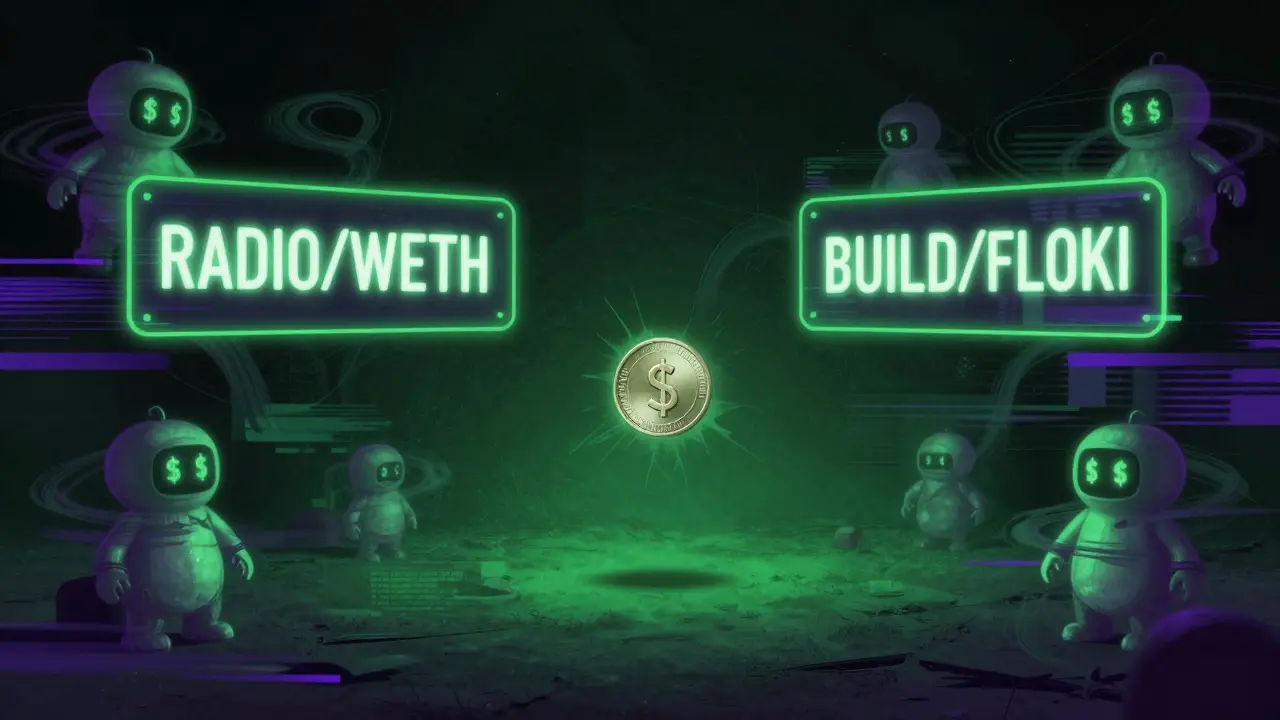
The "Starfish Topology" - A Solution to Nothing
REV claims their "Starfish Topology" is revolutionary. The idea? Instead of direct token swaps (like A→B, A→C, B→C), everything goes through RADIO. That sounds efficient. But in reality, it adds friction. Every trade now requires two steps: swap ETH→RADIO, then RADIO→your target token. That means double gas fees and double chances for failure.
Compare that to Uniswap, where you can swap ETH directly for USDC, DAI, or WBTC in one click. No middleman. No extra steps. RadioShack’s architecture doesn’t improve anything - it just makes trading more expensive and slower.
No Users. No Support. No Trust
There’s no evidence anyone is using this platform. Etherscan data shows fewer than 500 active users in the last six months. That’s not a DEX - that’s a ghost town.
Users report failed transactions, stuck funds, and zero customer support. One Reddit user, u/CryptoWatcher456, tried swapping $50 of ETH for RADIO. The transaction failed three times. He lost over $30 in gas fees. No reply from support. No explanation.
Trustpilot has zero verified reviews. CryptoSlate’s 17 reviews give it a 1.2/5. The top complaints? "Interface doesn’t work" (65%) and "liquidity vanishes mid-trade" (78%). The official Twitter account @RadioShackDeFi hasn’t posted since October 2025. It has 1,247 followers - many of them bots.
Who’s Behind It? And Why Should You Care?
REV controls everything: the exchange, the RADIO token, and Atlas USV - the DeFi protocol that supplies its "liquidity." That’s a conflict of interest. When one group owns the platform and the token, they can pump it, drain liquidity, and disappear. That’s the classic rug-pull pattern.
Tom’s Hardware called it "a tried and true strategy for rug-pulls." CoinDesk noted that RADIO’s structure looks more like a security than a utility token - a red flag for the SEC. If regulators step in, this whole thing collapses.
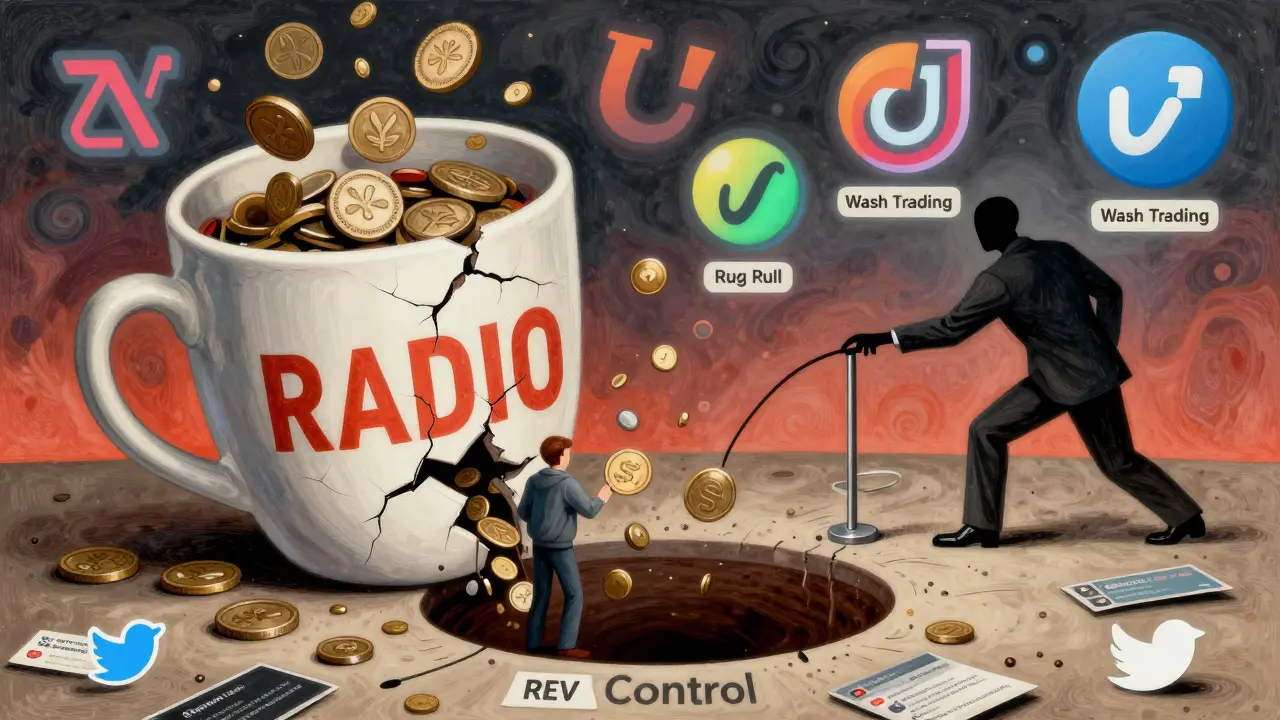
Market Reality: Nobody Cares
The DEX market is worth $154 billion. Uniswap controls 42.3%. PancakeSwap has 18.7%. Curve has 12.1%. RadioShack? It doesn’t even register on the chart. It’s not a player. It’s a footnote.
REV claims they’ll capture value as crypto grows from $3 trillion to $250 trillion. That’s fantasy. Real adoption doesn’t happen through nostalgia. It happens through reliability, liquidity, and security. RadioShack has none of those.
What’s the Future?
MEXC’s prediction? RADIO will reach $0.000053 by the end of 2026. That’s a 6% increase from today’s price. In crypto terms, that’s a flatline. BeInCrypto says if key support levels break, RADIO could go to zero.
There’s no roadmap. No development updates. No audits. No team transparency. Just a dead brand name slapped onto a broken DeFi protocol.
Bottom Line: Don’t Touch It
RadioShack (Ethereum) is not a crypto exchange. It’s a failed experiment with no users, no liquidity, and no future. The RADIO token has no utility. The interface doesn’t work. The volume is fake. The support is gone.
If you’re looking for a DEX, use Uniswap, Curve, or PancakeSwap. They’re real. They’re secure. They’re active. RadioShack is a graveyard.
Is RadioShack (Ethereum) a legitimate crypto exchange?
No. RadioShack (Ethereum) is not a legitimate exchange. It has near-zero trading volume, manipulated metrics, no user support, and no verifiable liquidity. Its sole purpose appears to be leveraging a defunct retail brand to attract unsuspecting users into a high-risk DeFi scheme with no real utility.
Can I trade RADIO token safely?
Trading RADIO is extremely risky. The token has no fundamental value, and its liquidity is so shallow that even small trades cause massive slippage. Multiple users report failed transactions and lost gas fees. There’s also a high chance this is a rug-pull - with REV controlling both the token and the liquidity pool, they can drain funds at any time.
Why is the trading volume so low?
The trading volume is low because almost no one uses it. The platform lacks features, has no user interface documentation, and offers no incentives to trade. The $83 daily volume is likely inflated by bots. Real users have abandoned it due to failed swaps, high gas fees, and zero customer service.
Is RadioShack (Ethereum) related to the old RadioShack store?
Only in name. The original RadioShack retail chain went bankrupt in 2015. The crypto project is run by Retail Ecommerce Ventures (REV), which bought the brand rights and tried (and failed) to revive the stores. The crypto project has no connection to the original company’s operations, products, or legacy - it’s purely a branding stunt.
Should I invest in the RADIO token?
Absolutely not. The RADIO token has no use case, no adoption, and no team transparency. Experts from CoinPaprika, BeInCrypto, and Tom’s Hardware all warn it’s a high-risk asset with zero long-term potential. Any price movement is likely artificial and unsustainable. Investing here is gambling, not crypto investing.
Are there better alternatives to RadioShack (Ethereum)?
Yes. Uniswap, Curve Finance, and PancakeSwap are all well-audited, high-liquidity DEXes with millions of users. They offer direct swaps, low slippage, and active development teams. RadioShack offers none of that. Stick to platforms with proven track records and transparent operations.
Ryan Burk
February 21, 2026 AT 13:34Amanda Markwick
February 22, 2026 AT 18:41Sriharsha Majety
February 23, 2026 AT 03:30Tabitha Davis
February 23, 2026 AT 21:09Vishakha Singh
February 24, 2026 AT 17:26Don B.
February 26, 2026 AT 16:19Andrew Hadder
February 26, 2026 AT 21:48Neeti Sharma
February 28, 2026 AT 13:45Fiona Monroe
February 28, 2026 AT 23:04Molley Spencer
March 1, 2026 AT 23:49John Fuller
March 3, 2026 AT 19:45Lucy Simmonds
March 4, 2026 AT 23:17Maggie House
March 5, 2026 AT 22:31Dana Sikand
March 6, 2026 AT 21:50Cameron Pearce Macfarlane
March 8, 2026 AT 15:01Elizabeth Smith
March 9, 2026 AT 11:59