Real-World DePIN Applications: How Decentralized Networks Are Changing Infrastructure in 2026
Think about the last time you connected to Wi-Fi at a coffee shop or charged your electric vehicle. You likely paid a fee to a centralized company that owns the router or the charging station. Now imagine if that coffee shop owner could earn money by sharing their excess bandwidth, or if your neighbor could sell surplus solar energy directly to you without a utility company taking a cut. This isn’t science fiction anymore. It is happening right now through DePIN, or Decentralized Physical Infrastructure Networks.
In 2026, we are seeing a massive shift away from traditional, top-down infrastructure models. Instead of waiting for big corporations to build out networks, communities are building them themselves using blockchain technology and token incentives. If you have been hearing buzzwords like 'Web3' or 'crypto infrastructure,' DePIN is where those concepts finally touch the real world. It bridges the gap between digital code and physical hardware, creating resilient, community-owned systems for everything from wireless connectivity to energy grids.
What Exactly Is DePIN?
To understand why this matters, we need to strip away the jargon. At its core, DePIN is a system that uses cryptocurrency tokens to incentivize people to build and maintain physical infrastructure networks. Traditional infrastructure relies on central authorities-like telecom giants or power companies-to invest millions in hardware. DePIN flips this model. It allows anyone with the right device to become a provider.
The magic happens through three main components:
- Blockchain Technology: This acts as the transparent ledger. It records who contributed what resource (like storage space or bandwidth) and ensures payments are secure and immutable.
- Smart Contracts: These are automated agreements. When you use someone’s Wi-Fi hotspot, the smart contract automatically verifies the connection and sends payment to the provider instantly, without a middleman.
- Tokens: These are the fuel. Providers earn tokens for contributing resources, and users spend tokens to access services. This creates a self-sustaining economic loop.
This structure eliminates single points of failure. If one server goes down in a traditional cloud, you might lose data. In a decentralized network, the data is replicated across thousands of devices globally. The network doesn't just survive; it thrives on participation.
The Two Pillars of DePIN: PRNs and DRNs
Not all DePIN projects are created equal. To make sense of the landscape, we categorize them into two distinct types based on how resources are shared. Understanding this distinction helps you see which sectors are ripe for disruption.
| Feature | Physical Resource Networks (PRNs) | Digital Resource Networks (DRNs) |
|---|---|---|
| Resource Type | Hardware-dependent (e.g., sensors, hotspots) | Digital assets (e.g., computing power, storage) |
| Location Dependency | High (must be physically present) | Low (can operate from anywhere) |
| Fungibility | Non-fungible (unique per location) | Fungible (one unit equals another) |
| Example Use Case | Wireless coverage, EV charging | Cloud storage, AI rendering |
Physical Resource Networks (PRNs) deal with tangible, location-specific assets. Think of a Wi-Fi hotspot in a specific city or an electric vehicle charger on a particular street. Because these resources are tied to geography, they are non-fungible. A hotspot in Raleigh cannot replace one in Tokyo. PRNs are revolutionizing sectors like mobility, energy distribution, and local connectivity.
Digital Resource Networks (DRNs), on the other hand, handle fungible digital goods. Computing power and data storage don’t care where they come from, as long as the data gets there fast. If you rent out spare GPU power for AI training, it doesn’t matter if your computer is in New York or London. DRNs are perfect for decentralized cloud storage and high-performance computing tasks.
Connectivity: The Rise of Decentralized Wireless
The most mature sector of DePIN is wireless connectivity. For years, mobile carriers have held monopolies over spectrum and infrastructure, leading to high costs and poor coverage in rural areas. DePIN changes the game by turning everyday objects into network nodes.
Helium is the pioneer of decentralized wireless networks, allowing users to deploy hotspots that provide LoRaWAN and 5G coverage in exchange for HNT tokens. Launched in 2019, Helium demonstrated that communities could build cellular-like coverage faster and cheaper than traditional ISPs. By 2026, Helium has expanded beyond simple IoT tracking to include full 5G broadband coverage. Users buy a hotspot, plug it in, and start earning rewards for providing coverage. Other users pay small fees to access this network, often roaming onto it when their primary carrier’s signal drops.
This model addresses a critical pain point: dead zones. In many suburban and rural areas, traditional providers haven’t found it profitable to lay fiber or build towers. But with DePIN, a farmer can place a few hotspots on their property, earn passive income, and simultaneously improve connectivity for their neighbors. It turns idle infrastructure into active revenue streams.
Energy Management: Peer-to-Peer Power Trading
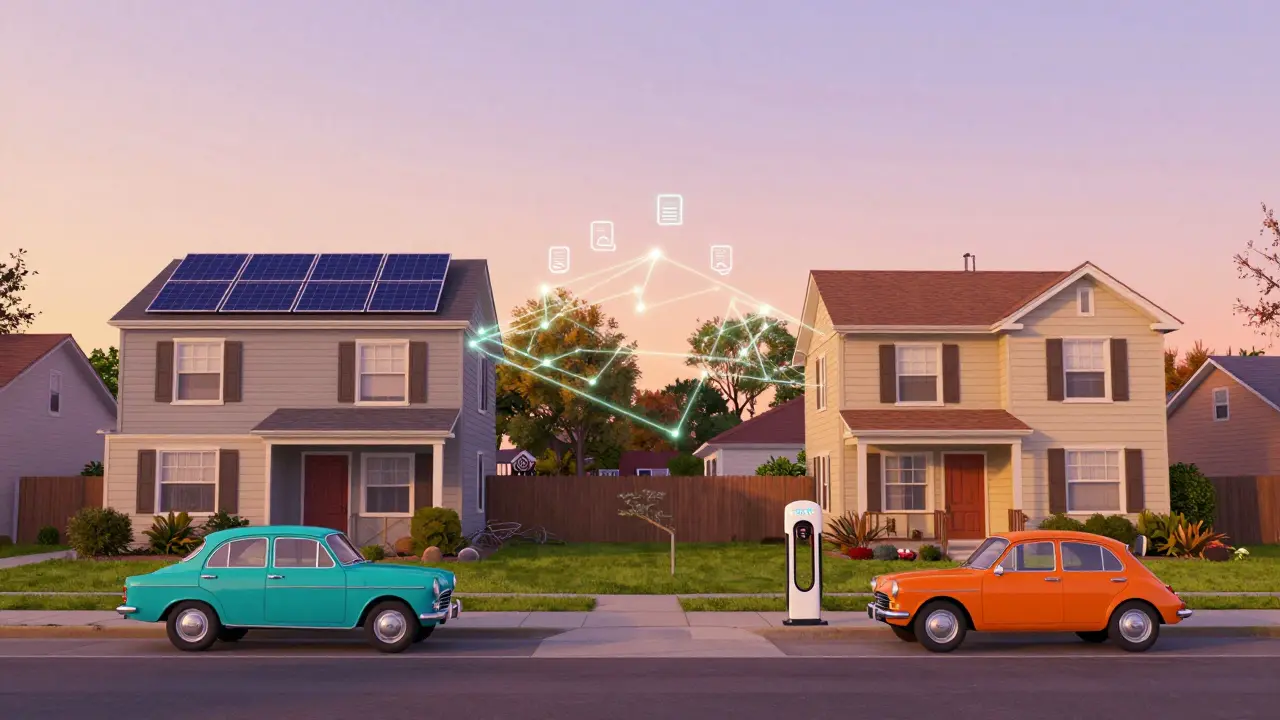
Energy grids are notoriously inefficient and centralized. When you install solar panels, you usually sell excess power back to the grid at a low rate, then buy it back at a higher rate during peak hours. DePIN introduces a peer-to-peer (P2P) energy market that bypasses this inefficiency.
Projects like Power Ledger is a blockchain-based platform enabling peer-to-peer trading of renewable energy among prosumers (producer-consumers). allow households with solar panels to sell excess electricity directly to neighbors via smart contracts. The transaction is recorded on the blockchain, ensuring transparency and automatic settlement. This not only lowers costs for consumers but also stabilizes the local grid by distributing load more evenly.
Imagine a neighborhood where every house has a battery and solar panels. During sunny afternoons, houses with full batteries sell cheap energy to those running AC units. At night, the process reverses. No utility company intermediary takes a large margin. This resilience is crucial as extreme weather events become more frequent, threatening centralized grid stability.
Storage and Compute: Challenging the Cloud Giants
We store petabytes of data in centralized clouds like AWS, Google Cloud, and Azure. These giants charge premium prices and hold all the cards. If they decide to raise rates or restrict access, businesses suffer. DePIN offers a competitive alternative through distributed storage and compute networks.
Filecoin is a decentralized storage network that allows users to rent out unused hard drive space to others in exchange for FIL tokens. It works by splitting files into encrypted shards and storing them across thousands of independent nodes. This makes data highly resistant to censorship and loss. Unlike a single data center that can be hacked or shut down, Filecoin’s data is scattered globally.
Similarly, compute-heavy tasks like AI model training require massive GPU power. Centralized providers often have long waitlists. DePIN platforms like Render Network is a distributed GPU rendering platform that connects artists and developers needing compute power with users who have idle GPUs. allow individuals with powerful gaming PCs to rent out their unused graphics processing units. This democratizes access to high-performance computing, lowering barriers for startups and creators who can’t afford enterprise-level cloud contracts.

The DePIN Flywheel: Why These Networks Grow Fast
You might wonder why these networks succeed where previous tech experiments failed. The secret is the "DePIN Flywheel," a self-reinforcing cycle of growth:
- Incentivization: Early adopters contribute resources (hardware, bandwidth, storage) and earn tokens. The promise of financial reward drives initial adoption.
- Improved Services: As more participants join, the network becomes denser and more reliable. More hotspots mean better coverage; more storage nodes mean faster retrieval speeds.
- User Adoption: Better service quality attracts end-users who need the infrastructure. They pay for services using tokens, creating demand.
- Value Accrual: Increased usage drives up token demand and value, which in turn attracts more investors and contributors, restarting the cycle.
This flywheel effect is powerful because it aligns incentives. Providers want the network to succeed so their tokens appreciate. Users want affordable, reliable service. The blockchain ensures trust without requiring a CEO to manage the relationship. It’s a virtuous circle that scales organically.
Security and Resilience Advantages
Centralized systems have a fatal flaw: single points of failure. Hackers target major data centers, and natural disasters can knock out entire regions’ power or internet. DePIN networks are inherently resilient. Because control is distributed, compromising the network requires attacking thousands of independent nodes simultaneously-a near-impossible task.
Transparency is another key benefit. Every transaction, from a gigabyte of stored data to a kilowatt-hour of sold energy, is recorded on the public ledger. You can verify exactly who provided the service and that they were paid fairly. Smart contracts automate this process, removing human error and fraud. For example, if a storage node fails to retrieve data when requested, the smart contract automatically penalizes the provider and redistributes the data to another node. This accountability builds trust in a way that opaque corporate policies never could.
Challenges and Realities in 2026
Despite the hype, DePIN isn’t without hurdles. Hardware costs remain a barrier. Buying a specialized hotspot or high-end GPU requires upfront capital. Regulatory uncertainty also looms. Governments are still figuring out how to tax token earnings and classify decentralized networks under existing telecom and energy laws.
Additionally, user experience needs improvement. While wallets and dApps have gotten much better, managing private keys and understanding gas fees can still intimidate average consumers. Projects must continue to abstract away the complexity, making DePIN feel as easy as plugging in a USB drive.
However, the trajectory is clear. As hardware becomes cheaper and regulations clarify, DePIN will move from niche crypto enthusiast projects to mainstream infrastructure solutions. We are already seeing partnerships between DePIN protocols and traditional enterprises, signaling a broader acceptance.
Is DePIN safe for beginners to participate in?
Participating in DePIN carries risks similar to any investment, primarily related to token volatility. However, the operational risk is lower than traditional infrastructure because you own the hardware. Start with established networks like Helium or Filecoin, research the tokenomics thoroughly, and ensure you understand the ongoing maintenance requirements of your hardware before committing funds.
How do I earn money from DePIN?
You earn by contributing resources. For wireless networks, you provide coverage via hotspots. For storage, you rent out unused hard drive space. For compute, you share GPU power. Each contribution is verified by the network and rewarded with native tokens, which you can hold, trade, or use within the ecosystem.
What is the difference between DePIN and Web3?
Web3 is a broad term for the decentralized internet, focusing on ownership of digital assets and identity. DePIN is a specific subset of Web3 that focuses on physical infrastructure. While Web3 deals with digital rights, DePIN deals with physical resources like bandwidth, energy, and storage, bridging the digital and physical worlds.
Can DePIN replace traditional ISPs and utility companies?
It may not fully replace them soon, but it will compete fiercely. DePIN excels in underserved areas and niche markets where centralized players are unprofitable. Over time, as networks scale, they could offer cheaper, more resilient alternatives, forcing traditional companies to innovate or partner with DePIN protocols.
What hardware do I need to start with DePIN?
It depends on the network. For wireless, you need specific hotspots (e.g., Helium Miner). For storage, any modern PC with extra hard drive space works. For compute, a powerful GPU is ideal. Always check the official documentation of the project for minimum hardware requirements to ensure profitability.
Dr Lynea LaVoy
June 23, 2026 AT 21:02I've been following the DePIN space for a while, and it's genuinely exciting to see how these networks are evolving beyond just crypto speculation. The idea of community-owned infrastructure is powerful, especially in areas where traditional ISPs have failed to provide adequate service. It feels like we're finally moving towards a more equitable model where individuals can benefit from their own resources.
Matthew Malone
June 25, 2026 AT 15:43This whole decentralized nonsense is just a way to bypass proper regulation and tax codes. We need strong national infrastructure controlled by trusted entities, not some random guy with a hotspot selling bandwidth to whoever wants it. It's chaotic and undermines our sovereignty.
aaliyah zahid
June 26, 2026 AT 03:32Oh, look at you, Mr. Malone, still clinging to the old ways while the world moves on. 😂 But seriously, the peer-to-peer energy trading aspect is fascinating. Imagine neighborhoods helping each other out during blackouts instead of waiting for the utility company to send a truck that might not show up for days.
Erik Kirana
June 26, 2026 AT 19:43The article mentions Filecoin and Render Network, which are interesting concepts, but let's be real about the hardware costs. You think an average person has idle GPUs sitting around? Most people are struggling to keep their current tech running. Plus, the electricity cost alone eats into any potential profit. It's a nice dream, but the math rarely works out for the little guy. 🤷♂️
dan kaffeman
June 28, 2026 AT 10:09You're all missing the bigger picture here. This isn't just about saving a few bucks on internet bills. It's about breaking the stranglehold of corporate monopolies that have been screwing us over for decades. If your neighbor can sell you solar power directly, why should we pay inflated rates to a faceless corporation? It's about freedom and resilience. Wake up.
Meg Gran
June 29, 2026 AT 19:55freedom is great but what about when the network goes down? who fixes it? there is no customer service hotline u can call. its just code and hope. i tried setting up a helium miner last year and it was a nightmare. the app kept crashing and i had to reflash the firmware like three times. not exactly plug and play as they claim.
Alexander DeVries
June 29, 2026 AT 20:06That's a valid point, Meg. The user experience is definitely a hurdle. However, I believe the technology is maturing rapidly. Just look at how mobile banking went from clunky apps to seamless experiences in a decade. DePIN projects are investing heavily in abstraction layers to make this easier. The early adopters pave the way for the masses.
Mark Corpuz
July 1, 2026 AT 07:16The distinction between PRNs and DRNs is crucial for understanding the market dynamics. Physical Resource Networks are inherently limited by geography, which creates local monopolies or oligopolies depending on node density. Digital Resource Networks, however, benefit from global liquidity. This means DRNs might scale faster, but PRNs offer more tangible, localized value propositions that are harder to replicate digitally.
Steven Jacobowitz
July 1, 2026 AT 09:01I'm curious about the security implications. Sure, distributed systems are resilient against single points of failure, but what about Sybil attacks? If someone sets up thousands of fake hotspots in one location, do they drain the rewards? How does the protocol verify physical uniqueness without centralized oversight? That seems like a massive vulnerability.
Yogendra Dwivedi
July 1, 2026 AT 18:23Good question, Steven. Many protocols use proof-of-coverage mechanisms, such as requiring nodes to respond to challenges from other nearby nodes. Some also integrate GPS data or require unique hardware IDs. It's not perfect, but the economic incentives usually discourage cheating because the cost of maintaining fake nodes outweighs the potential gains. The community policing aspect is also quite effective.
Sylvia Mossman
July 1, 2026 AT 19:30Don't get too excited. These tokens are volatile garbage. One day you're earning rewards, the next day the token price crashes 90% and your hardware is worthless e-waste. It's a pyramid scheme disguised as infrastructure. Only the insiders and VCs make real money. The rest of us are just providing free labor and capital for their exit strategy.
Alexis Abster
July 2, 2026 AT 10:50Sylvia, you're so negative! There's always risk in new technologies, sure, but look at the innovation happening. Yes, some projects fail, but others like Helium and Filecoin have shown staying power. It's about doing your research and choosing reputable projects. The potential for positive impact is huge, especially in underserved communities. Don't let fear stop you from exploring!
Brad Ranks
July 2, 2026 AT 22:03The regulatory landscape is going to be a bloodbath. Governments don't like losing control, and they certainly don't like losing tax revenue. Expect crackdowns on P2P energy trading and decentralized telecom services. They'll classify these tokens as securities or unlicensed utilities. It's coming, whether we like it or not.
Lee Paige
July 4, 2026 AT 18:31Exactly. And don't forget the surveillance angle. Decentralized networks sound private, but if the blockchain is public, every transaction is visible. Who controls the node operators? Are they really independent, or are they fronts for larger entities? I trust nothing that promises anonymity while collecting data on the grid. It's all a trap.
Caitlin Donahue
July 6, 2026 AT 07:46im not sure i understand all the tech jargon but the idea of neighbors helping neighbors sounds nice. maybe i can try renting out my extra hard drive space? seems low risk compared to buying a hotspot. anyone know if filecoin is easy to set up for beginners?