Understanding Your Jurisdiction's Crypto Laws and Regulations: A Global Guide for 2026
Imagine buying Bitcoin today only to find out your government considers it a security, a commodity, or even illegal property. The rules change depending on where you live, what you hold, and who you trade with. In 2026, the landscape of cryptocurrency regulations is the complex web of local, national, and international laws governing digital assets, blockchain technology, and decentralized finance. It’s no longer the Wild West. Governments worldwide have moved from confusion to concrete enforcement, creating a patchwork of rules that can make or break your financial strategy.
If you are holding crypto, running a business in the space, or just curious about investing, knowing your specific jurisdiction's stance is not optional-it’s essential. This guide breaks down how major regions handle crypto, what the new laws mean for you, and how to stay compliant without losing your mind.
The Three Pillars of Modern Crypto Regulation
Regulators generally focus on three main goals when crafting crypto laws. Understanding these helps you predict how your country might treat your assets.
- Consumer Protection: Preventing scams, ensuring exchanges hold your funds safely, and making sure you know the risks before you invest.
- Anti-Money Laundering (AML) and Counter-Terrorist Financing (CFT): Stopping criminals from using crypto to hide dirty money. This is where "Know Your Customer" (KYC) checks come from.
- Tax Collection: Ensuring the government gets its share of profits made from trading or mining.
By early 2026, over 78% of countries have some form of crypto regulation in place. The approach varies wildly, falling into three buckets: restrictive, neutral, and crypto-friendly.
Crypto-Friendly Jurisdictions: Where Innovation Thrives
Some countries actively court crypto businesses by offering clear rules, low taxes, and dedicated support. If you are looking to launch a project or invest heavily, these places offer the most clarity.
| Jurisdiction | Key Regulatory Body | Main Benefit | Recent Update (2025-2026) |
|---|---|---|---|
| United Arab Emirates | VARA (Virtual Assets Regulatory Authority) | Zero capital gains tax; comprehensive licensing | Expanded VARA guidelines for DeFi protocols |
| Switzerland | FINMA (Financial Market Supervisory Authority) | Clear distinction between payment, utility, and asset tokens | Updated guidance on security token offerings under revised Financial Services Act |
| Singapore | MAS (Monetary Authority of Singapore) | Strong legal framework for digital payment tokens | Revised digital token guidelines emphasizing consumer protection |
| Hong Kong | SFC (Securities and Futures Commission) | Licensed virtual asset trading platforms | Approval of multiple spot Bitcoin ETFs |
In the UAE, for example, the Virtual Assets Regulatory Authority (VARA) provides a single point of contact for licensing, which speeds up the process significantly. Switzerland’s FINMA has been refining its rules since 2018, treating different types of tokens differently based on their function. This precision allows businesses to operate with confidence.
The European Union: The MiCAR Standard
For anyone operating in Europe, the Markets in Crypto-Assets Regulation (MiCAR) is the EU's comprehensive regulatory framework for crypto assets, establishing uniform rules for issuers and service providers across member states. Fully operational by late 2024 and enforced through 2025-2026, MiCAR is the gold standard for global regulation.
Here is what changes for you under MiCAR:
- Licensing is Mandatory: All Crypto Asset Service Providers (CASPs) must get a license from their national authority. You can’t just open an exchange in your garage anymore.
- Stablecoin Rules: Issuers of stablecoins must back them 1:1 with high-quality liquid assets (like cash or treasury bills). They also need monthly attestations to prove they have the reserves.
- The Travel Rule: For transactions over €1,000, exchanges must share sender and receiver information. This kills anonymity for large trades.
- Consumer Rights: Clearer disclosure requirements mean you know exactly what risks you are taking before you buy a token.
The downside? Some services disappear. Users reported that certain staking options were removed from European exchanges because they didn't fit the new risk profiles. But the upside is safety. If an exchange fails, there are clearer paths to recourse.
The United States: Navigating the Patchwork
The US remains a unique case. Instead of one federal law covering everything, you have a fragmented system involving the SEC, CFTC, FinCEN, and state regulators. However, 2025 brought significant shifts.
The GENIUS Act is federal legislation passed in July 2025 that establishes a regulatory framework for payment stablecoins, requiring 1:1 backing and regular audits. This was a huge win for clarity regarding stablecoins like USDC or USDT. Issuers now must keep reserves in US dollars or Treasury bills and publish monthly transparency reports.
But for other tokens, the debate rages on. The SEC continues to argue that many altcoins are unregistered securities. Meanwhile, the CFTC treats Bitcoin and Ethereum as commodities. This duality creates a compliance nightmare for businesses. Coinbase CEO Brian Armstrong noted that complying with 50 different state frameworks costs millions annually. For individual investors, this means watching closely whether the token you hold is classified as a security in your state, which affects how you report it and what protections you have.
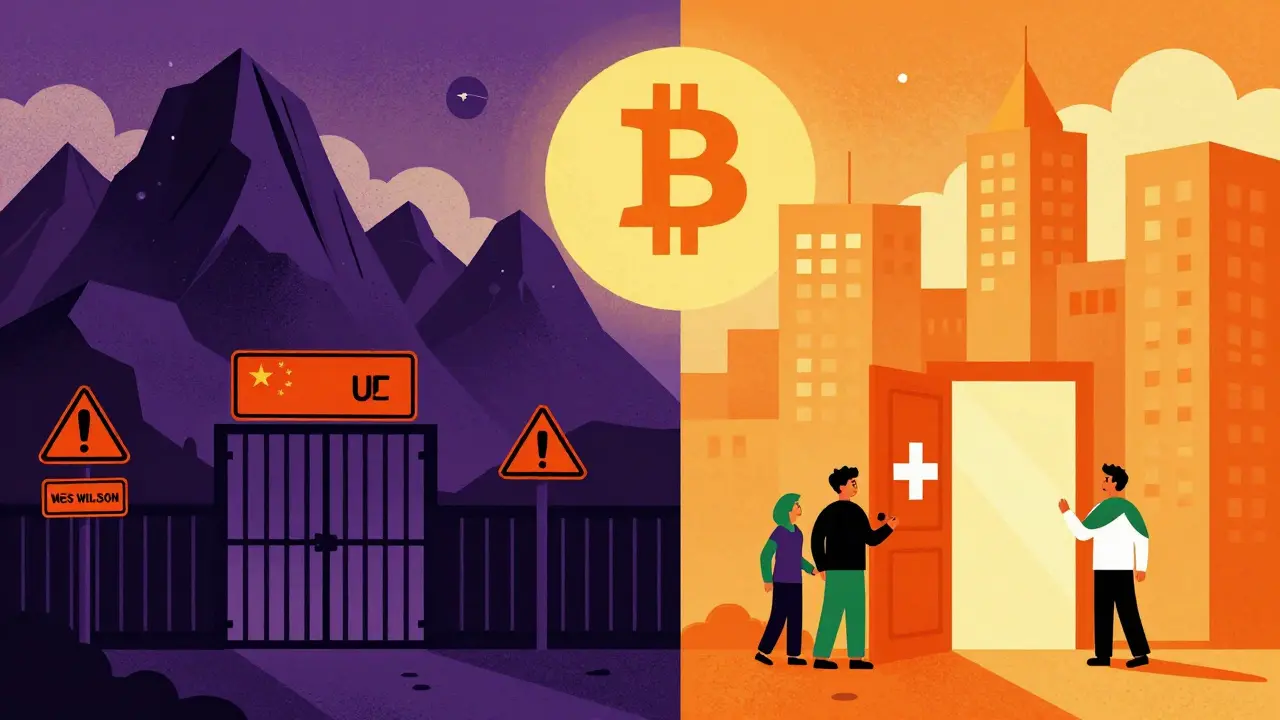
Restrictive Jurisdictions: High Risk, High Penalty
Not every country wants crypto. Some view it as a threat to monetary sovereignty or financial stability. Operating in these regions carries severe legal risks.
- China: Maintains a strict ban on crypto trading, ICOs, and mining. While peer-to-peer trading still happens underground, official channels are closed. Penalties can include heavy fines and imprisonment.
- India: Not a ban, but a deterrent. India imposes a flat 30% tax on crypto gains plus a 1% Tax Deducted at Source (TDS) on every transaction. This makes frequent trading economically unviable for many retail investors.
- Algeria, Bolivia, Bangladesh: These countries have outright bans with criminal penalties. In Algeria, using crypto can lead to 2-5 years in prison.
If you live in a restrictive jurisdiction, the safest route is often to avoid direct exposure or use offshore structures carefully-though this carries its own legal risks regarding residency and tax reporting.
Tax Implications: What You Keep vs. What You Pay
Regulation isn't just about legality; it's about cost. Tax laws vary dramatically and can eat into your profits faster than market volatility.
In Germany, if you hold crypto for more than one year, capital gains are tax-free. This encourages long-term holding. Contrast this with Portugal, where capital gains from crypto trading are taxed at 28% for individuals. In the US, crypto is treated as property, meaning every trade is a taxable event, requiring meticulous record-keeping.
Always consult a local tax professional. The rules on mining income, staking rewards, and airdrops are particularly complex and often differ from standard capital gains treatment.
Practical Steps for Compliance in 2026
So, what should you do right now? Here is a checklist to ensure you are staying on the right side of the law.
- Identify Your Local Regulator: Find out who oversees crypto in your country. Is it the central bank, a securities commission, or a new specialized agency?
- Check Exchange Licenses: Only use exchanges that are licensed in your jurisdiction. Unlicensed platforms may freeze your funds or shut down without warning.
- Understand Stablecoin Rules: If you use stablecoins, verify they comply with local reserve requirements. Under MiCAR and the GENIUS Act, non-compliant stablecoins face delisting.
- Keep Detailed Records: Use software to track every transaction. Date, amount, value in fiat currency, and purpose of the transfer. This is crucial for tax season.
- Stay Updated: Crypto laws change fast. Subscribe to updates from reputable sources like Chainalysis, PwC, or local financial news outlets.
The era of ignoring crypto regulation is over. By understanding your jurisdiction's specific rules, you protect your assets, avoid hefty fines, and contribute to a healthier, more sustainable ecosystem.
Is cryptocurrency legal in my country?
It depends entirely on your location. As of 2026, most countries allow crypto but regulate it strictly. Countries like China, Algeria, and Bolivia have outright bans. Others, like the US and EU members, allow it with heavy oversight. Check your local financial regulator's website for the latest status.
What is MiCAR and how does it affect me?
MiCAR is the European Union's comprehensive crypto regulation. If you live in the EU, it means stricter KYC checks, mandatory licensing for exchanges, and clearer rules for stablecoins. It enhances consumer protection but may reduce access to some high-risk DeFi products.
How are crypto gains taxed in the US?
In the US, crypto is treated as property. Short-term gains (held less than a year) are taxed as ordinary income. Long-term gains (held more than a year) receive lower capital gains rates. Every trade, sale, or purchase of goods with crypto is a taxable event.
Are stablecoins safe under new regulations?
Yes, more so than before. With the GENIUS Act in the US and MiCAR in the EU, major stablecoins must hold 1:1 reserves in high-quality liquid assets and undergo regular audits. This reduces the risk of depegging due to poor reserve management.
Can I mine Bitcoin legally?
Mining legality varies. It is banned in China and restricted in some countries due to energy concerns. In the US and EU, it is legal but subject to electricity taxes and environmental regulations. Always check local zoning and energy laws before setting up mining hardware.