Uniswap vs SushiSwap: Which DEX Is Right for You in 2025?
When you want to trade crypto without a middleman, you need a decentralized exchange - a DEX. Two names keep coming up: Uniswap and SushiSwap. Both let you swap tokens directly from your wallet. Both use the same core tech. But that’s where the similarities end. If you’re trying to decide which one to use, it’s not about which is ‘better.’ It’s about what you want to get out of it.
Uniswap: The Simple, Reliable Default
Uniswap launched in 2018 and didn’t just join the DeFi scene - it defined it. It’s the reason most people know how to trade crypto on a DEX. You connect your wallet, pick two tokens, click swap, and done. No confusing menus. No hidden rewards systems. Just clean, fast trading.
As of late 2025, Uniswap holds around $4 billion in locked liquidity. That’s ten times more than SushiSwap. Daily trading volume? Usually between $1 billion and $2 billion. That kind of depth means tighter spreads, less slippage, and fewer failed trades. If you’re swapping ETH for USDC or buying a new token with high volume, Uniswap is the safest bet.
Uniswap V3 changed the game with concentrated liquidity. Instead of spreading your funds across a wide price range, you can now lock them in a tight band - say, between $3,000 and $3,200 for ETH. That makes your capital work harder. It’s powerful, but it’s also complex. For most users, though, the default 0.3% fee pool works perfectly fine. Stablecoin pairs like USDT/USDC even have a 0.05% fee option, saving you money on frequent trades.
The UNI token? It’s only for voting on protocol upgrades. No staking rewards. No passive income. If you’re holding UNI hoping to earn something, you’re out of luck. But if you care about governance and want a say in how Uniswap evolves, you’ve got a voice.
Uniswap’s mobile app is solid. The interface is clean. Even if you’ve never touched a wallet before, you can figure it out in five minutes. That’s why beginners start here. And why institutions still use it.
SushiSwap: The Reward-Driven Alternative
SushiSwap didn’t set out to be a copycat. It launched in 2020 as a fork of Uniswap - but with one big twist: rewards. If you provide liquidity, you don’t just get trading fees. You also earn SUSHI tokens. That’s the whole point.
Today, SushiSwap has about $400 million in TVL and $50-150 million in daily volume. Smaller? Yes. But it’s not trying to beat Uniswap at its own game. It’s built for a different crowd: yield farmers, multi-chain users, and people who want to earn while they trade.
SushiSwap’s fee structure is simpler: 0.3% on every trade. 0.25% goes to liquidity providers. The other 0.05% is distributed to xSUSHI stakers. That’s right - if you stake your SUSHI tokens, you get a cut of every trade on the platform. It’s a direct incentive to hold and support the protocol. Over 60% of SUSHI tokens are staked as xSUSHI. That’s a strong signal of community trust.
Then there’s the Onsen program. This is SushiSwap’s secret weapon for new tokens. If you add liquidity to a freshly listed token pair, you get boosted SUSHI rewards - sometimes 10x or more. That’s why new projects often launch on SushiSwap first. It’s a magnet for early adopters looking to earn extra tokens before the price moves.
And SushiSwap isn’t stuck on Ethereum. It runs on 14+ chains: Avalanche, Fantom, Polygon, BNB Chain, Harmony, and more. If you’re using a chain other than Ethereum, SushiSwap is often your only real DEX option. Uniswap supports a few sidechains, but it’s still mostly Ethereum-focused.
Who Should Use Which?
Here’s the simple breakdown:
- Use Uniswap if: You want to swap tokens quickly, reliably, and without overthinking it. You’re new to DeFi. You trade high-volume pairs like ETH, USDC, or WBTC. You care about low slippage and proven security.
- Use SushiSwap if: You want to earn extra tokens while you trade. You’re active in yield farming. You use multiple blockchains. You’re comfortable with staking, rewards calculators, and cross-chain bridges. You like having more control over your earnings.
There’s no shame in using both. Many experienced users keep Uniswap as their main swap tool and SushiSwap as their reward engine. Swap your ETH for a new memecoin on Uniswap. Then, immediately add that new token to a SushiSwap liquidity pool to start earning SUSHI. It’s a common strategy.

Security and Trust: Who’s Safer?
Both platforms have been audited. Both have never been hacked at the protocol level. That’s huge. But trust isn’t just about code - it’s about track record.
Uniswap has been live since 2018. It’s survived bear markets, regulatory scrutiny, and dozens of copycats. Its code is simple, battle-tested, and widely used. If you’re risk-averse, that matters.
SushiSwap’s early days were rocky. The founder vanished with $14 million in funds - a scandal that shook the community. But the project was saved by users. The community took over, rebuilt it, and turned it into something better. Today, it’s fully decentralized. Still, some users hesitate because of that history.
If you’re worried about rug pulls or shady launches, stick to Uniswap’s main pools. If you’re comfortable with risk and chasing yield, SushiSwap’s Onsen program is where the action is.
Future Roadmaps: Where Are They Headed?
Uniswap is doubling down on its core strength: trading efficiency. It’s added an NFT marketplace. It’s improving its mobile app. It’s refining concentrated liquidity for retail users. It’s not trying to become a full DeFi suite. It wants to be the best place to swap tokens.
SushiSwap is going the opposite way. It’s building out a full DeFi ecosystem. You can now place limit orders, lend and borrow assets, and farm across multiple chains - all from one dashboard. It’s becoming a one-stop shop for advanced users. The goal? To be the most feature-rich DEX out there.
Both are adapting. Uniswap is making itself easier to use. SushiSwap is making itself more powerful. Neither is stopping.
Final Take: Pick Based on Your Goals
Uniswap is the default. It’s the Facebook of DEXes - simple, reliable, and everywhere. If you just want to trade crypto, this is your go-to.
SushiSwap is the hobbyist’s playground. It’s the place you go when you want to do more than swap - when you want to earn, farm, and explore. It’s not for everyone. But for those who get it, it’s worth the extra steps.
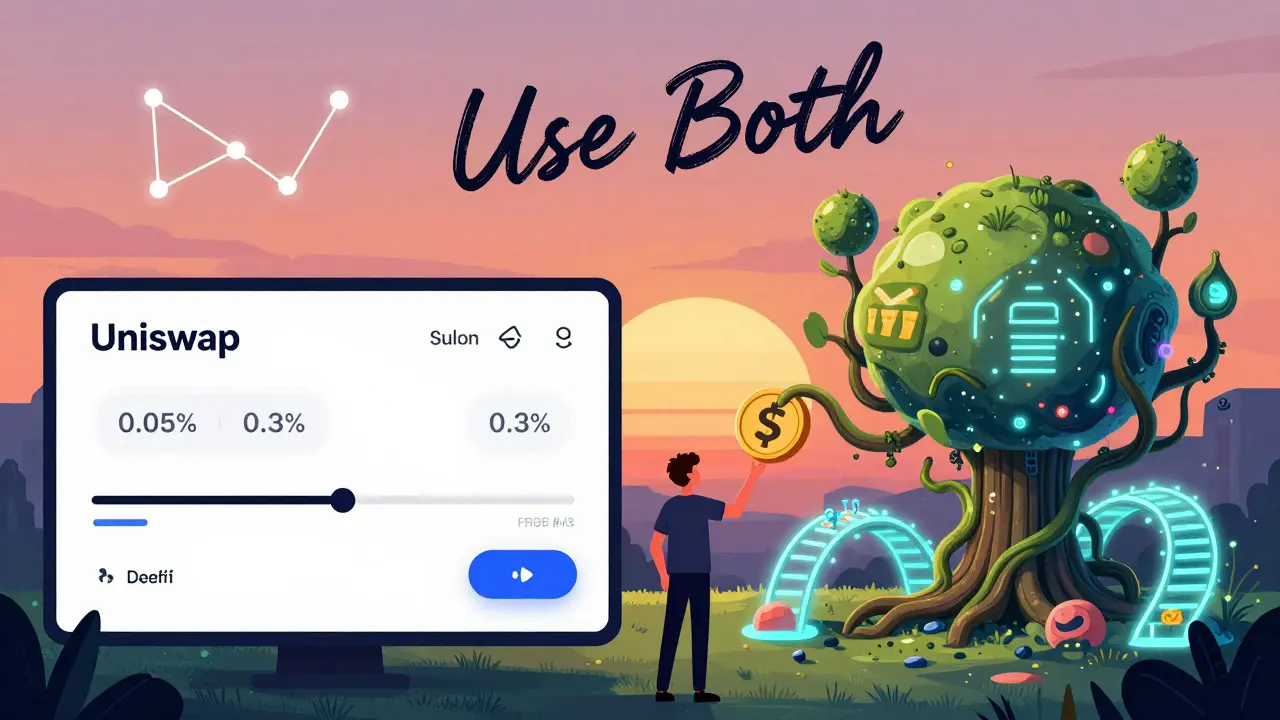
Start with Uniswap if you’re new. Learn how DEXes work. Then, if you’re curious about earning more, try SushiSwap. You don’t have to choose one forever. Use both. They’re not rivals - they’re tools for different jobs.
Quick Comparison Table
| Feature | Uniswap | SushiSwap |
|---|---|---|
| Launch Year | 2018 | 2020 |
| TVL (Late 2025) | $4 billion | $400 million |
| Daily Volume | $1-2 billion | $50-150 million |
| Trading Fees | 0.05%, 0.3%, or 1% | Fixed 0.3% |
| Liquidity Provider Earnings | 100% of fees | 0.25% of fees |
| Token Rewards | No | Yes (SUSHI via Onsen & staking) |
| Staking Rewards | No | Yes (xSUSHI gets 0.05% of fees) |
| Supported Chains | Ethereum, Polygon, Arbitrum, Optimism, Base, BNB Chain | 14+ including Avalanche, Fantom, Harmony |
| Best For | Beginners, high-volume swaps, reliability | Yield farmers, multi-chain users, reward seekers |
Frequently Asked Questions
Can I earn passive income on Uniswap?
Not directly. Uniswap doesn’t offer staking or token rewards. Your only income comes from trading fees if you provide liquidity. But you won’t earn extra tokens like SUSHI. If passive income is your goal, you’ll need to look elsewhere - or use SushiSwap.
Is SushiSwap safe to use?
Yes, but with caveats. The core protocol has been audited and hasn’t been hacked. However, SushiSwap’s Onsen program lets anyone list new tokens - many of which are high-risk. Only add liquidity to projects you’ve researched. Never stake in pools you don’t understand. The platform is safe; some of the tokens aren’t.
Which one has lower fees?
It depends. For stablecoin pairs, Uniswap’s 0.05% fee is cheaper than SushiSwap’s fixed 0.3%. For most other tokens, both charge 0.3%. But SushiSwap gives you SUSHI rewards on top, which can offset the higher fee. So while Uniswap is cheaper on paper, SushiSwap can be cheaper in practice if you’re earning rewards.
Do I need to understand blockchain to use either?
You need to understand your wallet - how to connect it, approve transactions, and set slippage. That’s it for Uniswap. For SushiSwap, you’ll also need to know what staking, yield farming, and cross-chain bridging mean. If you’re new, start with Uniswap. Learn the basics first.
Can I use Uniswap on my phone?
Yes. Uniswap has a polished mobile app available on iOS and Android. It’s one of the best DEX apps out there. SushiSwap’s mobile experience is functional but less refined. If you trade on the go, Uniswap’s app gives you a smoother experience.
Which one is better for new tokens?
SushiSwap. New tokens often launch on SushiSwap’s Onsen program because it offers big rewards to early liquidity providers. Uniswap tends to list only tokens with proven demand. If you want to get in on a new project early, SushiSwap is your best bet - but also your biggest risk.
Cathy Bounchareune
December 20, 2025 AT 17:15Uniswap is like that one friend who always shows up on time and never borrows money - reliable, boring, but you trust them with your life. SushiSwap? That’s the friend who invites you to a basement crypto party where everyone’s earning free tokens and someone’s trying to sell you a ‘rare’ NFT of a cat wearing a hat. I use both. Uniswap for swaps, Sushi for the dopamine hit of watching my SUSHI balance creep up like a slow-motion lottery win. 🤑
Luke Steven
December 21, 2025 AT 19:29It’s not about which DEX is better - it’s about what kind of relationship you want with money. Uniswap treats trading like a utility. SushiSwap treats it like a social contract. One gives you efficiency. The other gives you belonging. And in DeFi, where trust is fragmented and tokens are volatile, belonging might be the more valuable asset. We don’t just swap tokens - we swap identities. 🤔
Rachel McDonald
December 22, 2025 AT 02:30LOL at people still using SushiSwap. That place is a graveyard of failed tokens and rug-pulled LPs. I saw a guy lose $20k on an Onsen pool called ‘$DOGEFATHER’ - the token had a whitepaper written in Comic Sans. Uniswap at least has the decency to be boring. 🙄
Vijay n
December 22, 2025 AT 11:26Jayakanth Kesan
December 24, 2025 AT 00:58Man, I started with Uniswap when I was new. Learned the ropes. Then I dipped into SushiSwap for a weekend and made more in SUSHI rewards than I lost on a bad trade. It’s not about safety - it’s about opportunity. You don’t have to be a whale to win. Just show up, stake, and let the protocol do the heavy lifting. 🙌
Aaron Heaps
December 24, 2025 AT 13:27Uniswap is for people who want to feel safe while getting rekt by gas fees. SushiSwap is for people who want to get rekt *and* earn a badge for it. The only real difference? One gives you a medal. The other just gives you a receipt. 💸
Tristan Bertles
December 26, 2025 AT 00:37If you’re new, start with Uniswap. No shame in that. But don’t stop there. SushiSwap’s Onsen is where the magic happens - early access, boosted yields, the kind of upside that makes you forget about your 30% loss on Solana last month. Just don’t throw your whole portfolio into a new Onsen pool. Take a sip before you drink the whole glass. 🥂
Megan O'Brien
December 26, 2025 AT 03:53Uniswap V3 concentrated liquidity? More like concentrated FOMO. SushiSwap’s xSUSHI staking? Just another yield farm disguised as governance. We’re all just degens playing musical chairs with liquidity. The only real winner is the blockchain. 🤷♀️
Earlene Dollie
December 27, 2025 AT 18:20Uniswap is the corporate drone. SushiSwap is the rebel with a cause. I used to love Uniswap. Then I saw a girl cry because her $PEPELP got rug pulled on Sushi. Now I cry with her. But I still farm there. Because pain is the only real ROI in DeFi. 💔
Amit Kumar
December 29, 2025 AT 11:44Bro, Uniswap is like McDonald’s - everyone eats there, it’s safe, but you don’t leave feeling special. SushiSwap? That’s the street food stall in Mumbai where you get a plate of chaat with extra spice, a side of chaos, and someone hands you a free laddoo because you smiled. Yeah, you might get food poisoning. But damn, it’s memorable. 🇮🇳🔥
Rishav Ranjan
December 31, 2025 AT 10:29Steve B
December 31, 2025 AT 23:27One must consider the epistemological implications of liquidity provision in a post-centralized finance paradigm. Both protocols operate under the assumption of trustless interoperability, yet SushiSwap introduces a moral hazard through incentivized token distribution. The market, in its infinite wisdom, has chosen efficiency over participation. Or perhaps, it has been manipulated. 🤔
Sophia Wade
January 2, 2026 AT 08:33There is something profoundly poetic about Uniswap’s minimalism - a digital temple to the pure exchange of value, stripped of reward, spectacle, or ego. SushiSwap, by contrast, is a carnival: loud, glittering, intoxicating. One invites contemplation. The other, consumption. We are not just choosing a DEX - we are choosing a philosophy of wealth. And in that choice, we reveal ourselves. 🌌
Brian Martitsch
January 3, 2026 AT 23:56Uniswap is for people who can’t handle complexity. SushiSwap is for degens who think staking is a personality trait. I use neither. I use a centralized exchange and sleep at night. 🤷♂️
Jake Mepham
January 4, 2026 AT 19:45Y’all are overthinking this. I swap 80% of my trades on Uniswap. But every time a new memecoin drops? I jump to SushiSwap, add liquidity, earn SUSHI, then dump the token 3 hours later. That’s not farming - that’s tactical opportunism. And yeah, I’ve lost money. But I’ve also bought a new laptop with SUSHI rewards. It’s not magic. It’s math. 📊
Jacob Lawrenson
January 4, 2026 AT 21:24Uniswap for the grind. SushiSwap for the glow-up. I’ve got Uniswap open on my desktop. SushiSwap on my phone. Swap ETH for SHIB on Uniswap. Instantly add it to Sushi’s Onsen. Watch my xSUSHI stack. Repeat. It’s like a crypto version of ‘buy low, sell high’ - but you’re the one setting the price. 🚀
Jordan Renaud
January 6, 2026 AT 18:17It’s funny how we treat these platforms like rival teams. But really, they’re just tools. Uniswap is your hammer. SushiSwap is your Swiss Army knife. You don’t need to pick one forever. You just need to know when to use each. I’ve been in DeFi since 2021. I still use both. And I’ve never regretted it. Keep it simple. Stay curious. 🌱
Ellen Sales
January 7, 2026 AT 05:11Uniswap? More like Uniswap-never-gets-busted. SushiSwap? More like Sushi-sometimes-gets-rug-pulled-but-at-least-the-tacos-are-free. I use both. Also I spell 'liquidity' as 'liquidy' on purpose. 😘