What Are DAOs in Cryptocurrency: A Simple Guide to Decentralized Governance
Imagine a company with no CEO, no HR department, and no office building. Instead of a boss making decisions, thousands of people around the world vote on every major move using their phones. This isn't science fiction; it's how Decentralized Autonomous Organizations (DAOs) operate. If you've been following cryptocurrency, you've likely heard the acronym "DAO" thrown around constantly. But what exactly is it, and why does it matter for the future of finance?
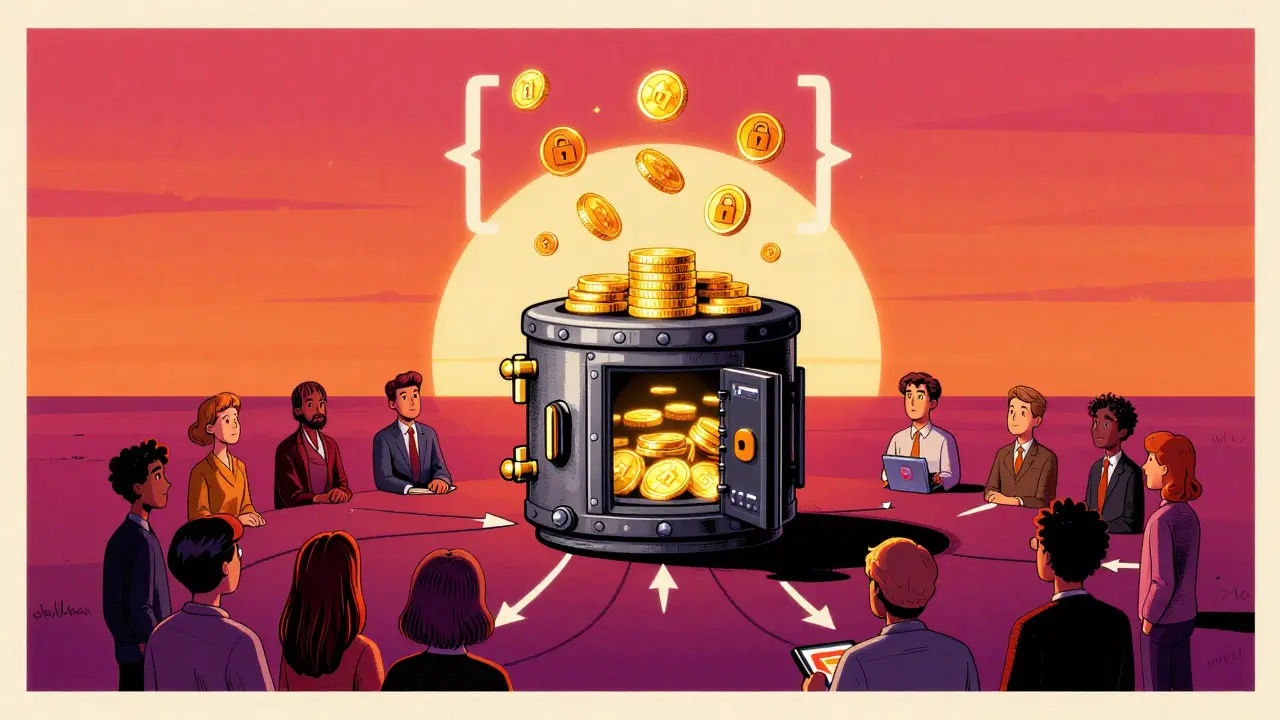
At its core, a DAO is an internet-native business owned and managed by its members. It replaces traditional corporate hierarchies with code and community consensus. The rules of the organization are written into smart contracts-self-executing programs on a blockchain that automatically enforce agreements without human intervention. When members want to change these rules or spend funds from the group's treasury, they submit a proposal. Other members vote using digital tokens. If the proposal passes, the code executes it immediately. No lawyers, no boardrooms, just transparent, immutable logic.
How DAOs Actually Work Under the Hood
To understand a DAO, you have to look past the buzzwords and see the mechanics. Unlike a traditional corporation where power sits at the top, power in a DAO is distributed among token holders. Here is the step-by-step process of how a decision gets made:
- Treasury Funding: Members buy governance tokens (like UNI for Uniswap or MKR for MakerDAO). These tokens represent ownership stakes and voting rights. The money raised goes into a shared digital wallet, often called the treasury.
- Proposal Creation: Any member can draft a proposal. This could be anything from "change the interest rate on loans" to "hire a new marketing agency" or "donate $50,000 to open-source software."
- Voting Period: The community discusses the proposal on forums like Discord or Snapshot. Once the discussion period ends, formal voting begins. Votes are usually weighted by how many tokens you hold, though some DAOs use one-person-one-vote systems.
- Execution: If the proposal meets the required quorum (minimum participation) and approval threshold, the smart contract automatically executes the action. Funds are moved, parameters are updated, or permissions are granted.
This structure relies heavily on Ethereum, which hosts about 87% of all active DAOs due to its robust smart contract capabilities. While other blockchains like Polygon and Solana are gaining ground, Ethereum remains the standard for serious governance because of its security and developer ecosystem.
The History: From Hacks to Billions
The story of DAOs starts with a massive failure. In 2016, a project simply called "The DAO" launched on Ethereum. It was designed as a venture capital fund without managers. Investors bought tokens to gain voting rights. It raised $150 million-the largest crowdfunding event in history at the time.
Then, hackers exploited a flaw in the code and drained $50 million worth of Ether. The incident forced the Ethereum network to undergo a controversial "hard fork" (a split in the blockchain) to recover the funds. Many purists left to form Ethereum Classic, refusing to alter the ledger. Despite this rocky start, the concept survived. Today, according to DeepDAO's 2023 report, DAOs collectively manage over $21 billion in assets. The sector has matured from experimental hacks to sophisticated governance engines powering some of the most valuable financial protocols in the world.
Types of DAOs: More Than Just Finance
Not all DAOs are created equal. They serve different purposes, and understanding these categories helps you decide if you want to join one.
| Type | Primary Goal | Example | Risk Level |
|---|---|---|---|
| Protocol DAOs | Manage DeFi apps and adjust fees/rates | Uniswap, Aave | Medium (Technical risk) |
| Investment DAOs | Pooled funding for startups or NFTs | The LAO, PleasrDAO | High (Market risk) |
| Social DAOs | Community building and networking | Friends With Benefits | Low (Time commitment) |
| Philanthropy DAOs | Charitable giving and grants | GitcoinDAO | Low (Reputational risk) |
Protocol DAOs are the workhorses of the space. They govern decentralized exchanges and lending platforms. For instance, Uniswap's DAO decides how to use its fee revenue. Investment DAOs act like mutual funds. Groups like PleasrDAO pool money to buy high-value assets, such as Edward Snowden's NFT, which sold for $5.4 million. Social DAOs focus less on money and more on membership perks, offering access to exclusive communities. Finally, Philanthropy DAOs use quadratic funding to distribute grants to developers building public goods.
Pros and Cons: Is a DAO Right for You?
DAOs offer exciting benefits, but they also come with significant drawbacks. It's crucial to weigh both sides before investing time or money.
The Advantages:
- Transparency: Every transaction and vote is recorded on the blockchain. You can audit the treasury yourself. There are no hidden accounting tricks.
- Permissionless Entry: Anyone with an internet connection and the required tokens can participate. There are no geographic restrictions or credit checks.
- Reduced Costs: By removing middlemen and administrative overhead, DAOs can operate more efficiently. ConstitutionDAO raised $47 million in 72 hours with near-zero administrative costs.
The Disadvantages:
- Slow Decision-Making: Democracy is slow. Corporate boards might decide in days; DAOs can take weeks to reach consensus. This makes them vulnerable during emergencies.
- Whale Dominance: Since voting power often correlates with token holdings, wealthy investors ("whales") can sway outcomes. TokenTerminal reports that the top 10 holders control over 50% of voting power in many major DAOs.
- Regulatory Uncertainty: Governments haven't fully caught up. The SEC has sued entities related to DAOs, arguing that some tokens function as unregistered securities. This legal gray area poses a risk to participants.
Getting Started: How to Join a DAO
If you're ready to dip your toes into decentralized governance, here is a practical roadmap. Don't rush in; start small.
- Set Up a Wallet: You'll need a non-custodial wallet like MetaMask or Ledger. This is your identity in the crypto world. Secure your seed phrase offline; never share it.
- Choose a DAO: Start with a well-documented protocol DAO like Uniswap or Aave. Avoid obscure investment DAOs until you understand the risks. Look for projects with active Discord servers and clear documentation.
- Acquire Governance Tokens: Buy the native token on a reputable exchange. For example, buying UNI gives you a voice in Uniswap's future. Keep in mind that token prices fluctuate wildly.
- Participate in Discussions: Before voting, read the proposals. Engage in the community forums. Many DAOs allow you to delegate your votes to trusted experts if you don't have time to research every issue.
- Vote: Use platforms like Snapshot for off-chain voting (which saves gas fees) or connect your wallet directly to the DAO's interface for on-chain execution.
Be prepared for a learning curve. A Consensys Academy survey found that new participants spend an average of 17 hours just learning the basics. Read the docs, ask questions, and expect to make mistakes.
The Future of DAOs in 2026 and Beyond
We are entering a maturation phase for DAOs. The wild west days of anonymous hack-and-slash are fading, replaced by structured governance and legal clarity. Wyoming passed the first DAO-specific legislation in 2021, granting them LLC status. Other jurisdictions are following suit. The EU's MiCA framework provides clearer guidelines for utility tokens, reducing some regulatory ambiguity.
Institutional adoption is accelerating. BlackRock filed for a DAO-managed tokenized fund in late 2024, signaling that traditional finance sees value in this model. We're also seeing the rise of "subDAOs," specialized units within larger organizations that handle specific tasks, improving efficiency. As tools improve and legal frameworks solidify, DAOs could become a standard structure for global, remote-first teams-not just in crypto, but in tech, media, and beyond.
Is it illegal to join a DAO?
Generally, no. Participating in a DAO is not inherently illegal. However, the legal status depends on your jurisdiction and the specific DAO's structure. Some DAOs may be classified as unregistered securities offerings by regulators like the SEC, which could pose risks for investors. Always do your own research and consider consulting a legal expert in your country.
Do I need to code to join a DAO?
No. While the underlying technology relies on code, participating as a member does not require programming skills. You only need a web browser and a crypto wallet. Most DAOs provide user-friendly interfaces for voting and discussing proposals. Technical knowledge is helpful but not mandatory for basic participation.
What happens if a DAO is hacked?
If a DAO's smart contract is exploited, funds can be stolen, as seen in the 2016 The DAO hack. Unlike banks, there is no insurance or customer support to reverse transactions. To mitigate this, reputable DAOs undergo rigorous third-party audits and maintain multi-signature wallets that require multiple approvals for large transfers. Always check if a DAO has active bug bounty programs.
How do DAOs make money?
DAOs generate revenue through various means depending on their type. Protocol DAOs earn fees from transactions on their platforms (e.g., trading fees on Uniswap). Investment DAOs profit from successful ventures or asset appreciation. Social DAOs may charge membership dues. All profits are typically redistributed to token holders or reinvested into the treasury based on community votes.
Can I create my own DAO?
Yes, creating a DAO is relatively easy thanks to tools like Aragon, DAOstack, and Colony. These platforms allow you to deploy a DAO with pre-built smart contracts in minutes. However, building a successful community and defining clear governance rules is much harder than the technical setup. Consider starting with a simple social DAO before attempting a complex financial protocol.
Mark Tuason
July 5, 2026 AT 23:49The distinction between protocol DAOs and social DAOs is quite significant for those looking to participate. Protocol DAOs require a deeper understanding of the underlying mechanics, whereas social DAOs are more accessible for community building. It is important to note that regulatory frameworks are still evolving, which adds a layer of complexity.
Autumn Story
July 6, 2026 AT 09:14I really love this explanation!! It makes so much sense now... The part about smart contracts executing automatically is just amazing! I hope more people can get involved in this kind of thing because it feels like the future. Maybe we can all have a say in how things run without needing a boss 😊
Ella Collinson
July 7, 2026 AT 22:42Let's be real here, the governance mechanisms in most DAOs are fundamentally flawed due to plutocratic voting structures. The assumption that token weight equals democratic representation is a fallacy that ignores the centralization risks inherent in liquidity provision. Most participants are passive holders who delegate votes to whales, creating a pseudo-decentralized facade while actual power remains concentrated among early investors and venture capital firms. The technical infrastructure is robust, but the sociological model is deeply broken and ripe for exploitation by sophisticated actors.
Andrew Schneider
July 8, 2026 AT 11:19Oh please 🙄 DAOs are just cults with better branding. You think you're voting on something important but really you're just following whatever the top 1% whisper into your ear via Discord. It’s a circus! A beautiful, chaotic, expensive circus where everyone pretends they’re changing the world while actually just burning gas fees 🔥🎪
Ray Arney
July 8, 2026 AT 11:32I guess it makes sense. Seems pretty complicated though.
Eric Braddock
July 9, 2026 AT 16:46Don't believe the hype. This is all part of a larger surveillance state experiment. They want you to put your money on the blockchain so they can track every single transaction you make forever. The SEC isn't suing because they hate innovation; they're suing because they need control. Wake up sheeple. The hard fork in 2016 was staged to reset the ledger and remove dissidents. Nothing is decentralized if the code can be changed by a few developers.
Nick G
July 11, 2026 AT 02:30I understand the skepticism surrounding these new models, and it is completely valid to question the efficacy of such systems when compared to traditional corporate structures that have been refined over centuries. However, one must also consider the cultural shift towards remote work and global collaboration, which necessitates new forms of organization that transcend geographical boundaries and legal jurisdictions. By engaging with these communities, even critically, we foster a dialogue that could lead to more inclusive and transparent methods of collective decision-making, potentially benefiting society as a whole through increased participation and reduced bureaucratic overhead.
Nick Wengel
July 12, 2026 AT 21:59It's interesting to see how different cultures approach governance. In my experience, community-based decisions often take longer but result in higher satisfaction among members. The key is finding a balance between efficiency and inclusion.
Alicia Hull
July 13, 2026 AT 23:44This article is dangerously oversimplified. How do you propose mitigating the risk of smart contract vulnerabilities? What about the tax implications for international participants? These are critical issues that cannot be ignored by anyone serious about participating in this space.
Johan Otto
July 14, 2026 AT 04:47Boring stuff. Just give me the moon boy 🚀
Anuj Kashyap
July 15, 2026 AT 18:48The philosophical implication of removing the 'boss' is fascinating, yet ironic. We replace human hierarchy with algorithmic determinism. Is code truly neutral? Or does it simply encode the biases of its creators in a more rigid form? One might argue that we are trading tyranny for automation, which is hardly a victory for freedom. 🤔
DJ Maleko
July 17, 2026 AT 11:42You guys are missing the point entirely. The real value isn't in the governance, it's in the treasury management. If you don't know how to allocate resources efficiently, you'll get voted out or drained. Stop talking about vibes and start looking at the PnL. 📉📈
Erika Pozzetto
July 18, 2026 AT 08:59It is imperative to recognize that the legal framework surrounding DAOs is not merely a hurdle but a fundamental component of their long-term viability. Without clear statutory recognition, these entities remain vulnerable to arbitrary enforcement actions by regulatory bodies which operate under existing laws that were never designed for digital-native organizations. Therefore, any discussion of DAOs must include a rigorous analysis of the jurisdictional nuances and the potential for retroactive legislation that could invalidate past transactions or impose severe penalties on participants.
Russ Fincham
July 20, 2026 AT 05:25Look, the tech is cool. But let's be honest, most DAOs are just scams waiting to happen. The lack of accountability is terrifying.
Linda Hilliard
July 22, 2026 AT 00:03Sigh. Another article written by someone who clearly hasn't spent enough time reading whitepapers from the late 2010s. The concept of quadratic funding is barely mentioned, which is a glaring omission for anyone claiming to understand modern DAO economics. It's almost laughable how superficial this overview is. One would expect a higher standard of discourse from this platform. :/
Winston Lacewing
July 23, 2026 AT 05:22I can't believe people are still falling for this nonsense. It's morally bankrupt to trust code over human judgment. What happens when the code fails? Who do you sue? Nobody! That's the problem. We are abandoning our moral responsibilities to machines. It's disgusting. 🤢😡
Kristine Lawson
July 24, 2026 AT 03:03One must critically evaluate the assertion that DAOs offer true decentralization. In reality, they often exacerbate inequality by empowering those with the most capital. Furthermore, the environmental impact of proof-of-work blockchains, although Ethereum has moved to proof-of-stake, remains a contentious issue that proponents conveniently ignore. The entire premise is built on a foundation of speculative greed rather than genuine societal improvement.