What Are Multi-Signature Crypto Wallets: A Complete Guide to M-of-N Security
You keep your house keys in a lockbox. You don’t give a spare key to every stranger you meet, nor do you leave the only key under the doormat. Yet, for years, many people treated their cryptocurrency like they left the master key to their bank account taped to their laptop screen. If that laptop gets hacked, or if you lose that one piece of paper with your seed phrase, everything is gone. There is no customer service line to call. There is no "forgot password" button on the blockchain.
This is exactly why multi-signature wallets, often called multi-sig wallets, have become the gold standard for serious asset protection. Instead of relying on a single point of failure, these wallets require multiple approvals to move funds. It’s like needing two out of three board members to sign off on a major corporate purchase before the money leaves the company account. For individuals managing large sums, teams running decentralized organizations, and institutions holding billions, this shift from single-key to multi-key custody isn't just an upgrade-it's a survival strategy.
How Multi-Signature Wallets Work: The M-of-N Model
To understand multi-sig, you first need to unlearn how traditional wallets work. In a standard single-signature wallet, you hold one private key. That key acts as both the ID and the signature. If you sign a transaction, it happens. Simple, but fragile. A multi-signature wallet changes the rules entirely by using a smart contract on the blockchain to enforce access controls.
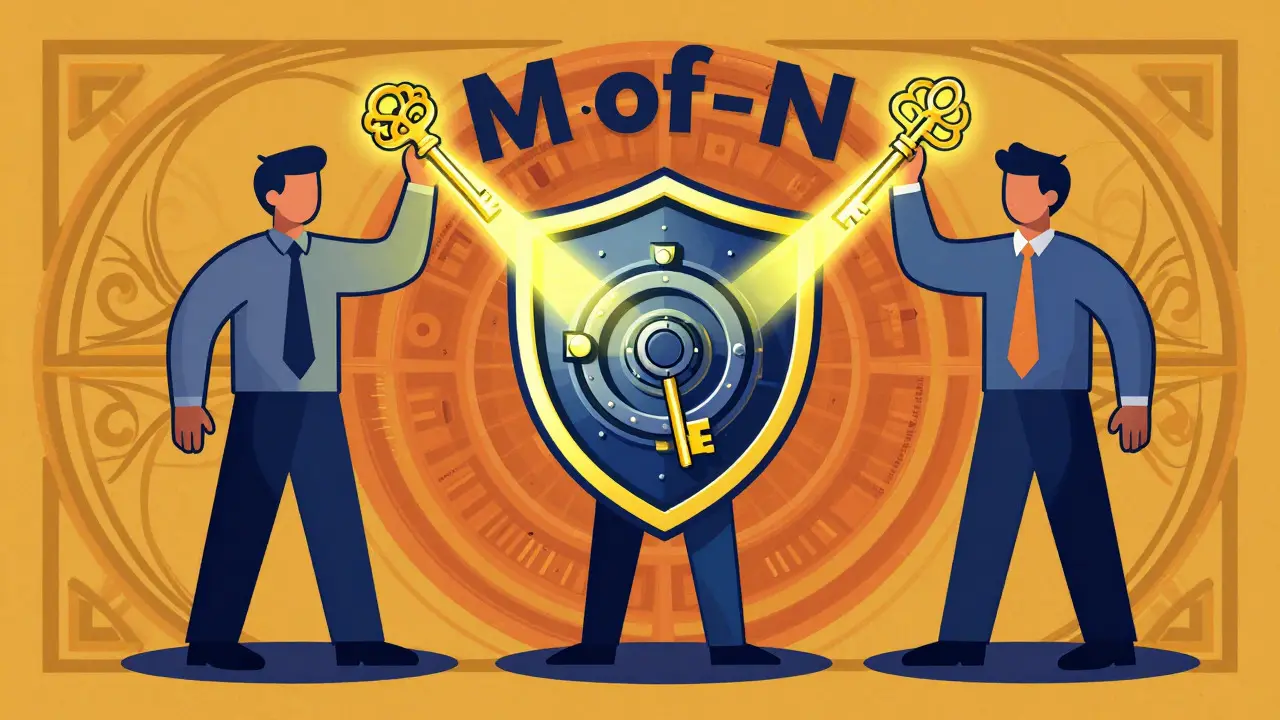
The core mechanism is known as the M-of-N model. Here, 'N' represents the total number of unique keys (or signers) associated with the wallet, and 'M' is the minimum number of signatures required to authorize a transaction. This structure allows for flexible security configurations tailored to your specific risk tolerance and operational needs.
- 2-of-3 Setup: This is the industry standard for most businesses and high-net-worth individuals. You generate three keys. Any two must sign a transaction to execute it. If you lose one key, you aren't locked out. If one key is compromised by a hacker, your funds are still safe because the thief lacks the second required signature.
- 3-of-5 Setup: Common in Decentralized Autonomous Organizations (DAOs) and larger companies. Five team members hold keys, but any three can approve a payment. This prevents a rogue employee or a small group from draining the treasury.
- 1-of-2 Setup: Often used for joint accounts between partners or spouses. Either person can move funds, providing redundancy without requiring constant coordination.
When a transaction is initiated, it doesn't broadcast to the network immediately. Instead, it enters a pending state. The other signatories receive notifications-usually via email or a mobile app-and review the details. Once the threshold 'M' is met, the smart contract combines the signatures and broadcasts the transaction. This process adds a layer of human verification that automated systems lack.
Why Multi-Sig Beats Single-Signature Wallets
The primary advantage of multi-sig is the elimination of single points of failure. According to data from Coinbase’s 2023 security report, 98% of hacked cryptocurrency exchanges utilized single-signature custodial solutions. When a single key is exposed, the attacker has full control. In a multi-sig environment, stealing one key grants zero access to the funds.
| Feature | Single-Signature Wallet | Multi-Signature Wallet |
|---|---|---|
| Security Risk | High: One compromised key = total loss | Low: Requires multiple compromised keys |
| Recovery | Impossible if seed phrase is lost | Possible if enough keys remain (e.g., 2 of 3) |
| Transaction Speed | Fast (~1 minute average) | Slower (~3-5 minutes due to approval steps) |
| Complexity | Low: Easy setup and use | High: Requires key management and coordination |
| Ideal User | Retail investors, small amounts | Institutions, DAOs, large holders |
Beyond theft prevention, multi-sig offers robust recovery options. In a single-sig world, losing your hardware device or burning your paper backup means your assets are gone forever. With a 2-of-3 multi-sig setup, you might store one key on a hardware wallet at home, one in a safety deposit box, and one with a trusted family member. If your home is burgled and the hardware wallet is stolen, you can still recover your funds using the other two keys. Ledger Academy reports a 92% reduction in successful theft attempts when multi-sig is properly implemented with geographically dispersed keys.
Who Should Use Multi-Signature Wallets?
While anyone *can* use a multi-sig wallet, it isn't always the right tool for the job. The complexity involved makes it overkill for someone buying $50 worth of Bitcoin for coffee. However, for specific user groups, it is essential infrastructure.
Decentralized Autonomous Organizations (DAOs): DAOs manage treasuries often exceeding millions of dollars. Colony Blog notes that multi-sig secured over $22 billion in DAO treasuries as of Q2 2023. A 3-of-5 setup ensures that no single developer or voter can unilaterally drain the community's funds, enforcing democratic governance on-chain.
Cryptocurrency Businesses and Exchanges: Companies handling client funds face strict regulatory requirements. The U.S. Office of the Comptroller of the Currency confirmed in 2022 that properly implemented multi-sig satisfies "dual control and segregation of duties" standards. BitGo reports that 78% of crypto businesses managing over $100,000 in assets now use multi-sig.
High-Net-Worth Individuals: If you hold significant wealth in crypto, treating it like a personal bank account with extra security layers is wise. Using a 2-of-3 setup with keys stored in different physical locations protects against local disasters like fire or flood, as well as targeted cyberattacks.
Joint Accounts: Couples or business partners who share financial responsibilities can use multi-sig to create transparent, shared custody arrangements without relying on a third-party intermediary.
Popular Multi-Signature Solutions
The market for multi-sig tools has matured significantly. You no longer need to be a coding expert to set one up. Several platforms offer user-friendly interfaces while maintaining rigorous security standards.
Safe (formerly Gnosis Safe) is arguably the most popular choice for Ethereum-based assets. It operates as a smart contract wallet, meaning the logic is enforced by the blockchain itself, not a central server. Safe scores highly for documentation clarity and has a massive ecosystem of integrations. It is the default choice for most DAOs and institutional treasuries on Ethereum.
BitGo dominates the institutional space. They offer managed multi-sig services where they act as one of the signers, providing insurance and 24/7 support. For enterprises that want security without the technical headache of self-custody, BitGo is a leading option. Their platform supports over 150 cryptocurrencies and includes advanced compliance features.
Trezor Suite has introduced multi-sig functionality directly into its hardware wallet software. This is ideal for individuals who already own Trezor devices and want to add an extra layer of security without switching to a completely new platform. It simplifies the process of generating and managing multiple keys.
Coinbase Custody provides multi-sig solutions integrated with their broader exchange and custody services. This is particularly useful for traders who want to move funds seamlessly between hot wallets for trading and cold storage for long-term holding.
Challenges and Risks of Multi-Sig
Multi-sig is not a magic bullet. It introduces new complexities that users must manage carefully. The biggest drawback is operational friction. Transactions take longer. BitPay Support reports a 47% longer approval time for multi-sig setups compared to single-sig. In a fast-moving market, waiting for three colleagues to sign off on a trade can mean missing the window.
Key management is another critical challenge. You are responsible for keeping N keys secure. If you choose a 3-of-5 setup, you need to ensure all five participants maintain their keys safely. If three people lose their keys simultaneously, the funds are locked forever. This requires clear communication protocols and regular audits of key status.
There is also the risk of poor implementation. Andreas Antonopoulos, a renowned cryptography researcher, warns that poorly configured multi-sig setups with co-located keys provide false security. If all three keys in a 2-of-3 wallet are stored on the same computer in the same office, a single ransomware attack could compromise all of them. Geographic and physical separation of keys is crucial for true security.
Setting Up Your First Multi-Sig Wallet
If you decide to move to multi-sig, preparation is key. Don't rush the process. BitGo recommends allocating 6-10 hours for the initial setup of an institutional wallet. For individuals, you should still expect to spend several hours learning the interface and testing transactions.
- Choose Your Configuration: Decide on your M-of-N ratio. For most individuals starting out, 2-of-3 is the best balance of security and convenience.
- Select Your Platform: Choose a reputable provider like Safe, BitGo, or Trezor based on your technical comfort level and asset type.
- Generate Keys Securely: Create your private keys offline. Avoid generating them on internet-connected computers if possible. Write down seed phrases on metal backups if storing long-term.
- Distribute Keys Physically: Store keys in different locations. One in a home safe, one in a bank deposit box, one with a trusted lawyer or family member. Never store digital copies of all keys in the same cloud folder.
- Test with Small Amounts: Before moving your life savings, send a tiny amount of crypto through the multi-sig process. Verify that all signatories can approve and that the transaction executes correctly.
- Document the Process: Create a clear guide for yourself (and heirs/partners) explaining how to access the wallet, who holds which keys, and how to initiate a transaction.
Remember, multi-sig is a tool for control and security, not just storage. By distributing trust among multiple parties, you build a system that is resilient against theft, loss, and fraud. As the cryptocurrency landscape matures, moving away from single-key dependency is no longer optional for serious investors-it’s fundamental.
Is a multi-sig wallet safer than a hardware wallet?
Yes, generally speaking. A standard hardware wallet uses a single private key. If that key is compromised (through phishing, malware, or physical coercion), your funds are at risk. A multi-sig wallet requires multiple keys, so even if one hardware device is stolen or compromised, the attacker cannot move funds without the other required signatures. However, multi-sig adds complexity that can lead to user error if not managed correctly.
Can I use a multi-sig wallet for Bitcoin?
Absolutely. Multi-signature functionality was actually first introduced in Bitcoin's protocol around 2012-2013. Many Bitcoin-focused wallets, including Electrum and BlueWallet, support multi-sig setups. It is considered the gold standard for securing large amounts of Bitcoin.
What happens if one signer loses their key in a 2-of-3 setup?
You are not locked out. Since you only need two signatures to move funds, you can continue to operate normally using the remaining two keys. However, you have lost your redundancy buffer. It is advisable to generate a replacement key and update the wallet configuration to restore the full 2-of-3 security posture.
Are there fees for using multi-sig wallets?
Yes, typically higher than single-sig transactions. Because multi-sig transactions involve more complex cryptographic operations and larger data sizes, they consume more block space. On networks like Bitcoin and Ethereum, this results in higher gas fees or transaction costs. Additionally, some managed service providers like BitGo charge monthly subscription fees for their enterprise-grade multi-sig platforms.
Do I need technical skills to set up a multi-sig wallet?
Basic technical understanding helps, but modern platforms like Safe and Trezor Suite have simplified the process significantly. You don't need to code, but you should understand concepts like seed phrases, public/private keys, and network confirmations. Coinbase Learning reports that 63% of new users benefit from supplemental training to avoid common setup errors.
Don Fizy
July 29, 2026 AT 02:46Great breakdown of the M-of-N model. I've been using a 2-of-3 setup with Safe for my DAO treasury and it's saved us from so many headaches. The key thing people miss is that you need to actually test the recovery process. Don't just set it up and forget it. Send $10 through the whole flow first. It feels tedious but when you're holding real value, that friction is your best friend. :)
Candice Cornett
July 30, 2026 AT 02:19it's all marketing hype. single sig is fine if you have common sense. most people are just lazy and want an excuse to not learn basic security. multi-sig adds unnecessary complexity for retail users who don't even understand private keys. stop pretending we all need institutional grade setups for our coffee money.
Lance Jantz
July 31, 2026 AT 04:41Oh, Candice, how quaintly dismissive of the sophisticated architecture required to truly secure one's digital sovereignty. You speak of 'common sense' as if it were a universal constant rather than a fragile construct easily shattered by phishing emails or malware. The pretension of believing that a simple hardware wallet suffices in an era of quantum threats and state-level actors is... well, let's call it charmingly naive. We are dancing on the edge of a cryptographic abyss, and you suggest we do so with one hand tied behind our backs because 'complexity' bores you. How utterly pedestrian.
Dominic Greco
July 31, 2026 AT 23:44They want you to think multi-sig is safe 🚩👁️🗨️ but have you considered that the smart contracts themselves could be backdoored? Or that the 'trusted' signers are actually compromised agents? Centralization is the goal. They give you this illusion of control while they watch every transaction metadata point. Wake up sheeple. The only true security is air-gapped cold storage with no internet connection ever. Even then, trust nothing. 🤫💸
Sus Sawyer
August 1, 2026 AT 07:03Dominic u r kinda paranoid lol. But yeah, smart contract risk is real. That's why i use Trezor Suite for my personal stuff. It's way easier than setting up Safe from scratch. Just make sure u generate keys offline. Don't be stupid and type seed phrases into online generators. Keep it simple. Security isn't about being fancy, it's about not making dumb mistakes. 💪
Aryan MISHRA
August 1, 2026 AT 11:38The article misses the critical aspect of key generation entropy. Most users fail here. Using weak RNG sources compromises the entire M-of-N structure. Furthermore, the gas costs on Ethereum L1 for complex multi-sig transactions are prohibitive for frequent micro-transactions. Layer 2 solutions are mandatory for viable adoption. Without L2 integration, multi-sig remains a luxury for whales only. Period.
Phil Babb
August 2, 2026 AT 10:04Aryan makes a solid point about L2s! In India, we see a lot of developers moving to Polygon or Arbitrum for their multi-sig deployments to save on fees. It's a game changer for smaller DAOs. Also, Phil here wants to add that community education is huge. We run workshops in Bangalore teaching devs how to use Gnosis Safe properly. It's not just about the tech; it's about the human workflow. If your team doesn't communicate, the best tech won't save you! 🇮🇳🔥
Sean Rowland
August 2, 2026 AT 16:38Let us delve deeper into the existential dread of key management. The concept of 'redundancy' is often misunderstood as mere duplication, whereas it is, in fact, a philosophical stance against entropy. When one loses a key, it is not merely a technical failure; it is a rupture in the social fabric of the signing group. One must ask: who holds the third key? A lawyer? A spouse? These are not neutral parties. They are vectors of potential betrayal. The drama of a lost key is not a bug; it is a feature of human nature. Prepare for the chaos.
Ryan Robinson
August 3, 2026 AT 13:30sean u talkin crazy again lol. just store one key in a safe deposit box and give one to ur mom. problem solved. dont overthink it. its just crypto bro. chill out. i use 2-of-3 and never had an issue. maybe write it down on metal tho, paper burns.
Earl Kott65
August 3, 2026 AT 18:25Oh wow, Ryan, what a revolutionary idea! Give the key to Mom! 🙄 Because clearly, family dynamics are the bedrock of financial security. Have you ever tried asking your mother to sign a transaction at 3 AM during a market crash? Spoiler alert: she's asleep or thinks you're playing video games again. 😂 Multi-sig is great until you realize your 'trusted' signer has terrible timing. But sure, keep dreaming. Maybe next time try a 3-of-5 setup with friends who actually understand blockchain. 😉
Ethan Yuwono
August 3, 2026 AT 19:24I think we can all agree that multi-sig is better than single sig for large amounts. But the social aspect is tricky. Trust is hard. Maybe we should focus more on threshold signatures instead of traditional multi-sig. It simplifies the transaction data. Just food for thought. No need to fight over it. Peace. 🕊️