What Is a 51% Attack on Blockchain? Explained with Real Examples
Imagine you walk into a coffee shop, pay for your latte with digital cash, and then-before the barista even hands you the cup-the payment record vanishes. You keep the coffee, and the transaction never happened. This isn't a glitch in the matrix; it's called a 51% attack, and it is one of the most terrifying scenarios for anyone relying on decentralized ledgers.
If you have ever wondered how secure your crypto really is, understanding this concept is crucial. It strips away the hype and reveals the raw mechanics behind blockchain trust. A 51% attack happens when a single group or entity controls more than half of the computing power (hash rate) on a Proof of Work network. With that majority control, they can rewrite history, reverse transactions, and steal funds through double-spending. While Bitcoin remains largely immune due to its massive size, smaller networks face real, documented threats.
How Does a 51% Attack Actually Work?
To understand the attack, you first need to understand how normal blockchains agree on what is true. Most major cryptocurrencies like Bitcoin use a system called Proof of Work (PoW). In this system, miners compete to solve complex mathematical puzzles. The first one to solve it gets to add a new block of transactions to the chain and earn a reward. The rule is simple: the longest chain of blocks is considered the valid truth by everyone on the network.
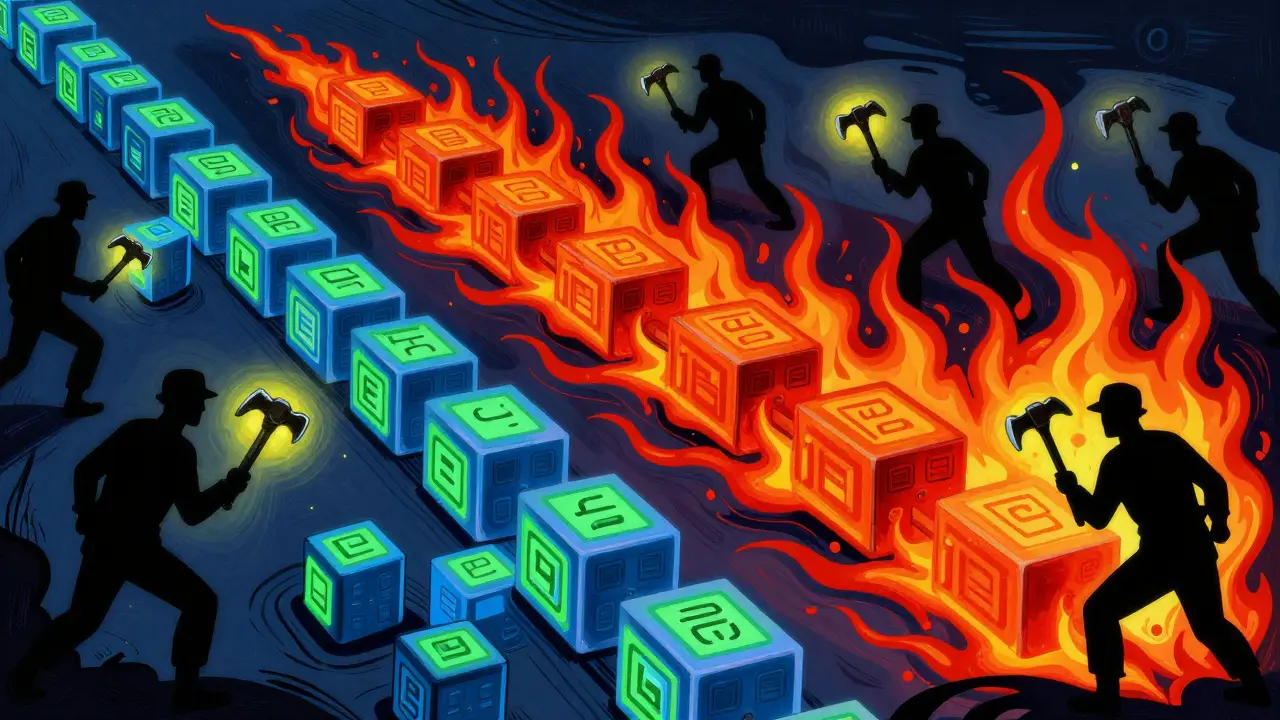
Here is where the attacker steps in. If a malicious actor controls 51% or more of the total mining power, they can mine blocks faster than the rest of the honest network combined. They don't just add blocks; they create their own private version of the blockchain.
The process usually looks like this:
- The Setup: The attacker secretly mines blocks on a hidden chain while simultaneously sending legitimate-looking transactions to the public network.
- The Transaction: For example, the attacker sends 10 coins to an exchange to buy goods or stablecoins. The public network confirms this transaction because it sees the coins moving.
- The Reveal: Once the attacker has received the goods or sold the coins, they release their secret, longer chain to the public. Because their chain is longer, the network accepts it as the valid one.
- The Erasure: The original transaction where the attacker sent the coins away is now part of the old, shorter chain. That chain is discarded. The coins are back in the attacker's wallet, but they still have the goods or cash from the initial sale. This is known as double spending.
It sounds like magic, but it’s just math and timing. The attacker doesn't break the encryption; they simply outvote the rest of the network.
What Can and Cannot Be Done in a 51% Attack
There is a lot of fear-mongering around these attacks, so let's separate fact from fiction. Knowing the limits of a 51% attack helps you assess actual risk.
What the Attacker CAN Do:
- Double Spend: As described above, they can spend the same coins twice by reversing their own outgoing transactions.
- Censor Transactions: They can prevent specific addresses from confirming transactions, effectively freezing them out of the network.
- Halt Network Activity: By refusing to include new blocks, they can stop the entire network from processing any new data.
What the Attacker CANNOT Do:
- Steal Funds Directly: They cannot access your private keys or move money from your wallet to theirs. They can only reverse transactions where *they* were the sender.
- Create New Coins: They cannot print infinite money. The protocol rules regarding coin issuance remain intact.
- Change Smart Contracts: On platforms like Ethereum Classic, they cannot alter the code of existing smart contracts, though they can revert states if those contracts depend on transaction order.
This distinction is vital. A 51% attack is not a hack that drains wallets at random. It is a coordinated effort to exploit the consensus mechanism for financial gain, primarily targeting exchanges or large merchants who might release goods before waiting for sufficient confirmations.
Real-World Examples: From Theory to Reality
For years, 51% attacks were treated as theoretical nightmares. Satoshi Nakamoto, the creator of Bitcoin, assumed acquiring such power would be impossible. However, as blockchain technology spread to thousands of smaller projects, the threat became very real.
Ethereum Classic (ETC) has been the poster child for these vulnerabilities. In January 2019, ETC suffered two separate 51% attacks within days of each other. Attackers reversed over $11 million worth of transactions. Then, in August 2020, three more attacks occurred, costing exchanges millions more. These weren't lone wolves; they were organized groups renting hash power.
Bitcoin Gold (BTG) also fell victim. In 2018, attackers halted the network and double-spent approximately $18 million. The pattern was clear: low market cap, low hash rate, high reward for theft.
But the landscape shifted dramatically in August 2025. Monero (XMR), a privacy-focused coin with a much larger market capitalization than ETC or BTG, experienced a successful 51% attack. This was a watershed moment. Monero uses a different algorithm (RandomX) designed to resist specialized hardware, yet attackers still managed to gain majority control. This proved that no network is truly safe if the economic incentives align against it. Even established protocols are vulnerable if enough resources are poured into breaking them.
| Network | Date | Estimated Loss | Key Takeaway |
|---|---|---|---|
| Ethereum Classic | Jan 2019 | $11M+ | First major demonstration of rented hash power attacks. |
| Bitcoin Gold | May 2018 | $18M | Showed vulnerability of GPU-mined coins. |
| Monero | Aug 2025 | Undisclosed | Proved even large-cap, privacy coins are not immune. |
Why Don't We See Bitcoin Under Attack?
You might wonder why Bitcoin hasn't faced this issue despite being the most valuable target. The answer lies in economics, not just technology. To attack Bitcoin, you would need to control more than half of its global hash rate. As of 2026, Bitcoin's hash rate is measured in exahashes per second (EH/s). Acquiring this much power would cost billions of dollars in hardware and electricity.
Research from the MIT Digital Currency Initiative highlights that attacks are generally unprofitable unless the attacker has low fixed costs. For Bitcoin, the cost of mounting an attack far exceeds any potential profit from double-spending. Furthermore, destroying Bitcoin's reputation would crash its price, wiping out the value of the attacker's own investment. It is a classic "mutually assured destruction" scenario.
However, for smaller chains, the math flips. An attacker might spend $50,000 to rent hash power and steal $5 million. That is a highly profitable business model. Services like NiceHash allow users to rent out mining power, which inadvertently creates a marketplace for launching these attacks. You don't need to own the machines; you just need to rent the time.

How Networks Protect Themselves
Blockchain developers aren't sitting idle. Several strategies are being employed to mitigate these risks.
1. Hash Rate Monitoring
Tools like Coin Dance and various blockchain explorers track hash rate distribution in real-time. If one mining pool suddenly grows to dominate 40%+ of the network, alerts are triggered. Exchanges often monitor these charts closely.
2. Increased Confirmation Requirements
After the ETC attacks, many exchanges increased the number of block confirmations required before crediting a user's account. Instead of releasing funds after one block, they might wait for 30 or even 100 blocks. This makes it exponentially harder and more expensive for an attacker to build a secret chain long enough to overwrite the transaction.
3. Switching Consensus Mechanisms
Many newer blockchains have moved away from Proof of Work entirely, adopting Proof of Stake (PoS). In PoS, security is based on holding and staking coins rather than computational power. While PoS has its own theoretical vulnerabilities (like the "nothing at stake" problem), a 51% attack in PoS requires buying 51% of the total supply, which is often economically self-defeating since it crashes the asset's value.
4. Decentralization Incentives
Projects are actively working to distribute mining power more evenly. This includes subsidizing mining hardware for independent operators or creating algorithms that resist ASIC centralization, ensuring no single entity can easily monopolize the network.
What Should You Do As a User?
If you hold small-cap altcoins or trade on exchanges, here are practical steps to protect yourself:
- Check Hash Rate Distribution: Before investing in a new PoW coin, look up its hash rate concentration. If one pool controls >30%, be cautious.
- Wait for Confirmations: Never trust a transaction immediately. For large amounts, wait for multiple block confirmations. On volatile networks, this is non-negotiable.
- Diversify Storage: Don't keep all your assets on one exchange. Use self-custody wallets where possible, as 51% attacks primarily impact centralized intermediaries.
- Monitor News: Follow security researchers and blockchain analytics firms. Early warnings about suspicious hash rate spikes can save you from trading during an active attack window.
The blockchain world is evolving rapidly. The August 2025 Monero attack served as a stark reminder that decentralization is not guaranteed; it must be actively maintained. Understanding the mechanics of a 51% attack empowers you to make smarter decisions about where you store and send your digital assets.
Can a 51% attack happen on Bitcoin?
Theoretically, yes, but practically, it is nearly impossible. The cost of acquiring enough mining hardware and electricity to control 51% of Bitcoin's hash rate would run into the billions of dollars. Additionally, such an attack would likely destroy confidence in Bitcoin, crashing its price and rendering the stolen funds worthless. The economic disincentive is too high.
What is the difference between a 51% attack and a hack?
A hack typically involves exploiting a software bug or weak code to steal funds directly. A 51% attack does not involve breaking code or stealing private keys. Instead, it exploits the consensus rules of the network by using brute force computing power to rewrite the transaction history, specifically to enable double-spending.
Why did Monero suffer a 51% attack in 2025?
Monero's attack in August 2025 demonstrated that even larger networks are vulnerable if hash rate becomes concentrated. Attackers likely rented significant amounts of hashing power from pools that were temporarily inactive or willing to sell capacity. This event highlighted that market cap alone does not guarantee security; hash rate distribution is equally critical.
How do I know if my coin is vulnerable to a 51% attack?
You can check websites like Coin Dance or Hashrate Index. Look for two things: the total hash rate (lower is riskier) and the distribution among mining pools. If a single pool controls more than 30-40% of the network's power, the risk of a 51% attack increases significantly.
Does Proof of Stake eliminate 51% attacks?
Proof of Stake changes the nature of the attack. Instead of needing 51% of computing power, an attacker needs 51% of the total staked coins. This is often more difficult and expensive because buying that much supply drives up the price, reducing profitability. However, PoS is not immune to all forms of consensus attacks, though traditional 51% hash rate attacks do not apply.
Barclay Chantel
May 31, 2026 AT 02:46Oh, please. Another breathless article pretending that blockchain security is some fragile glass house waiting to shatter. The reality is far more mundane and infinitely less exciting for the average retail investor who thinks they are revolutionizing finance by buying dog coins. These 'attacks' are merely market corrections enforced by brute force economics, not some grand hacker narrative. We should stop treating every minor fluctuation in hash rate distribution as an existential crisis for the entire paradigm of decentralized ledger technology. It is simply supply and demand meeting computational power.
Eric Grosso
May 31, 2026 AT 13:02i mean its kinda scary how easy it sounds to just rent hash power and steal money
like why does nicehash even allow this if its basically a weapon rental service?
doesnt seem right that u can just buy the ability to break the network
Joshua Alcover
June 2, 2026 AT 08:41The fundamental epistemological flaw in this discourse lies in the assumption that cryptographic consensus equates to ontological truth. When one examines the geopolitical ramifications of hash rate concentration, particularly within sovereign borders that prioritize algorithmic sovereignty over globalist decentralization mandates, it becomes evident that the 51% attack is merely a symptom of a broader systemic failure in the liberal economic order. The utilization of rented compute resources via platforms such as NiceHash represents a commodification of security protocols that undermines the very fabric of digital trust architectures we have painstakingly constructed. Furthermore, the notion that Proof of Stake offers a panacea is intellectually lazy; it merely shifts the locus of vulnerability from computational asymmetry to capital accumulation, thereby exacerbating existing wealth disparities under the guise of technological innovation.
Edith Mair
June 2, 2026 AT 13:04You're missing the point entirely. This isn't about philosophy or geopolitics, it's about basic risk management. If you are running a business on a chain with low hash rate, you are negligent for not requiring more confirmations. Exchanges need to wake up and stop being lazy about their security parameters. It's not rocket science to wait for 30 blocks instead of 1. Stop making excuses for poor infrastructure.
Miss Masquer
June 2, 2026 AT 21:13I find it truly fascinating how these attacks serve as a stark reminder of the human element within what we often perceive as purely mathematical systems, and I think it is incredibly important for us to consider the broader implications of how centralized mining pools can inadvertently create vulnerabilities that affect everyone involved in the ecosystem, because when we look at the historical context of Ethereum Classic and Bitcoin Gold, we see a clear pattern where economic incentives outweighed the moral obligations of maintaining network integrity, which leads me to believe that perhaps we need a more holistic approach to education regarding the true nature of decentralization and the responsibilities that come with participating in these emerging financial technologies, especially since the recent Monero incident has shown us that no amount of privacy features can protect against a determined adversary with sufficient resources, so let us all take a moment to reflect on our own practices and ensure that we are doing everything possible to safeguard our assets while also supporting projects that prioritize long-term sustainability over short-term gains.
Sam Dashti
June 4, 2026 AT 10:38Man, this whole thing is like watching a heist movie but with spreadsheets. The idea that someone can just rewind time and keep the coffee is wild. It’s like they’re playing god with the ledger. But hey, at least Bitcoin is too big to fail, right? Or too rich to care? Either way, small caps are basically playgrounds for wolves now. Gotta love the wild west vibe of crypto, keeps things interesting I guess.
Crystal Davis
June 4, 2026 AT 21:42Let's be clear: the majority of readers here do not understand the difference between a private key compromise and a consensus failure. The article simplifies the mechanics to the point of absurdity. A 51% attack requires sustained dominance, not just a spike. The mention of Monero in 2025 is particularly contentious given the specific nuances of RandomX resistance, suggesting either insider manipulation or a temporary liquidity crunch in the hash rental market. Most users treat these events as black swans when they are actually predictable outcomes of poor incentive structures. Do your own research before panic selling.
Dianne Wright
June 5, 2026 AT 19:19i feel like nobody really cares about the tech until something goes wrong then suddenly everyone is an expert
it makes me so tired seeing people blame the protocol when its usually user error or exchange negligence
why do i have to explain this again and again
sigh
Joe Clements
June 6, 2026 AT 14:33I totally get why this is confusing for newbies. It’s a lot to take in. Just remember that keeping your coins in a self-custody wallet helps a lot because attackers mostly target exchanges. Stay safe out there!
Rosie Morris
June 6, 2026 AT 15:54yeah joe ur right
i always forget to check the hash rate before buying stuff
thanks for the tip!
lorna erni
June 6, 2026 AT 20:28LISTEN UP PEOPLE! You are all sleeping on the biggest threat to your portfolio! If you are holding ETC or BTG derivatives without insurance, you are already dead! Wake up and smell the burning hash rates! Diversify or die trying! I’m telling you now, the next big rug pull is coming from a PoW chain you haven’t even heard of yet! Get off the sidelines and start monitoring Coin Dance RIGHT NOW! Don’t say I didn’t warn you when your life savings vanish into the ether!
Craig Swanson
June 7, 2026 AT 15:40Hey team, let’s channel this energy into learning rather than fear-mongering. Lorna, while your passion is noted, screaming doesn’t help anyone secure their keys. Let’s focus on actionable advice. Everyone, go check your confirmation settings. Let’s support each other in building better security habits. We are stronger together when we educate ourselves properly.
Christina Pearce
June 7, 2026 AT 19:45Thanks for sharing this info guys. It’s definitely good to know what to look out for. I’ll make sure to wait for more confirmations on my trades from now on. Safety first!