What Is Cryptographic Encryption in Blockchain?
When you send Bitcoin or verify a transaction on a blockchain, you're not relying on a bank or a middleman. You're relying on cryptographic encryption. It's what makes blockchain trustless, tamper-proof, and secure without needing a central authority. But what exactly does that mean? How does it work behind the scenes? And why can’t anyone just change your transaction history?
How Blockchain Encryption Keeps Data Safe
Blockchain encryption isn’t like the password protection on your phone. It’s a layered system built on math - hard, unbreakable math. At its core, it uses three cryptographic tools: hash functions, asymmetric cryptography (public and private keys), and digital signatures. Together, they create a system where data can’t be altered, identities can’t be faked, and transactions can’t be denied.Every piece of data on a blockchain - whether it’s a transaction, a contract, or a record - gets turned into a unique fingerprint. This fingerprint is called a hash. The most common hash function used in Bitcoin and many other blockchains is SHA-256. It takes any input - even a sentence - and turns it into a 64-character string of letters and numbers. Change one letter in that sentence? The hash changes completely. Try to guess the original input from the hash? Impossible. That’s why hashes are called one-way functions.
Now imagine each block in the chain contains the hash of the previous block. If someone tries to change a transaction in block 5, the hash of block 5 changes. That breaks the link to block 6, which contains block 5’s old hash. To fix it, they’d have to change block 6’s hash too. Then block 7. Then 8. And so on - all the way to the latest block. On a live blockchain with thousands of nodes, that’s not just hard. It’s computationally impossible. That’s immutability. And it’s all powered by hashing.
Public and Private Keys: Your Digital Identity
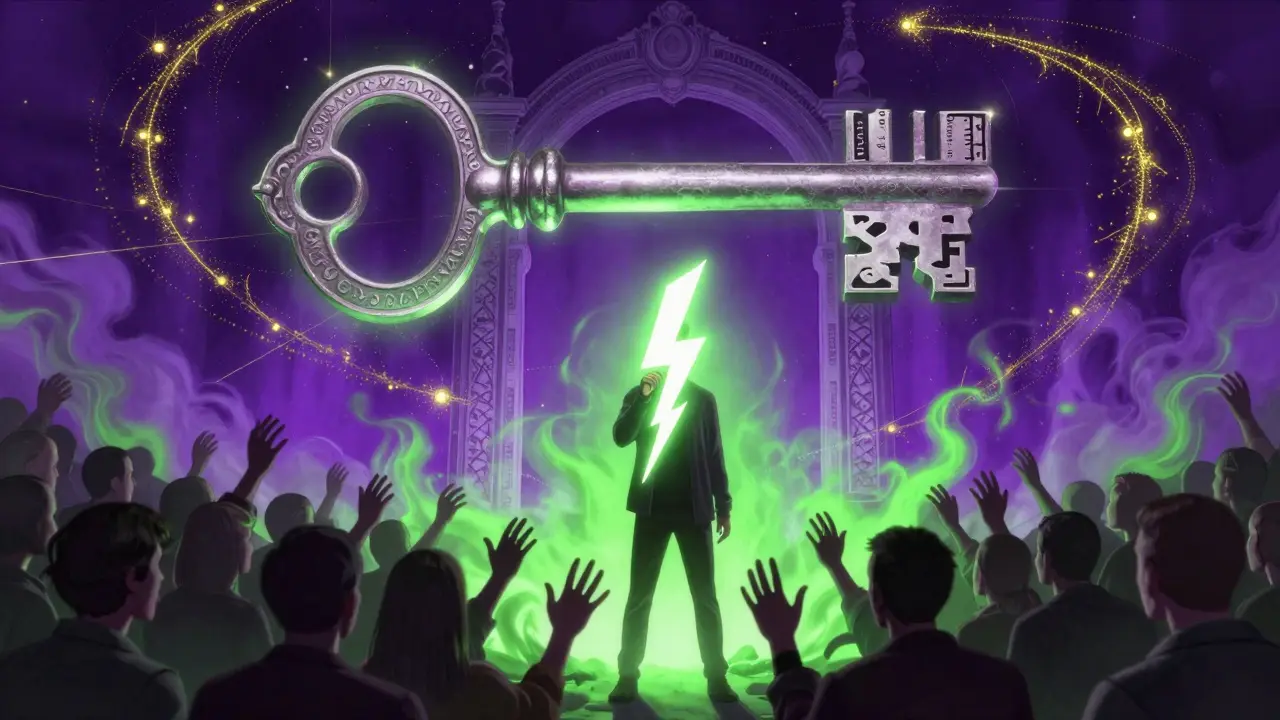
Who owns a Bitcoin wallet? Not a name. Not an email. Not a government ID. The owner is whoever holds the private key. This is where asymmetric cryptography comes in.Every user on a blockchain has two keys: a public key and a private key. Think of the public key like your bank account number - you can give it out freely. Anyone can send Bitcoin to it. But only the person with the matching private key can spend from it. The private key is like a secret signature. It never leaves your device. If you lose it, you lose access. If someone steals it, they own your assets.
When you send cryptocurrency, you don’t just type in an address. You sign the transaction with your private key. This creates a digital signature - a unique mathematical proof that only your key could have generated. The network checks that signature using your public key. If it matches, the transaction is valid. No one else could have signed it. That’s called non-repudiation. You can’t say later, “I didn’t send that.” The math proves you did.
Companies like Ethereum and Bitcoin rely on Elliptic Curve Cryptography (ECC) for this. It’s more efficient than older systems like RSA, giving strong security with smaller key sizes. That’s why mobile wallets and hardware devices can handle it without slowing down.
Why Blockchain Encryption Is Different from Traditional Systems
In traditional banking, your data lives on a server. That server can be hacked, corrupted, or changed by an admin. Cloud storage? Editable. Databases? Backups can be rolled back. But blockchain? Once data is confirmed and added to the chain, it’s permanent.That’s not magic. It’s design. Blockchains combine encryption with decentralization. Instead of one server holding the truth, thousands of computers (nodes) each hold a copy. Every new block is verified by consensus - meaning most nodes must agree it’s valid before it’s added. If someone tries to alter a transaction on their local copy, the rest of the network rejects it. The encryption ensures the data can’t be changed. The decentralization ensures no single point can be compromised to fake the whole ledger.
This makes blockchain encryption ideal for use cases where trust is scarce: supply chains, voting systems, land registries, and financial settlements. You don’t need to trust the other party. You just need to trust the math.
What Can Go Wrong? The Real Risks
Yes, the math is solid. But humans? Not so much.Most blockchain hacks don’t break SHA-256 or ECC. They steal private keys. How? Phishing. Malware. Poorly secured wallets. Reusing passwords. Leaving keys on cloud drives. In 2022, over $2 billion was stolen from crypto projects - and nearly all of it was due to key mismanagement, not algorithmic flaws.
Another big risk? Quantum computing. Right now, quantum computers are still experimental. But if they scale up, they could crack RSA and ECC by solving math problems that take classical computers thousands of years. SHA-256 hashing is more resistant, but not immune. Experts are already working on quantum-resistant algorithms like lattice-based cryptography and hash-based signatures. Some blockchains are starting to test them.
Smart contracts are another weak spot. They run on blockchain, so they’re immutable - but if the code has a bug, the flaw stays forever. The DAO hack in 2016 drained $60 million because of a coding error. Encryption didn’t fail. The logic did.

How Developers Build With Encryption Today
If you’re building a blockchain app, you don’t write encryption from scratch. You use libraries that have been tested for years:- OpenSSL - handles hashing, key generation, and encryption for many blockchains
- Libsodium - modern, easy-to-use crypto library used in Monero and other privacy-focused chains
- Ethereum’s Web3.js - lets developers sign transactions and interact with public/private keys in JavaScript
Best practices? Never store private keys in plain text. Use hardware wallets (like Ledger or Trezor) for large holdings. Enable multi-signature setups for business accounts - requiring 2 or 3 keys to approve a transaction. Regularly audit your code. Even small mistakes can cost millions.
The Future of Blockchain Encryption
The next big leap isn’t just stronger encryption - it’s smarter privacy. Zero-knowledge proofs (ZKPs) are already being used in Zcash and Ethereum’s Layer 2 solutions. They let you prove you own something or made a valid transaction - without revealing any details. Imagine proving you’re over 18 without showing your ID. That’s ZKP.As blockchain moves into healthcare, government, and IoT, encryption will need to adapt. IoT devices have limited power. They need lightweight crypto. Medical records need privacy. ZKPs and homomorphic encryption (which lets you compute on encrypted data) are being tested for these uses.
One thing won’t change: encryption is still the bedrock. Without it, blockchain is just a shared spreadsheet. With it, it’s a new kind of trust engine.
Is blockchain encryption the same as regular encryption?
No. Regular encryption often uses symmetric keys - one key to lock and unlock data. Blockchain uses asymmetric encryption: a public key to verify and a private key to sign. It also combines this with cryptographic hashing to create an immutable chain. The goal isn’t just to hide data - it’s to prove it hasn’t been changed since it was added.
Can blockchain be hacked?
The blockchain itself - the chain of encrypted blocks - has never been hacked. But exchanges, wallets, and smart contracts have. If someone steals your private key, they can drain your wallet. If a smart contract has a bug, attackers can exploit it. The encryption holds. The human layer often doesn’t.
What’s the role of SHA-256 in blockchain?
SHA-256 is the hash function used by Bitcoin and many other blockchains. It turns every block’s data into a unique 64-character fingerprint. It also links each block to the one before it. If even one byte changes, the hash changes completely. This makes tampering detectable and nearly impossible to reverse.
Are quantum computers a threat to blockchain?
Yes - but not immediately. Quantum computers could break RSA and ECC, which are used for key generation. That means private keys could be guessed. However, SHA-256 hashing is more resistant. The industry is already developing quantum-resistant algorithms, and some blockchains are preparing to upgrade. It’s a future risk, not a current one.
Do I need to understand cryptography to use blockchain?
No. Wallets and apps handle the encryption for you. But you do need to understand key management. Losing your private key means losing your assets. Never share it. Never store it online. Use a hardware wallet for serious holdings. Your safety depends on how you treat your keys - not on how much you know about hashing.
anshika garg
March 15, 2026 AT 18:51It’s wild to think that all this trust - in money, in contracts, in identity - is built on math no one fully understands. I sit here sipping chai and just… marvel. Like, we’re living in a poem written by physicists and coders. The fact that a 64-character hash can outlast empires? That’s not tech. That’s magic with a textbook.
And yet, we treat it like a vending machine. You put in your keys, you get your Bitcoin, and you never ask how the universe holds it together. We’re all just passengers on a spaceship made of prime numbers, and half of us don’t even know the windows are there.
I think we need to teach this in schools. Not as coding. As philosophy. Because this isn’t just about security. It’s about what we choose to believe when no one’s watching.
SHA-256 doesn’t care if you’re rich or poor. It doesn’t care if you’re from Mumbai or Milwaukee. It just… holds the truth. And that’s the most beautiful thing I’ve seen in this decade.
Also, I cried when I first understood public/private keys. Not because it was hard. Because it was so… fair.
Someone should make a symphony out of blockchain hashes. I’d listen to it on loop.
Anyway. I’m gonna go hug my hardware wallet now. It’s the only thing in my life that never lied to me.
Bruce Doucette
March 17, 2026 AT 02:33Also, SHA-256? Pfft. I’ve seen 12-year-olds crack it with a Raspberry Pi and a YouTube tutorial. 😏
Marie Vernon
March 17, 2026 AT 19:10Ross McLeod
March 17, 2026 AT 21:40The fundamental flaw in most blockchain narratives is the conflation of immutability with invincibility. Yes, altering a single block on a live, decentralized chain is computationally infeasible - but that’s not the same as saying the system is secure. Security is not merely a function of cryptographic primitives; it is a function of human behavior, economic incentives, and institutional oversight - none of which are addressed by SHA-256 or ECC.
Consider this: if 51% of the network’s hashing power is controlled by a single entity - which has happened multiple times - then immutability is a fiction. The math holds. The economics do not. And since economic actors are the ones who validate, mine, and maintain the network, the entire architecture relies on a fragile equilibrium of self-interest, not absolute truth.
Furthermore, the notion that private keys are ‘unbreakable’ ignores the fact that humans are not cryptographic primitives. We reuse passwords. We store keys in Dropbox. We click phishing links. We write them on Post-its. We do this because we are biological organisms with cognitive biases, not machines. The encryption works. The user doesn’t. And that’s the vulnerability.
Also, the claim that ‘blockchain is tamper-proof’ is misleading. Tampering is not the issue. The issue is *reversibility*. If a transaction is made in error - say, sending ETH to a dead address - there is no recourse. No customer service. No chargeback. No judge. The immutability that protects against fraud also protects against human error. That’s not a feature. It’s a design flaw dressed up as virtue.
So yes, the math is elegant. But the system is brittle. And we’re all pretending it’s not.
rajan gupta
March 18, 2026 AT 08:09Blockchain is like a cosmic tattoo. Once you get it, you can’t remove it. No matter how much you regret it. No matter how drunk you were when you sent that 5 ETH to a random address. The universe remembers. The hash remembers. Your ex remembers. Your mom remembers.
And that’s beautiful. And terrifying.
Every time I send crypto, I feel like I’m signing a blood pact with the blockchain gods. 🤵♂️🪙
Also, I think SHA-256 is secretly sentient. I swear it judges me when I mistype my password. It’s like… ‘Really? You thought ‘password123’ was a good idea?’ 😭
Quantum computing? Nah. I’m more scared of my cat walking on my keyboard and sending all my coins to a burner wallet. That’s real life. Not sci-fi.
Billy Karna
March 19, 2026 AT 00:05There’s a lot of confusion around what blockchain encryption actually does. People think it encrypts data like AES or RSA does - but it doesn’t. It doesn’t hide the content. It verifies it. That’s the critical difference.
Transactions on Bitcoin are fully public. Anyone can see them. The encryption isn’t there to hide the amount or the addresses - it’s there to prove you own the private key that controls the output. The public key is derived from the private key mathematically, and the signature proves you have the private key without revealing it. That’s the genius.
And yes, SHA-256 is used for hashing blocks, but also for mining. The proof-of-work puzzle is literally: find an input that hashes to a value below a target. That’s why mining needs so much power - it’s brute-forcing a hash. Not breaking encryption. Just trying trillions of combinations.
Also, ECC is used because it gives the same security as RSA with 256-bit keys instead of 3072-bit. That’s why mobile wallets work. Smaller keys = less memory, less bandwidth. Efficiency matters.
And the biggest mistake people make? Thinking that because the chain is immutable, the system is secure. No. The chain is immutable. The wallet isn’t. The app isn’t. The exchange isn’t. The human is the weakest link - always has been, always will be.
Best practice? Cold storage. Multi-sig. No cloud backups. No screenshots. No sharing. And if you don’t understand how to generate a key pair? Don’t use crypto. Period.
Cheri Farnsworth
March 20, 2026 AT 23:04Gene Inoue
March 22, 2026 AT 02:42Ricky Fairlamb
March 23, 2026 AT 23:50It is imperative to clarify a fundamental misconception perpetuated by the mainstream media: blockchain does not ‘encrypt’ data. It cryptographically hashes and signs it. Encryption implies confidentiality; hashing implies integrity. These are not synonymous. The conflation of these terms is not merely inaccurate - it is epistemologically dangerous.
Furthermore, the notion that ‘no central authority’ implies freedom is a fallacy. Decentralized networks are governed by protocol rules - rules written by developers, enforced by miners, and subject to hard forks. Who wrote the Bitcoin whitepaper? Who controls the Bitcoin Improvement Proposals? Who has the power to change consensus? The answer is not ‘no one.’ It is a small, elite cadre of engineers and venture capitalists.
And let us not forget: the private key is not ‘yours’ if it is generated by a wallet app you downloaded from an unverified website. The supply chain is compromised. The trust model is broken. You are not sovereign. You are a user. And you are being sold a myth.
Quantum computing is not a ‘future risk.’ It is an inevitability. And the industry’s current reliance on ECC is a ticking time bomb. The NIST standardization process for post-quantum cryptography has been underway for years - yet most blockchains remain inert. This is not innovation. It is negligence.
Arlene Miles
March 25, 2026 AT 21:09You know what? I’m so proud of how far we’ve come. I remember when people thought blockchain was just for Bitcoin bros. Now? We’re talking about land registries in Kenya, voting in Estonia, medical records that can’t be lost. This isn’t just tech - it’s a new social contract.
And yes, people mess up their keys. But that’s why we need education. Not fear. Not shame. We need to teach this like we teach driving. You don’t just hand someone a car and say ‘good luck.’ You show them the brakes. The mirrors. The rules.
I’ve helped three friends set up hardware wallets. One of them sent her first ETH to her mom. She cried. Not because it worked - but because she finally felt in control. That’s what this is. Not money. Agency.
So yes, quantum computers might come. Smart contracts might glitch. But the idea? The idea that we can build systems where trust isn’t owned by corporations? That’s already here. And it’s beautiful.
Don’t give up. Don’t get cynical. Help someone else understand. That’s the real crypto.
Jessica Beadle
March 27, 2026 AT 16:43Tony Weaver
March 28, 2026 AT 11:10Let’s be honest - this post reads like a TED Talk written by someone who just finished their first crypto course. The tone is reverent. The analysis is surface-level. The risks are mentioned as footnotes.
‘The math is solid’ - yes. So was the Lehman Brothers balance sheet. The system isn’t broken because the encryption failed. It’s broken because the incentives are misaligned. Miners prioritize profit. Developers prioritize features. Users prioritize convenience. And the result? A $2 billion heist in 2022 - not because of SHA-256, but because someone left their seed phrase in a Google Doc.
Also, zero-knowledge proofs? They’re brilliant. But they’re not magic. They add complexity. They require trust in the proving circuit. And they’re not deployed at scale. Not even close.
This isn’t the future. It’s a very expensive beta test. And we’re all the guinea pigs.
Patty Atima
March 30, 2026 AT 03:12Lucy de Gruchy
March 30, 2026 AT 10:04Lauren J. Walter
March 30, 2026 AT 21:37Carol Lueneburg
March 31, 2026 AT 06:51I just want to say - thank you. For writing this so clearly. I’m 62 and I thought crypto was just a scam. But after reading this? I get it. Not the math. But the *why*. It’s about giving people control. Especially people who’ve been left out. My granddaughter in Guatemala? She can get paid for her art without a bank. That’s not tech. That’s dignity.
I don’t need to know how SHA-256 works. But I need to know that someone like me can still be part of this. And you made me feel like I can.
Thank you. Really.
❤️
Brenda White
April 2, 2026 AT 03:44Tobias Wriedt
April 3, 2026 AT 06:40anshika garg
April 4, 2026 AT 01:39Wow. I didn’t expect this thread to turn into a philosophy circle. But here we are.
To the person who said ‘it’s just a password manager’ - maybe. But what if the password manager can’t be hacked? What if it’s not stored on a server? What if it’s held by you - and only you - in a metal box, buried in your backyard?
That’s not a password manager. That’s sovereignty.
And to the one who said ‘quantum computing will kill it’ - maybe. But the same thing was said about RSA in the 90s. And we adapted. We always do.
Blockchain isn’t perfect. But it’s the first time in human history that a system of trust was built without a single point of control. That’s worth fighting for.
Even if we mess up. Even if we cry. Even if we send ETH to the wrong address.
We’re learning. Together.
And that’s the most human thing of all.
Billy Karna
April 4, 2026 AT 11:44Exactly. The real innovation isn’t the encryption. It’s the *incentive structure*. Miners get rewarded for maintaining the chain. Validators are penalized for lying. Nodes replicate data to earn trust. It’s game theory baked into code.
And that’s why it survives - not because of SHA-256, but because it’s economically rational to be honest.
That’s the real breakthrough. Not the math. The economics.