What is Forta (FORT) Crypto? The Web3 Security Network Explained
Imagine you are running a high-stakes casino. You have thousands of players, millions of dollars moving around every second, and a dozen different ways someone could try to cheat the house. Now, imagine your security team only checks the cameras once a day. By the time they spot a problem, the money is gone. That is essentially how most blockchains operate without real-time monitoring. Forta is a decentralized network designed to fix this by acting as an always-on security camera for Web3. It doesn't just record transactions; it analyzes them in real-time to detect threats before they cause massive losses.
If you've seen the ticker FORT on exchanges like Bitunix or CoinGecko, you might be wondering what exactly this token does. Is it another meme coin with no utility? Or is it serious infrastructure? As of September 2026, Forta trades at a modest price, hovering around $0.015, but its role in the ecosystem is far more critical than its market cap suggests. Let's break down how this AI-powered monitoring layer works, why major investors like Coinbase and a16z backed it, and whether holding FORT makes sense for your portfolio.
The Core Problem: Why Blockchains Need Eyes
Smart contracts are immutable once deployed. If there's a bug, you can't just patch it like a website update. Traditional security relies on audits-experts reviewing code before launch. But audits are snapshots in time. They don't catch dynamic attacks that happen during execution, such as flash loan exploits or governance manipulation. This is where Forta steps in. It functions as a decentralized detection network, scanning every block across multiple chains like Ethereum, Polygon, and Arbitrum.
Think of Forta not as a single firewall, but as a swarm of independent sensors. These sensors, called "detection bots," run on nodes operated by community members. Each bot looks for specific patterns. One bot might watch for sudden large withdrawals from a DeFi pool. Another might flag a new smart contract that mimics a popular project but has slightly different logic. When these bots trigger alerts, the data is stored publicly on IPFS, creating a transparent history of potential threats. This allows protocols to react instantly rather than cleaning up the mess days later.
How Forta Works: Bots, Nodes, and Alerts
The architecture of Forta is surprisingly elegant in its simplicity. It relies on two main components: Scan Nodes and Detection Bots. Scan nodes are the hardware and software infrastructure that processes blockchain data. Operators run these nodes to earn rewards, but they must stake FORT tokens to participate. This staking mechanism ensures that node operators have skin in the game-if they lie about the data or go offline frequently, their stake gets slashed.
Detection bots are the brains of the operation. Written by developers and security experts, these scripts define what constitutes a threat. For example, a bot written for Uniswap might look for liquidity pools where the price diverges significantly from external oracles. A bot for DAOs might flag unusual voting patterns that suggest a hostile takeover attempt. Because anyone can write a bot, the coverage expands rapidly as new types of scams emerge. However, quality control is vital. To prevent spam, bot developers also stake FORT. High-quality bots get more visibility and rewards, while low-quality ones fade into obscurity.
| Feature | Traditional Audit | Forta Network |
|---|---|---|
| Timing | Pre-deployment snapshot | Real-time, continuous monitoring |
| Coverage | Specific codebase only | Cross-chain, protocol-agnostic |
| Response Time | Days to weeks for fixes | Seconds to minutes for alerts |
| Decentralization | Centralized firm | Community-run nodes and bots |

The Role of the FORT Token
Tokens in crypto often serve one purpose: speculation. FORT serves several functional roles within the network's economy. First, it acts as collateral. Both node operators and bot developers must lock up FORT to use the network. This aligns incentives; if you provide bad data, you lose money. Second, FORT is used for payments. Projects that consume Forta's alert data pay subscription fees in FORT. For instance, a standard plan costs 250 FORT per month. At current prices, that's roughly $4, making it an affordable insurance policy for mid-sized DeFi projects.
Governance is the third pillar. Holders of FORT can vote on protocol upgrades, treasury allocations, and fee structures. Since the total supply is fixed at 1 billion tokens, scarcity plays a role here too. As of late 2026, about 62.5% of the supply is circulating, with the remainder held in a community treasury. This treasury funds grants for new bot developers and marketing efforts to drive adoption. The fully unlocked supply means there is no inflationary pressure from new emissions, which distinguishes it from many newer Layer 1 tokens.
Forta Firewall: Moving Beyond Monitoring
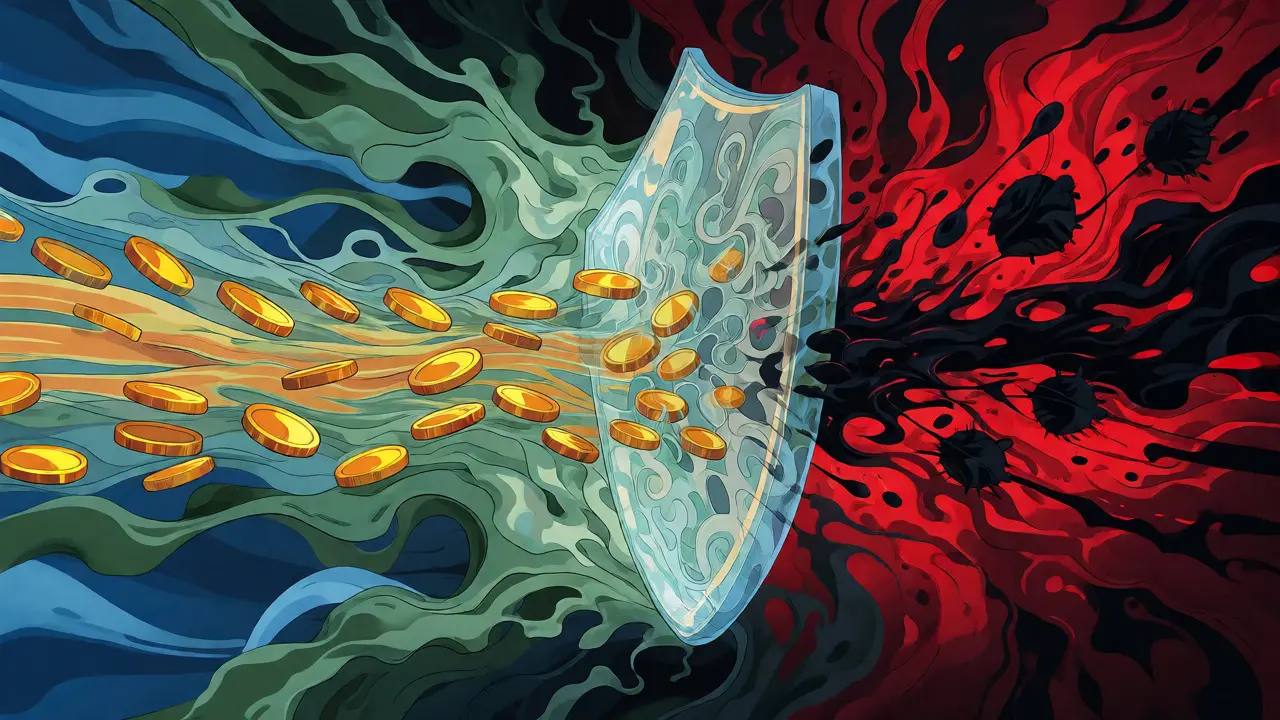
Monitoring is great, but prevention is better. In recent updates, Forta introduced Forta Firewall. This product integrates directly into transaction pipelines. Before a transaction executes on-chain, the Firewall screens it against known malicious addresses, sanctions lists, and anomalous behavior patterns. If a red flag appears, the transaction can be blocked or flagged for review.
This shift from passive observation to active filtering positions Forta as a compliance tool as much as a security tool. With increasing regulatory scrutiny on crypto, especially regarding anti-money laundering (AML) checks, having an automated way to screen wallet interactions is invaluable. Major exchanges and institutional custodians are increasingly looking for solutions like this to ensure they aren't interacting with sanctioned entities or tainted assets.
Market Position and Risks
Despite backing from heavyweights like OpenZeppelin, Coinbase Ventures, and Andreessen Horowitz (a16z), FORT remains a small-cap asset. Trading around $0.015 with a market cap near $10 million, it flies under the radar compared to giants like Chainlink or MakerDAO. This low valuation presents both opportunity and risk. On one hand, if Forta becomes the standard for Web3 security, the upside is significant. On the other, liquidity can be thin, meaning large buys or sells might move the price disproportionately.
Another challenge is competition. Centralized services like Nansen or Dune Analytics offer dashboards, but they lack the decentralized, trustless nature of Forta. Other decentralized networks exist, but few have achieved the same level of developer adoption for custom bots. The network effect is crucial here: the more bots available, the more valuable the network becomes to users, attracting more users, which in turn attracts more bot developers. Forta is currently in the early stages of this flywheel.
Getting Started with Forta
If you want to dive deeper, you don't need to buy tokens immediately. Developers can access the Forta Explorer to view historical alerts and see which bots are most active. For those wanting to contribute, writing a simple detection bot requires knowledge of JavaScript or Python and familiarity with EVM-compatible chains. The documentation, last updated in September 2026, provides clear guides on setting up local test environments.
For investors, due diligence involves checking the source of the token. Be careful not to confuse Forta (FORT) with Fortress (also sometimes abbreviated FORT in older contexts), a lending protocol. Always verify the contract address: 0x4154...ec29 on Ethereum. Liquidity is primarily found on centralized exchanges like Bitunix, though DEX availability varies. Given the volatility of small-cap crypto assets, treating FORT as a high-risk, high-reward infrastructure bet is a prudent strategy.
Is Forta a blockchain?
No, Forta is not a Layer 1 blockchain itself. It is a decentralized monitoring network that operates on top of existing blockchains like Ethereum, Polygon, and Arbitrum. It uses its own chain for governance and settlement, but its primary function is analyzing data from other chains.
Why do I need to stake FORT to run a node?
Staking creates economic security. If a node operator submits false data or fails to perform duties, their staked FORT can be slashed (penalized). This ensures that operators are financially motivated to maintain accurate and reliable monitoring services.
Can anyone create a detection bot on Forta?
Yes, Forta is permissionless. Any developer can write and deploy a detection bot. However, bots must be registered and typically require staking FORT to bind them to the network, which helps filter out spam and low-quality submissions.
What is the difference between Forta and traditional smart contract audits?
Audits are static reviews performed before deployment. Forta provides dynamic, real-time monitoring after deployment. Audits check for known vulnerabilities in code structure, while Forta detects unexpected behaviors and live attacks as they happen.
Where can I buy FORT tokens?
FORT is listed on several centralized exchanges, with Bitunix being a prominent venue. Availability on decentralized exchanges may vary depending on the chain (Ethereum or Polygon). Always verify the correct contract address to avoid confusion with similarly named tokens.