What is Karmaverse (KNOT)? A Deep Dive into the GameFi Metaverse
Imagine a world where you don't just play a game to pass the time, but you actually own the assets you earn and can trade them for real-world value. That is the core promise of Karmaverse is a blockchain-based GameFi metaverse platform that integrates multiple game worlds to create a sustainable play-to-earn and play-for-fun ecosystem. It isn't just one game, but a hub of different realities, from zombie apocalypses to cyberpunk cities, all linked by a shared economic system.
If you've followed the crypto space, you know that many "play-to-earn" projects crashed because they relied on endless new players to pay old ones. Karmaverse tries to fix this by focusing on high-quality gameplay first, backed by a team that previously built some of the top 10 strategy logic games (SLG) in mobile history. They aren't just crypto enthusiasts; they are professional game developers. This is a crucial distinction because a game that is actually fun to play is more likely to survive a market crash than a glorified digital spreadsheet.
Key Takeaways: KNOT at a Glance
- The Ecosystem: A multi-world metaverse featuring titles like Karmaverse Zombie and Cyberpunk worlds.
- The Tech: Built on the Polygon network for fast, cheap transactions.
- The Tokens: Uses a dual-token system consisting of KNOT (governance) and SERUM (utility).
- The Goal: Balancing "play-for-fun" with "play-to-earn" to avoid the hyperinflation seen in early GameFi projects.
How the KNOT Token Actually Works
At the center of this universe is the KNOT token. Unlike many coins that are just for speculation, KNOT has a specific job within the games. It's the "heavy lifter" currency. If you want to perform major upgrades, cure zombies in the flagship game, or enter high-stakes Player vs Player (PVP) battles, you'll need KNOT.
The supply is capped at 210 million tokens, which is a design choice meant to prevent the coin from becoming worthless through over-printing. However, the way these tokens move is what matters. The team set up a system where a huge chunk of the supply-about 29%-is dedicated to play-to-earn rewards, and another 25.2% goes toward staking. This means the project is heavily invested in rewarding people who actually spend time in the game and those who lock up their tokens to support the network.
But KNOT isn't the only currency. To stop the economy from crashing, Karmaverse uses a secondary token called SERUM. Think of KNOT as the gold and SERUM as the pocket change. You use SERUM for daily tasks and minor challenges. This two-tier system prevents the primary governance token from being dumped on the market every time a player finishes a simple daily quest.
The Technical Backbone: Why Polygon?
If you've ever tried to buy an NFT on the main Ethereum network during a rush, you know the "gas fees" can sometimes cost more than the item itself. Karmaverse avoids this by building on Polygon, a Layer 2 scaling solution. By using Polygon, the platform ensures that moving a sword from one player to another or claiming a reward doesn't cost a fortune in transaction fees.
This technical choice allows for a more fluid experience. In a strategy game, you can't have a 10-minute wait for a transaction to clear while your opponent is attacking your base. The speed of the Polygon network makes the gaming experience feel more like a traditional app and less like a slow blockchain experiment. Additionally, it gives the project access to the Polygon Studios ecosystem, providing a level of marketing and developer support that standalone chains often lack.
Market Reality: The Rise and Fall of KNOT
It's important to be honest about the numbers here. Like many GameFi projects that launched during the 2021-2022 hype cycle, KNOT has had a rocky ride. After its IEO launch at $0.50, it shot up to an all-time high of $0.742 in April 2022. For a few days, it looked like a rocket ship. But then, the broader crypto market shifted, and the "play-to-earn" bubble burst.
| Metric | Peak (April 2022) | Recent (2025/2026) |
|---|---|---|
| Price | $0.742 | ~$0.00015 - $0.0023 (Variable) |
| Market Cap | $4.18 Million | ~$11.90 Thousand |
| Circulating Supply | Low | ~5.64 Million KNOT |
Looking at these numbers, it's clear that the token has struggled. You'll see wildly different prices across exchanges like Binance and Coinbase, which usually means liquidity is low. When there aren't many people buying and selling, a single large trade can swing the price drastically. The current market value is down over 99% from its peak, which is a cautionary tale about the volatility of early-stage GameFi tokens.
Gameplay and the "Fun" Factor
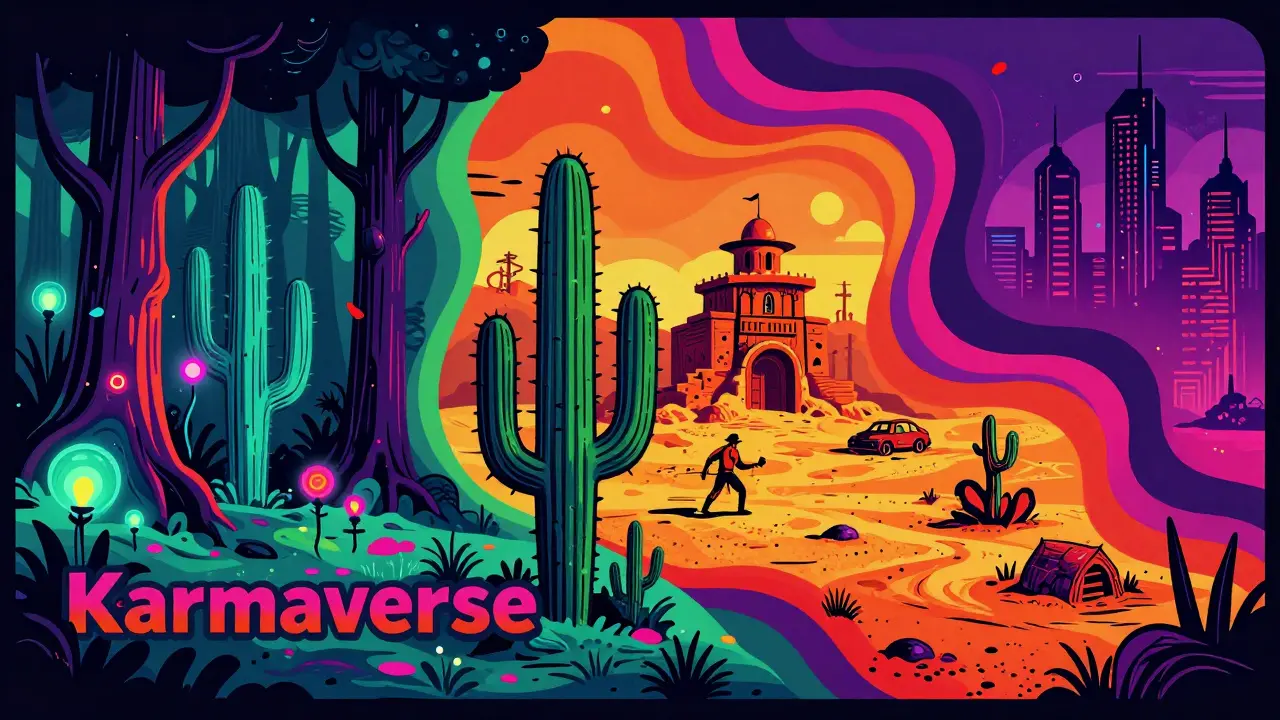
The project isn't just about the coin; it's about the worlds. The flagship is Karmaverse Zombie, a large-scale strategy game. The goal here is to blend the addictive nature of mobile strategy games with the ownership of Web3. Instead of spending money on "gems" that only the game studio owns, you use KNOT to upgrade your heroes.
Beyond zombies, the ecosystem includes:
- Fantasy World: Classic magic and adventure mechanics.
- Old West: A frontier-style setting with its own economy.
- Cyberpunk: A high-tech, low-life future setting.
The brilliance of this approach is that if one game world fails to attract players, the others can still sustain the ecosystem. It's a diversified portfolio of games rather than a single bet. By focusing on "play-for-fun," they hope to attract gamers who don't care about crypto, which is the only way these platforms can actually scale in the long run.
The Dual-Token Economic Model
To understand if KNOT is a viable asset, you have to understand the Output, Holding, and Consumption model. This is how the developers try to stop the token from crashing.
- Output: Tokens are generated through gameplay and staking rewards. If there's too much output, the price drops.
- Holding: Players are encouraged to keep their KNOT through staking and long-term hero upgrades. This removes tokens from the active selling market.
- Consumption: The game requires players to "spend" or burn tokens for essential actions. This creates a constant demand that offsets the rewards being paid out.
The project uses a probabilistic algorithm to adjust the SERUM supply dynamically. This means the game can essentially "feel" when the economy is getting too inflated and automatically tighten the belt, which is much smarter than a human team trying to manually adjust rewards every week.
Potential Risks and Red Flags
No crypto analysis is complete without looking at the dangers. The most glaring issue for KNOT is its Fully Diluted Valuation (FDV). If all 210 million tokens were to enter circulation today at current prices, the total value of the project would be very small compared to its launch goals. This means there is a significant risk of price dilution if the reserves are released too quickly.
Furthermore, the trading volume has become very thin. When a token has low volume, it's harder to exit a position without crashing the price further. While the team's pedigree in mobile gaming is a huge plus, a great game doesn't always equal a great token. Many successful games have zero cryptocurrency, and some of the most failed games had great tokens.
Is KNOT a safe investment?
Like all low-cap GameFi tokens, KNOT carries high risk. It has experienced a significant price drop from its all-time high and currently suffers from low liquidity across some exchanges. It is considered a high-volatility asset.
What is the difference between KNOT and SERUM?
KNOT is the primary governance and high-value token used for major upgrades and PVP battles. SERUM is a utility token used for daily tasks and common in-game activities to prevent the inflation of KNOT.
Which blockchain does Karmaverse use?
Karmaverse is built on the Polygon network, which allows for faster transaction speeds and significantly lower gas fees than the Ethereum mainnet.
How do I earn KNOT tokens?
You can earn KNOT through three main ways: participating in special in-game events, winning competitive PVP gameplay, or purchasing them from supported cryptocurrency exchanges.
Who is behind the Karmaverse project?
The project was founded by a development team with a track record of creating top 10 strategy logic games (SLG) in the mobile gaming industry, bringing professional game design expertise to the Web3 space.
Next Steps for Users
If you are a gamer, the best way to approach Karmaverse is to actually play the games. Focus on the fun elements and see if the play-to-earn mechanics feel sustainable. Don't treat it as a financial instrument first; treat it as a game that happens to have a token.
If you are a trader, be extremely careful with liquidity. Check the volume on the specific exchange you are using. Because the price varies significantly between platforms, you may find gaps in pricing, but these often come with the risk of not being able to sell your tokens quickly (slippage).
For those interested in staking, check the current reward rates against the price trend. Staking only makes sense if the value of the rewards exceeds the potential loss in the token's price during the lock-up period.
Miranda Jamieson
April 21, 2026 AT 01:54Another "innovative" GameFi project that's basically a dumpster fire. The price is down 99% and you're still trying to sell the "dual-token" fairy tale. Give me a break. 🙄
Ellie Drews
April 21, 2026 AT 21:28It is definitely a risky venture, but the idea of a multi-world hub is actually quite creative. Hope the devs can pull through!
Benjamin Forg
April 23, 2026 AT 08:01its all a trap to lock your liquidity while the whales dump on your head the polygon chain is just a facade for more control
Jason M
April 24, 2026 AT 07:21LISTEN UP EVERYONE! If you are looking to get into GameFi, the most CRITICAL thing is the team's pedigree! The fact that these guys built top 10 SLG games is an absolute GAME CHANGER! Don't let the short-term price action blind you to the long-term structural potential here! Let's dive deep into the mechanics and learn how to actually play the game instead of just staring at a candle chart! 🚀🚀🚀
Kyle Bush
April 25, 2026 AT 11:30USA all the way 🇺🇸!! This is how we build the future of gaming! Smash those zombies! 💥🧟♂️🔥
Larry Yang
April 26, 2026 AT 18:19The tokenomics are just... mediocre. I mean, the dual-token system is a tired trope at this point. it barely masks the systemic inflation. basically just another copy-paste project with a slightly better skin.
Keith Garcia
April 28, 2026 AT 00:59A truly pedestrian analysis of what is essentially a fiscal wasteland. The audacity to call this a "deep dive" when the price action suggests a plunge into the abyss is simply quaint. 💅✨
Doc Coyle
April 29, 2026 AT 06:01It is wrong to gamble like this. People lose their homes on these coins. We should focus on real work, not digital swords.
Eric Raines
April 29, 2026 AT 07:20I've seen a dozen projects like this and they all say they're "fixing" play-to-earn. Spoiler alert: they don't. I'm just here to watch the crash because it's honestly entertaining at this point.
jill huyo-a
April 29, 2026 AT 08:56I'm curious about how the probabilistic algorithm for SERUM actually works in practice. It seems like a great way to keep things stable if it's tuned correctly.
debashish sahu
April 30, 2026 AT 09:37The integration of multiple genres is an interesting approach to user retention.
Charlie Queen
May 1, 2026 AT 23:41Love seeing more variety in the metaverse! 🌈 The cyberpunk vibe is always a winner! ⚡️
Findlay Duncan Lyon
May 2, 2026 AT 05:44Properly executed SLGs are rare. If they nail the loop, they might actually survive.
Robert Mosolygo
May 3, 2026 AT 04:28The FDV is a ticking time bomb. Once those reserves hit the market, the remaining holders will be liquidated in seconds. It's a mathematical certainty that this is designed to exit-liquidity the retail traders. They use Polygon to hide the fees while they orchestrate the collapse behind the scenes. Absolute madness that anyone still thinks this is an investment rather than a donation to the developers.
Sara Ellis
May 5, 2026 AT 00:06money is just a number anyway
Lisa Camp
May 6, 2026 AT 18:25STOP BEING AFRAID AND JUST BUY THE DIP! WE ARE GOING TO THE MOON! 🚀🚀🚀
Gary Lingrel
May 7, 2026 AT 14:10imagine thinking a "dual token" saves a project lol... its just more ways to lose money
typical crypto cope
Guy Bianco
May 8, 2026 AT 13:38I believe it is important to approach these assets with caution and a long-term perspective. :)
Paige Raulerson
May 8, 2026 AT 19:58I barely read the whole thing but honestly, who even cares about "zombie strategy" games in 2026? It's so last decade. The aesthetic is just... tired. 🥱