What Is Liquidity Mining in DeFi? A Beginner’s Guide to Earning Passive Income
Imagine putting your crypto to work so it earns you money while you sleep. That is the promise of Liquidity Mining, a core mechanism in decentralized finance (DeFi) that rewards users for providing trading liquidity to exchanges. But unlike traditional bank deposits, this process carries unique risks and requires a bit more hands-on management. If you are looking to understand how to generate passive income with your digital assets without selling them, you need to know exactly how these pools function, what you stand to gain, and where things can go wrong.
How Liquidity Mining Actually Works
To grasp liquidity mining, you first need to understand the problem it solves. Traditional stock exchanges rely on market makers-large firms that buy and sell shares to keep prices stable. In the world of blockchain, there is no central authority to do this job. Instead, we use Automated Market Makers (AMMs). These are smart contracts that hold pairs of tokens, like ETH and USDC, allowing traders to swap one for the other instantly.
But AMMs need fuel. They need actual tokens sitting in the pool to facilitate trades. This is where you come in. When you participate in liquidity mining, you deposit two assets of equal value into a liquidity pool. For example, if Ethereum is trading at $3,000, you might deposit $1,500 worth of ETH and $1,500 worth of USDC. The smart contract then issues you LP tokens. Think of these as digital receipts proving your share of the pool.
As other users trade against your pool, they pay fees. These fees accumulate in the pool. Because you hold the LP tokens, you are entitled to a portion of those fees proportional to your stake. Many protocols also distribute their native governance tokens as extra rewards to incentivize participation. This combination of trading fees and token rewards is what makes liquidity mining attractive.
Liquidity Mining vs. Staking and Yield Farming
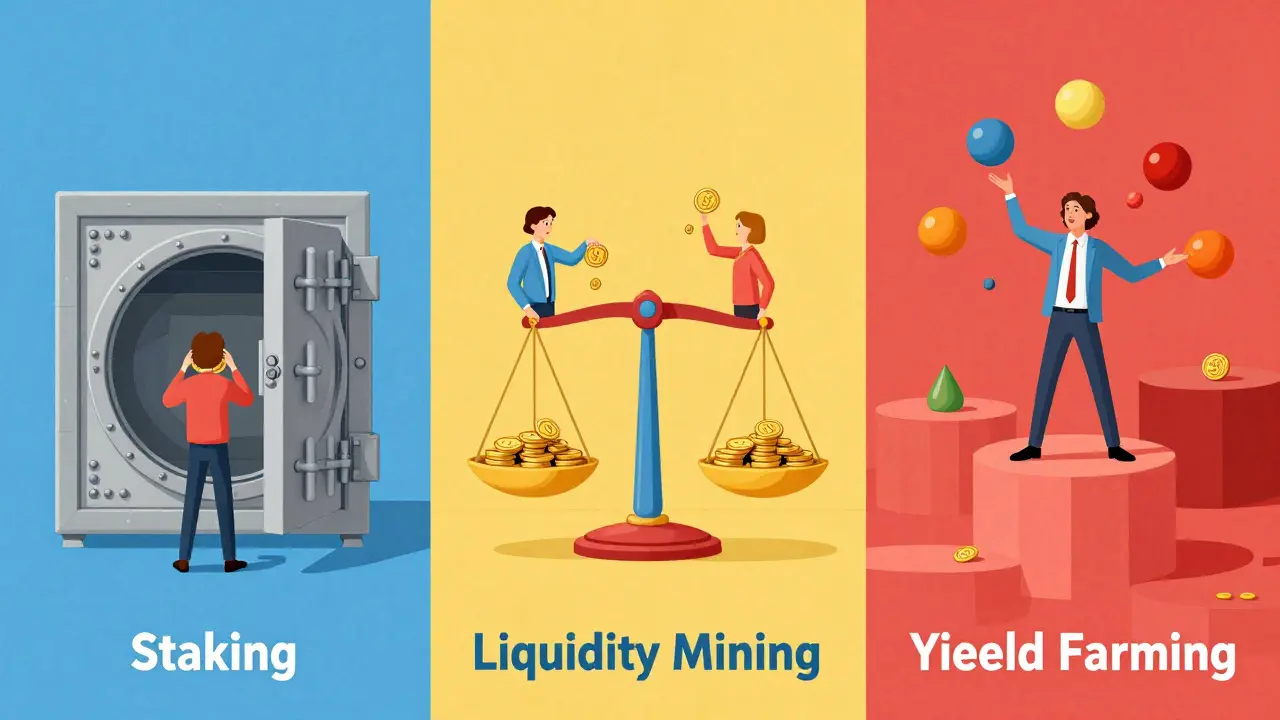
It is easy to get confused by the jargon in DeFi. You will hear terms like staking, yield farming, and liquidity mining used almost interchangeably, but they are distinct concepts. Understanding the difference helps you choose the right strategy for your risk tolerance.
| Mechanism | Primary Action | Risk Level | Reward Source |
|---|---|---|---|
| Staking | Locking coins to secure a network | Low to Medium | Block rewards / transaction fees |
| Liquidity Mining | Providing pairs to a DEX pool | Medium to High | Trading fees + protocol tokens |
| Yield Farming | Complex multi-protocol strategies | High | Incentives from multiple protocols |
Staking is generally simpler. You lock up a single asset, like SOL or DOT, to help validate transactions on a Proof-of-Stake network. Your main risk is the price dropping. Liquidity mining is different because you are exposing yourself to impermanent loss. Yield farming is essentially an advanced version of liquidity mining where you move your LP tokens between different protocols to chase higher returns, adding layers of complexity and smart contract risk.
The Hidden Danger: Impermanent Loss
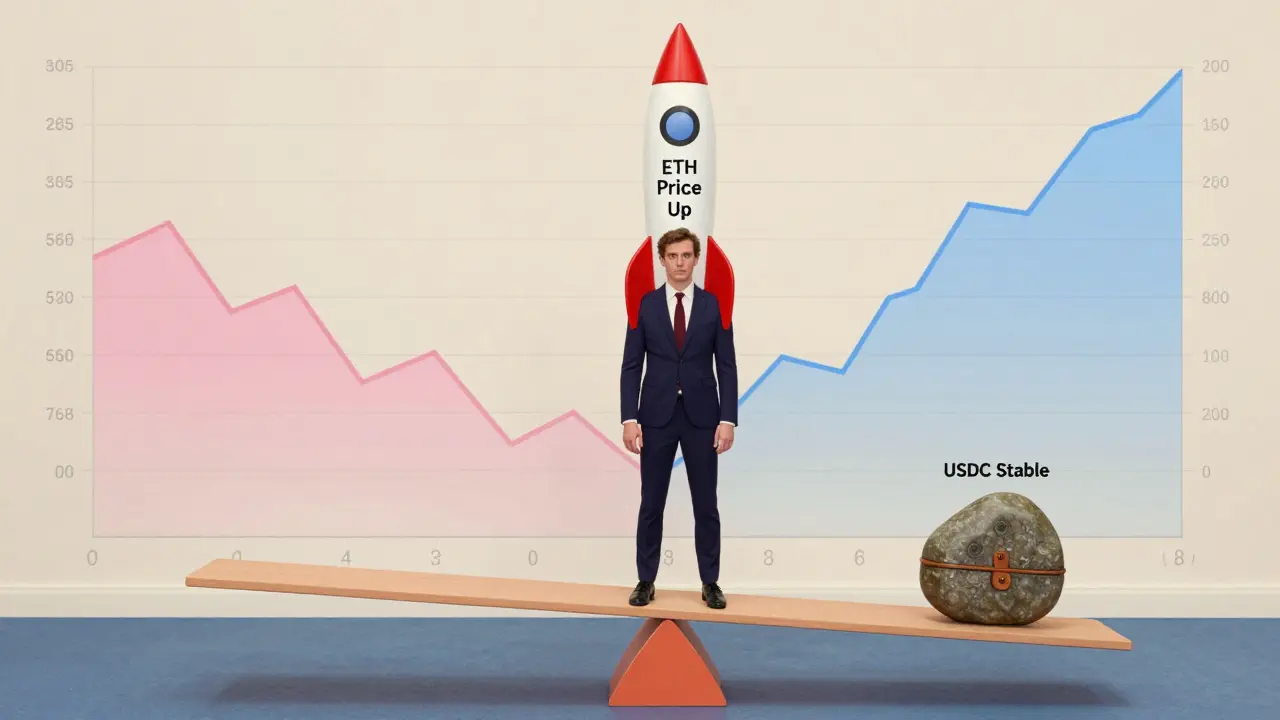
If there is one thing that keeps liquidity providers awake at night, it is impermanent loss. This term sounds scary, but it is just a mathematical reality of how automated market makers work. It occurs when the price of the tokens in your pool changes relative to each other.
Let’s say you deposit ETH and USDC when ETH is $2,000. If ETH skyrockets to $4,000, the AMM algorithm will automatically sell some of your ETH for USDC to maintain the pool’s balance. Meanwhile, if you had simply held the ETH in your wallet, you would have doubled its value. By being in the pool, you missed out on that full upside. Conversely, if ETH crashes, the pool buys more ETH, which might look good, but you still underperform compared to holding the winning asset.
This "loss" is only impermanent as long as you stay in the pool. If you withdraw, the loss becomes permanent. However, if the trading fees and token rewards you earn exceed the value lost to impermanent loss, you can still come out ahead. This is why experienced providers often prefer stablecoin pairs (like USDC/USDT) or pairs with highly correlated assets, as they experience less price divergence.
Top Platforms for Liquidity Mining
Not all decentralized exchanges are created equal. Some offer better user interfaces, lower fees, or more robust security audits. As of mid-2026, several platforms dominate the landscape.
Uniswap remains the giant in the room. With its V3 interface, it introduced concentrated liquidity, allowing providers to allocate capital within specific price ranges rather than across the entire curve. This can boost capital efficiency significantly, but it requires active management. If the price moves out of your range, you stop earning fees until you rebalance.
Curve Finance is the go-to for stablecoins and wrapped assets. It specializes in low-slippage swaps between similar assets, making it a favorite for those who want to minimize impermanent loss while still earning steady yields. Balancer offers flexibility by allowing pools with more than two tokens and customizable weightings, giving you more control over your exposure.
Newer platforms on Layer 2 networks like Arbitrum and Optimism are gaining traction because they drastically reduce gas fees. On Ethereum mainnet, a simple deposit could cost $50 or more during peak times. On L2s, it might cost pennies. This makes smaller positions viable and allows for more frequent rebalancing.
Step-by-Step: How to Start Liquidity Mining
Getting started is straightforward if you follow a disciplined approach. Here is a practical checklist to ensure you don’t make costly mistakes.
- Set Up a Web3 Wallet: You will need a non-custodial wallet like MetaMask or Rabby. Never share your seed phrase with anyone.
- Fund Your Wallet: Buy the necessary tokens on a centralized exchange and transfer them to your wallet, or use a bridge if moving between chains.
- Choose a Reputable DEX: Stick to established platforms with audited smart contracts. Avoid new, unproven protocols offering unsustainable APYs.
- Select Your Pool Carefully: Look for pools with high volume. High volume means more fees. Consider the volatility of the assets. Are you comfortable with the risk of impermanent loss?
- Calculate Costs: Factor in gas fees and any platform fees. Ensure the potential reward justifies the upfront cost.
- Add Liquidity: Connect your wallet to the DEX, select the pool, and approve the token spending limits. Double-check the amounts before confirming.
- Monitor and Manage: Set up alerts for price movements. If using a concentrated liquidity pool, you may need to adjust your range periodically.
Risks Beyond Impermanent Loss
While impermanent loss gets all the attention, other risks can wipe out your investment entirely. Smart contract risk is paramount. Even the most audited code can have vulnerabilities. Hackers exploit bugs in DeFi protocols regularly, resulting in millions of dollars stolen annually. Always research the audit history of any platform you use.
Regulatory risk is another factor. Governments are still figuring out how to classify DeFi activities. While liquidity mining itself is not illegal, the tokens you receive as rewards could potentially be classified as securities in certain jurisdictions. Stay informed about regulatory developments in your country.
Finally, beware of rug pulls. In smaller, newer projects, developers might abandon the project and drain the liquidity pool. Stick to well-known protocols with transparent teams and locked liquidity to mitigate this risk.
Is Liquidity Mining Worth It in 2026?
The DeFi landscape has matured significantly since the boom years of 2020-2021. Yields are generally lower, but the infrastructure is more robust. Liquidity mining is no longer a get-rich-quick scheme; it is a legitimate way to generate passive income if managed correctly.
For conservative investors, stablecoin pools on reputable platforms offer a safer entry point with modest returns. For those willing to take on more risk, volatile token pairs on Layer 2 networks can provide higher yields, provided you actively manage your position to counteract impermanent loss.
The key is education. Do not blindly chase the highest APY. Understand the mechanics, respect the risks, and start small. As DeFi continues to evolve, liquidity mining will remain a fundamental pillar, rewarding those who provide the essential fuel for decentralized markets.
What is the difference between liquidity mining and staking?
Staking involves locking a single cryptocurrency to support a blockchain network's operations, such as validating transactions, and earning rewards for doing so. Liquidity mining requires depositing pairs of tokens into a decentralized exchange pool to facilitate trading, earning rewards from trading fees and protocol tokens. Staking generally has lower risk regarding asset correlation, while liquidity mining exposes you to impermanent loss.
Can I lose all my money in liquidity mining?
Yes, though it is rare with reputable platforms. You can lose value through impermanent loss if the market moves sharply against your position. More dangerously, if the smart contract of the platform is hacked or if the project is a scam (rug pull), you could lose your entire principal. Always use audited, well-established platforms to minimize these risks.
What is impermanent loss?
Impermanent loss is a temporary reduction in value compared to simply holding the assets in a wallet. It happens when the price of the tokens in your liquidity pool diverges. The automated market maker sells appreciating assets and buys depreciating ones to maintain balance. If prices revert, the loss disappears; if you withdraw, it becomes permanent.
Do I need to pay taxes on liquidity mining rewards?
In many jurisdictions, including the United States, rewards from liquidity mining are considered taxable income at the time of receipt. Additionally, selling those rewards or withdrawing your principal may trigger capital gains tax. Tax laws vary by country, so it is crucial to consult with a tax professional familiar with cryptocurrency regulations.
Which blockchain is best for liquidity mining?
Ethereum has the largest total value locked (TVL) and most established protocols, but gas fees can be high. Layer 2 solutions like Arbitrum and Optimism offer lower fees and faster transactions, making them popular for active liquidity providers. Other chains like Solana and BNB Chain also offer competitive yields with low costs, but often carry higher smart contract risk due to younger ecosystems.