What is SafeMoon V2 (SFM)? Tokenomics, Risks, and Current Status
Remember the days when SafeMoon V2 was a high-profile decentralized finance token that promised automatic rewards for holding cryptocurrency? In April 2021, the original SafeMoon project boasted a market capitalization of roughly $17 billion. It was everywhere on social media, fueled by a unique promise: you could earn more tokens just by holding them. Today, the story looks very different. The price has dropped over 99% from its peak, the company behind it filed for bankruptcy, and regulators have taken legal action. So, what exactly is SFM, and why does it still exist?
If you are looking at your portfolio or scrolling through crypto news, you might be wondering if there is any life left in this asset. This guide breaks down the mechanics of the token, the severe legal and financial hurdles it faces, and what you need to know before interacting with it.
The Core Concept: Reflections and Burns
To understand SafeMoon V2 is a smart contract-based asset designed with built-in incentives for long-term holding, you first need to grasp its tokenomics. Unlike Bitcoin or Ethereum, which rely on mining or staking validators to secure the network, SafeMoon uses a mechanism called "reflections."
Here is how it works in practice:
- Transaction Fees: When you buy or sell SFM, a percentage fee is automatically deducted from the transaction.
- Reflections: A portion of that fee is redistributed to all existing holders. If you hold SFM in a compatible wallet, your balance slowly increases over time without you needing to do anything. This is often marketed as "earning while you sleep."
- Burn Mechanism: Another portion of the fee is sent to a burn address, permanently removing those tokens from circulation. This makes the token deflationary, meaning the total supply decreases over time, theoretically increasing scarcity.
This model was revolutionary in early 2021 because it gamified holding. However, it also discouraged trading. Every time someone tried to sell, they paid a fee, and the liquidity pool-which provides the money for buyers-could shrink. This created a fragile ecosystem where price stability depended heavily on continuous buying pressure.
From BNB Chain to Solana: The Technical Shift
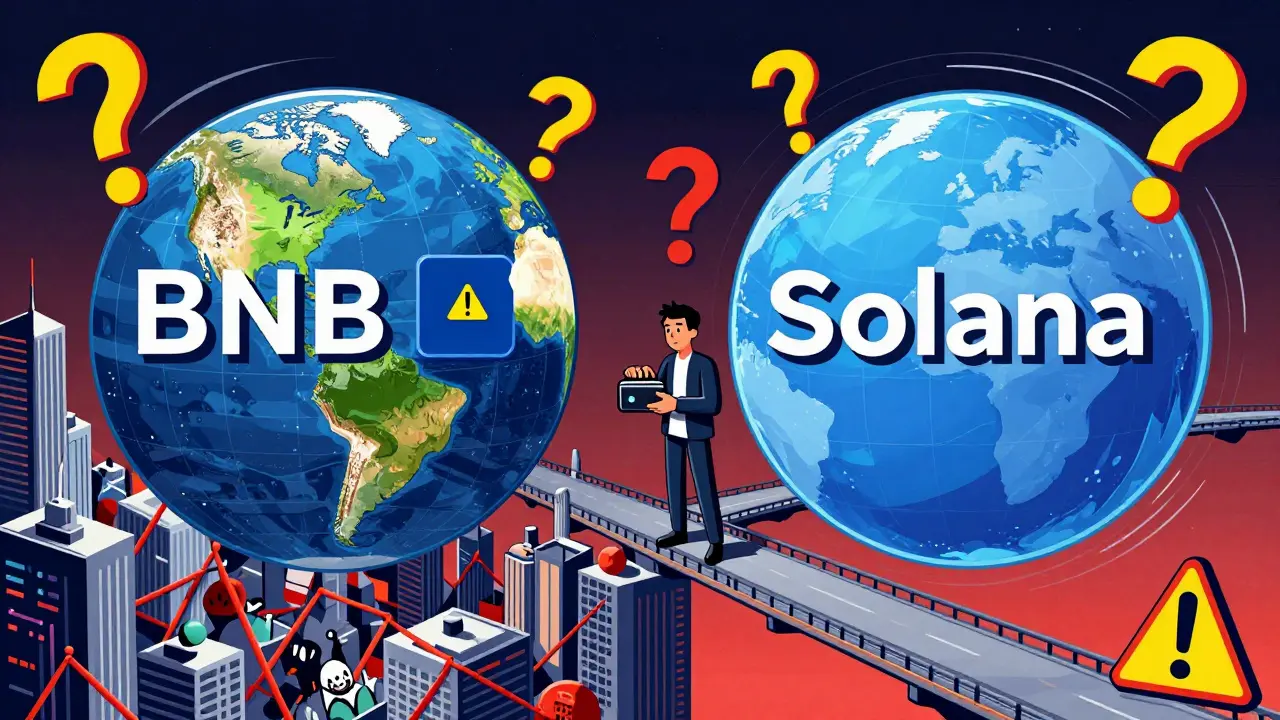
Originally, SafeMoon launched on the BNB Chain is a blockchain platform developed by Binance that supports smart contracts and decentralized applications. This choice was strategic at the time, as BNB Chain offered lower fees than Ethereum. However, the team later announced a migration to Solana is a high-performance blockchain known for fast transaction speeds and low costs.
Why move? Solana can process thousands of transactions per second with fractions of a cent in fees, whereas BNB Chain, while cheaper than Ethereum, can still experience congestion. For a retail-focused token like SFM, lower barriers to entry are crucial. According to data aggregators like CoinMarketCap, the new contract address on Solana is `ELPrcU7qRV3DUz8AP6siTE7GkR3gkkBvGmgBRiLnC19Y`.
This migration is significant but comes with caveats. Moving a token to a new chain requires users to bridge their assets or swap them manually. It also introduces new technical risks. If the smart contract on Solana has bugs, or if the bridge used for migration is compromised, funds could be lost. Furthermore, not all wallets support Solana natively, which could fragment the community between those who migrated and those stuck on the old chain.
The Legal Storm: SEC Charges and Bankruptcy
You cannot discuss SafeMoon V2 without addressing the elephant in the room: the legal troubles. In November 2023, the U.S. Securities and Exchange Commission (SEC) is the federal agency responsible for regulating securities markets in the United States and the Department of Justice (DOJ) is the executive department responsible for the enforcement of laws and administration of justice charged SafeMoon LLC and its executives with fraud, unregistered securities offerings, and money laundering.
These were not minor complaints. The regulators alleged that the founders misled investors about the use of funds and manipulated the token's price. Shortly after these charges, in December 2023, SafeMoon LLC filed for Chapter 7 Bankruptcy is a liquidation proceeding where a company's assets are sold off to pay creditors. This is a critical distinction. Chapter 7 means the company is shutting down completely, not reorganizing to survive. Its assets were acquired by the VGX Foundation, an entity linked to the Voyager ecosystem.
What does this mean for the token? Technically, the smart contract still exists on the blockchain. It is code, and code doesn't go bankrupt. However, the corporate entity that was supposed to develop the technology, manage marketing, and ensure compliance is gone. This leaves SFM in a state of uncertainty. Who maintains the website? Who responds to security vulnerabilities? Who ensures the reflection mechanism continues to work correctly?
Current Market Reality: Micro-Cap Status
Let's look at the numbers. As of mid-2024, SafeMoon V2 trades at a fraction of a penny. Data from CoinMarketCap and Crypto.com shows a price hovering around $0.0000027. The market capitalization is approximately $1 million. To put that in perspective, Bitcoin's market cap is in the trillions. Even small-cap altcoins often have valuations in the hundreds of millions.
| Metric | April 2021 (Peak) | Current Status (2024/2025) |
|---|---|---|
| Market Cap | ~$17 Billion | ~$1 Million |
| Price (ATH) | $0.007232 | ~$0.0000027 |
| Daily Volume | High (Millions) | Low (Hundreds/Thousands) |
| Regulatory Status | Unregulated Hype | Subject to Fraud Charges |
The drop in volume is particularly concerning. Low trading volume means low liquidity. If you decide to sell a large amount of SFM, you might not find enough buyers at the current price, causing your sell order to crash the price further-a phenomenon known as slippage. Conversely, if you want to buy, a single large purchase could spike the price artificially, making it difficult to enter at a fair value.
How to Buy (And Why You Should Be Careful)
If you still wish to acquire SFM, you generally cannot do so on major centralized exchanges like Coinbase Pro or Kraken due to regulatory risks. Instead, you must use decentralized exchanges (DEXs) or specific platforms that list high-risk assets.
- Choose a Wallet: Since SFM is migrating to Solana, you will likely need a wallet that supports Solana, such as Phantom or Solflare. If you are dealing with legacy BNB Chain tokens, MetaMask is required.
- Acquire Base Currency: Buy USDT or SOL on a reputable exchange. Transfer this to your wallet.
- Connect to a DEX: Use a platform like Raydium or Jupiter for Solana, or PancakeSwap for BNB Chain.
- Verify the Contract Address: This is the most critical step. Scammers create fake tokens with the same name. Always copy the official contract address from a trusted source like CoinMarketCap and paste it into the DEX. Never click links from social media.
- Adjust Slippage: Because of the reflection and burn fees, standard slippage settings (usually 0.5% or 1%) will fail. You may need to set slippage tolerance higher (e.g., 5-10%) to account for the fees embedded in the transaction.
Be aware that buying via third-party widgets in wallets often carries higher fees than using a DEX directly. Also, remember that once you send crypto to a smart contract, there is no customer support to reverse the transaction if something goes wrong.

Risk Assessment: Is It Worth It?
Crypto investing is inherently risky, but SafeMoon V2 sits in the highest risk category. Here is a breakdown of the specific dangers:
- Regulatory Overhang: The SEC and DOJ charges suggest that the token itself may be considered an unregistered security. This could lead to delistings from remaining exchanges or even legal restrictions on trading in certain jurisdictions.
- Governance Vacuum: With the original company bankrupt, there is no clear leadership driving development. The "VGX Foundation" acquisition adds another layer of opacity. Without active development, the project becomes a static relic.
- Liquidity Traps: With daily volumes in the hundreds or thousands of dollars, exiting a position can be difficult. You might see a paper profit on your screen, but realize you cannot sell without crashing the price.
- Opportunity Cost: Capital tied up in a stagnant, high-risk asset is capital not working for you elsewhere. Many other DeFi projects offer yield farming or staking opportunities with clearer roadmaps and regulatory compliance.
Some investors hold onto SFM hoping for a "meme coin revival" or a successful migration to Solana that sparks renewed interest. While possible, history shows that once trust is broken and regulatory scrutiny begins, recovery is exceptionally rare. The narrative that drove the $17 billion valuation-community hype and novel tokenomics-has been overshadowed by legal reality.
Conclusion
SafeMoon V2 remains a fascinating case study in the volatility of the crypto market. It demonstrates how quickly a project can rise on innovative ideas and community enthusiasm, and how rapidly it can fall when faced with legal challenges and structural flaws. For the average investor, the risks currently outweigh the potential rewards. The token is technically functional, but its future is clouded by bankruptcy, fraud charges, and minimal liquidity. If you choose to interact with it, treat it as a speculative experiment with money you can afford to lose entirely, and always prioritize verifying contract addresses to avoid scams.
Is SafeMoon V2 a scam?
While the token itself is a functioning smart contract, the U.S. Department of Justice and SEC have charged the founders with fraud, securities violations, and money laundering. The company filed for Chapter 7 bankruptcy, indicating insolvency. Therefore, while the code works, the business practices behind it were deemed illegal by U.S. regulators.
Can I buy SafeMoon V2 on Coinbase or Binance?
Generally, no. Major centralized exchanges like Coinbase and Binance have delisted SFM due to regulatory concerns and low liquidity. You typically need to use decentralized exchanges (DEXs) like PancakeSwap (for BNB Chain) or Raydium (for Solana) to trade it.
What happened to the original SafeMoon token?
The original SafeMoon token was upgraded to SafeMoon V2 to consolidate multiple contracts and fix issues with the initial launch. The V1 tokens were swapped for V2 tokens at a specific ratio. All current trading occurs under the V2 contract.
Does SafeMoon V2 still give reflections?
Yes, the smart contract code still includes the reflection mechanism. Holders automatically receive additional tokens proportional to their holdings when transactions occur. However, with low trading volume, the rate of accumulation is now extremely slow compared to 2021.
Is SafeMoon V2 moving to Solana?
The project has announced a migration to the Solana blockchain to benefit from lower fees and faster speeds. A new contract address on Solana has been published. Users should verify this migration through official channels, as scammers often create fake migration sites.