Why Are Crypto Prices So Volatile: The Real Reasons Behind the Swings
You buy a cryptocurrency. Two days later, it’s up 20%. Two days after that, it’s down 30%. If you’ve ever stared at your portfolio wondering if you should sell or hold your breath, you’re not alone. This isn’t just bad luck-it’s how the game is played.
Cryptocurrency prices are wildly volatile because the market is young, thin on cash (liquidity), and driven heavily by human emotion rather than steady fundamentals. Unlike the stock market, which has decades of rules, massive institutions, and deep pools of money to cushion blows, cryptocurrency markets are digital asset exchanges characterized by low liquidity, high sentiment sensitivity, and 24/7 trading hours that amplify price swings. When a big player moves, there aren’t enough buyers or sellers nearby to absorb the shock. The result? A ripple becomes a wave.
The Liquidity Trap: Why Small Trades Move Big Prices
Imagine trying to buy a house in a neighborhood where only one other person lives. You want to buy; they want to sell. But if ten more people suddenly want to buy that same house, the price skyrockets because there’s no competition for inventory. Now imagine the opposite: everyone wants to sell, but only one person is buying. The price crashes.
This is what happens in crypto due to liquidity constraints, which refer to the limited ability to buy or sell large amounts of an asset without significantly affecting its price. Traditional stock markets have trillions of dollars flowing through them daily. The crypto market, while growing fast, still has a fraction of that depth. According to research from Binance in August 2025, global liquidity levels directly dictate price stability. When liquidity tightens-which happens often-small trades cause disproportionate price movements.
- Deep Markets: Bitcoin and Ethereum have relatively deeper order books. It takes billions to move them drastically.
- Shallow Markets: Smaller altcoins can swing 50% in minutes because a single large sell order wipes out all available buyers.
This lack of depth means that when panic hits, there’s no safety net. Prices don’t just dip; they freefall until someone steps in to buy. Conversely, when FOMO (fear of missing out) kicks in, prices rocket upward because there aren’t enough sellers to keep the price grounded.
Supply Shocks: The Scarcity Engine
In traditional finance, if demand for a company’s stock spikes, the company can issue more shares. In crypto, especially with Bitcoin, the supply is fixed. There will never be more than 21 million Bitcoin, a digital currency with a hard cap of 21 million coins designed to create artificial scarcity and hedge against inflation. This creates a unique dynamic: any sudden increase in demand meets a wall of unyielding supply.
Think of it like gold, but harder to mine and easier to transfer. When investors rush in, they can’t get more coins instantly. They have to pay whatever the current seller asks. This drives prices up violently. When they rush out, they dump coins onto a shallow market, driving prices down just as fast.
We saw this clearly in early 2025. Bitcoin’s Stock-to-Flow ratio, a metric measuring existing supply versus new production rate, indicating scarcity, rose by 20% between January and April 2025. Normally, higher scarcity equals higher prices. Yet, Bitcoin dropped from $104,700 to $76,500. Why? Because external forces-like regulatory fears and macroeconomic instability-overrode the scarcity model. Supply mechanics set the stage, but sentiment writes the script.
Whales: The Giants Who Shake the Floor
Who are these "whales"? They’re individuals or entities holding massive amounts of crypto. A whale might hold 10,000 BTC. In a market with low liquidity, selling even 1,000 BTC can crash the price because regular retail traders simply can’t absorb that volume.
These large holders compound volatility. When a whale decides to take profits, they often do so in chunks, triggering stop-loss orders from smaller traders. Those stop-losses become market sell orders, which push the price down further, triggering more stops. It’s a cascade effect. One big player sneezes, and the whole market catches a cold.
Smaller market cap assets are particularly vulnerable. A whale moving into a micro-cap coin can pump its price by 100% overnight. Moving out can wipe out half its value just as quickly. This makes smaller cryptos high-risk, high-reward playgrounds for speculation.

Sentiment: The Emotional Rollercoaster
If liquidity is the engine, sentiment is the fuel. Crypto markets are heavily influenced by investor psychology. Unlike seasoned Wall Street veterans, many crypto investors are retail participants who react emotionally to news and social media trends.
Consider the Tesla Bitcoin purchase in January 2021. Elon Musk tweeted about it, and the market went wild. Buyers rushed in, fearing they’d miss the next big move. This created a reflexive feedback loop: rising prices attracted more buyers, which pushed prices higher. This is known as FOMO-driven momentum. It’s powerful, but unsustainable.
By October 2025, tools like the Fear and Greed Index showed rising greed levels. Buyers were optimistic, confident in further gains. But here’s the catch: extreme greed often precedes sharp corrections. When sentiment shifts from euphoria to fear, the reversal is swift. Social media amplifies this. A negative headline spreads faster than a positive one, causing rapid sell-offs.
| Sentiment Phase | Market Behavior | Price Impact |
|---|---|---|
| Fear | Panic selling, liquidations | Sharp drops, oversold conditions |
| Greed | FOMO buying, leverage accumulation | Rapid rallies, overbought conditions |
| Apathy | Low volume, sideways movement | Consolidation, range-bound prices |
Macroeconomics: The Global Wind
Crypto doesn’t exist in a vacuum. It’s tied to the broader economy. Interest rates, inflation, and geopolitical stability all play a role. When inflation runs hot, some investors turn to Bitcoin as a hedge against fiat currency devaluation. This increases demand and pushes prices up.
But when central banks raise interest rates, traditional investments like bonds become more attractive. Capital flows away from risky assets like crypto. We saw this in Q1 2025. Despite Bitcoin’s increasing scarcity, its price fell sharply. Why? Because macroeconomic instability and regulatory uncertainty scared investors. Money moved to safer havens.
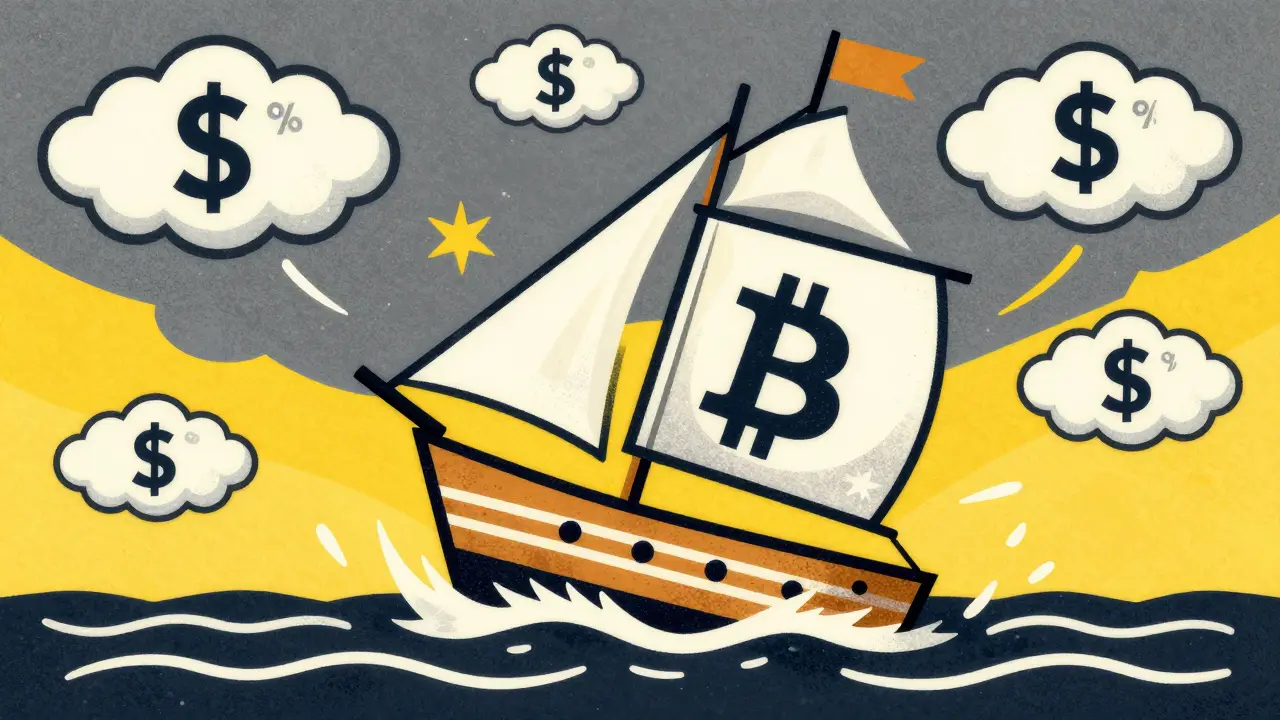
Global economic trends act like wind for a sailboat. Favorable winds (low rates, high inflation) push crypto higher. Headwinds (high rates, recession fears) drag it down. Understanding this context helps explain why crypto sometimes moves against its own internal logic.
Institutional Flows: The Double-Edged Sword
Institutions used to ignore crypto. Now, they’re major players. ETF inflows, corporate treasuries, and hedge funds bring billions into the market. This should stabilize prices, right? Not always.
In July 2025, healthy ETF inflows drove a 13.3% growth in total market cap. That’s good. But when institutions exit, the impact is severe. Their trading volumes are huge compared to retail. A single institutional sell-off can overwhelm the market’s liquidity, causing sharp declines.
Ethereum has become an institutional favorite, almost catching Bitcoin in ETF inflows. This brings maturity but also concentration risk. If institutions lose confidence in Ethereum, the fallout could be widespread. Institutional involvement adds depth but also introduces new sources of volatility.
Technical Triggers: Algorithms and Resistance
Traders use technical analysis to predict price movements. Key levels, like resistance zones, act as psychological barriers. For example, in October 2025, Bitcoin approached the $118,000-$120,000 range. This zone had previously seen heavy selling. As price neared it, traders expected resistance, leading to profit-taking.
Algorithmic trading exacerbates this. Bots monitor indicators like the 50-day moving average (MA50). In Q1 2025, MA50 declined steadily from $99,300 to below $85,400. This signaled downward momentum, triggering automated sells. These algorithms don’t feel fear; they execute code. This creates self-fulfilling prophecies where technical breaks lead to real price drops.
When markets reach overbought conditions, meaning prices have risen too quickly, short-term corrections are likely. Even in strong uptrends, profit-taking occurs. Technical factors create feedback loops that amplify volatility in both directions.
Regulatory Uncertainty: The Wild Card
News travels fast. Regulatory announcements can cause immediate price swings. In early 2025, regulatory uncertainty contributed to Bitcoin’s drop from $104,700 to $76,500. Policies shift, governments clarify rules, and markets react instantly.
Breaking news feeds into sentiment cycles. Cash squeezes make markets sensitive. Social and media feedback loops affect trader responses. Regulatory clarity reduces volatility long-term, but short-term shocks remain common. Investors must stay alert to policy changes that could reshape the landscape overnight.
Is crypto volatility decreasing over time?
While institutional adoption may gradually reduce extreme swings, fundamental drivers like limited liquidity and sentiment sensitivity persist. Volatility remains a defining characteristic, though perhaps less erratic than in early years.
Why does Bitcoin drop when interest rates rise?
Higher interest rates make traditional investments like bonds more attractive. Investors pull capital from risky assets like crypto to seek safer returns, reducing demand and pushing prices down.
What causes sudden crypto price crashes?
Crashes often stem from liquidity shortages combined with panic selling. Large sell orders overwhelm shallow markets, triggering stop-loss cascades and algorithmic selling, leading to rapid price declines.
Do whales really control crypto prices?
In smaller markets, yes. Whales can move prices significantly due to low liquidity. In larger assets like Bitcoin, their influence is diluted but still impactful during periods of low trading volume.
How does regulation affect crypto volatility?
Regulatory news creates immediate uncertainty. Positive clarity can boost prices, while restrictive policies or bans can trigger panic selling. Short-term volatility spikes around major policy announcements are common.