Wrapped Assets and Bridge Mechanisms: How Cross-Chain Liquidity Works
Imagine trying to send a physical dollar bill from your wallet in New York to a friend in Tokyo, but the only way to do it is to mail it via snail mail. It’s slow, risky, and frankly, inefficient. Now imagine you could hand that dollar to a trusted local agent who locks it in a vault, issues you a digital IOU on a global network, and lets your friend spend that IOU instantly. That’s essentially what wrapped assets are. They solve one of blockchain’s biggest headaches: fragmentation.
Blockchains like Bitcoin and Ethereum don’t speak the same language. They have different codebases, consensus mechanisms, and rules. Without a translator, Bitcoin can’t participate in Ethereum’s decentralized finance (DeFi) ecosystem. Wrapped tokens act as that translator. They allow value to move between isolated networks without actually moving the underlying asset. But how exactly does this magic trick work? And more importantly, where are the traps?
The Core Problem: Blockchain Isolation
To understand why we need wrapped tokens, you first have to accept a hard truth: most blockchains are islands. Bitcoin was built for secure value transfer. Ethereum was built for programmable money and smart contracts. Neither was designed to talk to the other directly. If you hold Bitcoin, you’re stuck on the Bitcoin chain. You can’t use it as collateral in an Ethereum-based lending protocol like Aave or Compound unless you sell it for ETH first. Selling introduces slippage, fees, and tax events. It breaks the flow.
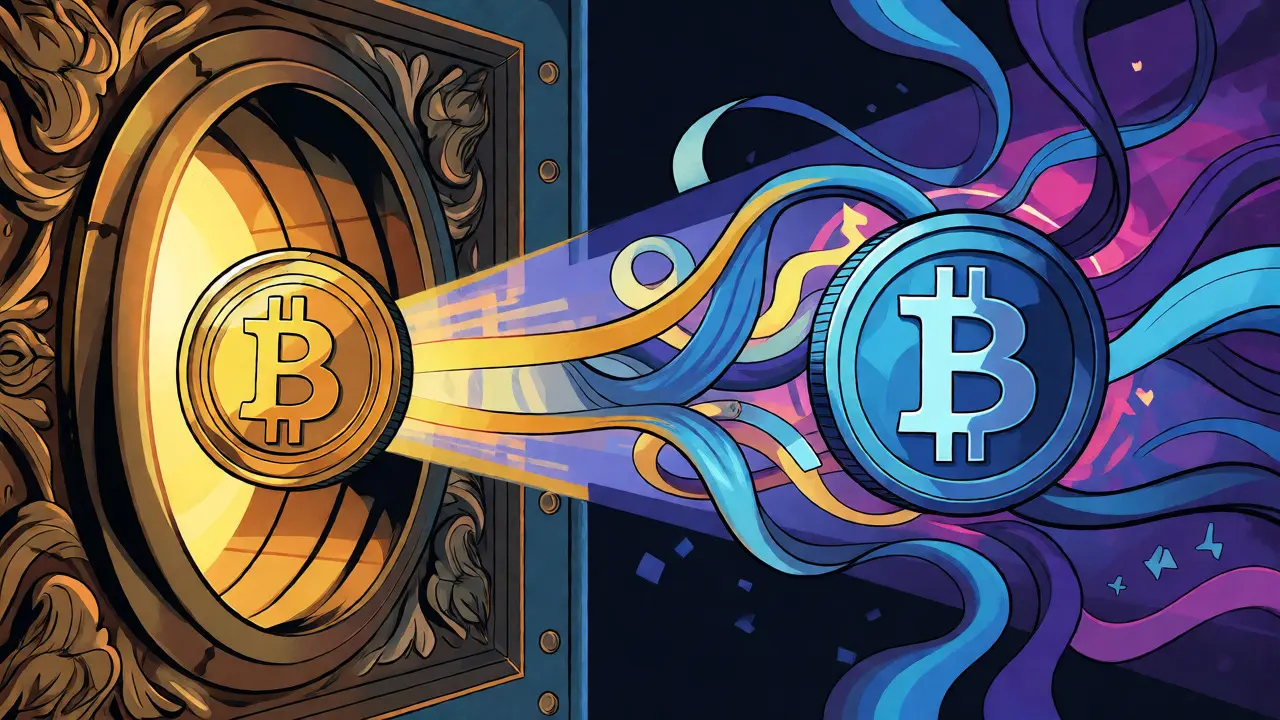
Bridge mechanisms were created to fix this. These are protocols that connect two separate blockchains, allowing data and value to pass between them. The most common method involves locking the original asset on its native chain and minting a representative token on the destination chain. This representative token is the "wrapped" asset. It’s not the real thing, but it behaves exactly like the real thing within the new environment.
How Wrapping Works: Lock, Mint, Burn, Redeem
The process follows a strict four-step cycle known as the lock-and-mint model. Let’s break it down using the most famous example: Wrapped Bitcoin (WBTC). Suppose you want to use your Bitcoin in an Ethereum DeFi app.
- Deposit: You send your native BTC to a designated custodian address. This address is controlled by a group of merchants and custodians who hold the actual Bitcoin in cold storage.
- Mint: Once the deposit is confirmed, the system mints an equivalent amount of WBTC on the Ethereum blockchain. WBTC is an ERC-20 token, meaning it follows the same standard as USDC or DAI, making it compatible with Ethereum wallets and dApps.
- Use: You now hold WBTC in your MetaMask wallet. You can lend it, trade it, or use it as collateral in DeFi protocols just like any other Ethereum token.
- Burn and Redeem: When you want your original Bitcoin back, you send the WBTC back to the bridge contract. The WBTC is burned (destroyed), and the custodian releases your original BTC back to your Bitcoin address.
This cycle ensures a 1:1 peg. For every WBTC in circulation, there should be exactly one BTC locked in the vault. If the supply drifts, the arbitrage market kicks in to correct the price.
Security Risks: The Custodian Trust Problem
Here’s the catch: wrapped assets introduce a centralized point of failure in a decentralized world. When you hold WBTC, you aren’t holding Bitcoin. You’re holding a claim on Bitcoin held by a third party. If that third party gets hacked, goes bankrupt, or acts maliciously, your wrapped token might become worthless.
This is known as the custodian trust problem. Unlike native assets, which are secured by thousands of independent nodes validating the blockchain, wrapped assets rely on the security of the bridge operators and custodians. High-profile exploits have proven this risk is real. In 2021, the Wormhole bridge was hacked for $320 million because attackers exploited a flaw in the signature verification logic. The wrapped SOL tokens issued during the hack were effectively counterfeit until the incident was resolved.
Most traditional bridges use multi-signature wallets, requiring several private keys to authorize transactions. While safer than a single key, they still require trust in the entities holding those keys. Users must perform Proof of Reserves audits to verify that the custodians actually hold the backing assets. Without regular, transparent audits, you’re flying blind.
Wrapped vs. Synthetic Assets: Know the Difference
It’s easy to confuse wrapped assets with synthetic assets, but they function differently. Understanding this distinction saves you from bad investment decisions.
| Feature | Wrapped Assets (e.g., WBTC) | Synthetic Assets (e.g., sUSD) |
|---|---|---|
| Custody Model | Original asset is locked in a vault/custody. | No custody; backed by collateral pools (often stablecoins). |
| Value Basis | Direct 1:1 peg to the underlying asset. | Tracks price via oracles; may deviate slightly. |
| Risk Profile | Custodian risk, bridge hack risk. | Oracle failure risk, collateral liquidation risk. |
| Primary Use Case | Interoperability (using Asset A on Chain B). | Exposure to price movements without ownership. |
With wrapped assets, you own a proxy for the real coin. With synthetic assets, you own a derivative that mimics the price action. If you want to use Bitcoin as collateral on Ethereum, you need WBTC. If you just want to bet on the price of gold without buying a bar, you might choose a synthetic gold token.

The Rise of Trust-Minimized Bridges
The crypto industry knows the current model is flawed. Relying on centralized custodians contradicts the ethos of decentralization. That’s why developers are building trust-minimized bridges. These newer mechanisms aim to reduce or eliminate the need for trusted intermediaries.
One leading solution is Chainlink’s Cross-Chain Interoperability Protocol (CCIP). Instead of relying solely on a small group of signers, CCIP uses a decentralized oracle network to verify cross-chain messages. Another approach involves light client verification, where the destination chain verifies the state of the source chain directly. While these technologies are still maturing, they represent the future of bridging. They promise higher security and less regulatory friction by removing the human element from the equation.
Regulators are also paying attention. Following several major bridge hacks, agencies like the SEC and CFTC are pushing for clearer definitions of who owns the underlying assets and how reserves are audited. Expect stricter compliance requirements for wrapped token issuers in the coming years.
Why Wrapped Tokens Are Essential for DeFi
Despite the risks, wrapped tokens remain the backbone of modern DeFi. They unlock liquidity that would otherwise sit idle. Consider the total value locked (TVL) in DeFi protocols. A significant portion consists of wrapped assets like WETH (Wrapped Ether) and WBTC. Why use WETH instead of native ETH? Because native ETH doesn’t follow the ERC-20 standard. Many smart contracts expect ERC-20 inputs. Wrapping ETH makes it fungible and compatible with the broader ecosystem.
Layer 2 networks like Arbitrum and Optimism further amplify this need. To move funds from Ethereum Mainnet to Arbitrum, users often rely on bridges that issue wrapped versions of their assets on the Layer 2. As scaling solutions grow, so does the demand for efficient, low-cost wrapping mechanisms. The goal is seamless movement-users shouldn’t care about the plumbing behind the scenes.
Are wrapped assets safe to hold long-term?
They carry higher risk than native assets due to custodian and bridge vulnerabilities. For long-term holding, many investors prefer keeping assets on their native chains or using self-custodial bridges with strong audit histories. Always check if the issuer provides regular Proof of Reserves reports.
What happens if a bridge gets hacked?
If a bridge is compromised, attackers may mint unlimited wrapped tokens, diluting the value. Projects often respond by pausing the bridge, freezing affected addresses, or issuing new tokens to replace the stolen ones. Your wrapped tokens might temporarily lose their 1:1 peg until the issue is resolved.
Can I unwrap my tokens anytime?
Generally, yes, but it depends on the specific bridge's liquidity and operational status. Some bridges require waiting periods or have minimum withdrawal amounts. Also, unwrapping costs gas fees on both the destination and source chains, so factor that into your calculation.
Is WBTC the same as Bitcoin?
No. WBTC is an ERC-20 token on Ethereum that represents Bitcoin. It relies on a consortium of custodians to hold the actual BTC. If you send WBTC to a Bitcoin wallet, the transaction will fail. You must bridge it back to the Bitcoin network to convert it to native BTC.
Do wrapped assets affect the supply of the original coin?
No. The original coin remains locked and unchanged on its native blockchain. Only the wrapped version circulates on the destination chain. The total supply of the original asset stays constant; the wrapped supply fluctuates based on user demand.